
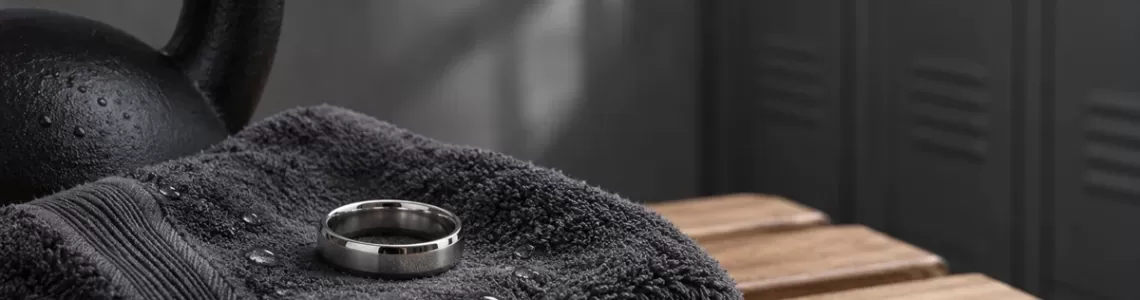
Removing a sterling-silver ring before a workout is the safest default. The main concern is not simply that sweat may dull silver. A ring can concentrate pressure during gripping, catch on equipment, strike a hard surface, trap moisture against skin, feel tighter as fingers swell, or expose a stone and setting to impact. Place it in a closed, padded container before the session rather than on a bench, in an open cup holder or loose in a gym bag.
A calm walk and a heavy barbell session do not create the same exposure. Neither do stretching, climbing, contact sport, rowing, cable work, cycling maintenance and exercise near electrical equipment. Use the rules for the actual activity and facility. If an instructor, employer, sport body or equipment manual says to remove jewelry, that rule controls. A general jewelry-care article cannot make an unsafe activity safe.
Why a 925 mark does not answer the workout question
The U.S. Federal Trade Commission explains that sterling or sterling silver describes material containing 92.5% silver. A 925 mark is therefore a fineness claim. It does not tell you the ring's cross-section, thickness, temper, solder history, plating, coating, stone identity, treatment, setting strength or current fit.
Those missing facts matter during exercise. A broad solid band, a thin hollow ring, a plated signet, an intentionally oxidized ring and a tall stone-set ring can all be described as sterling silver while responding differently to pressure and impact. The guide to sterling-silver ring weight explains why grams alone cannot prove construction or durability.
Do not use a workout as a stress test. A ring that survives one session without visible change has not been certified for the next one. Small distortion, a loosened prong or a developing crack may be hard to see until later. Product-specific care instructions and activity rules are stronger evidence than an informal trial.
Grip pressure can load the ring and the finger
When you close your hand around a bar, dumbbell, kettlebell, pull-up handle, racket or rowing grip, the ring sits between the equipment and your finger. Pressure that would otherwise spread across the skin can be concentrated at the ring edges. A wide band can feel especially prominent, while a raised head or setting can rotate and create a local pressure point.
The equipment can also press directly on the metal. Sterling silver is not immune to deformation. Whether a ring bends depends on geometry, thickness, temper, construction, previous resizing, soldered areas and the direction and magnitude of force. The article on why sterling-silver rings bend separates alloy identity from structural strength.
A comfort-fit interior can change how a band feels, but it does not remove the loading problem. Rounded inside edges may make ordinary wear more comfortable, while the outer ring still contacts a hard handle. Compare the interior profiles in the comfort-fit versus flat-ring guide without treating either profile as gym approval.
Snagging is a safety issue, not a finish issue
A ring can catch on a cable attachment, rack, climbing hold, net, strap, protruding fastener or moving part. Government of Canada hand-safety guidance warns that even a well-fitting ring can pose a severe hazard when it catches. U.S. NIOSH safety material similarly treats rings and other jewelry as items that can catch in machinery.
Peer-reviewed medical literature describes ring-avulsion injuries ranging from soft-tissue damage to complete amputation. That does not mean an ordinary workout is likely to cause such an injury, and this article does not assign a probability. It means the consequence can be serious enough that removal is a sensible control wherever catching or sudden traction is plausible.
Do not rely on a loose fit as protection. A loose ring may catch more easily or rotate into a vulnerable position. Do not rely on a tight fit either; a tight ring can be difficult to remove after swelling. A different ring material or breakaway design may have different behavior, but it is not a universal substitute for following the activity's no-jewelry rule.
Moving equipment and electricity require stricter boundaries
Workouts sometimes occur near treadmills, cable machines, fans, bikes and motorized equipment. Maintenance, adjustment and cleaning introduce additional hazards. Never reach into moving equipment or work near an exposed electrical source while wearing a metal ring. OSHA educational material specifically warns against rings and other metal jewelry around electricity because metal conducts and jewelry can catch.
Keep the categories clear. A stationary dumbbell is not an energized circuit, and a casual walk is not industrial machinery. Still, the absence of one hazard does not remove grip, impact, snagging or swelling concerns. Use a conservative rule: remove the ring before the session, and do not put it back on until the activity, equipment adjustment and cleanup are complete and your hands are dry.
Gloves are not a guaranteed solution. A ring beneath a lifting glove can still create a pressure ridge, trap moisture or damage the glove, and the glove can hide early discomfort. Gloves can themselves be restricted around rotating machinery. Follow the specific safety instructions for the equipment and task.
Sweat does not create one simple silver reaction
Sweat contains water and salts and can mix with skin oils, sunscreen, lotion, chalk, sanitizer and residue from equipment. The result varies with the wearer, session, climate, ring surface and cleaning routine. A dull film after exercise may be residue. Darkening may be tarnish, intentional oxidation, trapped material or a change at a plated surface. Appearance alone does not identify the cause.
Do not assume that one sweaty session will instantly ruin plain sterling silver. Also do not turn that observation into permission for repeated exposure. Moisture and residue can collect inside engraving, under a broad band, around a stone seat or at a seam. Repeated rubbing can make an exposed high point look different from a protected recess.
After exercise, wash and dry your hands before replacing the ring. If the ring was accidentally worn, follow its maker-approved care method. Do not compensate with toothpaste, bleach, abrasive powder, a random silver dip or vigorous polishing. The guide to polishing cloths and sterling-silver rings explains why even a soft treated cloth can alter plating, darkened details and directional finishes.
Swelling can turn a normal fit into a tight ring
Exercise, heat and individual circulation can change finger size during a session. A ring that fits comfortably at rest may feel tight later. That is a fit and safety observation, not proof that the ring shrank or that the alloy is defective. Do not keep twisting a tight ring over irritated skin simply to finish a set.
If a ring becomes painfully tight, or the finger develops numbness, marked color change or severe swelling, stop the activity and seek appropriate help. This article is not medical advice and does not provide an emergency ring-removal procedure. Avoid improvised cutting or force, especially around an injured finger.
Fit also changes how the ring behaves before swelling. A loose ring can rotate during gripping; a tight ring can trap moisture and pressure. Use the ring-size chart guide to understand diameter and circumference, but remember that a chart cannot predict fit during every activity or temperature.
Impact and abrasion affect the finish
Gym equipment is often harder and rougher than a silver ring. Knurling on a bar, textured grips, plates, stone walls, metal racks and floor contact can scratch, dent or flatten high points. A polished surface may show bright lines; a satin surface may develop cross-grain marks; an oxidized recess may collect pale chalk.
Normal wear does not prove poor quality, but a workout can accelerate contact that would otherwise occur gradually. The article Do Sterling Silver Rings Scratch? explains why scratch resistance depends on contact, finish and care rather than on a simple genuine-versus-fake test.
Do not try to erase every mark immediately. Repeated polishing removes material and can round engraving, brighten intentionally darkened details or create a patch on a brushed surface. Photograph the condition under neutral light, identify the finish, and use only the approved maintenance method.
Stone-set rings add more failure points
A stone's hardness measures resistance to scratching, not resistance to every kind of damage. GIA describes gem durability through hardness, toughness and stability. A hard stone can still chip or cleave under a sharp blow. A porous, treated, coated or fracture-filled material can also have chemical or heat limits.
The setting matters as much as the stone. A tall prong can catch a glove or strap. A bent prong can expose a stone edge. A bezel can lift. A channel wall can deform. Adhesive in an inlay can have care limits that are unrelated to the sterling substrate. Review gemstone durability for rings and the guide to prong, bezel and channel settings before assuming that a low-profile ring is impact-proof.
If a stone clicks, rotates, rattles or catches fabric after a workout, stop wearing the ring. Do not push repeatedly on the stone or use a metal pick to test it. A qualified jeweler can inspect the setting without turning a small problem into a larger one.
Skin irritation is not a purity test
Sweat, friction, chalk, soap, sanitizer and lotion can remain beneath a band. The American Academy of Dermatology notes that a rash under jewelry may involve contact allergy or irritation from soap and water trapped beneath a ring. A red or itchy mark therefore does not prove that the ring is fake, and it does not identify one metal by itself.
Remove the ring, clean and dry the skin gently, and stop wearing the piece if symptoms persist or recur. Seek medical advice when appropriate. Do not apply household chemicals to the ring or skin as an allergy test. The guide to ring rash, moisture and metal clues explains why allergy, friction and residue need different evidence.
A practical before-and-after routine
Before the workout
- Remove the ring before entering the activity area. Do this while your hands are cool and dry, not after swelling starts.
- Inspect it briefly. Look for a loose stone, lifted edge, open seam, new crack, bent shank or coating change.
- Store it securely. Use a closed padded case or individual pouch inside a locked or supervised location.
- Keep it separate. Keys, coins, watches and other jewelry can scratch the ring inside a bag.
- Follow the facility rule. No-jewelry instructions override personal preference.
After the workout
- Finish equipment handling first. Do not replace the ring before adjusting, cleaning or moving equipment.
- Wash and dry your hands. Remove sweat, chalk, sanitizer and soap residue, then dry between the fingers.
- Check finger comfort. Wait if the ring would be tight; do not force it over swollen tissue.
- Inspect the ring if it was worn accidentally. Compare the shank, finish and setting with earlier photographs.
- Escalate uncertainty. Stop wearing it if there is movement, distortion, a sharp edge, persistent residue or unexplained color change.
The delivery-inspection checklist for setting, stone and finish also works as a neutral baseline before a ring enters regular use. Good photographs make later comparisons more reliable.
Frequently asked questions
Will sweat tarnish a sterling-silver ring?
It can contribute to a mixed exposure involving moisture, salts, skin oils and other products, but one visible change cannot be assigned to sweat alone. Residue, tarnish, intentional oxidation and plating wear can look different or overlap. Remove the ring before exercise, then use only its approved care method.
Can I lift weights while wearing a plain silver band?
Removal is still the safest default. Even without a stone, the band can sit between the finger and a hard or textured handle, concentrate pressure, scratch, deform or catch. Plain construction removes some setting concerns but not grip, fit or snagging concerns.
Are cardio workouts safe for a ring?
Risk depends on the activity. A walk has less direct hand loading than rowing, cycling maintenance or a machine with cables, but swelling, sweat, accidental impact and facility rules still apply. Removing and securely storing the ring is the simple consistent practice.
Do lifting gloves protect the ring?
Not reliably. A glove can hide pressure, hold moisture and still transmit force from a handle to the ring. It may also snag or be restricted around moving parts. Follow the activity and equipment instructions rather than treating the glove as jewelry protection.
Can a workout bend a sterling-silver ring?
It is possible if sufficient force reaches a vulnerable geometry, but no universal threshold applies. Thickness, cross-section, temper, hollow construction, resizing and previous damage matter. A bent ring should be inspected rather than forced back into shape at home.
What if the ring feels tight after exercise?
Do not force or repeatedly twist it. Stop the activity and seek appropriate help for pain, numbness, marked color change or severe swelling. This guide does not replace medical assessment or an emergency ring-removal procedure.
Should I clean the ring after every workout?
If you remove it before the workout, cleaning may not be necessary. If it was exposed, follow the maker's instructions for the complete ring. Avoid automatic polishing, harsh chemicals and immersion when plating, stones, treatments, adhesives or repairs are unknown.
Does a 925 stamp mean the ring is strong enough for the gym?
No. The mark addresses silver fineness, not wall thickness, temper, construction, setting security, impact resistance or fitness for an activity. Ask construction-specific questions and remove the ring before the session.
References
- U.S. Federal Trade Commission, Buying Platinum, Gold, and Silver Jewelry - sterling-silver fineness terminology.
- Government of Canada, Our Hands at Work! - ring-catching and hand-safety guidance.
- U.S. OSHA, Basic Electricity Safety - metal jewelry, electricity and snag boundaries.
- NIOSH / CDC, Safety Rules - rings and jewelry around machinery.
- Ring Avulsion Injuries: A Systematic Review - medical evidence on injury severity and treatment categories.
- Gemological Institute of America, Tips on Caring for Jewelry - chemical, impact, treatment and storage care.
- Gemological Institute of America, More than the Mohs Scale - hardness, toughness and stability.
- American Academy of Dermatology, Itchy rash could be contact dermatitis - jewelry, moisture and skin-irritation boundaries.
Evidence boundary: this article provides general jewelry ownership and care information. It does not certify a product for sport, replace workplace or facility safety rules, diagnose a skin or finger condition, estimate the probability of injury, or override product-specific instructions. Unknown construction and activity conditions remain unknown.
Leave a Comment