
Do Sterling Silver Rings Scratch? Finish, Wear and Care
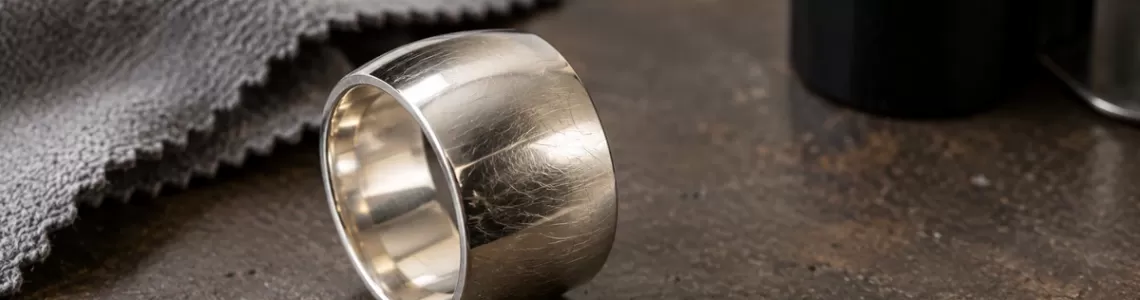
Yes, sterling silver rings can scratch. Sterling silver is a workable precious-metal alloy rather than a scratch-proof material, and a polished ring will usually develop fine wear lines during normal use. Those marks do not by themselves prove that the ring is fake, defective or unusually soft. What matters is the depth, location and pattern of the damage, the ring's finish and geometry, and whether any coating, plating, stone setting or soldered area is involved.
A buyer should separate three questions. Is the mark only in the surface finish? Has metal actually been displaced, dented or cracked? Would polishing remove more material than the mark justifies? The safest first response is observation, not aggressive cleaning. Photograph the ring under diffuse light, remove loose dirt with a method appropriate to the complete ring, and ask a qualified jeweller before trying to erase a deep or structural mark.
Why sterling silver develops scratches
Sterling silver is commonly described as 925 silver: 925 parts per thousand are silver and the balance is other metal. The alloy is used because pure silver is comparatively soft and sterling is more practical for many objects. Alloying does not make a ring immune to abrasion, dents or deformation. The Canadian Conservation Institute identifies silver among the soft metals that are especially vulnerable to scratching and abrasion.
A scratch forms when a harder particle or edge moves across the surface with enough pressure. Everyday sources include grit trapped under a cloth, metal tools, stone countertops, rough ceramics, keys and harder jewellery worn beside the ring. Even a material marketed as a polish works by abrasion. It removes tarnish and some metal, leaving a new pattern of very fine scratches. The result may look brighter because those scratches are small and aligned, not because the process was non-abrasive.
The visibility of wear depends on finish. A mirror-polished band shows scattered hairlines quickly because each line interrupts a highly reflective surface. A brushed finish already contains a controlled directional pattern, so new marks may blend at first. Hammered, carved or oxidized surfaces can hide some wear while making careless refinishing more likely to erase intended detail.
Normal wear lines versus a deeper problem
Fine, shallow lines spread across the outer shank are common wear evidence. They often become visible only when the ring is tilted under a lamp. A single deeper groove may come from one contact event. A dent indicates displaced metal rather than a surface-only line. A crack is different again: it may open at an edge, a joint, a thin section or beside a setting and should not be polished away or flexed for testing.
Location provides useful context. Marks on the palm side usually reflect contact with desks, handles and tools. Damage around a stone can involve the setting as well as the finish. A line that circles the shank at a prior resizing area may be a solder seam, a finishing boundary or a new crack. The guide to cast and fabricated sterling-silver rings explains why seams and process traces need construction context rather than diagnosis from one photograph.
Stop wearing the ring and seek assessment when a line opens under gentle viewing, catches sharply, crosses a thin or bent section, reaches a stone seat, or appears with movement, looseness or a change in shape. Do not bend the band to see whether the mark widens. The article on why sterling-silver rings bend separates surface wear from geometry and load problems.
Does a scratch mean the ring is not sterling silver?
No. Scratch resistance is not a reliable authenticity test. Genuine sterling silver can scratch, while plated base metals and other alloys can also scratch. The appearance of a fresh mark depends on lighting, oxidation, coating, plating and the underlying material. A bright line on an oxidized finish may simply expose unoxidized metal; a differently colored line on a plated object may indicate coating loss, but neither observation proves composition on its own.
A 925 stamp is a fineness representation, not a durability certificate. It does not report hardness, heat treatment, shank thickness, plating, workmanship or previous repairs. The comparison of a 925 stamp and a hallmark explains what marking systems can and cannot establish. When material identity matters, use seller documentation and appropriate professional testing instead of destructive scratching, filing or acid tests at home.
Why finish changes what you see
A high-polish surface behaves like a small mirror. Very fine lines scatter reflected light and can look dramatic in close photography even when they are shallow. A satin or brushed finish uses deliberately oriented abrasion. Random cross-grain scratches stand out because they interrupt that direction. Restoring the finish requires matching the original texture, not simply making the surface shiny.
Oxidized rings add another variable. Dark recesses may be intentional, while exposed highlights are expected to brighten with wear. Polishing the whole ring can remove the contrast that defines the design. Before cleaning a darkened piece, review the difference between intentional oxidation and tarnish. If the listing describes a plated, lacquered, antiqued or mixed finish, ask for care instructions specific to that finish.
Coatings can scratch independently of the metal. A clear barrier may show a line even when the silver below is intact. Rhodium or another surface layer may wear at high-contact areas. Re-polishing without identifying the finish can thin or remove that layer. The Federal Trade Commission's Jewelry Guides emphasize truthful disclosure of metal content and surface treatments; a buyer should not assume that every silver-colored ring has an identical surface system.
Can polishing remove scratches?
Polishing does not fill a scratch. Abrasive polishing lowers and reshapes the surrounding surface until the difference becomes less visible. That means metal is removed. The Canadian Conservation Institute warns that polishes leave a scratch pattern and that repeated polishing can remove detail or, on plated objects, wear through the silver layer.
For light tarnish, a suitable polishing cloth may be gentler than a liquid, paste or general-purpose metal polish, but it is still an abrasive tool. More pressure is not automatically better. Dirt or hard particles trapped in a cloth can create new lines. General metal polishes can be more aggressive than products intended for silver, and a compound suitable for plain sterling may be inappropriate for a plated, coated, oxidized or stone-set ring.
Deep scratches, dents and gouges may require controlled refinishing, sanding, burnishing, laser work, soldering or metal replacement. Each option changes the ring. A professional should first consider remaining thickness, hallmark and engraving placement, previous repairs, surface texture and stone sensitivity. Repeatedly chasing every hairline can do more harm than accepting an even wear pattern.
A safe first inspection
- Place the ring on a clean, padded surface and use diffuse light rather than a harsh flash.
- Photograph the top, both sides, inside, palm-side shank, hallmark area and any setting before cleaning.
- Look from several angles. A reflection, polishing line and open crack can appear similar in one view.
- Check whether the mark crosses an edge, joint, stone seat or visibly thinned section.
- Confirm the listed finish: polished, brushed, hammered, oxidized, plated or coated.
- Remove only loose dust with a clean, soft method suitable for every component.
- Stop if a stone moves, the band shape has changed, the line opens, or a sharp edge catches.
Our ring inspection after delivery guide provides a broader sequence for settings, stones and finish. Save the product description and initial photographs. If a new ring arrives with damage that was not disclosed, cleaning or polishing before contacting the seller can erase evidence and complicate a return.
How to reduce new scratches
Remove a ring before work that predictably puts it against tools, abrasive surfaces, masonry, gym equipment or chemicals. This is not a promise that careful wear prevents every mark; it simply reduces contact opportunities. Store the ring separately so harder jewellery, clasps and chains do not rub against it. Clean storage also matters because dust can contain abrasive particles.
Highly polished metals are sensitive to oils and salts from handling, according to the Canadian Conservation Institute's metal-storage guidance. Wipe gently with a clean, appropriate cloth after wear rather than scrubbing a dirty surface. Avoid tossing the ring into an unlined drawer or a bag with loose metal items. A soft pouch or compartment helps, provided the ring is dry and the material is clean.
When several rings are worn together, their edges and stones can contact each other. A harder gemstone can scratch a metal neighbor. The article on gemstone hardness, toughness and stability explains why hardness relates to scratching but does not describe resistance to chipping or impact. Consider spacing, profile and setting height rather than relying only on metal names.
Buyer checks before purchase
- What is the base metal and fineness, and is any plating or coating present?
- Is the finish mirror-polished, satin, brushed, hammered, antiqued or intentionally irregular?
- Are product photographs representative of the finish that will be delivered?
- How thick and wide is the shank at its most exposed point?
- Does the design contain stones, inlays, oxidation or coatings that limit refinishing?
- What care method does the seller recommend for this exact construction?
- What remedy applies if the ring arrives with an undisclosed gouge, crack or coating loss?
Surface condition should be judged together with structure. A heavily polished thin band is not necessarily a better purchase than a substantial ring with a visible but intentional satin texture. The hollow versus solid sterling-silver ring guide explains how internal construction changes dent and repair questions. The broader online jewellery buying checklist covers saving listing evidence and checking policies before checkout.
When professional refinishing makes sense
Professional refinishing may be reasonable when a deep isolated mark affects comfort, a repair already requires surface work, or the original finish has become inconsistent enough that the owner prefers restoration. It is less compelling when the ring has ordinary, even wear and adequate structure. The goal should be defined before work begins: soften a sharp edge, restore a brushed direction, reduce one gouge, preserve oxidation, or return the whole ring to a high polish.
Ask what material will be removed and which details will be protected. Hallmarks, engraving, crisp edges and relief can all be softened by repeated finishing. Stone-set rings may need additional precautions. A jeweller should inspect for loose settings, thin walls, prior sizing joints and plating before choosing an abrasive sequence.
Do not expect a refinished ring to remain mark-free. Once it returns to normal wear, new hairlines can develop. Some owners therefore treat an even patina of use as part of the ring's life, while others schedule occasional professional maintenance. Both choices can be reasonable when the structure is sound and the treatment matches the actual finish.
Do scratches change a ring's value?
There is no universal formula. On a recently purchased ring, an undisclosed gouge, open seam or damaged coating may be a condition issue that should be documented before use. On a regularly worn plain band, fine and evenly distributed wear may be expected. On an antique, signed or highly detailed ring, the original finish, maker's marks and accumulated surface history can matter more than a newly polished appearance.
Refinishing can improve presentation while reducing crisp edges, engraving depth and remaining metal. It can also make one repaired area visually different from the rest of the ring. Before authorizing work, ask for photographs, a written description of the proposed finish and confirmation of which marks or details will be preserved. If sale, insurance or historical importance is involved, obtain appropriate specialist advice rather than assuming that maximum shine creates maximum value.
For an ordinary purchase decision, focus on disclosure and function. Does the delivered condition match the listing? Is the ring comfortable and structurally sound? Are coatings, oxidation and prior repairs described? A surface line is only one piece of evidence. Price, a 925 stamp and polished photography cannot substitute for clear construction and condition information.
Frequently asked questions
Do sterling silver rings scratch easily?
They can develop fine wear lines during normal use because silver alloys are not scratch-proof. Visibility depends on contact, pressure, finish, geometry and lighting.
Does a scratch prove a ring is fake?
No. Genuine sterling silver scratches, and so do many plated and base-metal items. Composition should not be diagnosed from scratch appearance alone.
Can toothpaste remove scratches from silver?
Toothpaste is an uncontrolled abrasive for jewellery care. It may change the finish, create new scratching or damage coatings and adjacent materials. Use guidance appropriate to the exact ring instead.
Will a silver polishing cloth remove a deep scratch?
Usually not. A cloth may reduce light tarnish and blend very fine lines, but a deep groove requires assessment. More rubbing removes more surface metal.
Should I polish an oxidized silver ring?
Not until you know which dark areas are intentional. Broad polishing can remove designed contrast and soften detail.
Are brushed silver rings more scratch-resistant?
The metal is not necessarily more resistant. A directional finish can make some wear less obvious, while cross-grain marks may stand out and require finish-matched repair.
When is a scratch a safety concern?
Seek professional inspection if it is sharp, opens like a crack, crosses a thin or bent area, reaches a setting, or appears with looseness or shape change.
Can a jeweller make the ring look new again?
Often a jeweller can improve the finish, but every process has limits and may remove material. Coatings, stones, oxidation, engraving and remaining thickness affect the safe result.
References
- Canadian Conservation Institute: Silver — Care and Tarnish Removal
- Canadian Conservation Institute: Precipitated Calcium Carbonate Silver Polish
- Canadian Conservation Institute: Caring for Metal Objects
- Canadian Conservation Institute: Storage of Metals
- U.S. Federal Trade Commission: Jewelry Guides
- U.S. Federal Trade Commission: Buying Platinum, Gold and Silver Jewelry
- Gemological Institute of America: Ring Metals for Everyday Wear
Leave a Comment