
Oxidized Silver vs Tarnish: Finish, Cleaning and Buyer Checks
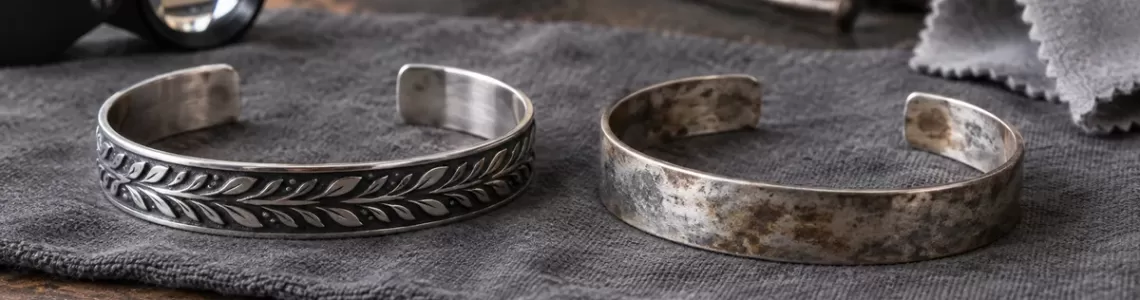
Quick answer: oxidized silver is a deliberately darkened finish used to create contrast, while tarnish is a surface change that develops when silver reacts with sulfur-containing substances in its environment. They can look similar because both may produce gray, brown or black areas, but a photograph cannot reliably tell you which process created the color. Before cleaning, confirm what the seller intended, identify every material in the piece, and preserve dark recesses if they are part of the design. A silver polish that brightens ordinary tarnish can also erase intentional oxidation.
This guide is for buyers comparing silver bracelets and mixed-material jewelry online. It explains finish language, inspection order, cleaning boundaries and seller questions. It does not authenticate a particular item, identify a chemical layer from a photograph, certify metal fineness, or promise how long a dark finish will last. Product specifications and written care instructions control for each item.
Oxidized silver and tarnish are related surface ideas, not interchangeable labels
Silver can darken because a surface layer forms through a chemical reaction. The Canadian Conservation Institute explains that silver tarnish is commonly associated with sulfur-containing gases and silver sulfide. Humidity, pollutants, storage materials and handling conditions can influence the process. That description explains why an uncoated silver object may change color over time, but it does not mean every dark silver surface is accidental damage.
Jewelry makers can intentionally create a darkened surface to emphasize engraving, texture or relief. In a buyer-facing description, terms such as oxidized silver, blackened silver, antiqued silver or patinated silver may signal that the dark color is part of the design. Those words still need context. The seller should make clear whether the underlying component is sterling silver, fine silver, silver plate or another material, and whether the dark appearance is created by a treatment, coating or natural aging.
The distinction matters because the buyer’s goal differs. Ordinary unwanted tarnish may be removed cautiously when the construction permits. Intentional oxidation should usually be preserved. A bright high point beside a dark recess can be a planned contrast rather than uneven cleaning. Conversely, an item described as bright polished silver should not arrive with unexplained blotches, transferable residue or a finish that conflicts with the listing.
What a 925 mark can prove—and what it cannot
The U.S. Federal Trade Commission’s consumer guidance explains that “silver,” “sterling” and “sterling silver” describe products containing 92.5 percent pure silver, and that 925 means 925 parts silver per thousand. The current U.S. Jewelry Guides similarly address misrepresentation of silver content and require plated or coated products to be described accurately. These rules concern composition claims. They do not tell you whether the visible surface was intentionally darkened after manufacture.
UK hallmarking uses another framework. The British Hallmarking Council’s guidance describes the sponsor or maker mark, fineness mark and assay office mark in a complete UK hallmark, subject to thresholds and local rules. A hallmark supports a precious-metal fineness claim; it is not a universal finish code. A dark surface does not cancel a valid fineness mark, and a 925 stamp does not prove the darkness was deliberately applied.
For mixed-material bracelets, the scope of a mark is especially important. A marked silver charm does not automatically make every jump ring, spacer, clasp spring, cord end or bead sterling silver. Likewise, an intentionally blackened silver component does not prove that adjacent dark beads or findings are silver. Read the component description rather than transferring one mark to the entire object.
Six visual clues to record before cleaning
1. Read the original listing. Save the material line, finish wording, care instructions and photographs. Look for specific language such as “oxidized sterling silver,” “antiqued finish,” “darkened recesses,” “silver plated,” “rhodium plated” or “polished silver.” If the page says only “vintage silver color,” the underlying material and process may still be unclear.
2. Note the pattern. Intentional oxidation often appears in recesses, around lettering, under raised motifs or in a consistent design pattern. Ordinary tarnish can also collect unevenly, so pattern alone is not proof. Record where the dark areas appear instead of immediately rubbing them away.
3. Compare high-contact and protected areas. Raised edges, clasp touch points and bracelet surfaces that rub against skin or a desk may become brighter as a dark finish wears. Protected recesses may stay dark. That wear pattern can be consistent with intentional oxidation, but it cannot establish the exact treatment or the original thickness of a surface layer.
4. Check for transferable residue. A stable dark finish and a loose powder are different observations. If material transfers heavily to a clean white cloth, flakes, feels sticky or leaves sharp pitting, stop wearing the item and ask the seller or a qualified jeweler before cleaning. Do not infer the chemistry from color alone.
5. Inspect every attached material. Pearls, porous stones, dyed beads, wood, cord, elastic, adhesive and plated findings can set stricter care limits than the silver component. A method that is acceptable for plain uncoated silver may damage the assembled bracelet.
6. Preserve evidence if the delivered item differs from the listing. Photograph the item in neutral light, including marks, dark areas, packaging and any visible wear. Avoid scratch tests, acid tests, dips and heavy polishing while a return or warranty question remains open. The site’s online jewelry return guide explains how to keep the description, measurements and condition evidence organized.
Why aggressive silver cleaning can remove the design
The Canadian Conservation Institute describes three broad tarnish-removal approaches: mechanical polishing, chemical dipping and electrochemical methods. Each changes or removes material at the surface. Museum guidance is deliberately conservative because repeated polishing can remove silver and alter details. Jewelry is smaller and intended for wear, but the same physical limit matters: a cleaning method cannot selectively know which dark layer you wanted to keep.
Polishing cloths and pastes remove surface material through abrasion. They may brighten exposed high points while leaving recessed contrast, which is sometimes the maker’s intended maintenance pattern. Heavy rubbing across the entire piece can flatten that contrast. Chemical dips can reach recesses and remove darkness more uniformly, which may destroy an antiqued effect. Electrochemical household recipes can also change surfaces unpredictably and may be unsuitable for plated, coated or mixed-material jewelry.
A maker-specific instruction can be more useful than a generic internet recipe. Tiffany’s care guidance for its own oxidized silver advises a dry, clean cloth and limited cleaning. That instruction should not be treated as a universal warranty for every oxidized product, but it illustrates the finish-preservation principle: begin with the least aggressive method and avoid assuming the dark layer is dirt.
A conservative cleaning decision
- The listing confirms intentional oxidation
- Use the maker’s instructions. Start with a clean, dry, soft cloth. Avoid silver dips, abrasive paste, toothpaste, baking-soda scrubbing and aggressive polishing unless the maker expressly permits them for that exact finish.
- The listing describes bright polished silver
- First rule out mixed materials, plating, coatings and fragile construction. If care instructions allow silver cleaning, test the gentlest method on a small inconspicuous area and stop if the surface changes unexpectedly.
- The finish is unknown
- Do not guess from color. Keep the item dry, wipe lightly without pressure, and ask the seller whether the darkness is intentional, removable or covered by care guidance.
- The piece includes pearls, stones, wood, cord or adhesive
- Follow the most sensitive material’s limit. The mixed-material bracelet cleaning guide provides a component-by-component framework.
- The item has loose residue, flaking or sharp damage
- Stop wearing it. Isolate it from soft textiles and other jewelry, preserve photographs and obtain product-specific advice rather than escalating home cleaning.
How intentional oxidation changes buyer expectations
An oxidized finish is not permanently frozen. Friction, skin contact, polishing, chemicals and repeated moisture can make raised areas brighter or create uneven wear. A seller can reasonably describe a finish as intentionally oxidized, but should not imply it will stay identical forever unless that claim is supported by a defined construction and use condition.
Ask where wear is expected. On a cuff, the inner wrist and desk-contact edge may change faster. On a bead bracelet, spacers can rub neighboring beads. On a chain, links and clasp parts move against one another. A design with bright high points and dark recesses may age gracefully because wear reinforces the contrast, but that is a style judgment, not a durability guarantee.
Also ask whether the dark surface can be restored. Some finishes can be reapplied by a jeweler; others depend on proprietary chemistry, hand finishing or a coating that is not easy to reproduce. “Can be re-oxidized” should be confirmed for the actual piece before purchase or service. A generic article cannot promise a repair outcome.
Oxidized silver, rhodium plating and silver plate are different claims
Oxidation describes a dark surface effect. Rhodium plating describes a bright platinum-group-metal coating when that coating is actually present. Silver plate describes a silver layer over a base material. These claims can affect care in different ways and should not be collapsed into “silver color.”
The rhodium-plated silver guide explains how a bright coating differs from a silver fineness claim. The solid sterling versus silver-plated guide separates bulk alloy from a surface layer. If a listing uses several finish words at once, ask which describes the base metal, which describes the visible surface, and which applies only to one component.
Do not use an ultrasonic cleaner simply because the item is called silver. Ultrasonic safety depends on stones, treatments, settings, solder, adhesive, plating and structural condition. Use the ultrasonic-cleaning compatibility checklist before considering a machine.
Applying the guide to real product pages
Start with the current sterling and fine silver bracelet collection, then read each product’s own material and finish description. The SUERTE fine-silver bead bracelet and the Eye of God sterling-silver and cord bracelet use different constructions. This guide does not assign an oxidized finish to either product unless its live page explicitly says so.
That discipline protects both buyer and seller. A dark product photograph may reflect lighting, post-processing, natural tarnish, a deliberate finish or shadows between components. Use the written specification as the claim. If the finish matters to your purchase, ask for a direct written answer before checkout.
Save the product description and care instructions supplied at purchase. If the appearance later changes, those records help distinguish an expected finish transition from a possible listing mismatch. Compare the same area under similar neutral lighting, and avoid cleaning before the seller or maker has had a chance to assess clear photographs.
Buyer questions worth asking
- Is the dark color intentional oxidation, ordinary tarnish, plating, paint, lacquer or another finish?
- Which components are sterling silver, fine silver, plated metal or non-silver material?
- Is the finish expected to brighten at raised edges with wear?
- Which cleaning products and methods are specifically prohibited?
- Can the finish be restored, and would that service change marks, texture or dimensions?
- Does the written warranty cover finish wear, or is finish change treated as normal use?
- If the item arrives different from the photos, what return condition must be preserved?
FAQ
Is oxidized silver fake silver?
No. Oxidation is a surface description, not proof of the underlying alloy. Genuine sterling or fine silver can have an intentionally darkened finish, but the silver claim still needs its own accurate description or hallmark evidence.
Does black silver always mean tarnish?
No. Black or gray areas may be intentional oxidation, natural tarnish, coating, residue, lighting or another surface treatment. A photograph alone cannot identify the process.
Can I use silver dip on oxidized jewelry?
Not by default. A dip can remove the dark contrast the maker intended and may harm other materials. Follow the exact maker’s care instructions.
Will intentional oxidation wear off?
It can change, especially on raised or high-contact areas. The rate depends on construction, treatment, friction, chemicals and wearing habits, so no universal lifetime is supportable.
Does 925 prove the dark finish is intentional?
No. A 925 mark concerns silver fineness. It does not identify the surface treatment or explain how the finish should be cleaned.
Should I polish bright edges but leave dark recesses?
Only if the maker’s instructions support that maintenance pattern. Use minimal pressure and avoid extending polish into dark recesses.
Is tarnish a health treatment or detox effect?
No reliable evidence supports treating silver tarnish or oxidation as a medical, detoxification or wellness effect. This guide addresses appearance, disclosure and care.
References
- Canadian Conservation Institute, Understanding how silver objects tarnish.
- Canadian Conservation Institute, Silver — Care and Tarnish Removal.
- U.S. Federal Trade Commission, Buying Platinum, Gold, and Silver Jewelry.
- 16 CFR 23.5, Misrepresentation as to silver content.
- British Hallmarking Council, Hallmarking: practical guidance.
- The Metropolitan Museum of Art, The Care and Handling of Art Objects.
- Tiffany & Co., How do I care for oxidized silver? — maker-specific care example, not a universal rule.
Evidence boundary: This article uses conservation, consumer-protection, hallmarking and maker-care sources to explain terminology and cautious decision-making. Museum methods are not home-cleaning recipes, one maker’s instruction does not control another maker’s product, and none of the cited sources authenticates a sunMYLOVE item. Last reviewed: September 27, 2026.
Leave a Comment