
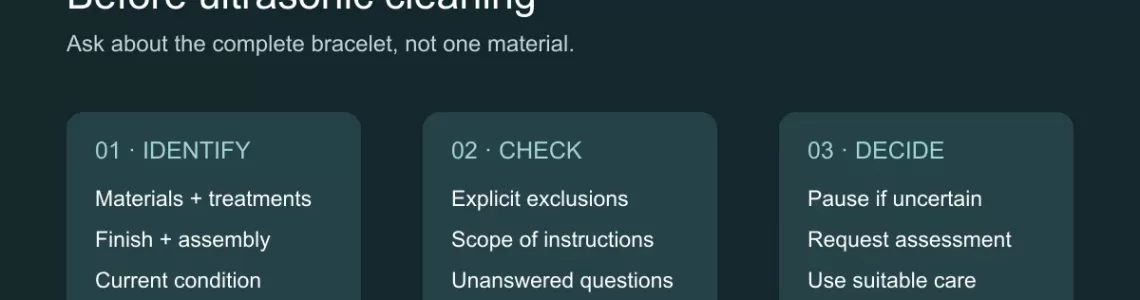
Answer first: Ultrasonic cleaning for bracelets is a compatibility decision, not a shortcut approved by a metal name. Do not put pearl bracelets, fracture-filled gems or unidentified mixed-material bracelets into an ultrasonic bath. For other pieces, establish the material, treatment, finish, construction and current condition before a jeweler considers machine cleaning. When those details are missing, pause rather than experiment. GIA identifies several exclusions and advises professional help when suitability is uncertain. GIA ultrasonic-cleaner guidance.
This guide answers one question: what information should a bracelet owner collect before choosing ultrasonic cleaning? It does not certify a particular sunMYLOVE bracelet or recommend a machine, chemical formula, temperature, frequency or cycle length. The decision framework below is our editorial synthesis; material-specific recommendations are attributed to the institutions that issue them.
What ultrasonic cleaning for bracelets means
An ultrasonic cleaner uses high-frequency sound through liquid to dislodge dirt in difficult-to-reach areas. That useful action also means that the bracelet encounters a process rather than just a soft wipe. The liquid, possible heating, vibration and condition of the object all matter. GIA warns that vibration can loosen mounted gems and that certain treatments and sensitive gem materials are unsuitable. A successful cleaning demonstration is therefore not proof that an apparently similar bracelet is compatible. GIA: mechanism and cautions.
In this article, cleaning means removing unwanted dirt or residues; polishing means an operation intended to alter surface appearance, often using abrasion; tarnish removal means addressing a reaction layer rather than ordinary loose dirt. These goals should not be treated as interchangeable. The Canadian Conservation Institute distinguishes cleaning from abrasive polishing and explains that repeated polishing can remove surface detail. Its advice concerns museum objects, not an automatic home-care recipe for wearable jewelry. CCI Notes 9/3 (PDF).
Compatibility here means that the complete piece has a justified cleaning method for its actual components and condition. It does not mean that its dominant material appears on a generic safe list. A bracelet can contain beads, spacers, string, a clasp and finishes that need different questions. Browse our beaded bracelet collection with that component-by-component approach, rather than interpreting a category label as a machine-cleaning approval.
Start with the whole object, not the most familiar component
Make a short inventory before deciding how to clean. Record what the seller actually states about each visible component. Keep unspecified details marked unknown. A dark bead is not a laboratory identification; a metallic spacer does not reveal its coating; an elastic appearance does not identify the cord polymer. Photographs help organize questions, but they cannot establish hidden treatments or an adhesive's compatibility.
A useful inventory has five columns: component, documented material, documented treatment or finish, connection method, and unresolved question. For example, a bead description might be available while string composition is not. That is a partially documented assembly, not evidence that the whole bracelet can be immersed. You do not need to solve every materials-science problem yourself: the point is to make the gaps visible before choosing a process.
Our black obsidian and brass 12mm bracelet listing illustrates why buyers should read the specific listing rather than infer care from a black bead photograph. This is a product reference, not a statement that the item has been tested in an ultrasonic cleaner. No test results, coating analysis or machine compatibility certification are supplied by this guide.
If construction is unfamiliar, consult the bead holes, cord and knots guide. Use it to identify questions about assembly and repair access. Do not pull knots apart, stretch a bracelet to discover its limit or remove components merely to make them fit a cleaning basket.
Three evidence-backed boundaries
1. Pearls are an explicit exclusion
GIA says not to use ultrasonic or steam cleaners on pearls. For routine cultured-pearl care it recommends a very soft clean cloth after wearing; its occasional warm soapy-water advice also requires strung pieces to be completely dry before reuse. Those instructions concern pearls and do not resolve the compatibility of every neighboring component in a mixed bracelet. GIA Pearl Care and Cleaning Guide.
The buying implication is simple: do not let a silver component cancel a pearl restriction. A label such as pearl and silver describes a combination, not a hierarchy in which silver's care requirements override everything else. For background rather than a machine protocol, read our freshwater pearl bracelet care guide.
2. A durable gem name is not the complete answer
GIA describes ultrasonic cleaning as usually suitable for spinel, but flags fractures as a possible problem and limits fracture-filled examples to gentle water-based cleaning or a damp cloth. This is important counterevidence to an absolute claim that no gemstone can ever be machine cleaned. It is equally strong evidence against assuming that every specimen of a nominally durable gem is suitable. Spinel is a comparison example here, not a claim that sunMYLOVE stocks it. GIA Spinel Care and Cleaning Guide.
Treatment, identity and condition are separate fields in your inventory. Knowing one does not silently fill in the others. A report that identifies one loose specimen also does not automatically describe every bead, spacer or connection in a finished bracelet. If a document is offered as reassurance, check which specimen it covers before making the cleaning decision.
3. Metal care also depends on construction and appearance
CCI's silver guidance calls for examination before treatment, highlights hollow and joined constructions, and warns that tarnish removal can remove underlying silver. It also treats nonmetal attachments as reasons to reconsider immersion. These are conservation observations, not quantified damage probabilities for modern bracelets. They support asking about the entire object rather than declaring all silver assemblies immersion-safe. CCI Notes 9/7 (PDF).
For pieces in our silver bracelet collection, read the stated purity, other materials and care information individually. We do not convert a category name, hallmark or silver description into a claim of ultrasonic compatibility. The same caution applies when the desired dark recesses or textured surface are part of the design rather than dirt to eliminate.
A five-gate compatibility checklist
The following framework is a conservative editorial decision aid, not a validated scoring tool. There are no invented risk percentages. Passing one row does not compensate for an unanswered row elsewhere. The practical outcomes are pause, use an explicitly suitable non-machine method, or obtain a professional assessment of the complete piece.
| Gate | Question to resolve | Reason to pause | Useful next step |
|---|---|---|---|
| Identity | What is each component? | Only a color, style or trade name is available | Request a specific material description |
| Treatment | Are fillers, coatings or other treatments documented? | Treatment information is absent or contradictory | Ask what is known and what has not been tested |
| Finish | What appearance should be preserved? | Patina, plating or decoration is uncertain | Ask about the intended finish and care limits |
| Assembly | How are beads, findings and inserts connected? | Cord, adhesive or hollow construction is unspecified | Have the intact assembly assessed |
| Condition | Does the piece need repair before cleaning? | Loose parts, chips or changes are visible | Stop wearing if necessary and seek repair advice |
Keep the distinction between no evidence of a problem and evidence of suitability. The first can simply mean nobody has examined the relevant feature. A generic manual saying silver jewelry is usually suitable cannot answer whether your particular piece includes a vulnerable finish, sensitive bead or damaged connection. Ask for a method attached to the actual bracelet, not a broad material family.
Before cleaning: a practical preparation sequence
- Define the goal. Is the problem dust, residue, dull appearance or a possible structural change? If you cannot tell, do not escalate automatically to a stronger method.
- Preserve the description. Keep the seller's material and care information with the item. Record unknowns without rewriting them as positive claims.
- Inspect without stress. Look under ordinary good light for changes and loose components. Do not scratch, bend, heat or chemically test the bracelet.
- Choose the applicable advice. A pearl rule, a metal conservation note and a machine manual have different scopes. None should be applied beyond the object it addresses.
- Ask one precise question. Can the complete bracelet be cleaned by this method while preserving its intended finish and assembly? A qualified repair provider can explain whether examination is needed.
- Keep an exit option. If suitability remains unresolved, postpone machine cleaning. Waiting for information is a legitimate decision, not failed maintenance.
At home, avoid improvising with a cleaner merely because it is already available. A machine's shortest cycle is not a demonstrated safe cycle for an unidentified assembly. Removing the heater or using only water does not establish compatibility either. This guide supplies no frequency threshold or time limit because the reviewed sources do not provide a universally applicable one for the site's mixed bracelets.
Choose a bracelet with care needs you can understand
For someone buying a first bracelet, maintenance clarity is a useful comparison criterion alongside fit and visual preference. Ask whether care instructions identify all materials, distinguish ordinary cleaning from refinishing, and explain when to seek help. A clear answer can be more valuable than a broad claim that a piece is easy to clean.
Explore the cuff bracelet collection by the specific listing's material description; the category URL is not itself proof of an alloy. Consider the preferred finish and whether you want the surface appearance preserved. An intentionally textured or darkened area is not automatically an unwanted deposit. If two bracelets appeal equally, choose according to documented care and comfortable fit, not an assumed ability to put either in a machine.
Before ordering, check the site's returns and refunds policy and ask unresolved material or care questions in advance. This link is not a promise that cleaning damage is covered. Do not use an aggressive cleaning experiment as a way to determine whether to return an item, and do not infer policy exceptions that the published terms do not state.
Three scenarios, with honest limits
Pearls plus silver: the pearl exclusion decides against an ultrasonic bath even if the metal is well documented. The remaining task is to choose care suitable for the complete assembly, not to find a setting that bypasses the exclusion. This is an application of the cited pearl guidance, not a sunMYLOVE laboratory test.
A bead bracelet with uncertain string: the seller describes the beads but does not specify the string or possible treatments. Mark those fields unresolved. Request appropriate whole-piece care rather than assuming that stone identity settles assembly compatibility. Our mixed-material cleaning guide addresses the separate task of planning non-machine care across components.
A metal cuff with dark recesses: first decide whether you want dirt removed or appearance changed. Ask how to preserve its actual finish. CCI notes that original coatings and patinated appearances can be significant, and advises against polishing when the intended appearance is uncertain. Its museum perspective supports this distinction, but does not certify any current cuff or prescribe domestic solvents. CCI: appearance before polishing (PDF).
Common errors and what to do instead
- Using a metal name as permission. Replace it with an inventory of the intact piece.
- Reading a safe list as a guarantee. Look for conditions, exclusions and specimen-specific information.
- Calling every dark area dirt. Establish the desired finish before changing appearance.
- Trying one cycle to see what happens. Resolve compatibility before exposure, not afterward.
- Copying museum chemical procedures. Use conservation notes for the stated principles, not as household solvent instructions.
- Confusing good appearance with no damage. Visual similarity alone is not a structural inspection or treatment analysis.
Frequently asked questions
Can every silver bracelet go in an ultrasonic cleaner?
No blanket approval follows from silver content. The complete piece may have other materials, finishes or construction details that require different care. Read its actual instructions and obtain assessment when the relevant details are uncertain.
Does water-only operation make pearl bracelets suitable?
No. GIA's pearl exclusion is not replaced by the owner's choice to omit cleaning chemicals. Choose pearl-appropriate care and account for the rest of the bracelet rather than experimenting with a machine.
Can I select a universally safe short cycle?
This guide cannot provide one. The sources reviewed do not establish a universal duration or frequency for the site's intact mixed-material bracelets. A machine setting is not a substitute for identity, treatment and condition information.
Does a gem report approve the whole bracelet?
Only read a report within its stated scope. Identification or treatment information about a submitted specimen is not automatically approval of the finished assembly, its string, its other beads or a particular cleaning process.
Are ultrasonic cleaners always inappropriate for gemstones?
No. The cited spinel guidance provides a conditional counterexample. That does not generalize to every gem, treated specimen or assembled bracelet. The useful question concerns this complete piece in its current condition.
What if a bracelet changes appearance after cleaning?
Stop further treatment, retain the original description and record what method was used. Contact the seller or a repair professional with those facts. Do not diagnose the cause from a photograph or attempt stronger chemicals to reverse an unidentified change.
Method, limitations and editorial review
sunMYLOVE reviewed the five institutional sources below on September 16, 2026, alongside the site's public catalog and existing guides. We compared exclusions with conditional examples and distinguished museum conservation from wearable-jewelry care. No bracelet was placed in a cleaner; no before-and-after experiment, failure rate or product certification is claimed. The checklist is a buyer-question framework, not an engineering standard or professional qualification.
Evidence strength is highest for explicit institutional recommendations within their scope. Extending them into a conservative whole-assembly question is reasonable editorial inference, clearly separated from measured outcomes. The sources share institutions and are not five independent clinical or experimental studies. No conclusion about health benefits, medical treatment, universal cultural meaning or guaranteed lifetime durability follows from this review.
References and evidence scope
- GIA, Gems and Ultrasonic Cleaners — process overview, exclusions and setting checks; not a test of our products.
- GIA, Pearl Care and Cleaning Guide — pearl-specific care and machine exclusions; not approval of adjacent materials.
- GIA, Spinel Care and Cleaning Guide — conditional suitability and fracture concerns; comparison example only.
- CCI Notes 9/7, Silver: Care and Tarnish Removal (PDF) — construction examination and conservation limits; no domestic chemical recipes adopted.
- CCI Notes 9/3, Brass and Copper (PDF) — cleaning, polishing and intended appearance; museum scope, not machine certification.
Reviewed: September 16, 2026. sunMYLOVE editorial note: Prepared by the sunMYLOVE organization as a research-led buying and care guide. Product references connect readers to actual listings and do not imply independent testing, treatment verification or a professional author credential.
Leave a Comment