
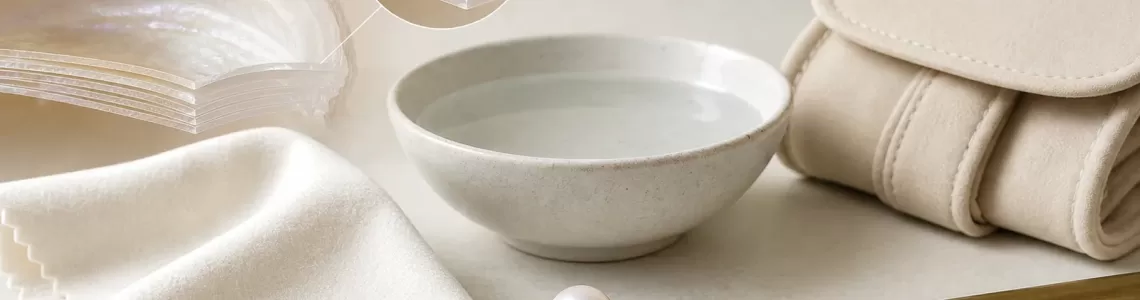
Answer first: Wipe a freshwater pearl bracelet with a very soft, clean cloth after wearing it. Keep perfume, hairspray, cosmetics, household cleaners, acids and high heat away from the pearls. For occasional deeper cleaning, use lukewarm water with a small amount of mild soap only when the bracelet’s string, elastic, metal and any adhesive are known to tolerate moisture. Never use steam or an ultrasonic cleaner. Let the bracelet dry completely, lying flat on a clean towel, before wearing or storing it. Keep it in its own soft, padded compartment so harder jewelry cannot scratch the pearl surface.
This conservative routine reflects guidance from the Gemological Institute of America (GIA) and the World Jewellery Confederation (CIBJO). It also applies preventive-conservation principles from the Canadian Conservation Institute (CCI) and the U.S. National Park Service (NPS). It does not assume that every bracelet is assembled in the same way. A cultured pearl, a sterling silver bead, elastic, silk, adhesive and a coating can respond differently to water, heat and chemicals. The safest method is set by the most vulnerable component.
Research question and scope
This guide asks: How can a buyer clean, wear and store a modern freshwater cultured pearl bracelet without adding avoidable abrasion, chemical exposure, heat or tension? It covers intact bracelets and simple strands intended for ordinary wear. It does not provide restoration advice for peeling nacre, cracked pearls, loose settings, corroded fittings, antique jewelry or an unidentified surface treatment. Those conditions need examination by a qualified jeweler or conservator.
The article distinguishes three kinds of information. Geological and gemological facts describe pearl structure and hardness. Institutional care recommendations describe lower-risk handling. Product-specific conclusions depend on the actual bracelet and cannot be inferred from a generic guide. Nothing here is a health claim, a durability guarantee or proof of pearl identity.
Five terms that prevent care mistakes
- Natural pearl
- A pearl formed in a mollusc without human intervention. It should not be treated as a synonym for every pearl sold in jewelry.
- Cultured pearl
- A pearl produced through human-assisted cultivation in a mollusc. “Cultured” describes the production process; it does not mean an imitation made entirely from plastic or glass.
- Freshwater cultured pearl
- A cultured pearl grown in a freshwater mollusc. Shape, surface, color and nacre appearance can vary. Those variations are not dirt to be scrubbed away.
- Nacre
- The layered material associated with a pearl’s surface and appearance. Care recommendations focus on protecting that surface from scratching, chemicals and heat.
- Composite jewelry
- An object made from more than one material. A bracelet may combine pearls, metal, string or elastic, knots, coatings and adhesive; the components may age or react differently.
CIBJO’s Pearl Book supplies standardized pearl terminology and states that natural and cultured pearls require special care. It advises keeping them away from solvents, high temperatures, ultrasonic cleaning and acids. This is more reliable than treating “pearl” as a decorative color or assuming all pale round beads share the same properties.
Why freshwater pearls need a different routine
The surface is comparatively easy to scratch
GIA places pearl around 2.5 on the Mohs hardness scale and describes it as soft and easily scratched or abraded. Mohs hardness measures relative scratch resistance, not resistance to every kind of impact, bending or aging. The practical conclusion is modest: do not let pearl jewelry rub against harder gemstones, metal edges, gritty dust or abrasive cloths. It does not mean a pearl will fail during normal careful wear.
Heat and chemical exposure matter
GIA notes that high heat can discolor, split or crack cultured pearls and that many chemicals and acids can damage them. Everyday exposure can include perfume, hairspray, cosmetics and perspiration. CIBJO likewise tells sellers to communicate special care requirements involving solvents, high temperature, ultrasonic cleaning and acids. These sources support a simple order of dressing: apply personal products first, allow them to dry, and put on the bracelet last.
Treatments can change the decision
Cultured pearls may be dyed, coated, bleached, irradiated or otherwise treated. GIA cautions that some treatments can alter over time. A home cleaning method cannot identify every treatment. If a product page does not disclose what you need to know, ask the seller before applying solvents or polish. Color change is not proof of a particular treatment, and a generic online test should not replace documentation.
The string or elastic may be more vulnerable than the pearl
Wet string can stretch and attract soil, while repeated water exposure can shorten the life of some elastics. Moisture can remain in drill holes or around knots. A pearl bracelet that looks dry on the outside may still be damp internally. GIA therefore advises that strung pearls be completely dry before wear. “Pearls can be cleaned with warm soapy water” is not permission to soak an assembled bracelet.
Before cleaning: a one-minute condition check
Work under bright, diffuse light over a folded clean towel. Remove rings and watches that might strike the bracelet. Look at every pearl, knot, spacer, clasp and connector. Check for:
- peeling, powdery areas, cracks or chips;
- a loose pearl or metal spacer;
- dark, stretched, frayed or exposed string;
- elastic that no longer returns to shape;
- green, black or powdery corrosion near metal;
- lifting coatings, glue residue or movement at a setting;
- a surface decoration that may snag a cloth.
If any of these is present, stop. Cleaning can turn a small weakness into a loss. CCI’s preventive-conservation guidance emphasizes that even careful cleaning can damage fragile natural materials. Photograph the condition and consult a professional rather than escalating to stronger chemistry.
A method-selection table
| Condition | Lowest-risk action | Do not do |
|---|---|---|
| Clean, intact bracelet after normal wear | Wipe each pearl with a clean, very soft dry cloth | Clean for the sake of making it “extra shiny” |
| Light skin oil or fingerprints | Use a cloth barely dampened with clean lukewarm water, then blot dry | Rub hard or use paper towel |
| Visible residue on a sound, water-compatible bracelet | Use a small amount of mild soap in lukewarm water; clean briefly and locally | Soak the bracelet |
| Unknown elastic, adhesive, coating or plated metal | Keep cleaning local and nearly dry; ask the seller if uncertain | Assume the whole object is water-safe |
| Cracked pearl, loose setting, frayed string or corrosion | Isolate the item and seek professional inspection | Use glue, polish, acid or an ultrasonic cleaner |
Step-by-step: routine after-wear care
Step 1: Remove the bracelet carefully
Unfasten a clasp rather than pulling the strand over the hand. For elastic designs, roll the bracelet gently over the hand instead of stretching one section sharply. Support the whole strand so no single knot or connector bears the load.
Step 2: Wipe, do not polish
Use a freshly cleaned, very soft, lint-free cloth reserved for pearl jewelry. Hold the bracelet on the towel and wipe each pearl with light, straight passes. Turn the cloth frequently. The aim is to lift recent residue before it builds up, not to abrade the surface into a higher shine.
Step 3: Let moisture dissipate
If the bracelet was exposed to perspiration or a damp climate, lay it flat in a shaded, ventilated room before closing it inside a pouch. Do not place it on a radiator, in direct sun or beneath a hot lamp. Heat used to accelerate drying can harm pearls and stringing.
Step 4: Inspect the string or elastic
Look at the spaces between pearls and around the clasp. A new gap, fraying or loss of elasticity is a service signal, not a cleaning problem. Stop wearing the bracelet until it is restrung or repaired.
Step-by-step: occasional deeper cleaning
Use this method only when wiping no longer removes visible residue and the complete bracelet is known to tolerate limited moisture.
- Prepare the area. Cover a stable table with a clean towel. Use a small bowl rather than an open sink. Prepare lukewarm water, a tiny amount of plain mild soap, a new soft brush and two clean cloths.
- Inspect again. Confirm that pearls are intact and that string, elastic, metal, coatings and adhesive show no instability.
- Make a weak solution. Add only a small amount of mild soap to the water. More soap creates more residue; it does not make the process safer.
- Clean locally. Dampen the cloth or soft brush and remove excess liquid. Work gently on the pearl surfaces without saturating knots or drill holes. Do not leave the bracelet immersed.
- Remove residue. Use the second cloth barely dampened with clean water. Do not rinse directly over an open drain.
- Blot and lay flat. Blot with a dry cloth, reshape the bracelet naturally and leave it flat on a clean towel.
- Wait until fully dry. Do not pick up or wear a strung pearl bracelet while the thread is wet. Drying time varies with construction and humidity; visual dryness alone may be insufficient.
- Reinspect. Confirm that no component has loosened, stretched or changed color before storage.
GIA explicitly advises against steam and ultrasonic cleaning for pearls. The fact that a machine is sold for jewelry does not make it safe for every gem or assembly. Vibration can also affect weakened settings or stringing. Professional cleaning is valuable because the jeweler can examine the exact object first.
How to store a freshwater pearl bracelet
Use separate, padded storage. GIA recommends keeping pearls away from sharp or rough objects and using a soft pouch or case. CCI and NPS preventive-conservation guidance supports reducing contact, vibration, dust and unnecessary handling for shell and other vulnerable natural materials.
- Place the bracelet in its own soft-lined compartment or clean pouch.
- Lay it flat and relaxed; do not hang a strung or elastic bracelet under tension.
- Keep metal chains, rings and harder gemstones in separate compartments.
- Avoid very hot, very dry storage and locations with rapid environmental changes.
- Keep the item away from windows, heaters, air-conditioning vents and household chemicals.
- Do not wrap pearls in strongly moisture-absorbing material for long-term storage; CIBJO specifically cautions against cotton wool.
- For travel, put the soft pouch inside a rigid case so the bracelet cannot be crushed.
GIA notes that extremely dry storage can be harmful to pearls. That does not justify deliberately wetting a bracelet or sealing it while damp. The practical middle ground is ordinary, stable indoor storage away from heat, not a homemade humidity treatment.
How construction changes the care plan
Freshwater pearl and sterling silver bracelets
A piece such as the Natural Freshwater Pearls and 925 Sterling Silver Bracelet combines materials with different care needs. Silver tarnish and pearl surface care are not the same task. A silver-polishing cloth or chemical dip intended for metal should not automatically contact pearls, string or coatings. Clean each material locally and ask for product-specific instructions before using a metal treatment.
Pearl, moonstone and silver combinations
The Pearls, Moonstone and 925 Sterling Silver Bracelet has more than one gem material as well as metal and stringing. A method suitable for one component may not be suitable for the whole bracelet. Choose the gentlest shared method and avoid home experiments based on a single ingredient.
Elastic versus knotted string
Elastic should not be overstretched, soaked repeatedly or stored under tension. Knotted string can darken, fray or lengthen and may need periodic restringing. There is no universal calendar because frequency of wear, humidity, strand weight and construction vary. Regular visual inspection is more honest than promising a fixed service life.
To compare product constructions, begin with the Beaded Bracelets collection and the freshwater pearl authenticity guide. After identity, use the freshwater pearl quality guide to assess luster, surface, shape and matching. Confirm the individual product description rather than transferring one page’s specifications to another item.
Wear habits that reduce cleaning
- Apply perfume, sunscreen, lotion, cosmetics and hairspray before putting on pearl jewelry.
- Let products dry on the skin before wearing the bracelet.
- Remove the bracelet before showering, swimming, exercising heavily, washing dishes or using cleaners.
- Avoid wearing it for heavy work where impact, abrasion or snagging is likely.
- Put the bracelet on last and remove it first when dressing.
- Wipe it after wear and store it separately.
These habits reduce chemical contact and repeated wet cleaning. They do not make the item damage-proof. Personal preference and intended styling are separate from material-care evidence; the existing freshwater pearl bracelet style article addresses appearance and wearing context, while this page is limited to care and risk reduction.
Common mistakes
- Using toothpaste or baking soda: abrasive particles can scratch a comparatively soft surface.
- Using vinegar, lemon or another acid: GIA and CIBJO specifically warn that acids can harm pearls.
- Putting pearls in an ultrasonic machine: it is directly contrary to pearl-care guidance.
- Applying silver dip to the whole bracelet: a metal treatment may damage pearls, string, adhesive or coatings.
- Soaking to clean between beads: moisture can remain in holes and knots and can affect string or elastic.
- Drying in sun or with a hair dryer: high heat and rapid drying add unnecessary risk.
- Wearing a wet strand: wet string can stretch and collect dirt.
- Storing with harder jewelry: contact can abrade or scratch pearl surfaces.
- Trying to glue a loose pearl: household adhesive can stain surfaces and complicate professional repair.
Buyer’s care checklist
Before purchasing, ask questions that the product page can actually answer:
- Does the listing identify the pearls as freshwater cultured pearls?
- What other materials touch the pearls—sterling silver, plated metal, elastic, thread, adhesive or coating?
- Is the bracelet elastic, clasped or knotted?
- Are treatments or color enhancements disclosed where relevant?
- Are product-specific cleaning instructions available?
- What is the return process if the item arrives damaged or differs from its description?
Review sunMYLOVE’s delivery information and returns and refunds policy before ordering. If a care or construction detail is unclear, use the contact page. Do not clean or repair a newly arrived damaged item before documenting it and reviewing the return conditions.
Frequently asked questions
Can freshwater pearls get wet?
Brief, controlled contact with lukewarm water can be part of occasional cleaning, but soaking is not recommended. The bracelet’s string, elastic, metal, coatings and adhesive may be less water-tolerant than the pearl. Dry the complete piece fully before wear or storage.
Can I shower or swim with a pearl bracelet?
Removing it is the lower-risk choice. Soap, shampoo, chlorine, salt, heat and repeated wetting can affect the pearl surface and the bracelet’s other components.
Can I use a silver-polishing cloth?
Only on the appropriate silver surface and only when the maker confirms compatibility. Many polishing cloths contain compounds intended for metal. Keep them away from pearls, string and unknown coatings.
How often should I clean freshwater pearls?
Wipe after wear when needed. Use deeper cleaning only when visible residue remains and the assembly is sound. There is no evidence-based universal schedule for every wearer and construction.
Why has the string become dark?
String can collect skin oils, cosmetics and dust or simply wear with use. Do not try to bleach it. Ask a jeweler whether the bracelet should be restrung.
Should pearls be stored in an airtight plastic bag?
Avoid improvised long-term storage that is extremely dry or that traps moisture. Use the maker’s soft pouch or a stable padded jewelry compartment. Keep the bracelet separate, clean and dry, away from heat and chemicals.
Can cleaning prove that a pearl is genuine?
No. Cleaning response is not an authentication test. Identity depends on reliable seller disclosure and, when needed, appropriate gemological examination.
What should I do if nacre appears to peel or a pearl cracks?
Stop wearing and cleaning the bracelet. Store it alone in a padded box and seek professional inspection. Do not use glue, polish or solvent.
Evidence limits and editorial method
sunMYLOVE reviewed the sources below on 26 July 2026. GIA and CIBJO directly address pearl hardness, chemicals, heat, cleaning, drying and storage. CCI and NPS provide broader preventive-conservation principles for shell and natural-history materials. The latter are used conservatively to explain padding, separation, handling and environmental stability; they are not direct tests of sunMYLOVE products.
This guide does not claim that every pearl is untreated, that every metal component is solid sterling silver, or that a particular stringing method is used unless the individual product page says so. It makes no medical, spiritual or therapeutic claim. Product-specific documentation and professional examination take priority over generic guidance.
References and evidence scope
- Gemological Institute of America — Pearl Care and Cleaning Guide. Direct support for hardness, heat, chemical exposure, ultrasonic/steam avoidance, wiping and full drying.
- Gemological Institute of America — How should I care for my pearls?. Direct support for chemical avoidance, separate soft storage and periodic inspection of string.
- Gemological Institute of America — Tips on Caring for Jewelry. Supports separate storage, professional ultrasonic decisions and drying strung pearls flat.
- CIBJO — The Pearl Book. International trade terminology and direct special-care guidance for natural and cultured pearls.
- Canadian Conservation Institute — Caring for Natural History Collections. Supports cautious cleaning, protection from physical force and handling of shell materials.
- U.S. National Park Service — Museum Handbook, Part I. Supports preventive-conservation principles and stable storage for shell and composite objects.
Reviewed: 26 July 2026. Editorial identity: sunMYLOVE. Educational care guidance only.
Leave a Comment