
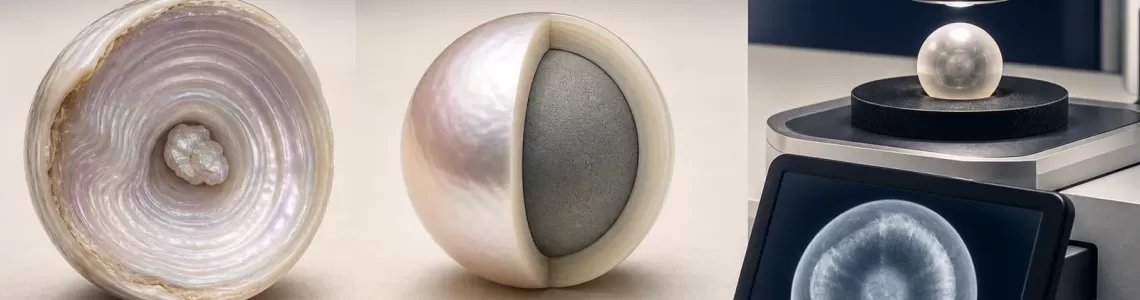
Answer first: Freshwater cultured pearls are real pearls formed by living freshwater mollusks with human assistance. They are not plastic, glass or shell-coated imitation pearls. However, “cultured” and “natural” are not interchangeable: a natural pearl forms without deliberate human intervention, while a cultured pearl forms after people initiate the process. For an online bracelet listing, freshwater cultured pearl is usually the clearest description when that identity has been established. A photo, price, shape or simple home test cannot reliably prove whether pearls are natural or cultured, freshwater or saltwater, treated or untreated.
This distinction matters because shoppers often see “real,” “genuine,” “natural,” “cultured,” “freshwater” and “imitation” used as if they mean the same thing. They do not. This guide explains what each term can prove, what a seller should disclose, which visible features help with preliminary evaluation, and when independent laboratory analysis is proportionate.
Research question, scope and evidence boundary
The research question is: what can a buyer safely conclude when a bracelet is described as freshwater pearl jewelry? The answer requires three separate judgments: identity, commercial description and quality. Identity asks whether the object is a pearl, cultured pearl or imitation. Commercial description asks whether freshwater, natural, cultured and treatment claims are accurate. Quality considers size, shape, color, luster, surface, nacre and matching.
This guide uses U.S. Federal Trade Commission rules, CIBJO terminology, gemological laboratory procedures and peer-reviewed pearl research. It does not authenticate any specific sunMYLOVE bracelet and does not claim that a product has a GIA, SSEF or other laboratory report unless such a report is explicitly supplied for that item. Laboratory methods can identify features that photographs and home tests cannot.
Pearl terminology: four labels that should not be collapsed
| Term | What it means | What it does not prove |
|---|---|---|
| Natural pearl | A pearl formed without deliberate human intervention | Freshwater or saltwater origin, quality, treatment status or value without further evidence |
| Cultured pearl | A pearl formed in a mollusk after people initiate the growth process | That it is natural, untreated, freshwater, saltwater, bead-nucleated or high quality |
| Freshwater cultured pearl | A cultured pearl grown in a freshwater mollusk and freshwater environment | Exact species, nucleation method, treatment, grade, durability or geographic origin |
| Imitation pearl | A manufactured product made to resemble a pearl | Formation in a mollusk or a nacre structure equivalent to a pearl |
The FTC Jewelry Guides in 16 CFR Part 23 set boundaries for pearl descriptions in the United States. They distinguish pearl, cultured pearl and imitation products; restrict the use of “natural” for cultured or imitation pearls; and address misleading regional terms and claims about cultured-pearl formation. The rules also require treatment disclosure when a treatment is not permanent, creates special care requirements or significantly affects value.
The CIBJO 2024 Pearl Book similarly treats “freshwater cultured pearl” as the required descriptive term for cultured pearls grown in freshwater. These are trade and disclosure frameworks. They do not replace a laboratory examination of an unknown strand.
So, are cultured freshwater pearls “real”?
In ordinary conversation, many buyers use “real pearl” to mean “not an imitation.” In that limited sense, a correctly identified freshwater cultured pearl is a pearl rather than a glass or plastic look-alike. But “real” is too vague for a careful product description. The more useful question is whether the item is accurately described as a freshwater cultured pearl, whether detectable treatments are disclosed when material, and whether the visible quality matches the price.
Do not convert “cultured” into “fake.” Culturing uses a living mollusk to deposit pearl material after human intervention. At the same time, do not convert “cultured” into “natural.” Natural and cultured describe different formation histories. Precise language protects both the buyer and the seller from an attractive but misleading shortcut.
How cultured freshwater pearls form
Freshwater pearl cultivation has used different nucleation methods. Many traditional Chinese freshwater cultured pearls were tissue-nucleated: a small piece of donor mantle tissue was inserted into a host mollusk, often producing pearls with varied shapes. Modern production also includes bead-nucleated freshwater cultured pearls. The inserted bead gives a more uniform foundation and can produce round pearls with bright luster.
That development is why origin cannot be inferred safely from shape alone. GIA's 2026 discussion of “freshwater akoyas” as a misleading term explains that modern bead-nucleated freshwater products may visually resemble saltwater akoya cultured pearls. GIA emphasizes that akoya identity relates to the saltwater mollusk and environment, not simply a round white appearance. A seller-created nickname is not a gemological identity.
Historical and biological studies also show that pearl culture is not a single fixed process. Research on Chinese freshwater cultured pearls documents changing production techniques, host mollusks and bead or tissue structures. Those findings support careful terminology; they do not let a shopper diagnose a mounted bracelet from a marketplace photograph.
What can you see at home—and what remains unproven?
| Observation | Useful for | Cannot reliably prove |
|---|---|---|
| Shape variation | Comparing uniformity and design character | Natural vs cultured or freshwater vs saltwater origin |
| Surface marks | Assessing visible condition and finish | Authenticity; imitations can be textured and cultured pearls can be smooth |
| Luster and reflection | Comparing visual quality within a known pearl type | Formation history, treatment or exact nacre structure |
| Drill-hole appearance | Spotting obvious coating damage or construction issues | A complete laboratory identity |
| Weight or temperature | Very rough comparison between known samples | Reliable authentication of an unknown bracelet |
| “Tooth test” friction | No recommended diagnostic use | Natural/cultured identity, environment, treatment or quality |
Internet home tests often turn a complex classification problem into one sensation: gritty equals real, smooth equals fake. That is not a responsible conclusion. Surface coatings, dirt, wear, treatment, polishing and the tester's perception can change the result. Rubbing a pearl against teeth can also contaminate or abrade a soft organic gem. A test that cannot distinguish natural from cultured or freshwater from saltwater does not answer the buyer's actual question.
The same caution applies to burning, scratching, cutting or chemical tests. Destructive experiments can damage the bracelet and still fail to establish origin. If the purchase is important enough to require proof, use documentation and an independent gemological laboratory rather than escalating home tests.
How laboratories identify and classify pearls
GIA's pearl identification workflow combines measurement, visual examination and advanced instruments. Depending on the item, testing may include real-time X-radiography, microradiography, UV-Vis reflectance spectroscopy, X-ray fluorescence and micro-computed tomography. The purpose is not merely to judge beauty; internal growth structures can help distinguish natural from cultured formation and bead-cultured from non-bead-cultured structures.
GIA's Pearl Reports and Services describe report fields such as identity, freshwater or saltwater environment, mollusk when determinable and detectable treatments. The Swiss Gemmological Institute SSEF likewise explains on its pearl identification page why radiography and other methods matter. These sources show why confident classification goes beyond a product photo.
A report still has boundaries. It applies to the submitted item, not to every visually similar pearl or every future product from a seller. Buyers should match the report number, image, quantity, dimensions and identifying details to the actual bracelet or pearls, and verify the report through the issuing laboratory when a verification service exists.
Freshwater pearl treatments: why disclosure matters
Pearl color and appearance can be natural, modified or enhanced. Bleaching, dyeing, irradiation, coating and optical brightening may affect appearance and care. Treatment is not automatically evidence of fraud; the problem is a missing or misleading disclosure when the treatment changes value, permanence or care requirements.
A peer-reviewed Gems & Gemology study of Chinese freshwater “Edison” pearls examined 23 samples using microscopy, fluorescence, Raman spectroscopy and trace-element analysis. The researchers identified color treatment in seven samples and optical brightening in five additional samples. This study proves that a laboratory can detect certain treatments using combined methods; it does not establish the treatment status of an untested bracelet.
Ask whether color is described as natural, dyed or otherwise treated, and whether special care is required. Do not infer treatment merely because a pearl is colorful, and do not infer “untreated” from a white appearance. If treatment status materially affects your purchase, request documentation before payment.
How quality is evaluated after identity
Identity answers “what is it?” Quality asks “how does this example compare?” GIA's seven pearl value factors are size, shape, color, luster, surface, nacre and matching. They are separate variables. A small baroque freshwater cultured pearl can have attractive luster; a round pearl can have weak luster or noticeable surface damage. Matching matters differently in a deliberately varied design than in a uniform strand.
Use the freshwater pearl quality guide to compare these seven factors without treating AAA as a universal cross-seller grade.
- Size: compare measured dimensions, not the scale of a cropped image.
- Shape: decide whether roundness or an organic baroque form serves the design.
- Color: separate bodycolor, overtone and orient when the description provides them.
- Luster: look for the brightness and sharpness of reflections under comparable lighting.
- Surface: distinguish normal growth features from chips, peeling, cracks or wear.
- Nacre: remember that appearance alone may not reveal internal construction or thickness.
- Matching: evaluate consistency only when the design is intended to match.
These factors organize observation; they are not a universal price formula. Species, environment, production, treatment, design, metal components, workmanship, market demand and seller services also affect a finished bracelet.
A practical verification ladder for online buyers
- Read the exact noun phrase. Prefer “freshwater cultured pearl” over a vague “real pearl.”
- Check what is actually promised. Look for size, quantity, shape, color, metal identity, stringing material and treatment disclosure.
- Separate product photography from proof. Images help evaluate visible design and condition, not internal origin.
- Ask targeted questions. Is the pearl cultured? Freshwater or saltwater? Is the color treated? Is a laboratory report included?
- Match evidence to price and risk. A modest everyday bracelet may need accurate description and a return policy; a high-value natural-pearl claim may justify independent laboratory documentation.
- Verify reports. Match the report to the actual item and check it with the issuing laboratory.
- Review the complete bracelet. Pearl identity does not verify the silver alloy, clasp, cord, elastic, adhesive or workmanship.
- Read delivery and return terms before ordering. A practical remedy matters when an online item differs materially from its description.
How this applies to a pearl-and-silver bracelet
A finished bracelet is a system of different materials. The sunMYLOVE freshwater pearl and 925 sterling silver bracelet is a relevant design example, but this editorial guide does not add an independent laboratory claim to that product. Evaluate the pearls, silver components, stringing, fit and care instructions separately.
For metal terminology, use the 925 sterling silver vs 999 fine silver guide. For ordinary cleaning and storage, consult the freshwater pearl bracelet care guide. Pearls are softer and more chemically sensitive than plain silver, so the complete bracelet should follow the needs of its most sensitive component. The GIA pearl care guide warns about scratching, heat, acids, perfume, cosmetics and unsuitable steam or ultrasonic cleaning.
Water exposure also depends on construction. Review the sterling silver bracelet water-exposure guide, but do not transfer advice for plain metal directly to strung pearls. After wetting, string or cord must dry completely, and the seller's care instructions for the full item take priority.
Common buying mistakes
Treating “cultured” as a synonym for fake
Cultured pearls form in mollusks after human intervention. Imitation pearls are manufactured to resemble pearls. Those are different categories.
Treating “real” as proof of natural origin
A vague “real” claim does not establish natural formation, freshwater environment, treatment status or laboratory verification. Ask for the precise identity.
Using price as an authenticity test
Freshwater cultured pearl production can make attractive pearls relatively accessible. A low or high price alone cannot authenticate them.
Believing a perfectly round pearl must be saltwater akoya
Modern bead-nucleated freshwater cultured pearls can be round and bright. Origin depends on the mollusk and environment, not visual resemblance alone.
Expecting a product photo to disclose treatment
Photography, lighting and display calibration affect color. Certain treatments require laboratory methods to detect confidently.
Ignoring the non-pearl components
A genuine cultured pearl does not prove the metal fineness, clasp reliability, stringing material or durability of the complete bracelet.
Frequently asked questions
Are freshwater pearls genuine pearls?
A correctly identified freshwater cultured pearl is formed by a living freshwater mollusk with human assistance and is not an imitation. Use the precise term “freshwater cultured pearl” rather than relying on the vague word “genuine.”
Does cultured mean artificial?
No. Cultured means people initiated pearl growth in a mollusk. Artificial, simulated or imitation pearls are manufactured look-alikes and require different disclosure.
Are freshwater cultured pearls natural pearls?
No. Natural and cultured describe different formation histories. A cultured pearl should not be presented as a natural pearl.
Can I tell real pearls with the tooth test?
No home friction test reliably determines natural vs cultured, freshwater vs saltwater, or treatment status. It can also contaminate or abrade the surface. Use accurate seller disclosure and laboratory analysis when proof is material.
Why are freshwater cultured pearls often affordable?
Production methods and the ability of some freshwater mollusks to produce multiple cultured pearls contribute to supply. Price still varies with size, shape, color, luster, surface, nacre, matching, treatment, design and workmanship.
Do freshwater pearls need a certificate?
Not every modest bracelet requires a laboratory report. A report becomes more proportionate when identity, natural origin, treatment or value materially affects the purchase. Never imply a report exists when it does not.
Can freshwater cultured pearls be dyed?
Yes, some are dyed, irradiated, coated, bleached or optically brightened. Treatment is not automatically deceptive, but material treatment and special care requirements should be disclosed accurately.
What should an online freshwater pearl listing include?
At minimum, look for the precise pearl description, dimensions, shape, color, quantity, treatment information when material, metal and stringing details, care guidance, clear images, delivery terms and a usable return policy.
Buyer checklist
- The listing says “freshwater cultured pearl,” not just “real pearl.”
- Natural origin is not implied without appropriate evidence.
- Size and quantity are stated numerically.
- Color and any material treatment are described accurately.
- Metal fineness and non-metal components are identified separately.
- Photos are treated as design evidence, not laboratory authentication.
- Any report can be matched to the item and verified with the issuer.
- Care requirements cover pearls, metal and stringing.
- Delivery and return terms are read before payment.
Browse the sterling silver bracelet collection and compare each item's actual specification. Before ordering, review sunMYLOVE's delivery information, returns and refunds policy, and About sunMYLOVE page.
Method and evidence scope
sunMYLOVE reviewed current U.S. regulatory text, an international jewellery terminology standard, gemological laboratory procedures and peer-reviewed pearl-treatment research. We prioritized sources that define terms or explain how identity is established. We did not use seller anecdotes, home tests, AI summaries or price as authentication evidence. Search demand for the exact primary keyword was not available from a reliable first-party source during review and is recorded as UNKNOWN.
The article distinguishes what evidence can prove from what it cannot. A regulation governs commercial description; it does not authenticate a bracelet. A laboratory method can classify a submitted item; it does not certify visually similar products. A quality framework organizes comparison; it does not guarantee value or investment performance.
References and evidence scope
- U.S. Electronic Code of Federal Regulations. 16 CFR Part 23—Guides for the Jewelry, Precious Metals, and Pewter Industries. Supports pearl, cultured, imitation, natural, regional and treatment-disclosure terminology.
- CIBJO. 2024 Pearl Book. Supports international trade terminology, including freshwater cultured pearl.
- Gemological Institute of America. How GIA Identifies and Classifies Pearls. Supports the laboratory workflow and instrumental-method boundary.
- Gemological Institute of America. Pearl Reports and Services Details. Supports report fields and verification scope.
- Gemological Institute of America. Freshwater Akoyas—A Trending Misnomer for Certain Freshwater Pearls, 2026. Supports the warning that appearance alone does not establish akoya identity.
- Zhou et al. Detection of Color Treatment and Optical Brightening in Chinese Freshwater “Edison” Pearls, Gems & Gemology 57(2), 2021. Supports treatment-detection mechanisms and limitations.
- Swiss Gemmological Institute SSEF. Pearls. Supports the importance of radiography and advanced testing in pearl identification.
- Gemological Institute of America. Pearl Quality Factors. Supports the seven-factor comparison framework.
- Gemological Institute of America. Pearl Care and Cleaning Guide. Supports conservative care for soft, chemically sensitive pearls.
Reviewed: August 3, 2026. sunMYLOVE editorial note: This research-based buyer guide separates documented terminology, laboratory identification and visible quality. It is educational information, not an appraisal, authentication report or guarantee for a specific product.
Leave a Comment