
Freshwater Pearl Quality: How to Judge Luster, Surface, Shape and Matching
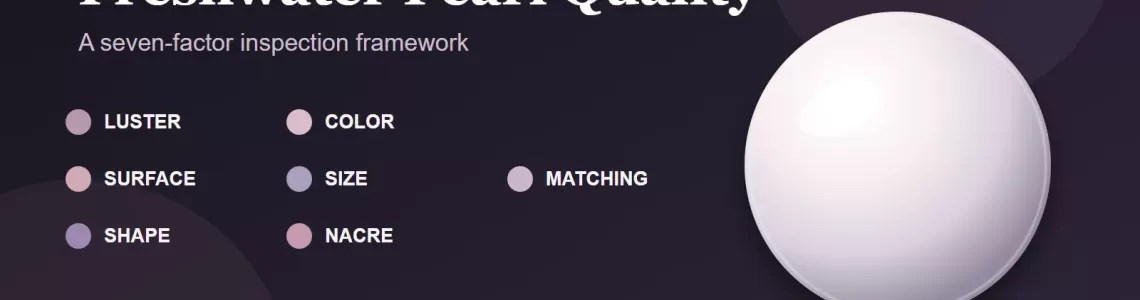
Answer first: Freshwater pearl quality is best compared by looking at seven separate factors: size, shape, color, luster, surface, nacre and matching. For most shoppers, luster is the fastest useful signal: a pearl with strong, sharp reflections usually looks livelier than one with a dull, chalky appearance. Surface condition matters too, but small natural-looking features do not automatically make a pearl unattractive or unsuitable. Shape and color are partly style choices, while matching matters most when several pearls appear together in a bracelet. A seller's A, AA or AAA label is only useful when the seller explains its criteria; it is not a universal cross-store standard.
This guide shows how to inspect a freshwater pearl bracelet in a consistent order, what questions to ask, and which conclusions require laboratory testing. If you first need the terminology behind natural and cultured pearls, read our freshwater pearl authenticity buyer's guide. For cleaning and storage after purchase, use our freshwater pearl bracelet care guide.
Research question and scope
The practical question is: How can a buyer compare the visible quality of freshwater pearl bracelets without pretending that a home inspection is a laboratory report? The scope is visual and shopping-oriented. It covers loose-looking pearls and finished bracelets, including designs that combine pearls with sterling silver or other stones. It does not authenticate a pearl, determine whether a color is natural, identify every treatment, or assign a laboratory grade.
The framework comes from the Gemological Institute of America's seven pearl value factors, the Federal Trade Commission's rules for pearl descriptions, CIBJO terminology and disclosure guidance, and GIA laboratory research. GIA describes seven factors used to describe and evaluate pearls: size, shape, color, luster, surface, nacre and matching. GIA also emphasizes that the factors interact; no single number tells the whole story. See GIA's Pearl Quality Factors and its peer-reviewed overview, Pearl Classification: The GIA 7 Pearl Value Factors.
Key terms before you compare pearls
- Cultured pearl
- A pearl produced in a mollusk after human intervention begins the growth process. “Cultured” does not mean imitation. The FTC distinguishes natural pearls, cultured pearls and imitation pearls in advertising, and warns sellers not to use “pearl” alone for a cultured pearl without appropriate disclosure. See the FTC's jewelry advertising guidance.
- Luster
- The appearance of light reflected from or just below a pearl's surface. In shopping terms, examine the brightness and sharpness of reflections rather than asking only whether the pearl is shiny.
- Surface characteristics
- Visible features such as spots, bumps, wrinkles or abrasions. Their number, size, depth, location and contrast all affect how noticeable they are.
- Nacre
- The pearl material deposited by the mollusk. Nacre structure contributes to appearance and durability, but a shopper cannot reliably measure it from a photograph.
- Matching
- How deliberately the pearls in a multi-pearl item relate in size, shape, color, luster, surface and nacre appearance. Good matching can mean uniformity or a controlled graduated/mixed design.
The seven pearl quality factors
1. Luster: start with the reflections
GIA calls luster one of the most important pearl value factors. High-luster pearls show bright reflections with relatively sharp edges; low-luster pearls look soft, dim or chalky. Compare pearls under diffused daylight or a neutral indoor light. Move the bracelet slowly. A lively reflection should travel across the surface rather than disappear into a flat glow.
Photographs can exaggerate luster through strong point lights, sharpening or exposure. Ask for more than one angle and, if possible, a short neutral-light video. Do not confuse a hard white highlight from the lamp with strong overall luster: examine the transition around the highlight and whether surrounding shapes remain legible.
2. Surface: judge visibility, not imaginary perfection
GIA evaluates the type and number of surface characteristics and how noticeable they are. A small feature on the side of a pearl may matter less visually than a deep, high-contrast pit at the center of the most visible face. Inspect the bracelet at ordinary viewing distance first, then close up. This prevents a macro photograph from making tiny features seem more important than they are in wear.
Surface features are not a simple authenticity test. Cultured pearls may have very clean surfaces, and imitation products may be manufactured with irregularities. Likewise, a blemish does not prove a pearl is natural, untreated or valuable. The useful question is whether the features distract you, threaten the drill area, or conflict with the seller's description.
3. Shape: roundness is a category, not the only goal
Common shape descriptions include round, near-round, oval, button, drop, circled and baroque. Round pearls are traditionally scarce and often command a premium, but baroque shapes can be intentionally expressive. Compare a pearl with the shape the listing promises, not with an assumption that every good pearl must be perfectly round.
Roll-like comparisons can help with loose pearls, but they are not practical for a finished bracelet. Instead, view the strand from the side and rotate it. For a uniform design, ask whether the profiles look consistently round or consistently oval. For a baroque design, look for a coherent rhythm rather than identical outlines.
4. Color: separate bodycolor, overtone and personal preference
Pearl color descriptions can include a dominant bodycolor plus an overtone and, in some cases, an iridescent orient effect. White, cream, pink, peach and lavender appearances are common in the freshwater market, but color varies with lighting, white balance, background and screen settings. A warm indoor photo is not reliable evidence of the exact color you will see in daylight.
Color is primarily a design choice unless rarity or treatment disclosure is at issue. GIA research shows that detecting some color treatments and optical brightening requires advanced analytical methods. Therefore, a buyer should ask whether color treatment is disclosed rather than attempting to “prove” natural color from a photo. See GIA's study on color treatment and optical brightening in Chinese freshwater pearls.
5. Size: compare measurements, not visual scale alone
Pearl size is normally expressed in millimeters. Product images may make beads look larger or smaller depending on cropping and wrist size. Look for a stated diameter or size range and compare it with a ruler. In a bracelet, even a one- or two-millimeter difference changes visual weight. Smaller pearls generally read as finer and more understated; larger pearls create a stronger focal presence.
Size is not an automatic quality score. A smaller pearl with strong luster and coherent matching can be more appealing for a particular design than a larger but dull pearl. When comparing prices, hold the other factors as constant as possible.
6. Nacre: important, but difficult to verify at home
Nacre affects both appearance and durability. GIA notes that poor nacre quality can create a chalky appearance or reveal underlying structure in some pearl types. But freshwater cultured pearls have varied growth structures, and online shoppers cannot reliably determine internal structure, nacre thickness or cultivation method from a surface photograph.
Do not accept a precise nacre claim without an explained basis. Instead, use visible proxies cautiously: even luster, no obvious peeling, and sound drill edges are reassuring observations, not laboratory measurements. GIA's identification process combines visual examination with instruments and imaging; read how GIA identifies and classifies pearls.
7. Matching: evaluate the bracelet as a composition
Matching matters whenever multiple pearls share a design. In a deliberately uniform bracelet, compare adjacent pearls for luster, size, shape and color. One visibly dull pearl among bright neighbors can interrupt the pattern. In a mixed design, perfect sameness may be neither possible nor desirable; look instead for intentional repetition, balance and a clear focal sequence.
This is especially relevant when pearls are combined with moonstone or sterling-silver elements. The pearls need not match the other material, but their scale, spacing and brightness should produce a coherent design. You can compare two real examples in sunMYLOVE's freshwater pearl and sterling silver beaded bracelet and pearl, moonstone and sterling silver bracelet. These links identify available designs; they do not imply independent laboratory grading.
Comparison table: what you can and cannot conclude
| Factor | Useful home or photo check | What it cannot prove |
|---|---|---|
| Luster | Brightness and sharpness of moving reflections | Natural origin, treatment status or a lab grade |
| Surface | Location, contrast and depth of visible features | Authenticity by the presence or absence of blemishes |
| Shape | Consistency with round, oval or baroque description | Quality without considering style and other factors |
| Color | Appearance under more than one neutral-light view | Natural color or absence of treatment |
| Size | Stated millimeter diameter or range | Overall value by size alone |
| Nacre | Obvious peeling, chalkiness or damaged drill edges | Thickness, internal structure or cultivation method |
| Matching | Consistency or intentional progression across the item | Whether every pearl is identical internally |
A five-minute bracelet inspection method
- Read the identity words. Confirm whether the listing says cultured freshwater pearl, imitation pearl or another material. “Freshwater pearl” should not be treated as proof of natural, non-cultured origin.
- Check measurements. Note pearl diameter, bracelet length or fit range, and whether the design stretches, clasps or wraps. Use our wrist measurement guide for beaded bracelets before ordering.
- Look at luster first. Compare reflections across all pearls, not just the brightest hero-image bead.
- Scan the visible surfaces and drill areas. Decide what you consider acceptable at normal distance, then inspect close-ups for deep damage or rough edges.
- Review shape and matching. Ask whether variation is accidental or part of the design.
- Ask about color disclosure. If a color is a deciding factor, ask whether it has been dyed, irradiated, coated or otherwise treated. Do not infer treatment from color alone.
- Read the return terms. Lighting and screens can change color perception, so check the returns and refunds policy before relying on a photo.
How to interpret A, AA and AAA pearl grades
Alphabet grades are widely used in retail, but buyers should not assume that “AAA” means exactly the same thing across different sellers. GIA's seven-factor framework describes separate attributes rather than turning every pearl into one universal retail letter. CIBJO's Pearl Guide and Pearl Blue Book emphasize consistent terminology and disclosure across the trade.
If a seller uses a letter grade, ask for the definition behind it: What luster level is required? How much surface variation is allowed? Is shape included? Does the grade apply to each pearl or the finished strand? A transparent factor-by-factor description is more comparable than a letter with no criteria.
Common buying mistakes
- Choosing by size alone. Size changes visual impact, but it does not replace luster, surface and matching.
- Treating round as universally best. Roundness can be scarce, while baroque variation may be the intended design value.
- Believing every blemish proves authenticity. Surface features are not a conclusive real-versus-imitation test.
- Comparing seller grades as if they were standardized. Compare the stated criteria, not just the letters.
- Judging exact color from one edited image. Request neutral-light views and read the return policy.
- Assuming a home test can detect treatment. Some treatments require spectroscopy, imaging or other laboratory methods.
- Ignoring fit and construction. A beautiful pearl bracelet still needs an appropriate circumference, sound stringing and comfortable hardware.
Questions to ask a seller
- Are these cultured freshwater pearls, imitation pearls, or something else?
- What is the pearl diameter or size range in millimeters?
- How are shape and surface variation described?
- Has the color been treated, and if so, how is that disclosed?
- If a letter grade is used, what measurable or visible criteria define it?
- Are photos of the actual item or representative stock?
- What is the bracelet fit range and return window?
For broader shopping, browse the verified beaded bracelets category. To understand who stands behind the catalog and editorial material, see About sunMYLOVE.
Frequently asked questions
What is the most important freshwater pearl quality factor?
Luster is usually the fastest and most influential visible factor. Look for bright, relatively sharp reflections. However, value and suitability still depend on surface, shape, color, size, nacre and matching.
Does a flawless surface mean a pearl is fake?
No. A clean surface does not prove imitation, and a blemished surface does not prove authenticity. Surface features are one quality factor, not a standalone identification test.
Are round freshwater pearls always better than baroque pearls?
No. Roundness can affect rarity and price, but shape is also an aesthetic decision. A well-matched baroque bracelet may be more distinctive and better suited to the buyer's style.
Is AAA a universal pearl grade?
No universal retail AAA definition applies across every seller. Ask each seller for its criteria and compare luster, surface, shape, size and matching directly.
Can I tell whether pearl color is natural from a photo?
Not reliably. Lighting, editing and screen settings affect appearance, and some treatments require laboratory instruments to detect. Ask for disclosure rather than relying on a visual guess.
How much surface variation is acceptable?
That depends on visibility, depth, location, price and personal preference. Inspect at normal viewing distance first. Small features may be acceptable; deep damage near drill holes deserves closer attention.
How should pearls in a bracelet be matched?
A uniform bracelet should show deliberate consistency in luster, color, size and shape. A mixed or graduated design should still have an intentional rhythm. Matching means coherence, not necessarily identical pearls.
Can this checklist authenticate freshwater pearls?
No. It helps compare visible quality and seller clarity. Authentication, treatment detection and internal-structure analysis may require gemological testing.
Method, evidence limits and editorial note
This guide was prepared by the sunMYLOVE editorial team using publicly available material from GIA, the U.S. Federal Trade Commission and CIBJO. Sources were selected because they directly address pearl description, value factors, identification or treatment disclosure. We also checked the live sunMYLOVE catalog and existing guides to avoid duplicating the authenticity and care topics.
Evidence boundary: The seven factors are established professional descriptors, but this article does not assign a laboratory grade to any sunMYLOVE product. Visual observations are not proof of natural origin, treatment status, nacre thickness or certification. GIA's published classification framework includes scope and pearl-type considerations; applying the factors here is a practical comparison method, not a claim that every freshwater bracelet has received a GIA report. Product-specific material and construction statements should be read from the relevant live listing.
References and evidence scope
- Gemological Institute of America. Pearl Quality Factors. Supports the seven-factor framework and consumer definitions.
- Gemological Institute of America, Gems & Gemology. Pearl Classification: The GIA 7 Pearl Value Factors. Supports factor relationships, terminology and classification scope.
- Gemological Institute of America. How GIA Identifies and Classifies Pearls. Supports the boundary between visual inspection and laboratory identification.
- U.S. Federal Trade Commission. The Loupe: Advertising Diamonds, Gemstones and Pearls. Supports natural, cultured and imitation pearl disclosure language.
- CIBJO. Pearl Guide. Supports industry terminology and buyer-facing disclosure.
- CIBJO. Pearl Blue Book. Supports standardized nomenclature and disclosure context.
- Gemological Institute of America, Gems & Gemology. Detection of Color Treatment and Optical Brightening in Chinese Freshwater “Edison” Pearls. Supports the statement that some treatment detection requires laboratory analysis.
Reviewed: August 13, 2026. Editorial responsibility: sunMYLOVE organization. This is a research-informed buying guide, not a gemological report or guarantee about an individual item.
Answer first: Freshwater pearl quality is best compared by looking at seven separate factors: size, shape, color, luster, surface, nacre and matching. For most shoppers, luster is the fastest useful signal: a pearl with strong, sharp reflections usually looks livelier than one with a dull, chalky appearance. Surface condition matters too, but small natural-looking features do not automatically make a pearl unattractive or unsuitable. Shape and color are partly style choices, while matching matters most when several pearls appear together in a bracelet. A seller's A, AA or AAA label is only useful when the seller explains its criteria; it is not a universal cross-store standard.
This guide shows how to inspect a freshwater pearl bracelet in a consistent order, what questions to ask, and which conclusions require laboratory testing. If you first need the terminology behind natural and cultured pearls, read our freshwater pearl authenticity buyer's guide. For cleaning and storage after purchase, use our freshwater pearl bracelet care guide.
Research question and scope
The practical question is: How can a buyer compare the visible quality of freshwater pearl bracelets without pretending that a home inspection is a laboratory report? The scope is visual and shopping-oriented. It covers loose-looking pearls and finished bracelets, including designs that combine pearls with sterling silver or other stones. It does not authenticate a pearl, determine whether a color is natural, identify every treatment, or assign a laboratory grade.
The framework comes from the Gemological Institute of America's seven pearl value factors, the Federal Trade Commission's rules for pearl descriptions, CIBJO terminology and disclosure guidance, and GIA laboratory research. GIA describes seven factors used to describe and evaluate pearls: size, shape, color, luster, surface, nacre and matching. GIA also emphasizes that the factors interact; no single number tells the whole story. See GIA's Pearl Quality Factors and its peer-reviewed overview, Pearl Classification: The GIA 7 Pearl Value Factors.
Key terms before you compare pearls
- Cultured pearl
- A pearl produced in a mollusk after human intervention begins the growth process. “Cultured” does not mean imitation. The FTC distinguishes natural pearls, cultured pearls and imitation pearls in advertising, and warns sellers not to use “pearl” alone for a cultured pearl without appropriate disclosure. See the FTC's jewelry advertising guidance.
- Luster
- The appearance of light reflected from or just below a pearl's surface. In shopping terms, examine the brightness and sharpness of reflections rather than asking only whether the pearl is shiny.
- Surface characteristics
- Visible features such as spots, bumps, wrinkles or abrasions. Their number, size, depth, location and contrast all affect how noticeable they are.
- Nacre
- The pearl material deposited by the mollusk. Nacre structure contributes to appearance and durability, but a shopper cannot reliably measure it from a photograph.
- Matching
- How deliberately the pearls in a multi-pearl item relate in size, shape, color, luster, surface and nacre appearance. Good matching can mean uniformity or a controlled graduated/mixed design.
The seven pearl quality factors
1. Luster: start with the reflections
GIA calls luster one of the most important pearl value factors. High-luster pearls show bright reflections with relatively sharp edges; low-luster pearls look soft, dim or chalky. Compare pearls under diffused daylight or a neutral indoor light. Move the bracelet slowly. A lively reflection should travel across the surface rather than disappear into a flat glow.
Photographs can exaggerate luster through strong point lights, sharpening or exposure. Ask for more than one angle and, if possible, a short neutral-light video. Do not confuse a hard white highlight from the lamp with strong overall luster: examine the transition around the highlight and whether surrounding shapes remain legible.
2. Surface: judge visibility, not imaginary perfection
GIA evaluates the type and number of surface characteristics and how noticeable they are. A small feature on the side of a pearl may matter less visually than a deep, high-contrast pit at the center of the most visible face. Inspect the bracelet at ordinary viewing distance first, then close up. This prevents a macro photograph from making tiny features seem more important than they are in wear.
Surface features are not a simple authenticity test. Cultured pearls may have very clean surfaces, and imitation products may be manufactured with irregularities. Likewise, a blemish does not prove a pearl is natural, untreated or valuable. The useful question is whether the features distract you, threaten the drill area, or conflict with the seller's description.
3. Shape: roundness is a category, not the only goal
Common shape descriptions include round, near-round, oval, button, drop, circled and baroque. Round pearls are traditionally scarce and often command a premium, but baroque shapes can be intentionally expressive. Compare a pearl with the shape the listing promises, not with an assumption that every good pearl must be perfectly round.
Roll-like comparisons can help with loose pearls, but they are not practical for a finished bracelet. Instead, view the strand from the side and rotate it. For a uniform design, ask whether the profiles look consistently round or consistently oval. For a baroque design, look for a coherent rhythm rather than identical outlines.
4. Color: separate bodycolor, overtone and personal preference
Pearl color descriptions can include a dominant bodycolor plus an overtone and, in some cases, an iridescent orient effect. White, cream, pink, peach and lavender appearances are common in the freshwater market, but color varies with lighting, white balance, background and screen settings. A warm indoor photo is not reliable evidence of the exact color you will see in daylight.
Color is primarily a design choice unless rarity or treatment disclosure is at issue. GIA research shows that detecting some color treatments and optical brightening requires advanced analytical methods. Therefore, a buyer should ask whether color treatment is disclosed rather than attempting to “prove” natural color from a photo. See GIA's study on color treatment and optical brightening in Chinese freshwater pearls.
5. Size: compare measurements, not visual scale alone
Pearl size is normally expressed in millimeters. Product images may make beads look larger or smaller depending on cropping and wrist size. Look for a stated diameter or size range and compare it with a ruler. In a bracelet, even a one- or two-millimeter difference changes visual weight. Smaller pearls generally read as finer and more understated; larger pearls create a stronger focal presence.
Size is not an automatic quality score. A smaller pearl with strong luster and coherent matching can be more appealing for a particular design than a larger but dull pearl. When comparing prices, hold the other factors as constant as possible.
6. Nacre: important, but difficult to verify at home
Nacre affects both appearance and durability. GIA notes that poor nacre quality can create a chalky appearance or reveal underlying structure in some pearl types. But freshwater cultured pearls have varied growth structures, and online shoppers cannot reliably determine internal structure, nacre thickness or cultivation method from a surface photograph.
Do not accept a precise nacre claim without an explained basis. Instead, use visible proxies cautiously: even luster, no obvious peeling, and sound drill edges are reassuring observations, not laboratory measurements. GIA's identification process combines visual examination with instruments and imaging; read how GIA identifies and classifies pearls.
7. Matching: evaluate the bracelet as a composition
Matching matters whenever multiple pearls share a design. In a deliberately uniform bracelet, compare adjacent pearls for luster, size, shape and color. One visibly dull pearl among bright neighbors can interrupt the pattern. In a mixed design, perfect sameness may be neither possible nor desirable; look instead for intentional repetition, balance and a clear focal sequence.
This is especially relevant when pearls are combined with moonstone or sterling-silver elements. The pearls need not match the other material, but their scale, spacing and brightness should produce a coherent design. You can compare two real examples in sunMYLOVE's freshwater pearl and sterling silver beaded bracelet and pearl, moonstone and sterling silver bracelet. These links identify available designs; they do not imply independent laboratory grading.
Comparison table: what you can and cannot conclude
| Factor | Useful home or photo check | What it cannot prove |
|---|---|---|
| Luster | Brightness and sharpness of moving reflections | Natural origin, treatment status or a lab grade |
| Surface | Location, contrast and depth of visible features | Authenticity by the presence or absence of blemishes |
| Shape | Consistency with round, oval or baroque description | Quality without considering style and other factors |
| Color | Appearance under more than one neutral-light view | Natural color or absence of treatment |
| Size | Stated millimeter diameter or range | Overall value by size alone |
| Nacre | Obvious peeling, chalkiness or damaged drill edges | Thickness, internal structure or cultivation method |
| Matching | Consistency or intentional progression across the item | Whether every pearl is identical internally |
A five-minute bracelet inspection method
- Read the identity words. Confirm whether the listing says cultured freshwater pearl, imitation pearl or another material. “Freshwater pearl” should not be treated as proof of natural, non-cultured origin.
- Check measurements. Note pearl diameter, bracelet length or fit range, and whether the design stretches, clasps or wraps. Use our wrist measurement guide for beaded bracelets before ordering.
- Look at luster first. Compare reflections across all pearls, not just the brightest hero-image bead.
- Scan the visible surfaces and drill areas. Decide what you consider acceptable at normal distance, then inspect close-ups for deep damage or rough edges.
- Review shape and matching. Ask whether variation is accidental or part of the design.
- Ask about color disclosure. If a color is a deciding factor, ask whether it has been dyed, irradiated, coated or otherwise treated. Do not infer treatment from color alone.
- Read the return terms. Lighting and screens can change color perception, so check the returns and refunds policy before relying on a photo.
How to interpret A, AA and AAA pearl grades
Alphabet grades are widely used in retail, but buyers should not assume that “AAA” means exactly the same thing across different sellers. GIA's seven-factor framework describes separate attributes rather than turning every pearl into one universal retail letter. CIBJO's Pearl Guide and Pearl Blue Book emphasize consistent terminology and disclosure across the trade.
If a seller uses a letter grade, ask for the definition behind it: What luster level is required? How much surface variation is allowed? Is shape included? Does the grade apply to each pearl or the finished strand? A transparent factor-by-factor description is more comparable than a letter with no criteria.
Common buying mistakes
- Choosing by size alone. Size changes visual impact, but it does not replace luster, surface and matching.
- Treating round as universally best. Roundness can be scarce, while baroque variation may be the intended design value.
- Believing every blemish proves authenticity. Surface features are not a conclusive real-versus-imitation test.
- Comparing seller grades as if they were standardized. Compare the stated criteria, not just the letters.
- Judging exact color from one edited image. Request neutral-light views and read the return policy.
- Assuming a home test can detect treatment. Some treatments require spectroscopy, imaging or other laboratory methods.
- Ignoring fit and construction. A beautiful pearl bracelet still needs an appropriate circumference, sound stringing and comfortable hardware.
Questions to ask a seller
- Are these cultured freshwater pearls, imitation pearls, or something else?
- What is the pearl diameter or size range in millimeters?
- How are shape and surface variation described?
- Has the color been treated, and if so, how is that disclosed?
- If a letter grade is used, what measurable or visible criteria define it?
- Are photos of the actual item or representative stock?
- What is the bracelet fit range and return window?
For broader shopping, browse the verified beaded bracelets category. To understand who stands behind the catalog and editorial material, see About sunMYLOVE.
Frequently asked questions
What is the most important freshwater pearl quality factor?
Luster is usually the fastest and most influential visible factor. Look for bright, relatively sharp reflections. However, value and suitability still depend on surface, shape, color, size, nacre and matching.
Does a flawless surface mean a pearl is fake?
No. A clean surface does not prove imitation, and a blemished surface does not prove authenticity. Surface features are one quality factor, not a standalone identification test.
Are round freshwater pearls always better than baroque pearls?
No. Roundness can affect rarity and price, but shape is also an aesthetic decision. A well-matched baroque bracelet may be more distinctive and better suited to the buyer's style.
Is AAA a universal pearl grade?
No universal retail AAA definition applies across every seller. Ask each seller for its criteria and compare luster, surface, shape, size and matching directly.
Can I tell whether pearl color is natural from a photo?
Not reliably. Lighting, editing and screen settings affect appearance, and some treatments require laboratory instruments to detect. Ask for disclosure rather than relying on a visual guess.
How much surface variation is acceptable?
That depends on visibility, depth, location, price and personal preference. Inspect at normal viewing distance first. Small features may be acceptable; deep damage near drill holes deserves closer attention.
How should pearls in a bracelet be matched?
A uniform bracelet should show deliberate consistency in luster, color, size and shape. A mixed or graduated design should still have an intentional rhythm. Matching means coherence, not necessarily identical pearls.
Can this checklist authenticate freshwater pearls?
No. It helps compare visible quality and seller clarity. Authentication, treatment detection and internal-structure analysis may require gemological testing.
Method, evidence limits and editorial note
This guide was prepared by the sunMYLOVE editorial team using publicly available material from GIA, the U.S. Federal Trade Commission and CIBJO. Sources were selected because they directly address pearl description, value factors, identification or treatment disclosure. We also checked the live sunMYLOVE catalog and existing guides to avoid duplicating the authenticity and care topics.
Evidence boundary: The seven factors are established professional descriptors, but this article does not assign a laboratory grade to any sunMYLOVE product. Visual observations are not proof of natural origin, treatment status, nacre thickness or certification. GIA's published classification framework includes scope and pearl-type considerations; applying the factors here is a practical comparison method, not a claim that every freshwater bracelet has received a GIA report. Product-specific material and construction statements should be read from the relevant live listing.
References and evidence scope
- Gemological Institute of America. Pearl Quality Factors. Supports the seven-factor framework and consumer definitions.
- Gemological Institute of America, Gems & Gemology. Pearl Classification: The GIA 7 Pearl Value Factors. Supports factor relationships, terminology and classification scope.
- Gemological Institute of America. How GIA Identifies and Classifies Pearls. Supports the boundary between visual inspection and laboratory identification.
- U.S. Federal Trade Commission. The Loupe: Advertising Diamonds, Gemstones and Pearls. Supports natural, cultured and imitation pearl disclosure language.
- CIBJO. Pearl Guide. Supports industry terminology and buyer-facing disclosure.
- CIBJO. Pearl Blue Book. Supports standardized nomenclature and disclosure context.
- Gemological Institute of America, Gems & Gemology. Detection of Color Treatment and Optical Brightening in Chinese Freshwater “Edison” Pearls. Supports the statement that some treatment detection requires laboratory analysis.
Reviewed: August 13, 2026. Editorial responsibility: sunMYLOVE organization. This is a research-informed buying guide, not a gemological report or guarantee about an individual item.
Leave a Comment