
How to Measure Your Wrist for a Beaded Bracelet
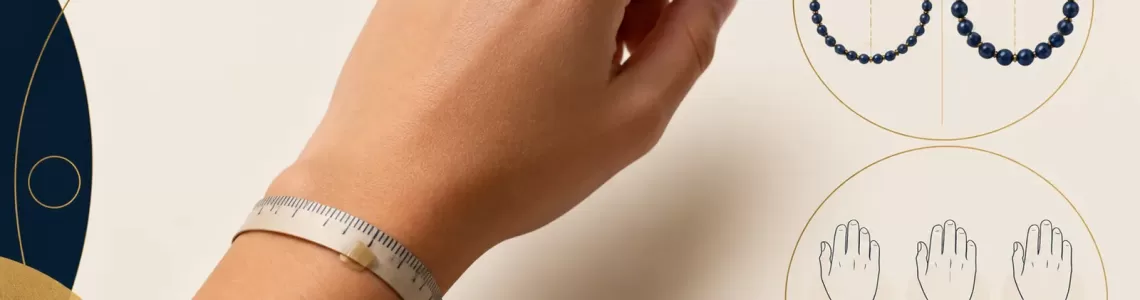
Answer first: to measure your wrist for a beaded bracelet, place a flexible, non-stretch tape at the exact point where you will wear the bracelet, usually just below the wrist bone. Wrap it flat against the skin without squeezing, read the circumference in millimetres, and repeat the measurement two or three times. Keep that number as your raw wrist circumference. Do not automatically add a universal allowance. First check whether the seller's listed size means wrist circumference, finished bracelet length, inside circumference, or an adjustable fit range; then account for bead diameter, closure and construction.
This distinction matters because a 7-inch wrist and a “7-inch bracelet” are not necessarily equivalent. Large round beads project inward and reduce usable space. A clasp adds structure, elastic cord stretches, a sliding knot has a range, and a rigid bangle must pass over the hand. The safest online decision starts with an accurate body measurement and ends with the product's own sizing method—not a one-size-fits-all calculator.
Research question, scope and evidence
The question is: How can a buyer turn a wrist measurement into a defensible beaded-bracelet size without pretending every design fits the same way? This guide covers elastic, clasped and adjustable beaded bracelets. It compares cuffs and bangles only to show why their measuring methods differ. It does not replace a maker's product-specific chart, guarantee comfort, diagnose swelling, or determine the size of a bracelet whose construction and measurements are unknown.
ISO 8559-1:2017 describes anthropometric measurements and uses anatomical reference points so body dimensions can be defined consistently. Its wrist-girth definition locates the measurement over the wrist-bone area. ISO 7250-1:2017, confirmed current in 2023, likewise explains body-measurement definitions, landmarks and principles for design. These are measurement references, not retail bracelet-sizing standards. They support measuring a defined body location; they do not prescribe a universal jewelry allowance.
Five terms that prevent sizing mistakes
| Term | What it means | Why buyers should care |
|---|---|---|
| Raw wrist circumference | The body measurement at the intended wearing point, taken without adding ease | This is the stable starting number to save and share |
| Finished bracelet length | The length of the assembled bracelet measured along a stated path, often laid flat | It may include a clasp or components that do not become usable inside space |
| Inside circumference | The path around the inside surface that contacts or surrounds the wrist | Often closer to perceived fit, but sellers do not always publish it |
| Fit allowance or ease | Space between the body and the worn bracelet | Depends on design, bead size and preference; it is not one universal number |
| Adjustable range | The smallest and largest wearable setting of a sliding knot, extension chain or similar mechanism | Your wrist should sit inside the functional range, not merely match its maximum |
When a product page says only “size 7 in,” ask which of these definitions it uses. The number might describe a flat strand from end to end, an inside path, a recommended wrist size, or a selectable manufacturing length. Comparing unlike definitions is a common reason an apparently correct bracelet feels tight.
How to measure your wrist for a beaded bracelet: six steps
1. Choose the actual wearing point
Decide where the bracelet will sit before measuring. Most people place a beaded bracelet just below the wrist bone toward the hand, but stacking, watches, cuffs and personal preference can shift the position. Measure the location you intend to use rather than the narrowest point you can find. Keep your hand relaxed and your forearm in a neutral position.
2. Use a flexible, non-stretch tool
A soft measuring tape is easiest. If you use string, ribbon or a narrow paper strip, choose material that does not stretch, mark the meeting point, lay it flat, and measure it against a rigid ruler. Do not use elastic cord, a phone charging cable or thick rope; their stretch and diameter can distort the result.
3. Keep the tape flat and snug, not compressive
Wrap the tape in one level loop. It should touch the skin all the way around without digging in, leaving an imprint or crossing itself. Do not slide a finger underneath while taking the raw measurement; that silently adds an uncontrolled allowance. If the tape has a bulky metal end, begin at another clear mark and subtract the starting value.
4. Read in millimetres and repeat
Record the measurement to the nearest practical millimetre. Take the tape off and repeat the whole process two or three times. If the readings disagree, check location, posture and tension rather than averaging obviously inconsistent attempts. The CDC's 2021 NHANES Anthropometry Procedures Manual is not a bracelet guide, but its emphasis on defined equipment, recording and quality control supports the same principle: repeatable technique matters.
5. Preserve the raw number
Write “wrist circumference,” the exact wearing point, date and unit beside the number. Do not convert it into a bracelet size yet. Saving the raw measurement lets you use different brands' charts without stacking one seller's allowance on top of another.
6. Convert units exactly, then apply the seller's system
If a chart uses inches, divide centimetres by 2.54; if it uses centimetres, multiply inches by 2.54. NIST's SI length guidance and NIST Special Publication 1038 document the exact relationship: 1 inch equals 2.54 centimetres. Round only after conversion, and keep enough precision to distinguish adjacent size options.
Why bead diameter changes the fit
A strand's centreline or flat length is not the same as its open space. Round beads occupy volume on both sides of the cord. As bead diameter increases, the inner surface of the bracelet moves inward. Therefore, two bracelets with the same measured strand length can have different inside circumferences and feel different on the same wrist.
This is geometry, not a claim that every large-bead bracelet needs the same extra length. Knot size, spacer width, bead holes, cord tension, clasp length, charms and whether the bracelet forms a perfect circle all matter. The most useful product information is a measured inside circumference or a wrist-fit range for the finished design. If only flat length is published, ask whether the seller has tested that exact bead size on a sizing mandrel or can recommend a wrist range.
Compare the structures in the beaded bracelet collection. A freshwater pearl and 925 silver bracelet does not distribute space exactly like a pearl and moonstone bracelet. These links show construction differences; they are not substitutes for checking each product's current size options.
Match the measurement method to the bracelet structure
| Structure | What to verify | Main risk | Best next step |
|---|---|---|---|
| Elastic beaded bracelet | Recommended wrist range, bead diameter, cord construction and whether the stated size is inside circumference | Buying small because “it stretches,” leaving the cord under constant tension | Choose within the maker's wrist range; treat stretch as access, not fit allowance |
| Clasped beaded bracelet | Whether clasp length is included, usable inside path, extension settings and one-handed fastening space | A flat end-to-end length overstates wearable space | Compare the raw wrist with the stated inside size or maker recommendation |
| Sliding-knot or adjustable bracelet | Minimum and maximum wearable circumference and how much cord remains at each setting | Matching the wrist to the extreme limit, which may be hard to put on or secure | Place the wrist comfortably inside—not at the edge of—the functional range |
| Rigid cuff | Inside width, inside height, opening gap and metal flexibility | Using wrist circumference alone for a shape-dependent opening | Follow the product's cuff instructions; see the men's brass cuff selection guide |
| Closed bangle | Inside diameter and the compressed hand/knuckle circumference | A bangle fits the wrist but cannot pass over the hand | Use a bangle-specific hand measurement, not this wrist-only method |
How tight should a beaded bracelet be?
There is no evidence-based universal answer for every person and construction. A close fit limits movement but may accentuate pressure from large beads or charms. A relaxed fit permits movement but can rotate, strike surfaces or slide toward the hand. An excessively loose bracelet may catch on objects; an excessively tight bracelet can leave pressure marks and keep elastic under continuous load.
Use a preference statement instead of guessing a number: close, balanced or relaxed. Then ask how the seller translates that preference for the exact design. If the page supplies a product-specific allowance, confirm whether it has already been built into the selectable “wrist size.” Never add the same allowance a second time.
| Preference | Expected behaviour | Questions to ask |
|---|---|---|
| Close | Minimal rotation and movement, without compression | Will the bead diameter or charm press into the wrist? Is stretch being used as permanent tension? |
| Balanced | Some movement while remaining near the intended position | What wrist range did the maker test for this exact construction? |
| Relaxed | More drape, rotation and movement toward the hand | Could the bracelet pass over the hand, snag, or interfere with work? |
Human dimensions vary within every market. NASA's Anthropometric Source Book, Volume II and its current anthropometrics technical brief address human variability for engineering design. They do not set jewelry sizes, but they reinforce why one “average” wrist or one fixed allowance cannot serve every buyer.
A product-page checklist before choosing a size
- Find the size definition. Does the option mean wrist size, finished length, inside circumference or adjustable range?
- Check units. Confirm whether decimals are inches or centimetres and convert with 2.54 exactly.
- Match the exact variant. A different bead diameter, clasp or number of strands can change fit.
- Look for an inside measurement. It is often more useful than flat strand length for large beads.
- Check closure access. A clasped bracelet needs practical fastening room; a bangle needs hand clearance.
- Read customization rules. Measure twice before ordering a non-returnable custom size.
- Save the listing. Keep the selected size definition, chart and order confirmation.
- Ask before improvising. If the page is ambiguous, request the recommended wrist range for the exact item.
The 925 silver red-cord bead bracelet and multilayer bead-chain bracelet illustrate why the same body measurement must be interpreted through the specific closure and strand construction. Buyers comparing a different material or rigid format can also browse the sterling-silver bracelet collection, but should not transfer one design's fit rule to another.
Using string when you do not have a tape
Wrap non-stretch string at the wearing point and mark the exact overlap with a fine pen. Lay the string straight without pulling it and measure between the start and mark on a rigid ruler. Repeat with a fresh measurement rather than reusing a stretched or frayed piece. A broad paper strip can be easier to keep level, but it must not tear or overlap at an angle.
A 2016 study in BMC Medical Research Methodology compared self-measured and technician-measured body circumferences using flexible, inelastic paper tape. It was not a wrist or jewelry study, so it cannot provide a bracelet allowance. It is relevant only to the limitation that self-measurement can differ from trained measurement and benefits from clear instructions and repetition.
Gift sizing without an exact wrist measurement
Guessing from age, height, clothing size, sex, photographs or an “average wrist” has high uncertainty. If the gift must remain a surprise, the lower-risk options are an adjustable design with a clearly stated range, discreetly measuring a bracelet the recipient already wears, or asking someone close to the recipient for the raw wrist circumference. When measuring an existing bracelet, identify whether you are recording its inside circumference or flat length and note its bead size and closure.
Do not describe an estimated size as exact. Check delivery information and returns and refund conditions before ordering, especially when a size will be customized.
Common sizing mistakes
- Measuring over a watch, sleeve or another bracelet.
- Pulling the tape tight enough to compress the skin.
- Adding a finger under the tape and then adding another allowance.
- Using elastic string as the measuring tool.
- Confusing wrist circumference with flat bracelet length.
- Ignoring bead diameter and assuming every 7-inch bracelet has the same inside space.
- Buying elastic small because it can stretch.
- Using a wrist measurement for a closed bangle that must pass over the hand.
- Rounding centimetres and inches repeatedly during conversion.
- Ordering a custom size before confirming whether the seller has already added ease.
Frequently asked questions
Where exactly should I measure my wrist?
Measure at the point where the bracelet will actually sit, commonly just below the wrist bone toward the hand. Keep the arm relaxed and use the same location for every repeat measurement.
Should I add half an inch to my wrist measurement?
Not automatically. Some sellers publish that rule for particular products, while others list a finished inside size or have already built allowance into a “recommended wrist size.” Use the exact product's definition and construction.
Does a larger bead make the same bracelet length feel tighter?
Often, yes, because larger beads project farther inward and reduce usable inside space. The exact difference also depends on cord, spacers, knots, clasp and how length was measured, so ask for an inside circumference or tested wrist range.
How do I measure my wrist with string?
Use non-stretch string, mark where the ends meet without compressing the wrist, lay it straight, and measure the marked length against a rigid ruler. Repeat the process to check consistency.
Should an elastic bracelet be smaller than my wrist?
Do not assume so. Elastic helps the bracelet pass over the hand; it should not necessarily remain under strong tension during wear. Follow the maker's recommended wrist range for the exact bead size and cord construction.
Can I measure a bracelet I already own?
Yes, but record its construction and measuring method. Inside circumference is not the same as flat length, and a small-bead elastic bracelet may not translate directly to a large-bead clasped design.
What if my wrist falls between two listed sizes?
First confirm what the listed sizes mean and whether adjustment is available. For a non-adjustable design, ask the seller which option matches your raw wrist and fit preference. Do not silently add an allowance that may already be included.
Method and evidence scope
This guide was prepared by comparing current ISO body-measurement references, CDC anthropometry procedures, NIST unit definitions, NASA anthropometric-design resources, a peer-reviewed self-measurement study, live search intent and the site's real bracelet structures. Commercial sizing charts were reviewed as examples of market practice but were not treated as universal scientific standards. Current search volume is UNKNOWN because first-party GSC data were not available for this run.
The evidence supports a defined measurement location, non-stretch tools, repeatable recording, exact unit conversion and explicit treatment of human variability. The bead-size and structure sections are reasonable geometric and product-design inferences. The evidence does not establish a single comfort allowance, predict an individual's preferred fit, diagnose wrist swelling or replace product-specific instructions.
References and evidence scope
- ISO 8559-1:2017 — Size designation of clothes, anthropometric definitions.
- ISO 7250-1:2017 — Basic human body measurements for technological design.
- CDC/NCHS — NHANES 2021 Anthropometry Procedures Manual.
- NIST — SI Units: Length.
- NIST Special Publication 1038 — SI unit practice and exact inch conversion.
- NASA — Anthropometric Source Book, Volume II.
- NASA OCHMO-TB-049 — Anthropometrics.
- BMC Medical Research Methodology — agreement between self- and technician-measured circumferences.
Reviewed: 6 August 2026. Recheck the exact product's current size definition and customization terms before ordering.
sunMYLOVE editorial note: this guide separates a body measurement from a product size. It does not present a fixed allowance as universal and does not use stretch, bead appearance or a category label as proof of fit. Product-specific dimensions and written seller guidance remain decisive.
Leave a Comment