
How to Choose the Right Brass Cuff Bracelet for Men
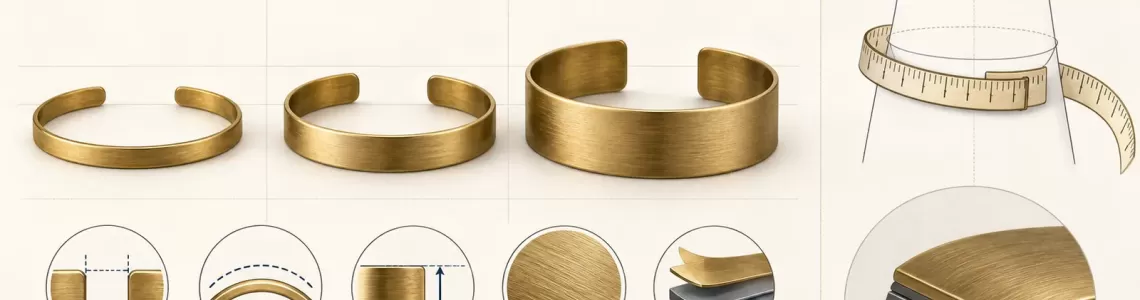
Answer first: choose a men’s brass cuff by matching the actual wrist and the bracelet’s measured interior—not by trusting “men’s,” “one size,” or a letter size alone. Confirm the opening, inner circumference or diameter, band width, thickness, weight, alloy or base metal, surface finish, and return conditions. A cuff should pass onto the narrow side of the wrist without force, rest without pinching, and resist falling off during normal movement. Do not repeatedly bend an unknown cuff to make it fit.
The phrase brass cuff bracelet for men describes a style and target customer, not a universal geometry or material specification. Brass is a family of copper-zinc alloys, while cuffs vary in opening, curvature, width, thickness, work hardening, joined components and coatings. This guide turns those variables into a practical buying decision. It does not authenticate a specific product, provide a medical diagnosis, or promise that wearing brass changes pain, circulation or health.
Research question, scope and evidence
The question is: What information lets a buyer choose a brass cuff that is likely to fit, feel comfortable and match the advertised material? The evidence comes from official alloy references, government conservation guidance, chemical-restriction guidance and U.S. jewelry-marketing rules. Those sources are strongest on composition, corrosion, skin-contact risk and claim boundaries. Fit and style still require the wearer’s measurement and the seller’s product-specific dimensions.
The Copper Development Association’s wrought-brass database lists many copper-zinc alloy families with different copper, zinc and additional-element ranges. The records show why “brass” is not one recipe and why bendability or skin-contact composition cannot be inferred from a gold-like color.
Start with five decisions, in this order
- Measure the intended wearing point. Use a flexible tape or a non-stretch string, keep it flat against the skin and record both centimetres and inches.
- Match measured geometry. Ask for the cuff’s inner circumference or inside dimensions, opening, width, thickness and weight. A generic S/M/L label is secondary.
- Choose coverage and profile. A slim band, medium textured cuff and wide statement cuff put different amounts of metal against the wrist and interact differently with sleeves and watches.
- Verify material and finish. Separate solid brass, brass-plated metal, lacquered brass, patinated brass, mixed-material construction and unknown gold-tone metal.
- Check risk and recourse. Review skin-contact disclosures, care instructions, delivery, return eligibility and whether a custom-sized item is returnable.
This order matters. A visually perfect cuff that cannot pass onto the wrist or that pinches one edge is not the right purchase. Likewise, a good fit does not prove a seller’s alloy or coating claim.
Step 1: measure the wrist you will actually use
Measure at the point where the cuff will sit, usually near but not directly on the wrist bone. Do not rely on height, body weight, gender or a population average. Left and right wrists can differ, and a person may prefer a cuff on the side opposite a watch. If the purchase is a gift, a well-fitting existing cuff is more useful than guessing from clothing size.
What to record
- Wrist circumference at the wearing point.
- Whether the wearer prefers close, neutral or visibly loose contact.
- Any prominent wrist bone or sensitivity at a pressure point.
- The inside dimensions and opening of an existing cuff that fits.
- Which wrist will wear the bracelet and whether it must sit beside a watch.
There is no evidence-based universal allowance that works for every rigid cuff. The safe comparison is the wearer’s measurement plus the specific product geometry. A seller should explain how its listed size was measured. “Fits most men” is not a substitute for dimensions.
Step 2: understand cuff geometry
A cuff is not sized like a flexible chain. Its security depends on the relationship among the wrist, the internal curve and the opening. The opening must admit the narrow side of the wrist without forcing the bracelet over the hand, yet it should not be so large that the cuff rotates off during ordinary movement.
| Specification | What it affects | What to ask |
|---|---|---|
| Inner circumference or inside dimensions | Overall fit around the wrist | Is the measurement taken along the inside surface? |
| Opening | Entry onto the wrist and retention | What is the gap at the ends before adjustment? |
| Band width | Coverage, visual weight and sleeve interaction | Is width constant or does the design flare? |
| Thickness | Rigidity, edge profile and possible adjustability | Is thickness measured at the thinnest or thickest point? |
| Weight | Perceived presence and movement | Is the listed weight for the exact size or an approximate sample? |
| End shape | Pressure concentration and ease of entry | Are the terminals rounded, flat, pointed or decorated? |
How a cuff should feel
A practical fit has three properties: it can be put on without force, it does not create a sharp pressure point at rest, and it remains on during normal wrist rotation. Temporary light contact marks are not the same as pain, numbness, swelling or broken skin. Remove the cuff if it causes discomfort or neurological symptoms; a product guide cannot diagnose the cause.
Step 3: choose width by use, not by gender
Width changes visual scale and contact area, but “masculine” and “feminine” are style labels rather than fit measurements. A narrow cuff can be visually precise and easy to place beside a watch. A medium cuff gives texture more room. A wide cuff is a statement and may meet a shirt cuff sooner or feel warmer because it covers more skin.
| Profile | Useful when | Check before buying |
|---|---|---|
| Slim, about 4–6 mm | You want low visual weight, stacking space or less sleeve interference | Terminal shape, local pressure and whether the narrow band rotates |
| Medium, about 6–12 mm | You want visible texture without full statement coverage | Curvature, thickness and how raised details meet the skin |
| Wide, above about 12 mm | You want a single focal piece | Wrist mobility, flare, weight, edges and shirt-cuff clearance |
These bands are descriptive shopping groups, not medical or engineering limits. Compare actual product dimensions. Within sunMYLOVE’s catalog, a 5 mm knife-cut brass cuff, a 6 mm textured brass cuff and the wide Cloud & Sea brass cuff illustrate different profiles. These links show design choices; they do not override the measurements on each product page.
Step 4: treat “brass” as a material family
Brass principally combines copper and zinc, but that definition covers many alloys. Copper.org’s database lists C22600 Jewelry Bronze as one specific copper-zinc alloy example. The existence of a named jewelry alloy does not mean every item marketed as brass uses C22600. Other brasses may include additional elements or different proportions, and manufacturing history changes mechanical behavior.
Solid brass, plated brass and gold-tone metal
- Solid brass: the body is represented as brass throughout, although separate solder, inlay or hardware may differ.
- Brass-plated: a brass layer is applied over another base metal. Wear can expose the substrate.
- Coated or lacquered brass: a clear or colored surface layer changes initial contact and tarnish behavior, but coatings can wear.
- Patinated brass: the surface appearance is intentionally altered; aggressive polishing may remove the designed finish.
- Gold-tone metal: a color description that does not identify composition.
Under the U.S. FTC Jewelry Guides, jewelry marketers should not misrepresent material aspects such as type, metallic content, durability or coating. The guides do not create a universal definition for every informal “brass tone” phrase, so the buyer should request an unambiguous base-metal and finish description.
Step 5: do not use bendability as proof of quality
Many open cuffs allow limited fit adjustment, but there is no universal safe number of bends. Brass can work-harden during forming, and a finished cuff may include thin and thick zones, soldered parts, inlays, texture, plating or lacquer. Those variables change where stress concentrates.
Use the seller’s fitting method. If adjustment is permitted, make one small, even change rather than repeatedly opening and closing the cuff for every wear. Do not squeeze decorative terminals, stone settings or wood inlays unless the maker explicitly identifies the safe adjustment zone. Visible cracking, lifting finish, loose inlay or a new sharp bend is a stop signal.
The Canadian Conservation Institute’s dezincification note explains one corrosion mechanism in which zinc is lost and a copper-rich surface remains. It is a conservation reference, not a prediction that a bracelet will fail. It does show why color change and strength cannot be judged from a single marketing photo.
Skin contact: separate green marks, irritation and nickel release
A green mark can result from copper-containing surface products transferring to skin, especially with moisture, salts, cosmetics or acids. That mark is not automatically an allergy diagnosis. Conversely, the absence of green color does not prove an item is nickel-free or suitable for a sensitized wearer.
EU Regulation 552/2009, which established Annex XVII restrictions under REACH, includes bracelets among articles intended for direct and prolonged skin contact under the nickel entry. The rule controls release under defined conditions, not simply total nickel content. It applies in its legal market and should not be described as a worldwide certification.
A 2026 UK Office for Product Safety and Standards jewelry report records a bangle and related items rejected after testing found excessive regulated metals. One enforcement case does not prove a problem across all brass jewelry; it demonstrates why color, price and product name cannot replace testing or traceable compliance information.
If you have known metal allergy, review the evidence and questions in the nickel allergy and jewelry buyer’s guide. For ordinary copper-salt transfer, see why brass bracelets turn skin green. Stop wearing an item that causes persistent itching, rash, blistering, swelling or pain and seek qualified medical advice.
Finish and care can change the buying decision
Polished, brushed, hammered, knife-cut, darkened and lacquered surfaces do not age identically. The Canadian Conservation Institute’s brass and copper care note distinguishes cleaning from polishing: polishing is abrasive and removes some surface metal. It also warns that an intentional patina or coating can be damaged by the wrong treatment.
The Institute’s broader metal-care guidance explains how salts from fingerprints, moisture and mixed-metal contact can accelerate corrosion. For wearable jewelry, a conservative routine is to wipe the cuff dry with a soft cloth after wear, keep it away from wet storage and cosmetics, and use only a method compatible with the stated finish. For mixed wood-and-brass construction, follow the wood and brass jewelry care guide because the most sensitive material controls the method.
A product-page evidence checklist
Before adding a cuff to the cart, look for answers to these questions:
- What are the inner dimensions or inner circumference and the opening?
- What are the band width, thickness and approximate weight?
- Is the body solid brass, brass-plated, coated, patinated or mixed-material?
- Are any solder, terminal, inlay or decorative components made from another material?
- Is adjustment allowed, and where should force be applied?
- Are skin-contact or restricted-substance claims supported for the buyer’s market?
- What care method is compatible with the finish?
- Can a sized, adjusted or customized item be returned?
Browse the Brass Cuff Bracelets collection by profile and compare the actual specifications. If a mixed material is preferred, the ebony-inlay brass cuff is a useful example of why finish and care must be considered together. Before ordering, review sunMYLOVE’s delivery information, returns and refunds policy, and About sunMYLOVE page.
Common mistakes
- Buying by “men’s size” alone: gender labels do not supply wrist or cuff geometry.
- Forcing the cuff over the hand: most open cuffs are intended to enter from the narrow side of the wrist.
- Bending it every day: repeated deformation can concentrate stress; the safe cycle count is unknown without product-specific testing.
- Assuming color proves solid brass: plating, lacquer, patina and other alloys can look similar.
- Using green skin as an allergy test: transfer, irritation and allergy are different questions.
- Polishing every dark area: the surface may be an intentional patina or coating.
- Ignoring the return policy: custom sizing or adjustment can change eligibility.
Frequently asked questions
How should a men’s brass cuff bracelet fit?
It should enter from the narrow side of the wrist without force, rest without pinching or a sharp pressure point, and remain secure during ordinary wrist rotation. Compare your wrist measurement with the seller’s actual inner dimensions and opening.
Should a cuff bracelet be tight or loose?
Neither extreme is a universal target. A close fit may reduce rotation but must not cause pain, numbness or swelling. A looser fit should still resist slipping off. Personal anatomy and the cuff’s end shape matter more than a generic allowance.
Are brass cuff bracelets adjustable?
Some permit limited adjustment, but adjustability depends on alloy, thickness, work hardening, texture, joints, inlays and coatings. Follow the seller’s instructions and avoid repeated open-close bending.
Is solid brass better than brass-plated metal?
They are different constructions. Solid brass does not have a different substrate waiting beneath a thin brass layer; plated construction may offer another weight, cost or finish. “Better” depends on accurate disclosure, wear expectations, skin contact and care.
Can the color tell me whether a cuff is brass?
No. Brass compositions vary in color, and gold-tone coatings, other copper alloys and patinas can overlap visually. Ask for the base metal and finish; use professional analysis if composition is materially important.
Will a brass cuff turn skin green?
It can leave green copper-containing transfer under some combinations of moisture, salts, cosmetics, skin chemistry and surface condition. That is not a universal outcome and is not, by itself, an allergy diagnosis.
Is a brass bracelet nickel-free?
The word “brass” alone does not prove a tested nickel-release result or the composition of solder, plating and decorative parts. Ask for market-appropriate documentation if nickel exposure matters.
Can a brass cuff improve arthritis or circulation?
There is not sufficient reliable human evidence to treat an ordinary brass cuff as a therapy for arthritis, pain or circulation. Choose it as jewelry, not as medical treatment.
Method and evidence scope
sunMYLOVE compared official alloy descriptions, government conservation guidance, EU nickel-contact guidance, U.S. jewelry-marketing rules and a UK enforcement example with the actual decisions a cuff buyer must make. We used commercial SERPs only to identify common questions, not as technical evidence. We did not bend-test or assay the linked products, infer a product’s compliance from its color, or turn a museum-conservation recommendation into a guarantee for every wearable finish.
Evidence boundary: alloy references establish that brass compositions and properties vary; conservation sources explain mechanisms and conservative care; regulatory sources explain claim and skin-contact rules in their jurisdictions. None of them determines whether a particular cuff will fit your wrist or proves an untested item’s composition. Product-specific dimensions, seller documentation and return terms remain necessary.
References and evidence scope
- Copper Development Association. Wrought Copper Alloys: Brasses. Supports brass as a broad copper-zinc alloy family with different composition ranges and additional elements.
- Copper.org Alloy Database. C22600 Jewelry Bronze. Provides one traceable jewelry-alloy example; it is not attributed to untested products.
- Canadian Conservation Institute. Cleaning, Polishing and Protective Waxing of Brass and Copper. Supports the cleaning-versus-polishing distinction and finish/patina caution.
- Canadian Conservation Institute. Caring for Metal Objects. Supports moisture, fingerprints, salts and mixed-metal corrosion mechanisms.
- Canadian Conservation Institute. Preventing and Treating the Dezincification of Brass. Supports the mechanism and limits of color-based interpretation.
- EUR-Lex. Commission Regulation (EC) No 552/2009 amending REACH Annex XVII. Supports the EU release-based framework and inclusion of bracelets.
- U.S. Electronic Code of Federal Regulations. 16 CFR Part 23—Jewelry Guides. Supports material-aspect and coating claim boundaries in U.S. jewelry marketing.
- UK Office for Product Safety and Standards. Jewelry chemical-risk product safety report. A single enforcement example showing that appearance and product name do not replace testing.
Reviewed: 4 August 2026.
sunMYLOVE editorial note: This guide is maintained as evidence-aware buying information. If a cited rule, product specification or internal policy changes, the affected statement and review date should be updated rather than silently generalized.
Leave a Comment