
How to Care for Wood and Brass Jewelry: Cleaning & Storage
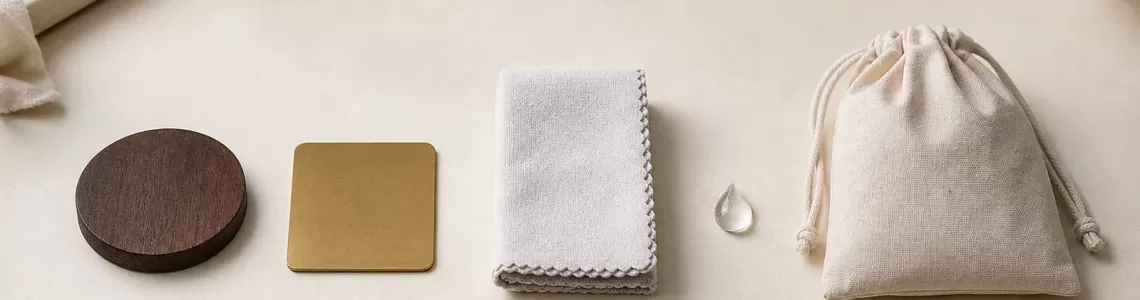
Answer first: The safest way to care for wood and brass jewelry is to treat it as a mixed-material object, not as a solid brass ornament. Start with a dry, soft cloth. Keep the wood, cord, adhesive joints and unknown coatings out of soaking water and away from acidic brass-cleaning recipes. Clean only the brass area more actively when you have confirmed that it is solid, uncoated brass and can be isolated from the wood. Dry the piece immediately, then store it separately in a clean, low-humidity pouch or box.
This guide explains how to care for wood and brass jewelry using a risk-based method adapted from museum conservation guidance. It is written for pendants, necklaces and bracelets that combine dark wood, brass, cord, beads, adhesive or surface finishes. It is not a promise that every finish, glue or alloy will react the same way. When the construction is unknown, the lowest-risk action is inspection and dry cleaning rather than polishing.
Research question and scope
The practical question is not simply “How do I clean brass?” It is: How can I remove ordinary dust, fingerprints and light soil from a mixed wood-and-brass jewelry piece without damaging the more sensitive material? That distinction matters because wood and brass respond differently to moisture, chemicals, friction and storage conditions.
The Canadian Conservation Institute identifies brass as a copper-and-zinc alloy and explains that metal corrosion is promoted by water, high relative humidity, pollutants, salts and fingerprints. The U.S. National Park Service explains that wood is hygroscopic: it exchanges moisture with surrounding air and can swell, shrink, warp or check as conditions change. A cleaning method that brightens exposed brass may therefore stain wood, soften an adhesive, remove a coating or leave abrasive residue in a joint.
This article applies to ordinary home care. It does not cover archaeological metal, valuable antiques, cracked lacquer, lifting veneer, active powdery corrosion, insect damage, mould or flood recovery. Those conditions require professional assessment.
Know what you are caring for before you clean
A mixed-material necklace may contain more layers than are visible at first glance. The “brass” may be solid brass, plated base metal, lacquered brass, intentionally patinated brass or a brass-coloured alloy. The wood may be unfinished, oil-finished, waxed, stained, lacquered or sealed. The parts may be mechanically joined, wired, glued or combined with an adjustable cord.
Do not identify a species such as ebony from colour alone. Dark staining, ebonized finishes and other dense dark woods can look similar in photographs. A product listing can describe the seller’s stated material, but visual inspection at home cannot verify botanical species. The care method below therefore focuses on observable construction and finish rather than making an unsupported species claim.
Before cleaning, inspect the piece under bright, indirect light:
- Look for cracks, loose inlays, lifting edges, sticky finish or exposed glue.
- Check whether the brass has a clear coating, deliberate dark patina or worn plating.
- Note green, blue, white or powdery deposits instead of immediately scrubbing them.
- Test whether the cord, knots and drilled holes are secure.
- Photograph the piece so you can compare its condition after cleaning.
If you are choosing a new piece, compare construction on the sunMYLOVE pendant necklace collection. Product photos can help you see whether brass is an isolated element, an inlay or a surface detail. Examples include the handcrafted ebony wood and brass pendant necklace, the ebony wood and brass arrowhead pendant and the ebony wood and brass teardrop pendant. For wristwear, compare the current men’s brass cuff bracelet collection, where product pages control the live dimensions, finish and availability.
Why wood and brass need different care
Wood responds to moisture changes
The National Park Service describes wood as hygroscopic. Below the fibre saturation point, wood responds to ambient relative humidity by absorbing or releasing moisture. This can produce dimensional movement. Museum objects are not the same as wearable jewelry, but the material principle is relevant: repeated wetting, rapid drying and large humidity swings create avoidable stress.
Finishes and adhesives add uncertainty. A sound modern coating may tolerate a lightly damp cloth, while damaged lacquer, unfinished wood, porous end grain, inlay and some adhesive joints may not. That is why “soak for ten minutes” is a poor default for mixed-material jewelry even when a similar instruction is acceptable for a plain metal item.
Brass changes at the surface
Brass commonly develops tarnish or patina as its copper-rich surface reacts with the environment. Tarnish is not automatically evidence that the metal is fake, defective or unsafe. The Canadian Conservation Institute also warns that polishing is abrasive: it removes tarnish and some surface metal. Repeated or aggressive polishing can reduce detail, expose a plated base or create an uneven appearance.
A dark or mottled surface may be an intended design finish. On products such as the round patina brass disc pendant or verdigris patina square pendant, removing colour would change the design rather than “restore” it. When appearance is intentional or uncertain, clean without polishing.
The safest routine: inspect, dry-clean, isolate and store
Step 1: Remove loose dust without rubbing it into the surface
Place the jewelry on a clean towel so it cannot roll or scratch. Use a clean, soft, lint-free cloth to lift surface dust. For recesses, use a very soft artist’s brush and direct debris away from joints and drilled holes. Do not use a stiff toothbrush by default; trapped grit plus pressure can scratch soft metal or a clear finish.
Step 2: Wipe after wear
Fingerprints transfer oils, moisture and salts. The Canadian Conservation Institute documents fingerprint staining on brass and recommends preventing contamination as part of metal care. For wearable jewelry, a practical adaptation is to wipe the piece gently with a dry cloth after use, paying attention to brass surfaces that touch skin.
Step 3: Use minimal moisture only when dry cleaning is insufficient
If the finish is sound and the maker has not prohibited moisture, lightly dampen one corner of a cloth with plain water. The cloth should be barely damp, not wet enough to release droplets. Test a hidden spot, then wipe a small area and dry it immediately with a second cloth. Do not let water enter holes, knots, seams, inlays or glued joints.
Stop if colour transfers to the cloth, the finish becomes tacky, the grain raises, a joint moves or the surface changes unevenly. A test spot is useful, but it does not guarantee that every component is identical.
Step 4: Treat exposed brass as a separate zone
If the brass is solid, uncoated, mechanically attached and clearly separated from the wood, light soil can be removed with a soft cloth. More active polishing should be rare. The Canadian Conservation Institute recommends starting with the mildest approach and cautions that commercial metal polishes may contain hard abrasives, ammonia or additives that leave residues.
Do not apply lemon juice, vinegar, salt, baking soda paste, toothpaste or metal polish across an assembled wood-and-brass pendant. Acidic and abrasive recipes may attack brass tarnish, but they can also affect a coating, lodge in crevices, stain adjacent wood or reach adhesive. A method demonstrated on a plain brass bowl is not automatically suitable for jewelry with mixed materials.
Step 5: Dry and rest the piece before storage
After any barely damp cleaning, dry every accessible surface. Leave the piece in a clean, shaded, ventilated indoor area until it is fully dry. Do not speed-dry wood with direct heat, a radiator, hot hair dryer or strong sunlight. Rapid local drying can create uneven moisture movement, and heat may also affect glue or finish.
Decision table: choose the lowest-risk action
| Observed condition | Recommended home action | Avoid |
|---|---|---|
| Light dust, stable finish | Soft dry cloth; soft brush for recesses | Soaking, compressed air at close range, stiff brushes |
| Fingerprints on exposed brass | Gentle dry wipe after wear | Repeated aggressive polishing |
| Light soil on sound sealed wood | Barely damp test wipe, then immediate drying | Saturating holes, end grain, cord or adhesive joints |
| Stable dark brass patina | Clean without polishing unless the intended finish is known | Assuming every dark area is unwanted tarnish |
| Plated or lacquered metal | Dry cloth and maker-specific instructions | Abrasive cloths, acidic recipes and metal polish |
| Green powder, lifting finish, loose inlay or sticky surface | Stop wearing; isolate; seek qualified advice | Scrubbing, solvents, oiling or gluing over the problem |
Can wood and brass jewelry get wet?
An accidental splash is not the same as prolonged immersion, but routine wetting increases risk. Remove mixed wood-and-brass jewelry before showering, swimming, washing dishes, sauna use and water sports. Pool chemicals, salt water, soap residues and repeated moisture exposure add variables beyond plain water.
If the piece gets wet, blot it rather than rubbing aggressively. Open the cord so air can reach contact points, then allow slow indoor drying away from direct heat. Do not seal a damp pendant immediately in a plastic bag. If the wood swells, the finish turns cloudy, a glue line opens or corrosion appears, stop wearing it until the condition is assessed.
Should you oil or wax dark wood jewelry?
There is no universal oiling schedule for wood jewelry. Oil, wax and lacquer are different finish systems, and adding an unknown product can darken the wood, soften an existing coating, trap soil or interfere with later repair. The NPS guidance for museum wood distinguishes finished from unfinished surfaces and warns that wax can enter the pores of unfinished wood and cannot be completely removed.
Use a finish product only when the maker identifies the original finish and recommends a compatible maintenance material. “Food-safe” does not automatically mean appropriate for a finished pendant, adhesive joint, cord or brass inlay. Essential oils, cooking oils and perfumed furniture products are especially poor default choices because composition, oxidation and residue vary.
Storage: reduce moisture, contact and pollutants
Store the necklace only when clean and dry. Keep it in its own soft pouch or a divided jewelry box so the brass cannot scratch other pieces and chains cannot abrade the wood. Close the clasp and lay the cord in a relaxed curve rather than a tight knot.
Choose an indoor location away from bathrooms, window condensation, direct sun, radiators and rapidly changing temperatures. The Canadian Conservation Institute emphasizes moderate humidity, water protection, dust control and separation for metals. The NPS emphasizes stable conditions for wood. For normal home storage, the shared principle is more useful than chasing a museum number: avoid dampness and abrupt swings.
Do not place damp silica gel directly against jewelry. If you use a desiccant in a humid climate, keep it contained, follow its indicator or regeneration instructions and avoid over-drying wood. A breathable pouch inside a stable drawer is often a simpler solution than an unmonitored airtight box.
Common mistakes and why they fail
- Cleaning the whole pendant with a brass recipe: the method ignores wood, finish, cord and adhesive.
- Polishing until every dark area disappears: the colour may be intentional patina or a coating, and polishing removes material.
- Using toothpaste: its abrasives and additives are not controlled for a delicate mixed-material surface.
- Soaking to clean drilled holes: holes and end grain can admit moisture where drying is slow.
- Applying oil whenever wood looks dull: dullness can come from dust, finish wear or light damage; more oil is not a diagnosis.
- Storing pieces together: contact creates scratches, tangles and transferred residues.
- Repairing a loose joint with household superglue: misalignment, staining and irreversible residue can make a later repair harder.
A 60-second after-wear checklist
- Check the cord, clasp, inlay and drilled holes.
- Wipe skin-contact surfaces with a clean dry cloth.
- Confirm the piece is dry and free from perfume or lotion residue.
- Store it separately in a soft pouch away from humidity and sunlight.
- Stop using it if a joint loosens or a surface becomes powdery, sticky or cracked.
For purchase and care questions about a specific construction, use the sunMYLOVE contact page. Before ordering, review delivery information and the returns and refunds policy so care expectations and return eligibility are clear.
Frequently asked questions
Can I clean a wood and brass necklace with soap and water?
Do not soak it. If the maker allows moisture and the finish is stable, use a barely damp cloth on a small test area, then dry immediately. Keep water away from holes, cord, inlays and adhesive joints.
Can I use vinegar or lemon juice on the brass?
Not as a default on an assembled mixed-material piece. Acids can affect coatings, enter joints and stain or wet adjacent wood. Use dry cleaning first and follow maker-specific instructions.
Does tarnish mean the brass is low quality?
No. Brass is a copper alloy and surface change is expected under some environmental conditions. Tarnish alone does not establish composition or quality.
Should brass jewelry always be polished bright?
No. Patina may be intentional, stable or aesthetically important. Polishing is abrasive and can remove detail, coating or plating.
How do I care for ebony wood jewelry?
Use the same conservative method unless the maker supplies finish-specific instructions: inspect, wipe dry, avoid soaking and rapid heat, and store under stable indoor conditions. Do not assume dark colour proves the wood species.
Can I wear a wood pendant in the shower?
It is safer to remove it. Repeated water, heat, soap and slow drying around drilled holes or joints increase risk to wood, finish, cord and adhesive.
When should I stop home cleaning?
Stop when a finish lifts or turns sticky, colour transfers, a joint moves, corrosion is powdery, plating flakes, the wood cracks or the material identity is uncertain and the piece is valuable.
Method and evidence limits
This guide reviewed primary conservation guidance for wooden objects, copper alloys, mixed-material handling, humidity and storage, then translated the lowest-risk principles to ordinary wearable jewelry. Museum standards are intentionally conservative and are not product-specific laboratory tests. The article therefore distinguishes documented material behaviour from practical home-care inference.
No claim is made that sunMYLOVE products were laboratory tested for humidity resistance, coating durability, alloy composition or chemical compatibility. No medical, wellness or protective effect is attributed to wood, brass or wearing jewelry. Product construction and finish should be confirmed from the individual listing or by contacting the seller.
References and evidence scope
- Canadian Conservation Institute — Caring for metal objects: alloy definitions, corrosion risks, fingerprints, polishing limits and storage principles.
- Canadian Conservation Institute Note 9/3 — Cleaning, Polishing and Protective Waxing of Brass and Copper: distinction between cleaning and abrasive polishing; finish and patina cautions.
- Government of Canada Publications — The Care of Wooden Objects: scope of basic wood conservation, maintenance, storage and display.
- U.S. National Park Service Museum Handbook, Appendix N — Curatorial Care of Wooden Objects: wood hygroscopicity, humidity response, finishes, cleaning and storage.
- U.S. National Park Service Museum Handbook, Appendix O — Curatorial Care of Metal Objects: handling, storage, cleaning risks and professional-treatment boundaries.
- U.S. National Park Service Museum Handbook, Chapter 6 — Handling, Packing and Shipping: planning and reducing physical risk during handling.
- Institute of Conservation — Environmental management guidance: risk-based relative-humidity management and material sensitivity.
Reviewed: July 23, 2026.
sunMYLOVE editorial note: This guide is maintained as general educational information. If a product listing or maker instruction conflicts with a general method here, follow the construction-specific instruction or request clarification before cleaning.
Leave a Comment