
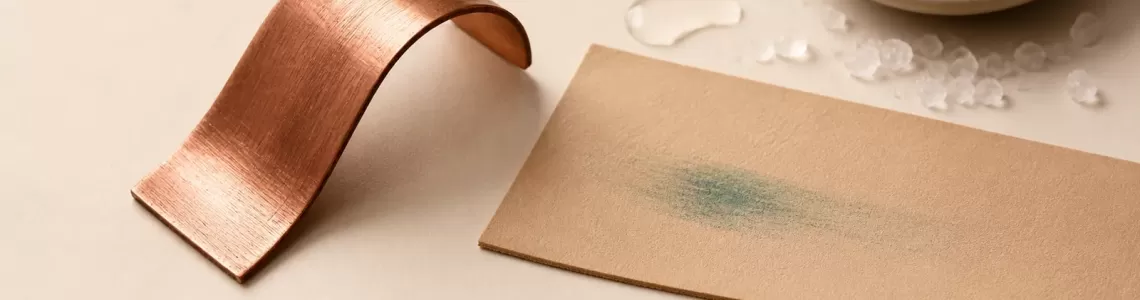
Answer first: A brass bracelet can leave a green or blue-green mark because brass is a copper alloy. Copper at the exposed surface can react with oxygen, moisture, salts in perspiration, skin oils, lotions or other environmental substances. Some of the resulting copper compounds can transfer from the metal to the skin. The color alone does not prove that a bracelet is fake, dangerously toxic, medically effective or “drawing toxins” from the body. Wash the residue away with mild soap and water, dry the bracelet, and reduce moisture and product buildup. If the area is itchy, painful, swollen, blistered, broken or persistent after the jewelry is removed, stop wearing it and seek qualified medical advice.
This guide separates visible chemistry from medical claims. It explains what a green transfer mark can reasonably indicate, what it cannot diagnose, how to distinguish a removable stain from a possible skin reaction, and how to care for brass without stripping every intentional surface finish. It does not diagnose dermatitis, certify an alloy formula or promise that any cleaning method will prevent all future color change.
Research question and scope
The practical question is: Why does a brass bracelet sometimes leave green color on the skin, and what is the lowest-risk response? The scope is modern brass and other copper-alloy jewelry worn on intact skin. It includes surface tarnish, transferable corrosion products, sweat, cosmetics, moisture, routine cleaning and buying questions. It does not cover copper poisoning treatment, occupational exposure, open wounds, implanted devices, severe allergy, archaeological “bronze disease” or restoration of valuable historic metalwork.
The evidence base combines chemistry education from the Royal Society of Chemistry (RSC) and American Chemical Society (ACS), preventive-conservation guidance from the Canadian Conservation Institute (CCI), toxicology from the U.S. Agency for Toxic Substances and Disease Registry (ATSDR), clinical commentary from an academic medical center and a randomized placebo-controlled trial of copper bracelets in rheumatoid arthritis. Museum guidance is used conservatively for surface care; it is not a direct test of sunMYLOVE products.
Five terms that should not be confused
- Oxidation
- A chemical process in which copper at the surface changes as it reacts with substances in its environment. Oxygen is important, but moisture, salts, sulfur compounds, carbon dioxide and organic substances can affect the products that form.
- Tarnish
- A thin surface change that alters color or reflectivity. Tarnish is not automatically structural damage.
- Patina
- A surface layer on copper or a copper alloy. CCI notes that stable patinas can be red, brown, black, blue or green and may be natural or intentionally created. “Patina” should not be used as a blanket label for every loose green deposit.
- Corrosion product
- A compound formed as metal reacts. Some layers are coherent and stable; others can be loose, powdery or associated with contaminants and require professional attention.
- Skin stain versus dermatitis
- A stain is transferred color that usually washes away and does not by itself show inflammation. Dermatitis is a skin condition that may involve itch, redness, scaling, swelling, blistering or pain. Color alone cannot diagnose it.
The copper-alloy chemistry behind a green mark on brass
Brass is not pure copper, but its copper component can participate in the same broad surface chemistry. The RSC explains that copper jewelry can react with oxygen and perspiration to form compounds with a green tinge that rub onto the skin. Depending on the environment, exposed copper in an alloy may react with sulfur compounds, chlorides from salt, carbon dioxide, water and substances in sweat or personal-care products. The exact surface mixture is not necessarily a single compound, and its color can range from darker brown to blue-green.
ACS likewise describes copper as a metal that oxidizes readily. In air it can form brown-black oxides; in other environments, green surface compounds can develop. The familiar architectural patina on outdoor copper and a temporary wrist stain share the broad idea of surface reaction, but they are not chemically identical in every setting. A bracelet contacts skin, soap, lotion and concentrated perspiration, while a roof or monument experiences rain, pollution and long outdoor exposure.
That distinction matters because popular explanations often say “copper oxide is green.” Copper oxides themselves are commonly red, brown or black; green and blue-green appearance may involve carbonates, chlorides, sulfates, organic copper compounds or mixtures. A buyer does not need to identify the exact salt at home. The useful conclusion is that moisture and contaminants can accelerate surface reaction and that transferable color is not a purity test.
Why one person—or one day—can be different
Perspiration and salt
Perspiration supplies water and salts, and evaporation can concentrate those salts on the skin. A laboratory or clinical observation about sweat corrosion does not mean that everyone’s sweat has a single fixed “acidity.” Activity, climate, duration of wear, evaporation and product residue can change the local environment under a bracelet.
Lotions, sunscreen, perfume and soap residue
Personal-care products can leave films that hold moisture or contain ingredients that interact with metal. A bracelet may begin marking the skin after a new lotion is introduced even though the jewelry has not changed. This is a plausible cause, not proof about a specific formula. The lower-risk response is to apply products first, let them dry fully and wipe the bracelet after wear.
Humidity and duration of contact
Warm, humid conditions keep the metal-skin interface damp for longer. A snug cuff worn all day is exposed differently from a loose bracelet worn for an hour. More contact time can provide more opportunity for both reaction and transfer.
Surface finish, alloy and coating
Solid copper, brass, bronze, copper-bearing silver alloy and plated jewelry do not expose the same surface. A coating can reduce contact temporarily but may wear unevenly. A green mark can therefore show that copper-containing material is accessible at the surface; it cannot, by itself, identify the full alloy or prove that a listed purity claim is true or false.
Cleaning and polishing residues
CCI documents green corrosion products associated with trapped polish residues and harsh ammonia- or acid-based cleaners on copper alloys. This does not mean every home-polished bracelet will corrode, but it shows why more polish is not always the solution. Residue in texture, engraving or joints can create a new problem.
What a green mark can and cannot prove
| Observation | Reasonable conclusion | Not established |
|---|---|---|
| Green color wipes from metal onto skin | A copper-containing surface has likely reacted with the local environment and transferred colored compounds | Exact copper purity or complete alloy composition |
| Color appears after exercise or hot weather | Moisture, salt, contact time and temperature may have increased reaction or transfer | A medical change in body “pH” or copper deficiency |
| Mark washes away without irritation | The color may be a superficial transfer stain | Guaranteed safety for every wearer or every future exposure |
| Itching, redness or blisters occur | A skin reaction is possible and the item should be removed | Which metal or ingredient caused it |
| Bracelet darkens or develops patina | The surface has changed through reaction, aging or an intentional finish | That the product is fake, ruined or medically active |
| A seller claims pain relief or detoxification | A marketing claim has been made | Clinical effectiveness |
Is the green stain dangerous?
A dermatologist writing for Nebraska Medicine describes the common green residue from copper-containing jewelry as washable and not harmful in that typical context. That statement should not be stretched into “all green marks are harmless.” Individual skin reactions, broken skin, contaminated products and unusual exposures require separate evaluation.
ATSDR’s toxicological profile reviews copper exposure across routes and emphasizes important evidence limits. It reports that available in-vivo data do not establish the rate and extent of absorption through intact skin. Ex-vivo human-skin studies produced variable results depending on the copper compound and vehicle. These findings do not justify claims that a bracelet reliably supplies needed copper, draws out excess copper, detoxifies the body or predicts systemic exposure from stain intensity.
Use symptoms, not color alone, to decide when to stop. Remove the bracelet if there is itching, burning, pain, swelling, scaling, blistering, an open area or a rash that persists after removal. Wash gently and seek medical advice when symptoms are significant, recurrent or spreading. Patch testing and diagnosis belong to qualified clinicians. A reaction could involve nickel, cobalt, an adhesive, a coating, trapped soap, friction or another factor rather than copper itself.
Do copper bracelets treat pain or arthritis?
There is no good basis for presenting a copper bracelet as a treatment for pain, inflammation or rheumatoid arthritis. A randomized double-blind placebo-controlled crossover trial enrolled 70 people with painful rheumatoid arthritis. Participants wore several devices, including a copper bracelet, in different treatment periods. The investigators found no statistically significant or clinically meaningful benefit for pain, inflammation, physical function, disease activity or medication use beyond placebo.
This trial has boundaries: it addressed rheumatoid arthritis, used a particular design and population, and does not answer every conceivable health question. But it directly contradicts broad claims that simply wearing a copper bracelet reliably relieves rheumatoid arthritis symptoms. A jewelry description should focus on verified material, dimensions, construction and appearance—not replace medical care.
What to do when your wrist turns green
- Remove the bracelet. Do not keep wearing it to “test” whether the color becomes darker.
- Look for symptoms. Separate a removable stain from itch, redness, swelling, pain or broken skin.
- Wash the skin gently. Use mild soap and water, rinse and dry. Do not scrub irritated skin with abrasive products.
- Inspect the bracelet. Check for moisture, lotion film, loose powder, trapped polish, damaged coating, sharp edges and cracks in composite parts.
- Wipe the jewelry. For a sound, simple copper surface, begin with a soft clean cloth. Follow the product-specific care instructions before adding water or cleaner.
- Let it dry completely. Keep it in a ventilated shaded place; do not use a hair dryer or direct sun.
- Record what changed. New lotion, hotter weather, exercise, swimming or a recently polished surface may help explain timing without proving a medical cause.
- Stop if irritation recurs. Seek professional medical advice for persistent or significant symptoms.
How to reduce green transfer without damaging the bracelet
Keep the contact area dry
Remove copper jewelry before showering, swimming, exercising heavily, washing dishes or using household cleaners. Dry the wrist before putting the bracelet back on. This reduces moisture and salt exposure; it does not guarantee zero patina.
Apply personal-care products first
Put on lotion, sunscreen, perfume and styling products before jewelry. Let them dry. Wipe the bracelet after wear with a soft cloth so residue does not accumulate.
Do not over-polish
CCI distinguishes cleaning from polishing: cleaning removes contaminants, while polishing is abrasive and removes tarnish plus some surface metal. Repeated polishing can reduce surface detail. If a bracelet has an intentional darkened, hammered or textured finish, polishing may erase the design. Determine the intended appearance before acting.
Avoid acids and harsh ammonia cleaners
Popular home recipes use vinegar, lemon, salt or ammonia. These can accelerate copper reaction, leave residue in recesses or affect adjacent wood, cord, adhesive and coatings. CCI specifically identifies inappropriate acid- and ammonia-based cleaning compounds as possible contributors to localized green corrosion on museum objects. A museum object and a wearable cuff are not identical, but the residue risk is directly relevant.
Be cautious with clear coatings
A barrier coating can reduce metal-skin contact, but it changes the object and may wear, peel or trap contamination. Nail polish is not a universal conservation treatment, and recoating may affect appearance or return eligibility. Ask the seller or a qualified jeweler before applying a coating.
Care by construction
Open brass cuffs
Start with the current men’s brass cuff bracelet collection when comparing dimensions, surface finish and construction. A simple cuff such as the Curved Wide Brass Cuff Bracelet exposes a broad metal surface to skin. Avoid repeatedly bending the cuff to put it on; mechanical flexing and surface care are separate issues. Wipe the inner surface after wear and inspect edges and texture.
Slim or textured brass bracelets
A design such as the Slim Curved Brass Cuff Bracelet may have narrow areas where residue accumulates. A Textured Brass Cuff Bracelet adds recesses where residue can collect. Use a soft cloth and minimal liquid. Do not force abrasive paste into grooves in an attempt to make every recess equally bright.
Brass combined with wood
The Ebony Inlay Curved Brass Cuff Bracelet is a composite object. Water, metal polish and solvent suitable for bare brass may affect wood, finish or adhesive. Clean locally and let the most sensitive component determine the method.
These links use the products’ verified on-page brass descriptions even though several legacy URLs still contain the word “Copper.” That URL wording is not evidence that the item is pure copper. Review sunMYLOVE’s brand and editorial information, then follow each item’s stated material and construction rather than transferring assumptions from one design to another.
When green on the metal needs professional attention
A stable, smooth patina is different from rapidly growing loose powder. CCI describes active copper-alloy corrosion as light green powder developing in spots or as a loosely adherent layer. This phenomenon is especially associated with archaeological and contaminated objects, so it should not be casually diagnosed on modern jewelry from a photograph.
Stop home cleaning and ask a metals conservator or qualified jeweler when green material is powdery, returns quickly after gentle cleaning, emerges from joints, accompanies pitting, or appears near wood, leather, adhesive or an unknown coating. Do not seal active residue beneath wax or clear coating.
Common myths and mistakes
- “Green skin means the bracelet is fake.” It indicates surface chemistry, not complete composition or authenticity.
- “The darker the stain, the more copper the body absorbed.” Transfer color is not a validated measure of dermal absorption.
- “The bracelet is drawing toxins out.” There is no credible mechanism or clinical evidence established by a green stain.
- “Copper entering the skin relieves arthritis.” The cited randomized trial did not find meaningful therapeutic benefit beyond placebo.
- “Vinegar and salt are always safe because they are natural.” Acids and chlorides can accelerate corrosion and leave residue.
- “All patina is damage.” Stable or intentional patina may be part of the design; loose active corrosion is a different condition.
- “All rashes are copper allergy.” Nickel, cobalt, coatings, adhesives, friction, trapped moisture and irritants are possible alternatives.
- “More polishing means better care.” Polishing removes surface metal and can erase texture and intentional finish.
Buyer checklist for brass bracelets
- Does the product page state brass, another copper alloy, plating or composite construction clearly?
- Are dimensions, opening style and surface finish described?
- Is a darkened or colored patina intentional?
- Does the bracelet combine wood, cord, magnets, adhesive or coated components?
- Are care instructions consistent with the complete construction?
- Are health claims absent or carefully limited to evidence?
- What should you do if the item arrives damaged or differs from its description?
Before ordering, review sunMYLOVE’s delivery information, returns and refunds policy and FAQ. If a material, coating or care detail is unclear, use the contact page before applying a cleaner.
Frequently asked questions
Does brass always turn skin green?
No. Transfer depends on the alloy and exposed surface, moisture, perspiration, contact time, products on the skin, environment and maintenance. Lack of a mark does not prove that no copper is present in the alloy.
Can I wash the green stain off?
A superficial stain commonly washes away with mild soap and water. Do not scrub irritated or broken skin. Persistent color plus symptoms should be assessed medically.
Is green skin a brass or copper allergy?
Not by itself. Allergy involves a clinical reaction, not simply color. Itch, redness, scaling or blisters warrant removing the item and seeking professional advice. Color alone also cannot identify which alloy component, coating or residue caused a reaction.
Does green skin mean copper poisoning?
A color transfer is not a diagnostic test for systemic copper exposure or poisoning. ATSDR notes important gaps in in-vivo intact-skin absorption data. Contact a medical professional or poison service for a suspected toxic exposure rather than relying on stain color.
Can I use vinegar and salt to clean the bracelet?
This guide does not recommend that as a default. Acid and chloride can accelerate reaction, lodge in texture and harm composite materials. Use product-specific instructions or professional care.
Will a clear coating prevent green marks?
It may reduce direct contact while intact, but coatings can wear and change appearance. They are not permanent, universal or appropriate for every finish. Ask before applying one.
Should I remove all patina?
No. Patina may be stable and intentional. Remove only ordinary surface contamination using a method compatible with the design; ask a professional about powdery or rapidly recurring green corrosion.
Can a brass or copper bracelet relieve joint pain?
A randomized placebo-controlled rheumatoid arthritis trial of copper bracelets found no meaningful therapeutic effect for pain, inflammation or disease activity beyond placebo. It did not test brass as a treatment, and it gives no basis for extending a therapeutic claim to brass jewelry. Jewelry should not replace evidence-based treatment.
Method, evidence limits and sunMYLOVE editorial note
sunMYLOVE reviewed the sources below on 27 July 2026. Chemistry sources support oxidation and colored surface products; CCI supports the distinction between stable patina, contamination, cleaning and abrasive polishing; ATSDR defines the limits of dermal-exposure evidence; Nebraska Medicine addresses the common removable stain; and the randomized trial tests a specific therapeutic claim.
The sources do not test every sunMYLOVE bracelet, brass formula, finish, adhesive or wearer. Copper chemistry is applied only at the alloy-component level; it is not treated as proof that a brass product is pure copper. This guide therefore uses conditional language and the least intensive care method. It does not claim medical benefit, detoxification, universal safety, exact composition or guaranteed stain prevention.
References and evidence scope
- Royal Society of Chemistry — Why does copper jewellery turn your skin green?. Direct explanation of copper, perspiration, oxygen and transferable green compounds; used here only to explain the copper component in brass.
- American Chemical Society — React with Copper. Supports copper oxidation and the range of surface compounds formed in different environments.
- Canadian Conservation Institute — Caring for metal objects. Supports stable patina, active corrosion, contaminants and residue risk.
- Canadian Conservation Institute — Cleaning, Polishing and Protective Waxing of Brass and Copper. Supports the distinction between cleaning and abrasive polishing.
- ATSDR — Toxicological Profile for Copper. Supports toxicological context and explicit limitations in intact-skin absorption evidence.
- Nebraska Medicine — Why does some jewelry turn my skin green?. Dermatologist-reviewed explanation of a common washable transfer stain.
- Richmond et al. — Copper bracelets and magnetic wrist straps for rheumatoid arthritis. Randomized double-blind placebo-controlled crossover trial; supports the limits on therapeutic claims.
Reviewed: 27 July 2026. Editorial identity: sunMYLOVE. Educational chemistry, care and evidence-boundary guidance only.
Leave a Comment