
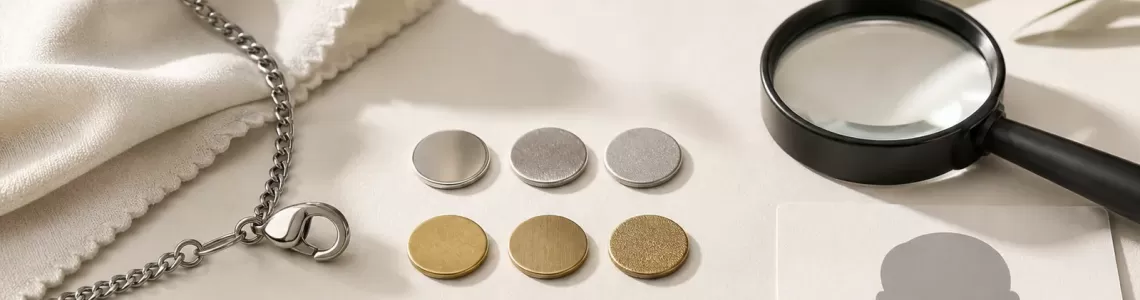
Answer first: A necklace rash does not prove that a piece contains nickel, and a metal’s color does not reveal its complete alloy. Nickel is a common cause of allergic contact dermatitis, but friction, trapped soap, moisture, coatings, adhesives and other metals can produce similar symptoms. The safest buying approach is to separate three questions: what the seller actually documents, how much metal touches the skin and what your own medical history requires. If a rash is persistent, blistering, infected or recurrent, stop wearing the item and seek qualified medical advice rather than trying to diagnose the cause from a product photograph.
This guide explains what authoritative sources say about nickel exposure from jewelry, what terms such as “nickel-free” and “hypoallergenic” can and cannot tell you, and how to make a lower-risk pendant or bracelet decision without inventing certainty. It is educational information, not a diagnosis or a claim that any sunMYLOVE item is nickel-free unless its individual product page explicitly says so.
Research question and scope
The practical question is: How should a buyer evaluate jewelry when nickel sensitivity is known or suspected? The scope is jewelry worn against intact skin, especially necklaces, pendants, bracelets, clasps and chains. Fresh piercings, occupational exposure, implanted devices, prescription treatment and severe allergic reactions are outside this guide. The evidence base combines dermatology guidance, public-health toxicology and the European Union’s legally defined nickel-release limits.
Four terms that should not be confused
- Allergic contact dermatitis
- A delayed immune reaction after skin contact with an allergen. The American Academy of Dermatology (AAD) identifies nickel as a common cause and notes that jewelry is a frequent exposure source.
- Irritant contact dermatitis
- Inflammation caused by friction, moisture, soap, surface dirt or another irritant rather than a specific allergy. DermNet emphasizes that a jewelry-site rash is not automatically a metal allergy.
- Nickel content
- The amount of nickel present in an alloy or component.
- Nickel release
- The amount of nickel that migrates from an article under defined conditions. This is the concept used by the EU restriction for items in direct and prolonged skin contact. Content and release are related but not identical.
What is firmly established
Nickel can sensitize some people through direct and prolonged skin contact. The U.S. Agency for Toxic Substances and Disease Registry (ATSDR) describes allergic reaction as the most common harmful health effect of nickel and explains that further contact can produce dermatitis after sensitization. The AAD likewise says necklaces, rings, bracelets, watches and earrings containing nickel can trigger symptoms in susceptible people.
The European Union’s REACH restriction translates this risk into measurable release limits. For necklaces, bracelets, chains, rings and other articles intended for direct and prolonged skin contact, the rule restricts products when nickel release is greater than 0.5 micrograms per square centimetre per week. Piercing posts have a lower 0.2 microgram limit. A non-nickel coating must keep release below the applicable limit for at least two years of normal use. These are regulatory thresholds, not a promise that every sensitive person will react identically.
It is also established that visual inspection is inadequate. DermNet states that it is difficult to determine nickel content by looking at jewelry. A silver-colored clasp may be one of several alloys or a plated base metal; a warm-colored component may be brass, bronze, plated metal or another alloy. Color is appearance evidence, not a laboratory result.
What the evidence does not establish
- A rash under a necklace does not, by itself, identify nickel as the cause.
- “Silver tone,” “gold tone” and “brass color” do not disclose an alloy.
- A coating does not necessarily remain intact forever; wear, sweat, cleaning and friction can change the contact surface.
- “Hypoallergenic” is not a universal guarantee that no person will react.
- A home spot test is not a full material certificate and does not predict clinical severity.
- No responsible product guide can diagnose allergy or replace a dermatologist’s patch testing.
Nickel allergy, irritation or something else?
DermNet lists several alternatives to allergic contact dermatitis: friction, dirt or surface particles, soap and water trapped under jewelry, non-metal components, and infection at a piercing site. The AAD advises removing the suspected item and paying attention to whether the rash clears and returns with re-exposure, while also recommending professional evaluation for persistent or concerning symptoms.
| Observation | What it may suggest | What it cannot prove |
|---|---|---|
| Itching or redness where metal touches | Contact dermatitis is possible | Which metal or substance caused it |
| Irritation after exercise or hot weather | Sweat, friction or increased metal-ion release may contribute | A nickel diagnosis |
| Reaction only beneath a clasp | The clasp or trapped moisture deserves attention | The pendant body has the same alloy |
| Reaction after months of trouble-free wear | Sensitization, coating wear or another new factor is possible | That the original listing was false |
| No reaction during a short trial | Short-term tolerance | Permanent safety for every wearing condition |
A five-step buying framework
1. Start with construction, not the product name
A pendant necklace can include a pendant body, bail, jump rings, chain or cord, clasp, end caps, solder, plating and adhesives. These parts may not share one material. Read the specification for the components that actually touch skin. When a listing is unclear, ask a specific question such as “What is the base metal and surface finish of the clasp and chain?” rather than “Is this safe?”
2. Match documentation to your sensitivity
If you have never reacted to jewelry, clear material descriptions and sensible care may be enough. If you have a diagnosed nickel allergy, generic words should not replace component-level documentation. Ask whether “nickel-free” refers to composition, tested release, or only the visible pendant. If the seller cannot answer, treat that as uncertainty rather than proof of danger or safety.
3. Consider the contact pattern
A long pendant worn over clothing presents a different exposure pattern from a tight choker, watch or bracelet. Cord-based necklaces may reduce continuous chain-to-skin contact, but metal bails, rings and clasps can still touch the neck. Browse the sunMYLOVE pendant necklace collection by construction and examine each product’s own specifications rather than assuming every item is identical.
4. Plan for finish wear
Plating and clear coatings can reduce direct contact while intact, yet both may wear. The EU rule explicitly addresses coating durability because a barrier’s performance over time matters. Avoid aggressive polishing, abrasives and unapproved acids that could remove a finish. For mixed wood-and-metal pieces, follow the conservative methods in the site’s wood and brass care draft once published; until then, ask for item-specific guidance through Contact Us.
5. Keep a rational exit plan
Before ordering, read Returns & Refunds and Delivery Information. A transparent return path matters when individual skin tolerance cannot be predicted from an image. Custom products may have different eligibility, so confirm before customization.
How to read common jewelry claims
| Claim | Useful interpretation | Question to ask |
|---|---|---|
| Nickel-free | Potentially useful, but the testing basis and covered components matter | Does this apply to the clasp, chain, bail and solder, and is it based on composition or release testing? |
| Hypoallergenic | Intended to reduce allergen exposure | Which material or standard supports the claim? |
| Sterling silver | Conventionally 92.5% silver alloy | What are the remaining alloy and all attached components? |
| Stainless steel | A family of alloys, not one composition | What grade is used, and is there nickel-release documentation if needed? |
| Plated | A surface layer over a base material | What is the base metal, coating and care method? |
| Brass | Primarily a copper-zinc alloy family | Is the item solid, plated or coated, and which components contact skin? |
For comparison shopping, the site’s sterling silver bracelet category, copper bracelet category and beaded bracelet category illustrate why category labels are only a starting point: attached findings, cords, beads and finishes still need product-level reading.
Home nickel tests: useful screen, limited conclusion
Dimethylglyoxime (DMG) spot tests are commonly used to screen for nickel release from a surface. DermNet notes that commercial testing kits exist, but a consumer test has boundaries. A positive result can support avoiding that contact surface. A negative result does not certify the whole piece: geometry, worn coatings, inaccessible components, test technique and later surface changes matter. Do not scrape a product, apply chemicals outside kit instructions or treat a spot test as a medical patch test.
Care practices that reduce avoidable irritation
- Put jewelry on clean, dry skin and remove it before heavy sweating when practical.
- Do not trap soap, lotion or water beneath tight jewelry.
- Wipe skin-contact surfaces with a clean, soft cloth after wear.
- Store pieces separately to reduce scratching and coating wear.
- Use only care methods compatible with every material in the piece.
- Inspect clasps, plating and high-friction edges periodically.
- Stop wearing an item if irritation develops; do not “push through” a rash.
These steps reduce friction, residue and moisture, but they do not make a nickel-releasing item suitable for someone with a confirmed allergy. For mixed-material designs such as the perforated ebony-style wood and obsidian pendant or sculpted wood and obsidian pendant, follow the listing and ask which hardware contacts skin; the links identify products, not independent material certification.
Common mistakes
- Assuming a luxury price or color proves alloy composition.
- Using “hypoallergenic” as if it means zero risk.
- Focusing on the pendant while ignoring the clasp, chain and jump rings.
- Confusing green skin discoloration with allergic dermatitis; discoloration can be a chemical residue while dermatitis is an inflammatory skin condition.
- Applying vinegar, lemon, toothpaste or abrasive metal polish to a coated or mixed-material piece.
- Continuing to wear jewelry over broken or inflamed skin.
- Presenting an online article as a diagnosis.
Three buyer scenarios
No previous reaction
Use ordinary product due diligence: identify the skin-contact components, understand whether a surface is solid metal or plated, follow the care instructions and avoid trapping moisture. There is no evidence-based reason to self-diagnose an allergy in the absence of symptoms. At the same time, the absence of a past reaction is not a material test, so keep product claims precise.
A previous unexplained necklace rash
Do not assume the pendant body was responsible. Review the chain, clasp, bail, jump rings, cord ends, cleaning products, perfume, sunscreen and the fit of the necklace. Stop wearing the suspected piece until the skin recovers. If you later discuss the episode with a clinician, a photograph of the rash location and a record of the jewelry’s documented materials may be more useful than guessing the alloy.
Confirmed nickel allergy
Use the most conservative standard. Follow the advice given by your dermatologist, request component-level information and do not treat price, color or “premium” wording as evidence. A design that minimizes metal-to-skin contact may be useful, but it does not override unknown hardware. If documentation is incomplete, choose a better documented alternative or ask before ordering. A return policy is a commercial safeguard, not a substitute for exposure prevention.
Why honest uncertainty improves a product page
Accurate jewelry guidance does not need absolute claims. “Material not independently verified” is more useful than an invented guarantee, and “contact us for clasp composition” is more actionable than a vague safety promise. Search engines, buyers and AI answer systems can all distinguish a bounded statement from marketing language. For sunMYLOVE, the editorial standard is therefore to separate catalog description, supplier information, regulation and clinical evidence. If future laboratory documentation becomes available, it should be added to the relevant product page with the test method, component scope, date and issuing body—not generalized across unrelated products.
A 60-second pre-purchase checklist
- Which components touch skin?
- Are those components identified by material and finish?
- Does “nickel-free” cover the complete item and explain its basis?
- Is the piece plated or coated, and what care protects that finish?
- Will it sit against skin or over clothing?
- Is there a clear contact and return route?
- If you have diagnosed allergy, is the evidence strong enough for your dermatologist’s advice?
Frequently asked questions
Can you tell whether jewelry contains nickel by looking at it?
No. Appearance does not disclose the full alloy, base metal, solder or plating. Ask for component-level documentation or appropriate testing.
Does “nickel-free” mean zero nickel?
Not necessarily across every market or claim system. It may describe composition, intentional addition or release performance. Ask what the term covers and how it was verified.
Is sterling silver always safe for nickel allergy?
Sterling silver is primarily silver with other alloying metal, commonly copper, but attached findings or traces may differ. A category name alone is not a universal medical guarantee.
Can brass cause a jewelry rash?
Yes, but the cause may be allergy to a constituent metal, irritant dermatitis, friction, moisture or another component. A clinician can distinguish possibilities more reliably than appearance.
Does clear coating permanently block nickel?
No coating should be assumed permanent. Wear and cleaning can reduce its barrier function. The EU restriction recognizes durability by requiring compliant release performance over normal use for coated articles.
Should I use a home nickel test?
A validated kit can be a screening tool when used exactly as directed, but it is neither a whole-product certificate nor a medical allergy test.
When should I stop wearing a piece and seek help?
Stop when a rash develops. Seek qualified care for persistent, recurrent, painful, blistering, spreading or infected-looking symptoms, and for any uncertainty about diagnosis or treatment.
Method, evidence limits and editorial policy
sunMYLOVE reviewed dermatology guidance, U.S. public-health toxicology and EU primary regulation. We prioritized claims that could be directly supported and excluded seller blogs, competitor listings and AI summaries as evidence. The guide does not infer the alloy of any item from a photograph, does not claim clinical testing of sunMYLOVE products and does not turn population estimates into an individual risk prediction. Regulatory requirements vary by market and can change; buyers should use the rules applicable to their location.
References and evidence scope
- American Academy of Dermatology — Nickel allergy: How to avoid exposure and reduce symptoms.
- American Academy of Dermatology — Itchy rash could be contact dermatitis.
- DermNet — Jewellery allergy.
- ATSDR — Toxicological Profile for Nickel.
- EUR-Lex — REACH Annex XVII, Entry 27: Nickel.
- American Academy of Dermatology — Contact dermatitis management tips.
Reviewed: July 24, 2026.
sunMYLOVE editorial note: This article will be reviewed when authoritative guidance, regulations or the product catalog materially changes. Product-specific claims are limited to what is visible on each listing; contact the store before purchase when a component description is insufficient for your needs.
Leave a Comment