
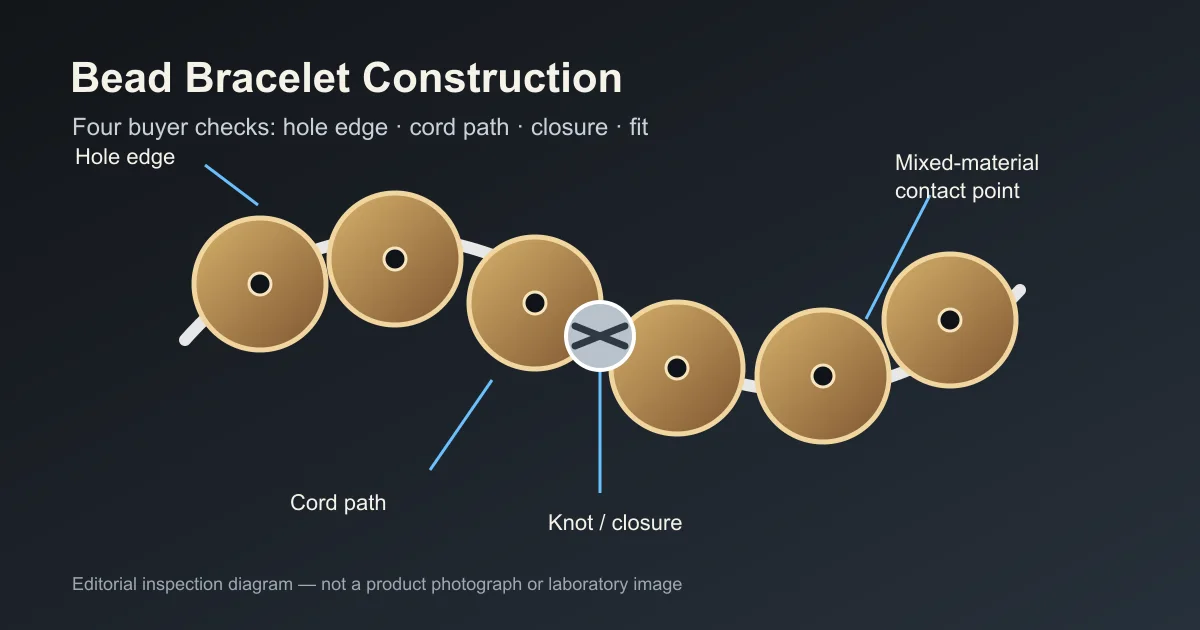
Quick answer: A bead bracelet is only as dependable as its weakest load-bearing point: the cord, the bead-hole edges, the knot or closure, and any metal connector. Before buying, look for clean hole exits, enough space for the cord to move without obvious cutting pressure, a closure suited to the design, and a fit that does not require hard stretching. Photographs can reveal useful warning signs, but they cannot prove cord chemistry, drilling method, gemstone identity, or service life. Ask the seller for written construction details when those facts matter.
What this guide answers
This guide explains how to read the visible construction of an adult fashion bead bracelet before purchase and how to inspect it after delivery. The research question is practical: which details help a buyer distinguish a well-explained assembly from an uncertain one? It covers elastic, textile cord, sliding cord, wire and connector-based designs. It does not authenticate a stone, identify a polymer by sight, calculate a universal lifespan, or certify an individual bracelet from a photograph.
The framework is especially useful when comparing pieces in the sunMYLOVE beaded-bracelet collection, including mixed-material designs such as the colored glass and brass bead bracelet and the 12 mm black obsidian and brass bracelet. Product pages remain the controlling source for each item’s stated materials, size, availability and care.
Construction terms worth knowing
- Bead hole
- The passage through a bead. Its diameter, straightness and finish affect how the stringing material sits and moves.
- Hole edge or exit
- The rim where the cord enters or leaves the bead. A visibly chipped or sharp exit can concentrate wear at a small point.
- Cord path
- The route taken by elastic, thread, cord or wire through the assembly. It includes hidden sections inside beads.
- Load-bearing point
- A place that routinely carries tension: a knot, crimp, clasp, connector, sliding closure or a cord segment pressed against a hole edge.
- Spacer
- A smaller bead or component placed between larger elements. It may change spacing and movement, but appearance alone does not prove a protective function.
- Elastic recovery
- The ability of elastic to return toward its original size after stretching. A photograph cannot establish recovery or fatigue life.
The four-point inspection: hole, cord, closure and fit
1. Inspect bead-hole exits
Zoom in where the cord emerges from the beads, especially beside metal accents and at the point nearest the closure. Look for obvious chips, fractures, rough rims, displaced coatings, or a cord that appears pinched into one edge. The Canadian Conservation Institute advises examining beadwork for weak or broken threading and cracked or unstable beads before cleaning. Its museum guidance is not a warranty for modern jewelry, but it supports a sound general principle: inspect the bead and the thread together rather than judging shine alone.
A dark line at a hole is not automatically damage; it may be shadow, drill residue, surface finish or the cord itself. Likewise, a slightly irregular hole in a hand-finished bead is not automatically unsafe. The useful question is whether the listing and photos show an intact exit without a clear cutting edge. If the critical area is hidden, ask for a close photograph rather than inferring quality from a front-facing lifestyle image.
2. Identify the stringing system
“Beaded bracelet” describes appearance, not the load-bearing material. The assembly may use elastic, braided textile cord, waxed cord, coated wire, fishing-line-like monofilament, multiple strands, or a combination. Each system creates a different user task. Elastic should pass over the hand without extreme stretching. A sliding cord needs enough tail and a closure that moves without slipping. Wire normally needs a purpose-made termination rather than a simple textile knot. Multi-strand designs need secure shared connectors.
Do not assume that a thick-looking cord is stronger or that a transparent cord is a particular polymer. Cord diameter, material, construction, age, exposure and knot design all matter. A responsible product description should state the stringing method when it affects fit or use. If it does not, the honest status is unknown.
3. Find the knot, crimp, clasp or sliding closure
Every continuous loop has a joining method, even when it is hidden inside a bead. For elastic, inspect whether the knot area creates an obvious hard bulge or a stretched segment. For braided cord, look for clean ends and a closure that is not visibly fraying. For wire, check whether crimps and clasps align with the strand rather than forcing a sharp bend. Decorative caps can conceal a neat finish, but they also conceal the actual join; concealment alone is neither proof of quality nor proof of weakness.
The CCI notes that loose thread ends and weak original thread require case-specific treatment; it specifically warns against damaging original threading while securing beads. For a consumer bracelet, that translates into a cautious rule: do not improvise glue, melt an unknown cord, or pull a failing knot tighter without knowing the material. Stop wearing the piece and ask the seller or a qualified repairer whether restringing is appropriate.
4. Check fit as part of construction
A bracelet that is too tight keeps its cord and hole edges under unnecessary tension. One that is very loose may strike surfaces and snag. Measure the wrist where the bracelet will sit, then follow the exact sizing convention used by the product page. Some sellers ask for bare wrist circumference; others list finished inner circumference. Those numbers are not interchangeable. Use the wrist-measurement guide and the broader bracelet buying guide, but let the individual listing control the final choice.
Construction comparison table
| System | Convenience | What to inspect | Fit risk | When to pause use |
|---|---|---|---|---|
| Elastic loop | Fast on and off | Flattened areas, whitening, fuzzing, exposed knot, overstretching | Hard stretching over the hand accelerates stress | Persistent looseness, visible split, knot movement |
| Braided or waxed cord | Often adjustable | Fraying, slipping slider, compressed knot, rough bead exits | Over-tightening can load the closure and holes | Core fibers visible, slider will not hold |
| Coated jewelry wire | Stable shape with clasp | Kinks, broken coating, sharp bend near crimp, clasp alignment | Too-small fit may kink the wire | Exposed wire, damaged crimp, clasp separation |
| Multi-strand assembly | Layered appearance | Equal strand tension, shared connector, rubbing between strands | One short strand may carry disproportionate load | Uneven sag, loose connector, strand abrasion |
| Mixed material with metal accents | Contrast and weight | Sharp metal openings, finish wear, cord contact, movement | Harder or heavier elements can change local stress | Sharp edge, cracked bead, cord visibly cut or pinched |
This table is a decision aid, not a ranking of materials. No construction type is automatically best. A correctly explained and appropriately fitted elastic bracelet can be more suitable for one buyer than a clasped design, while another buyer may value repairability or a narrower fit range.
What photos can prove—and what they cannot
Good product photographs can show bead diameter relative to the wrist, visible surface variation, approximate spacing, closure style, the number of strands, and some hole exits. They may also reveal obvious chips, fraying or asymmetry. They cannot reliably prove mineral species, treatment, geographic origin, alloy composition, cord chemistry, hole-polishing method, tensile strength, or how long the bracelet will last.
This evidence boundary matters because construction language can become overconfident. The U.S. jewelry rules prohibit misleading representations about a product’s material, manufacture, composition and other characteristics. A buyer should prefer precise written statements over broad labels such as “indestructible,” “premium cord,” or “natural” when the seller provides no definition or support. The natural-stone variation guide explains why visual variation and material authentication are separate questions.
A step-by-step pre-purchase check
- Start with the listing facts. Record the stated bead material, bead diameter, metal components, stringing system, wrist options and closure type. Mark missing fields as unknown rather than filling them from appearance.
- Zoom into high-stress zones. Inspect hole exits beside the closure, the largest or heaviest beads, metal spacers and any point where the cord changes direction.
- Match construction to use. Frequent removal may favor a convenient closure. Active use, repeated water exposure or heavy impact may be inappropriate unless the listing expressly allows it.
- Use the correct measurement convention. Compare the seller’s size definition with your wrist measurement. Ask before ordering if the listing is ambiguous.
- Check care for every component. A mixed bracelet must be cared for according to its most sensitive bead, finish, cord or connector—not the toughest component.
- Read delivery and return terms. Review delivery information and the returns and refunds policy before purchase, especially for customized sizing.
- Save the product record. Keep the listing, size choice and written clarification so you can compare the delivered item with what was promised.
Delivery-day inspection
Inspect the bracelet over a clean tray or light-colored towel so a loose component is easier to find. Do not pull the piece hard as a “strength test.” Instead, rotate the loop gently and examine the entire cord path that is visible. Confirm that the size, bead count and closure match the listing. Check for a cracked bead, an obvious sharp hole exit, a free cord end, a slipping closure, a bent connector or a cord segment that is already abraded.
Try the bracelet on only after the visual check. For elastic, roll it over the hand rather than stretching one section far away from the beads. For a slider, tighten gradually and confirm that it holds under ordinary movement. For a clasp, make sure it closes fully without forcing the strand into an acute bend. If there is a defect, photograph it before attempting repair and contact the seller.
Care for the weakest component
Beads are often combined with materials that respond differently to water, humidity, light, cosmetics and abrasion. The Canadian Conservation Institute notes that changes in relative humidity can create stress where dissimilar materials meet, and that rough or sharp adjacent edges can contribute to bead damage when thread contracts. Museum objects and wearable jewelry have different use conditions, so the lesson is not to impose museum storage targets at home. The transferable principle is to avoid rapid environmental extremes and inspect contact points.
Begin routine care with a soft, dry cloth. Do not soak the whole bracelet merely because one bead type tolerates water. CCI guidance for glass beadwork recommends examining weak threads and unstable beads before cleaning and warns against immersion. GIA’s pearl-care guidance likewise says a pearl strand should be completely dry before wear and treats the string as part of the care problem. If a mixed bracelet includes pearls, porous wood, coated glass, dyed material or an intentionally oxidized metal, product-specific advice should override a generic cleaning recipe.
Store the bracelet dry, away from direct heat, and separately from sharp or heavier jewelry. Lay a multi-strand design so its own weight does not pull one strand. Avoid perfume, sunscreen and household cleaner overspray. Recheck the closure and visible cord after a snag, fall or period of heavy use.
Replacement signs and repair decisions
Stop routine wear when you see a split elastic strand, exposed wire, a crimp that has opened, a closure that slips, a cracked load-bearing bead, or progressive fraying at the same hole. A stretched bracelet that no longer returns to fit is also a practical replacement signal. There is no evidence-based universal schedule such as “replace every six months”; exposure and construction vary too much. Periodic visual checks are more defensible than a fabricated calendar.
Restringing may preserve the beads while replacing the weaker cord, but it can change fit, spacing and appearance. Ask whether the original bead holes will accept the proposed material and whether the repairer will preserve intentional order and orientation. Do not enlarge holes or polish edges unless you accept that material will be removed. A repair recommendation for one bead type should not be generalized to another.
Common mistakes
- Buying by bead appearance alone. The hidden cord and the visible joining points carry the load.
- Assuming every dark hole edge is damage. Request a close image; shadows and finishes can mislead.
- Stretching elastic as a test. Deliberate overextension is not a realistic inspection and can create the failure being tested.
- Using one cleaner on a mixed bracelet. Clean for the most sensitive component and avoid immersion unless explicitly approved.
- Inferring chemistry from transparency or thickness. A photo cannot identify the cord polymer or strength.
- Ignoring the seller’s measurement convention. Bare-wrist size and finished bracelet circumference are not the same.
- Repairing with unknown glue or heat. Adhesive and melting methods can damage finishes, cord and beads or make later repair harder.
- Treating “handmade” as a performance specification. Craft method does not replace material, sizing and construction facts.
Frequently asked questions
Do larger bead holes make a bracelet stronger?
Not automatically. Hole diameter must be considered with bead wall thickness, edge finish, cord size, movement and the joining method. A larger opening can accept a thicker cord, but it may also leave a thinner wall in some bead shapes.
Can I tell whether a hole was drilled well from a product photo?
You may see obvious chips, rough exits or misalignment, but a standard photo cannot show the full internal passage or prove the drilling and finishing process.
Is elastic or cord better for a men’s bead bracelet?
Neither is universally better. Elastic is convenient; adjustable cord offers fit range; wire-and-clasp systems offer a different structure. Choose according to fit, use, repairability and the seller’s documented construction.
How tight should a bead bracelet be?
It should not require hard stretching or leave persistent pressure marks, and it should not be so loose that it repeatedly strikes surfaces. Measure the intended wrist position and follow the product’s stated sizing method.
How often should the cord be replaced?
There is no reliable universal interval. Replace or repair when inspection finds progressive fraying, splitting, exposed wire, loss of elastic recovery, a slipping closure or another material failure.
Can I shower with a bead bracelet?
Avoid it unless the exact product explicitly permits repeated water exposure. Water can affect cord, coatings, porous beads, metal finishes and the points where different materials meet.
Does a knot hidden inside a bead prove better construction?
No. It may create a cleaner appearance and reduce snagging, but it also hides the join. Quality depends on the actual cord, knot, fit and hole condition.
Are beaded bracelets safe for children?
This guide concerns adult fashion jewelry. Loose beads can become small parts, and children’s jewelry is subject to additional safety requirements in some jurisdictions. Do not treat an adult listing as suitable for a child without explicit age-appropriate information.
Method and evidence scope
sunMYLOVE reviewed the site’s current product catalogue, existing bracelet guides, disclosed Google Search Console queries, current public search intent, and authoritative conservation, jewelry-description and safety guidance. The exact query drill bit beaded bracelets for men appeared in first-party GSC data, but reliable public search volume is UNKNOWN. The article therefore answers the underlying buyer task—how drilling and stringing interfaces affect inspection—without pretending that the query has a known monthly volume.
Government and professional sources below support inspection, careful cleaning, truthful material description and safety boundaries. Conservation guidance describes valuable or historic objects under controlled conditions; it does not certify the durability of a modern retail bracelet. GIA’s pearl guidance applies directly only where pearls are present. No source proves the material, construction method or lifespan of a particular sunMYLOVE item; current product specifications and direct inspection remain necessary.
References and evidence scope
- Canadian Conservation Institute: Care of Objects Decorated with Glass Beads — inspection of loose beads, weak thread, cracked glass and cautious cleaning.
- Canadian Conservation Institute: Caring for Ceramic and Glass Objects — material variability, physical forces and deteriorating glass beads.
- Canadian Conservation Institute: Basic Care of Textiles — minimizing tension, handling and storage of thread-based structures.
- Gemological Institute of America: Pearl Care and Cleaning — care limits for pearl strands and their stringing.
- U.S. Federal Trade Commission: Jewelry Guides — rules and guidance against deceptive representations about jewelry composition, manufacture and qualities.
- Health Canada: Lead and Cadmium in Children’s Jewelry — jurisdiction-specific child-jewelry safety boundary; not evidence about adult-product composition.
sunMYLOVE editorial note: Prepared and reviewed by the sunMYLOVE product content team. We separate visible construction clues from facts that require seller documentation or testing. We do not claim laboratory validation, a universal cord lifetime, medical benefit or child suitability. Product pages control current specifications. Last reviewed: September 4, 2026.
Leave a Comment