
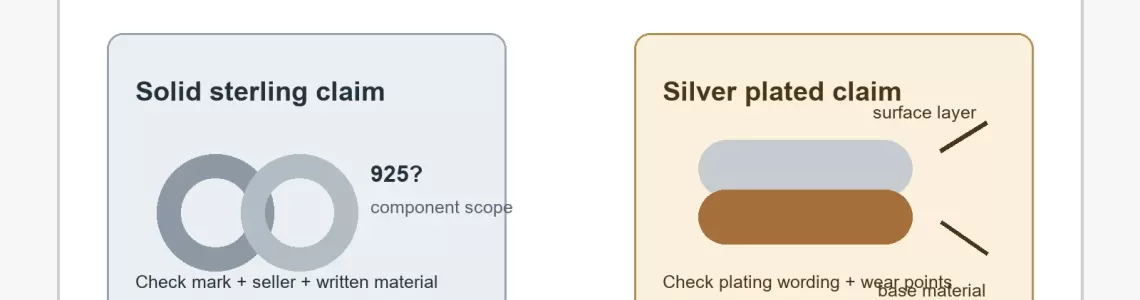
Quick answer: a solid sterling silver bracelet should be represented as a silver alloy that is 92.5% silver, often marked 925 or sterling, while a silver plated bracelet is a base material with a silver layer on the surface. A stamp, color or product photo is useful only when it matches the seller's written specification, return terms and construction details. Buyers should compare the claim, the mark, the base material disclosure, the wear points and the seller identity before treating a bracelet as solid sterling.

Why this distinction matters
"Silver bracelet" is a broad shopping phrase. It can point to solid sterling silver, fine silver, silver-plated base metal, silver-colored stainless steel, plated brass, mixed materials, or a bracelet that contains only a few silver components. Those constructions can all look bright in a listing photograph, but they do not age, repair, clean or price the same way. The U.S. Federal Trade Commission consumer guidance describes sterling silver as 92.5% pure silver and explains that silver plate means a layer of silver applied to a base metal. That difference is the starting point for a careful purchase decision, not a minor wording detail.
For sunMYLOVE shoppers, the practical question is not whether plated jewelry is automatically bad. A plated bracelet can be attractive and affordable when it is described honestly. The risk appears when a listing, marketplace title or reseller description makes the item sound like solid sterling while the durable silver content is only on the surface. A bracelet buyer should therefore read every material claim as a claim about construction, not only color.
What "solid sterling silver" can and cannot prove
Sterling silver is a silver alloy, not pure silver. In common U.S. consumer language and many jewelry references, sterling means 925 parts silver per thousand, with the remaining alloy chosen for workability and strength. A sterling bracelet may still contain non-silver cord, elastic, pearl, stone, clasp springs, plating, oxidation or decorative coating. The term "solid sterling" usually means the silver component is sterling through that component rather than only coated on the outside, but it does not mean every attached material is silver.
That boundary matters for beaded bracelets. A bracelet with sterling silver accent beads and natural stone beads is not the same as an all-sterling bracelet. A red cord bracelet with one 925 silver charm is also not the same as a solid sterling chain. Read the actual component list before comparing prices. If the listing names 925 silver beads, ask whether the claim applies to each silver bead, a single charm, a plated surface or the entire bracelet. A responsible product page should make this visible without requiring guesswork.
What "silver plated" means in practice
Silver plating means silver has been applied over another material. The base can be copper alloy, brass, nickel-containing alloy, steel or another metal. The visible surface may initially resemble solid silver, especially under studio lighting. Over time, friction points such as bead edges, clasp contact areas, bracelet backs and sliding knots can reveal the base material if the layer wears thin. This is a normal construction limit of plating, not proof that every plated item was deceptive.
The key buyer question is disclosure. If a listing says "silver plated brass," "silver tone alloy," or "silver plated copper," you can decide whether the price and expected wear match the construction. If it says only "silver bracelet" while avoiding base material, thickness, plating language and return terms, treat that as incomplete evidence. Do not use home acid tests or scraping on a bracelet you may return; those methods can damage the item and may not answer the full construction question anyway.
Six checks before you buy
1. Match the title to the specification table
Marketplace titles are often compressed for search. The specification table, material bullet and product description should agree. If the title says sterling silver but the material line says "alloy," "silver color," "plated" or "electroplated," the safer reading is that the item is not solid sterling unless the seller explains the difference. Keep a copy of the listing page and order record in case the delivered bracelet does not match the written claim.
2. Read the mark, but do not rely on the mark alone
A 925 mark can support a sterling claim, but a mark is not a complete authentication system for every online purchase. The FTC consumer guide notes that silver items may be marked 925 and that marked silver items should also identify the company or person standing behind the mark. In the UK, hallmarking guidance explains that approved hallmarks are a consumer-protection system applied by assay offices for precious metal articles that meet the relevant rules. Those frameworks are helpful, but they do not turn every stamped object on a marketplace into verified sterling.
For small bracelets and mixed-material pieces, marks may be tiny, absent because of legal exemptions, hidden on a clasp, or applied only to one component. A seller should not use that complexity to make vague claims. Ask which parts are sterling, where the mark is located, and whether the mark is a quality mark, maker mark, decorative stamp or brand code.
3. Check whether plating is disclosed after the silver claim
Some descriptions combine silver with other metal language. "925 silver plated," "sterling plated," "silver coated," and "silver tone" do not mean the same thing as solid sterling silver. U.S. jewelry advertising guidance is specifically concerned with unfair or deceptive precious-metal claims, and the National Stamping Act rule referenced in 16 CFR Part 23 warns against using sterling wording on silver-plated articles in a misleading way. The practical buyer rule is simple: if the construction includes a base metal under a silver layer, the base should be disclosed clearly enough for you to judge value and wear.
4. Look at wear points and design stress
Bracelets receive more friction than earrings or pendants because they move against skin, desks, cuffs and watch bands. Plating usually shows wear first at edges, raised textures, clasp tongues, jump rings and beads that rub each other. Solid sterling can also scratch and tarnish, but surface color change is different from a base metal showing through. If the product has adjustable sliding cord or elastic, inspect whether silver claims apply to beads, end caps, spacer rings or only a charm.
5. Compare price only after comparing construction
A very low price does not prove plating, and a high price does not prove sterling. Weight, bead size, hollow construction, labor, stone content, brand margin and shipping all affect price. Still, if a bracelet is described as large solid sterling silver beads at a price that seems inconsistent with the stated material, slow down and ask for clearer specifications. A hollow 999 fine silver bead bracelet, a 925 accent-bead bracelet and a silver-plated brass bracelet can sit in different price ranges for legitimate reasons.
6. Confirm return terms before interpreting uncertainty
When a seller cannot answer material questions, the return policy becomes part of the risk calculation. Read the store's returns and refunds policy and delivery information before ordering. If the bracelet is customized, sized to order or sold through a marketplace with separate rules, confirm whether material-disclosure disputes are covered. Do not damage the bracelet with destructive testing and then expect a straightforward return.
Comparison table
| Buyer question | Solid sterling silver bracelet | Silver plated bracelet | What to ask the seller |
|---|---|---|---|
| Silver content | Sterling silver component is typically 92.5% silver by mass. | Silver is a surface layer over another material. | Which exact components are sterling, plated or base metal? |
| Marking evidence | May show 925, sterling, maker mark or region-specific hallmark. | May have plating language, brand stamp or decorative mark. | Where is the mark, and what does each symbol mean? |
| Wear pattern | Can tarnish, scratch and dent but remains silver alloy through the silver component. | Can reveal base material at friction points as the layer wears. | What care limits apply to the finish? |
| Cleaning | Use silver-appropriate cloths and avoid methods that harm stones, cord or oxidation. | Avoid aggressive polishing that can remove the plated layer. | Is the piece plated, coated, oxidized, stone-set or mixed-material? |
| Value comparison | Material value depends on weight, construction and current metal content. | Value depends more on design, base construction and finish durability. | What is the listed material weight or component description? |
How to use marks without over-reading them
Hallmarks and quality marks are evidence systems, but they are not magic. The London Assay Office explains that a millesimal fineness mark indicates metal quality in parts per thousand and that official hallmarking marks an article to the lowest standard of precious metal. UK consumer guidance also explains that hallmarking exists to help buyers recognise tested precious-metal items and know where to contact consumer-rights bodies. Those statements are useful when you are buying in a hallmarking jurisdiction or from a seller that provides clear hallmark photographs.
However, many international online jewelry purchases involve small items, mixed materials, items below local hallmarking thresholds, or goods sold from jurisdictions with different rules. That means the correct standard is not "no mark equals fake" or "925 stamp equals proven." The better standard is evidence consistency: the mark, seller identity, material wording, product photos, invoice, return policy and price should all point in the same direction.
Care differences after purchase
Solid sterling silver can tarnish when exposed to sulfur compounds, humidity, cosmetics and storage conditions. Clean it conservatively: wipe after wear, store dry, and use silver-specific cloths or methods only when compatible with the whole bracelet. If the bracelet includes pearls, moonstone, cord, wood, elastic or oxidation, follow the most delicate component rather than treating the entire piece like plain metal.
Silver plated bracelets need even gentler handling. Abrasive polish can remove the layer you are trying to preserve. Do not soak mixed-material bracelets, and keep friction low when storing them. If the plating wears, the practical options are to enjoy the aged surface, ask a jeweler about replating if the base construction justifies the cost, or replace the item. Do not treat wear-through as a medical, spiritual or detox sign; it is a material and finish issue.
Where sunMYLOVE shoppers can continue
Start with the fine and sterling silver bead bracelet collection when you want silver-focused bracelets. Compare individual construction on pieces such as the SUERTE 999 fine silver bead bracelet, the Good Luck 999 fine silver bead bracelet, the Eye of God 925 sterling silver red string bracelet and the freshwater pearl and 925 sterling silver bracelet. For silver purity differences, read the 925 vs 990 vs 999 silver bracelet guide. For maintenance, use the sterling silver bracelet care guide. For claim boundaries, keep the silver bracelet health-claims evidence guide separate from material identification.
Common mistakes
- Assuming any bright white bracelet is sterling silver.
- Treating a 925 stamp as complete proof without checking seller identity and component scope.
- Comparing a plated bracelet and a solid sterling bracelet by color alone.
- Using destructive home tests before reading return terms.
- Ignoring cord, elastic, stone and clasp materials in a mixed bracelet.
- Using aggressive silver polish on plated or oxidized finishes.
Frequently asked questions
Is 925 always solid sterling silver?
No. A 925 mark can support a sterling claim, but it must be interpreted with the written specification, component scope and seller identity. It does not automatically prove every part of a mixed bracelet is sterling.
Is silver plated jewelry fake?
No. It is a valid construction when disclosed clearly. The problem is unclear or misleading wording that makes plated base metal sound like solid sterling silver.
Can a magnet tell me if a bracelet is sterling silver?
A magnet can sometimes reveal a strongly magnetic base component, but it cannot authenticate sterling silver or identify every alloy, plating layer, clasp spring or mixed material.
Will sterling silver turn my skin green?
Skin marks can come from copper-containing alloys, surface compounds, cosmetics, moisture or other materials. A temporary mark is not proof of toxins or health effects. Stop wearing jewelry that causes irritation.
Can silver plating be polished like sterling silver?
Use much more caution. Abrasive polishing can remove plating, especially on raised edges and clasp contact points.
Why does a bracelet say sterling silver and alloy in the same listing?
It may be a mixed-material piece, a poor translation, or an unclear claim. Ask whether the silver wording applies to the whole bracelet, selected components, or only a surface finish.
Should I buy only hallmarked silver?
Hallmarks are strong evidence in jurisdictions where they apply, but small, mixed or international items may follow different rules. Use hallmark evidence together with the full product specification and return terms.
Does solid sterling silver have health benefits?
There is not enough reliable evidence to treat wearing a sterling silver bracelet as a therapy for pain, circulation, immunity, sleep or detox. Choose it for material, design, fit and care needs.
Method and evidence scope
This guide compares buyer-facing material claims, not individual laboratory results. It uses consumer-protection and hallmarking sources to explain how words such as sterling, 925, silver plate, hallmark and fineness should be read. It cannot authenticate a bracelet from a photograph, prove the composition of a specific delivered item, or replace an independent assay or jeweler inspection. Product links are examples from the live sunMYLOVE catalog and should be checked against each individual product page before ordering.
References
- Federal Trade Commission: Buying platinum, gold, and silver jewelry
- 16 CFR 23.5: Misrepresentation as to silver content
- British Hallmarking Council: Hallmarking in the UK consumer protection
- UK hallmarking practical guidance summary
- London Assay Office: What is a hallmark?
- London Assay Office: Mixed metals and plated items
- U.S. Customs and Border Protection: Marking precious metal jewelry
sunMYLOVE editorial note: Prepared by the sunMYLOVE product content team for U.S. and international jewelry buyers. Last reviewed: August 19, 2026. The article is educational, not legal, medical or laboratory advice. It does not claim that jewelry treats, prevents or improves any health condition.
Leave a Comment