
Online Jewelry Buying Checklist: Product Page to Checkout
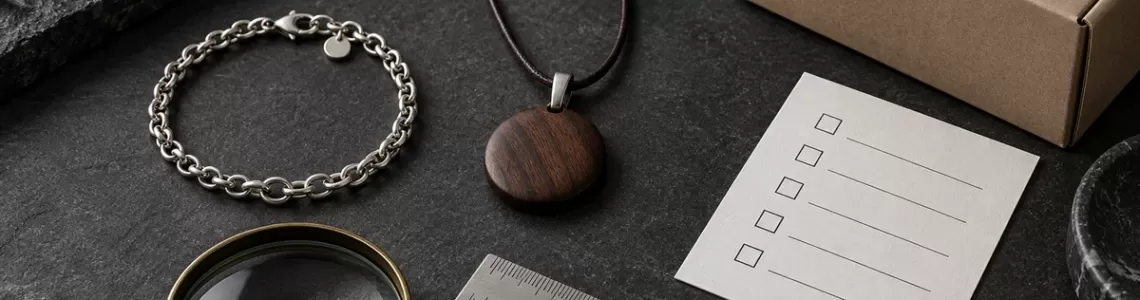
Buying jewelry online is easier when a product page is read as a set of separate promises rather than as one overall impression. A polished photograph may show shape and color, but it does not automatically establish metal content, exact dimensions, wrist fit, cord construction, shipping timing or return eligibility. Before adding a bracelet or necklace to a cart, record the claims that matter, identify what the listing actually measures, and note every decision that still depends on a seller answer. This checklist organizes that work from product page to delivery without treating an attractive image, a star rating or a familiar material word as proof of every quality.
Start with the exact item, option and page state
Save the product URL, title, visible option names and the date you reviewed the page. If a listing offers sizes, colors, materials or pendant variants, select the intended option and confirm whether the image, price, availability and measurements change. A statement attached to a large pendant does not necessarily describe a small pendant option. A bracelet size label can refer to wrist circumference, finished inside circumference, overall strand length or a seller-specific category.
Take a screenshot or preserve the order summary before purchase when a measurement, material or delivery promise is important. The goal is not to build a dispute file for every order. It is to prevent option drift: a buyer may research one variation, then accidentally add another to the cart. Confirm the selected option again in the cart before moving toward checkout.
Do not infer that a photo represents scale. Cropping, camera distance and display size can make a small pendant look large or a heavy bracelet look delicate. Use a documented measurement, then compare it with an object or piece you already own. Our bracelet buying guide provides a separate starting point for wrist measurement and fit; it should be used with the measurements on the specific product page.
Separate material claims by component
A piece of jewelry can combine a precious-metal component, base-metal accent, stone or glass bead, wood, cord, elastic, adhesive and surface coating. Read each material claim at the component level. “Sterling silver bracelet” may describe the main metal, a charm, selected spacers or the entire piece depending on the listing. The wording and scope matter more than the prominence of the phrase.
The U.S. Federal Trade Commission’s Jewelry Guides address representations about type, quality, metallic content, size, weight, treatment, durability and other material aspects. They do not certify any product page. They support a practical reading rule: do not upgrade an ambiguous claim into a broader one. If only a clasp is identified as sterling silver, do not assume every bead, connector and decorative element is sterling.
Hallmarks are evidence, not a complete identity system. A photographed “925” mark can support a claim about the marked component, but a photo does not prove who applied it or whether an unmarked mixed-material part has the same composition. Ask which component carries the mark and whether the listed material applies to the whole item or to named parts. Our mixed-material necklace guide explains how to keep claims attached to the components they actually name.
Translate every measurement into a buying decision
Dimensions are useful only when the measurement method is clear. For bracelets, distinguish actual wrist circumference from finished bracelet length, inside circumference, elastic range and wrap count. For necklaces, distinguish total cord length, maximum closed loop, minimum adjustment, pendant height and wearable drop. For a pendant opening, compare the narrowest usable bail or hole with the largest chain end or folded cord section that must pass through.
Use millimeters for small jewelry components and centimeters or inches for wearable lengths, but avoid false precision when the source is approximate. NIST’s current Handbook 44 collects official measurement and conversion references. That does not turn a seller’s rounded “8 mm bead” into a laboratory measurement. Preserve the original wording—such as approximately 8 mm—and measure consistently.
Bead diameter also changes the path around a wrist. Two bracelets with the same end-to-end length can fit differently if one uses larger, less flexible beads. The bracelet bead-size guide separates bead diameter from wrist fit. For a wrap design, use the double-wrap fit guide to check wrist measurement, turn count and closure range instead of relying on a generic small/medium/large label.
Inspect construction, closure and load paths
Ask what carries the load. A chain depends on links and end fittings; a beaded bracelet may depend on elastic, cord, wire, knots, crimps or a clasp; a pendant necklace may concentrate wear at a drilled hole, bail or sliding knot. Product photos should show the closure, connection points and any high-friction areas clearly enough to identify the construction type.
A lobster clasp, toggle, hook, sliding knot and elastic loop solve different problems. A toggle may be easy to see but needs adequate bar-and-ring geometry. A lobster clasp can be secure when its spring and jump rings are sound, but it may be difficult for some wearers to operate one-handed. Elastic can be convenient but provides no universal service-life guarantee. A sliding knot should move with controlled friction and should not be advertised as certified breakaway hardware unless specific documentation exists.
Look for sharp hole edges, stretched links, open jump rings, uneven crimps, flattened cord, fraying and a knot that can pass through its stopper. These observations do not predict an exact failure date. They help a buyer decide whether a listing shows enough of the load-bearing construction. The bead bracelet construction guide provides a more detailed inspection path for holes, cord and knots.
Use photos for visible facts, not hidden properties
Photographs can establish visible layout, approximate color relationships, surface texture and the presence of a photographed mark. They usually cannot prove alloy composition, treatment history, gemstone identity, wood species, coating chemistry, cord fiber, tensile strength or long-term color stability. Different lighting, white balance, editing and screens can also shift apparent color.
Look for multiple angles, a scale reference and close views of the closure and attachment points. Treat a ruler photo as useful only if the measured edges and units are visible. A lifestyle image can show approximate worn scale, but body size, pose and perspective still affect perception. If fit depends on a few millimeters, use numeric measurements rather than estimating from a model photograph.
Generic photos deserve extra care. If the same image represents several options, ask whether the option changes dimensions, pattern, stone appearance or hardware. Natural materials can vary, but “natural variation” should not be used to erase a specific listing promise. Record which visible differences are expected and which would mean a different item was supplied.
Read reviews as observations, not specifications
Reviews can reveal recurring usability issues: a clasp may be hard to operate, a size label may run smaller than buyers expected, or a cord may arrive with a different feel than photographs suggest. A review cannot replace the current product page because designs, suppliers and options can change. Give more weight to reviews that identify the exact option, explain how a measurement was taken and distinguish observation from assumption.
The FTC’s Consumer Reviews and Testimonials Rule guidance explains boundaries around fake reviews, incentives, insider relationships and review suppression. It does not tell a buyer that every positive or negative review is true. Use it as a reminder to examine context: look for disclosed incentives, suspicious repetition, wrong-product details and whether the reviewer actually describes using the item.
Star averages compress different concerns into one number. Read for fit method, construction, material scope, delivery and service separately. A five-star review about packaging does not validate sterling content. A one-star review caused by a missed delivery date does not by itself prove poor construction. Extract the relevant observation, then compare it with the current listing and your own priorities.
Check shipping language before relying on an arrival date
Separate processing time, shipment date, transit estimate and promised arrival. “Ships in three days” is not the same as “arrives in three days.” Custom sizing, personalization and made-to-order work may begin only after the seller receives required information. Confirm when the clock starts and whether weekends, holidays or address verification affect the estimate.
The FTC’s Mail, Internet, or Telephone Order Merchandise Rule addresses the basis for shipping representations and the seller’s duties when a covered order cannot ship within the promised time. This article is general U.S.-oriented buyer education, not legal advice or a conclusion about a specific transaction. Laws, store terms and remedies vary by location and facts.
For a gift or event, leave a buffer for carrier movement, inspection and any exchange. Do not schedule a non-refundable event around an estimate that the seller does not present as a guaranteed delivery date. If timing is essential, obtain a product-specific answer in writing and confirm that the selected option is in stock or otherwise available under the stated schedule.
Read the return policy for the selected option
Return terms can differ for standard, sale, personalized, engraved, resized, hygiene-sensitive and made-to-order items. Check the return window, when it begins, required condition, packaging, authorization process, return shipping responsibility, restocking terms and whether the original shipping charge is refundable. Do this before altering, wearing extensively or cleaning the item.
The FTC’s online shopping guidance recommends reviewing seller and return information before buying. It does not create one universal return period. A store policy, marketplace rule, card-network process and local law can each have different scopes. Preserve the policy that was displayed for your order and ask before purchase if an option’s eligibility is unclear.
If the received item seems wrong, document the packaging, selected option, visible condition and measurement method before changing anything. Do not retie knots, polish metal, resize a bracelet or apply oils while a return decision is pending. The online jewelry return checklist explains how to preserve condition and compare the received item with the listing without assuming a legal outcome.
Distinguish warranty, service and ordinary care
A warranty, service plan and seller goodwill are not interchangeable. Record duration, covered components, exclusions, required inspection, shipping responsibility and the remedy offered. “Lifetime” needs a defined subject and term; it may refer to the original purchaser, the product’s expected life, a named component or a service program with conditions.
Care advice should fit every material in the piece. A polish suitable for one metal can damage wood, cord, coating or a treated stone. A waterproof claim for one component does not establish safe immersion for an assembled piece. Start with low-risk handling: keep the item dry unless product-specific instructions say otherwise, avoid chemicals and heat, and inspect high-friction areas.
Our warranty-versus-service-plan guide separates written coverage from maintenance promises. Preserve receipts and product-specific instructions when they matter. Do not use a general article, including this one, to override the seller’s documented care process.
Check recall and safety information without inventing risk
A recall search is appropriate when a brand, model or product category raises a specific concern. The U.S. Consumer Product Safety Commission maintains recall and product-safety listings. The presence of recalls in a broad jewelry category does not mean every visually similar item is recalled. Match the brand, model, SKU, date range and description carefully.
Also consider the intended wearer and activity. Small parts, cords and heavy pendants can create different risks for children, while machinery, sports and workplace equipment can create snag or entanglement risks for adults. Remove jewelry when an activity or rule makes it inappropriate. Do not test breakaway strength around a person’s neck or load a bracelet to failure while it is being worn.
If a safety claim is essential, ask for product-specific documentation. “Hypoallergenic,” “nickel-free,” “lead-free,” “breakaway,” “waterproof” and “child-safe” are distinct claims; one should not be substituted for another. A cautious product page states the scope and avoids universal guarantees that the available evidence cannot support.
A cart-to-checkout verification sequence
- Identity: confirm the exact product, URL and selected option.
- Materials: map every claim to the component it describes.
- Measurements: identify the method, unit and whether values are approximate.
- Fit: compare the correct body measurement with the product’s construction.
- Construction: inspect closure, load path, holes, cord, knots and connectors.
- Photos: use them for visible facts, not hidden composition or strength.
- Reviews: extract option-specific observations and check context.
- Shipping: separate processing, shipment, transit and arrival language.
- Returns: confirm the policy for the selected, personalized or sale option.
- Cart: reread option, quantity and total before proceeding; do not place a test order.
The sequence is intentionally conservative. It does not require a seller to answer questions that are irrelevant to your decision. It helps identify the few facts that matter most before money changes hands. If a critical answer is unavailable, record it as data not available and decide whether the uncertainty is acceptable.
FAQ
Does a product photo prove the jewelry’s metal content?
No. A photo can show a visible mark and appearance, but it does not independently verify alloy composition, who applied the mark or whether every component has the same metal content. Use the listing’s component-specific claims and supporting documentation.
Should bracelet length equal wrist circumference?
Not automatically. Finished length, inside circumference, bead diameter, flexibility, wrap count and desired movement all affect fit. Use the seller’s stated measurement method and compare it with an actual wrist measurement.
Can I rely on the largest star-rating average?
A star average is not a specification. Read option-specific reviews for fit, construction, delivery and service separately, and look for disclosed incentives or wrong-product details.
Does an estimated arrival date guarantee delivery?
Not necessarily. Separate processing, shipment and transit estimates. If arrival timing is essential, ask whether the date is guaranteed for the selected option and preserve the written answer.
Can I clean or resize an item before deciding whether to return it?
That can change its condition or return eligibility. Document the item first, review the policy and ask the seller before polishing, retieing, resizing or applying any treatment.
What should I do when a product page leaves an important fact unanswered?
Ask a narrow product-specific question and keep the answer. If the answer remains unavailable, record DATA_NOT_AVAILABLE rather than assuming the most favorable material, measurement, warranty or delivery interpretation.
References and evidence boundaries
These sources support general U.S.-oriented advertising, measurement, online-order, review, return-policy and recall checks. They do not certify a specific product, replace store terms, determine a legal remedy or guarantee fit, delivery or durability.
- Federal Trade Commission: Jewelry, Precious Metals and Pewter Industries Guides.
- National Institute of Standards and Technology: Handbook 44, current edition.
- Federal Trade Commission: Consumer Reviews and Testimonials Rule Q&A.
- Federal Trade Commission: Mail, Internet, or Telephone Order Merchandise Rule.
- Federal Trade Commission Consumer Advice: Online Shopping.
- U.S. Consumer Product Safety Commission: Recalls and Product Safety Warnings.
Leave a Comment