
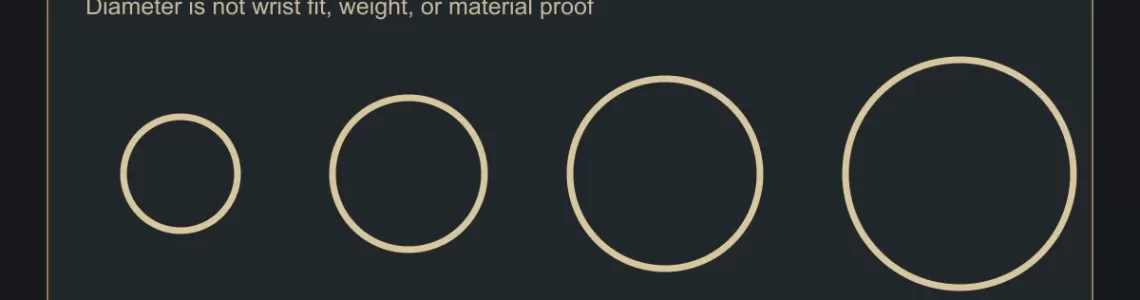
Answer first: a bracelet bead size is the measured diameter of one bead, usually stated in millimetres. It is not the bracelet’s inner circumference, guaranteed wrist fit, weight, hole size, or proof of material. For an online comparison, verify the stated bead diameter, count, bracelet construction, and wrist-fit method separately. Smaller beads generally create a finer visual rhythm; larger beads generally create more visual presence and can reduce usable inner space when the same outside circumference is kept. Those are practical geometric and styling inferences, not universal comfort rules.
Research question and scope
This guide answers a narrow buyer question: what does 6 mm, 8 mm, 10 mm, or 12 mm mean on a beaded bracelet, and how should that number affect an online purchase? It applies to approximately round beads measured across their widest diameter. It does not assume that every bead is perfectly spherical, that nominal size equals every bead’s exact size, or that two bracelets with the same bead diameter fit identically.
The International System of Units uses the millimetre for small lengths. A metric ruler can resolve millimetres, but a caliper is normally easier for a round object because it contacts opposite sides. NIST’s educational metric ruler shows the relationship among millimetres and centimetres and emphasizes reading a length scale accurately. See the NIST Metric Ruler resource. This source establishes the unit and measurement principle; it does not prescribe jewelry style or fit.
Definitions buyers should keep separate
- Bead diameter
- The distance across one bead. For a non-round bead, a useful listing may need more than one dimension.
- Nominal size
- A size label such as 8 mm. Natural materials and handmade finishing may produce variation, so the label should not be read as a claim that every bead is mathematically identical.
- Bracelet length or inner circumference
- The usable loop that must pass over or sit around the wrist. This is a separate measurement from bead diameter.
- Bead count
- The number of beads in the strand. Count, bead diameter, spacers, knots, and closure components all contribute to the outside length.
- Hole size
- The drilled opening through a bead. It affects cord choice and construction, but cannot be inferred reliably from outside bead diameter.
- Profile
- How far the bracelet stands away from the wrist. A larger round bead ordinarily creates a higher profile than a smaller round bead of the same material.
What 6 mm, 8 mm, 10 mm and 12 mm actually tell you
The numbers give a physical scale, not a style verdict. An 8 mm round bead is 2 mm wider than a 6 mm bead, but the visual difference is not merely “two units.” Diameter affects the projected area of the circle and the volume of a sphere nonlinearly. If two beads were perfect spheres of the same density, a 10 mm bead would have about 1.95 times the volume of an 8 mm bead, while a 12 mm bead would have about 3.38 times the volume of an 8 mm bead. Real jewelry rarely follows that ideal exactly because holes remove material, stones vary in density, shapes vary, and metal or cord components add mass.
That calculation is a transparent geometric comparison, not a product-weight claim. Never use it to infer the weight of a listed bracelet unless the seller supplies a measured weight. The FTC’s Jewelry Guides identify size, weight, material, quality, and other characteristics as claims that should be represented truthfully. See the FTC Jewelry Guides overview and the FTC’s business guidance, In the Loupe.
| Nominal diameter | Useful mental reference | Likely visual effect | Buyer check |
|---|---|---|---|
| 6 mm | 0.6 cm | Finer rhythm; more beads are normally needed for the same outside strand length | Check whether photos are close-ups that exaggerate scale |
| 8 mm | 0.8 cm | Middle scale often easy to compare with a ruler | Do not assume “standard” fit; verify the bracelet’s fit method |
| 10 mm | 1.0 cm | More visual presence and a higher profile than 6–8 mm | Check cuff clearance, keyboard use, sleeves, and total construction |
| 12 mm | 1.2 cm | Bold scale; fewer beads may span a similar outside length | Verify inner space and weight instead of judging from diameter alone |
These are comparison cues, not gender rules. A person may prefer any size. Marketing labels such as “men’s,” “women’s,” “bold,” or “delicate” do not replace dimensions.
Why bead diameter changes fit without being the fit measurement
Imagine two circular bracelets with the same outside circumference. The bracelet built from larger round beads uses more of that outside dimension in bead thickness, leaving less usable space inside. That is why copying the outside length of a thin cord bracelet can produce a tighter result when the new bracelet uses larger beads. Stretch, knots, spacers, irregular shapes, and wrist compression complicate the comparison.
The practical sequence is:
- Measure the wrist where the bracelet will sit by following the beaded-bracelet wrist measurement guide.
- Read the specific product’s sizing method. Determine whether it states inner circumference, total laid-flat length, wrist range, or a broad size label.
- Check the bead diameter and whether natural variation is expected. The guide to why natural stone beads vary explains why color, pattern, shape, and finish should not be treated as industrially identical.
- Check construction. Elastic cord, a fixed clasp, an adjustable sliding knot, and a wrap design behave differently. The bead bracelet construction guide separates drill holes, cord, knots, and buyer checks.
- If the listing does not reveal how fit was measured, ask before ordering rather than converting bead diameter into wrist size.
A five-part online comparison method
1. Confirm the unit and measurement direction
Look for “mm” next to a number and identify what was measured. For a round bead, diameter is normally the maximum distance across it. For oval, barrel, disc, or irregular beads, one number may be incomplete. A listing that shows 8 × 10 mm communicates more than “about 10 mm” because orientation matters.
2. Separate measured facts from photography
Close focus, a wide-angle phone camera, cropping, and a small model wrist can make beads look larger. A hand or wrist is an inconsistent scale reference. Use the stated dimension and place that distance against a physical ruler. For a quick paper mock-up, mark circles of 6, 8, 10, and 12 mm; the exercise is approximate but more reliable than comparing differently cropped product photos.
3. Check whether the material can vary
Natural stone, wood, bone, and cultured pearls can vary in shape and surface. GIA describes pearl size in millimetres and treats size as one of several value factors rather than a complete quality grade. Its pearl overview notes that cultured pearl sizes vary and that size sits alongside shape, color, luster, surface, matching, and nacre. GIA also explains that typical ranges are not absolute limits in its cultured pearl types FAQ. These pearl-specific sources demonstrate an important evidence boundary: a diameter is a dimension, not proof of origin, treatment, or quality.
4. Compare the complete bracelet
On the sunMYLOVE beaded bracelets category, compare bead scale together with strand type, metal accents, wrap count, and the product’s own sizing information. For a larger-scale example, the black obsidian and brass 12 mm beaded bracelet should be evaluated from its actual listing rather than assuming that every 12 mm bracelet has the same weight or fit. A long strand that can also wrap, such as the Bodhi root long beaded necklace / wrap bracelet, has a different user task from a single-loop elastic bracelet.
5. Preserve a return-safe decision trail
Save the listing’s measurement language, selected size, and any seller answer before purchase. If buying a gift, use the bracelet gift pre-purchase checklist to distinguish fit evidence from assumptions about shipping and returns. Review the current returns and refunds page; do not assume personalized, resized, or worn items follow the same route as standard items.
Comfort, movement and daily use
There is no evidence-based rule that one bead diameter is comfortable for every wrist. Comfort depends on wrist anatomy, fit allowance, bead surface, total weight, cord tension, spacers, work tasks, and personal preference. Larger beads can feel more prominent against a keyboard edge or under a close cuff. Smaller beads can create more articulation because more joints or cord contact points may occur around the loop. Those are reasonable mechanical expectations, not guarantees.
For work involving rotating machinery, energized equipment, food production, medical procedures, gloves, or contamination control, workplace rules may be more important than diameter. The article on wearing bracelets at work provides task-based checks and does not claim that a smaller bracelet is automatically safe.
Safety boundary: adult jewelry is not a children’s toy
Loose beads are small objects. The CPSC’s small-parts regulatory summary concerns products intended for children under three and explains the small-parts rule. That regulation should not be misapplied to claim that adult jewelry has been tested or certified as a toy. The practical boundary is simpler: keep loose beads, broken strands, and adult jewelry away from young children, and do not describe an adult bracelet as child-safe without applicable evidence.
Common mistakes
- Treating 8 mm as a wrist size. It is normally one bead’s diameter.
- Comparing photos instead of dimensions. Crop and perspective change apparent scale.
- Assuming bead diameter predicts weight. Density, drill hole, bead count, metal components, and construction matter.
- Assuming nominal size means zero variation. Natural and hand-finished beads may not be identical.
- Ignoring inner circumference. Larger beads can reduce usable inner space at the same outside length.
- Using gender labels as measurements. “Men’s” is not a millimetre value or fit specification.
- Forgetting task clearance. A high-profile bracelet may interact with cuffs, desks, gloves, and equipment.
- Inferring material or quality from size. Diameter cannot prove stone identity, treatment, silver fineness, or craftsmanship.
A practical comparison when two listings use the same diameter
Suppose two bracelets both list 8 mm beads. Do not treat them as equivalent. First compare the stated inner circumference or wrist range. Then compare whether one design uses round beads while the other mixes spacers, metal components, or irregular natural beads. Check whether the closure is elastic, corded, or fixed, because the same nominal circumference can behave differently when the bracelet is stretched over the hand or opened at a clasp. Finally, compare the seller’s photographs only after the measurements: camera distance, wrist size, and cropping can make an identical diameter appear larger or smaller.
This sequence is intentionally conservative. It helps a buyer identify which facts are known and which remain assumptions. If a listing gives diameter but omits inner circumference, strand construction, or a usable wrist range, ask the seller before buying rather than converting diameter into a fit promise. For a gift, keeping the return window available is often more useful than guessing from the recipient’s body size, clothing size, or a photograph.
Buyer checklist
- Is bead diameter stated in millimetres?
- Is the bead round, oval, disc, barrel, or irregular?
- Is a second dimension needed?
- Does the listing provide inner circumference, wrist range, or only an outside length?
- What are the bead count, spacer pattern, and closure or cord type?
- Is natural dimensional variation disclosed?
- Does the photo include a trustworthy scale reference?
- Will the profile suit sleeves, a keyboard, gloves, and daily tasks?
- Are return and resizing terms clear for the selected configuration?
Frequently asked questions
Is 8 mm the standard bracelet bead size?
No universal standard makes 8 mm the correct choice for everyone. It is a common nominal diameter in listings, but fit still depends on inner circumference, construction, and the wearer.
Are 10 mm beads much bigger than 8 mm beads?
The diameter is 25% larger. If ideal spheres of the same material are compared, volume is about 95% greater. Real bracelet weight will differ because material, holes, count, and components vary.
Do larger beads make a bracelet tighter?
They can reduce inner space when the outside circumference remains the same, but construction may compensate. Use the seller’s inner-circumference or wrist-range method rather than bead diameter alone.
Can I measure a bead with a ruler?
Yes, approximately. Align the maximum width with millimetre marks and view straight on. A caliper is generally easier for a round bead, but its reading is only as useful as correct placement and reasonable precision.
Does a larger bead mean higher quality?
No. Size is one characteristic. It does not prove material identity, treatment, durability, surface quality, origin, or workmanship.
How many 8 mm beads make a bracelet?
There is no fixed count. The answer depends on the intended loop, spacers, knots, closure, hole path, bead variation, and how fit is defined.
Should a gift buyer choose smaller beads to be safe?
Not automatically. Smaller beads do not solve an unknown wrist measurement. Verify fit, preferences, task use, and return terms.
Method, evidence limits and editorial note
We reviewed dimensional measurement guidance, U.S. jewelry-claim guidance, gemological pearl-size material, child small-parts scope, sunMYLOVE’s live category and product pages, and existing fit and construction guides. Search volume for the primary query is UNKNOWN; no volume has been invented. The numeric sphere comparisons are calculations from ideal geometry and are labeled as such. They do not establish the weight of a real product. Style and comfort statements are decision aids, not clinical or ergonomic findings.
Reviewed: September 19, 2026. sunMYLOVE editorial note: product-specific dimensions and construction should be checked on the current listing. This guide does not certify any product, replace a seller’s measured fit information, or promise identical natural beads.
References and evidence scope
- NIST, Metric Ruler (SP 376) — SI length-scale reading and millimetre context.
- Federal Trade Commission, Jewelry Guides — truthful representation of jewelry characteristics including size and weight.
- Federal Trade Commission, In the Loupe — accurate, non-deceptive jewelry descriptions and material disclosures.
- Gemological Institute of America, Pearl — size as one of multiple pearl value factors and millimetre ranges.
- GIA, cultured pearl types and characteristics — typical sizes vary and are not absolute limits.
- U.S. Consumer Product Safety Commission, Small Parts Regulatory Summary — scope boundary for products intended for children under three.
Leave a Comment