
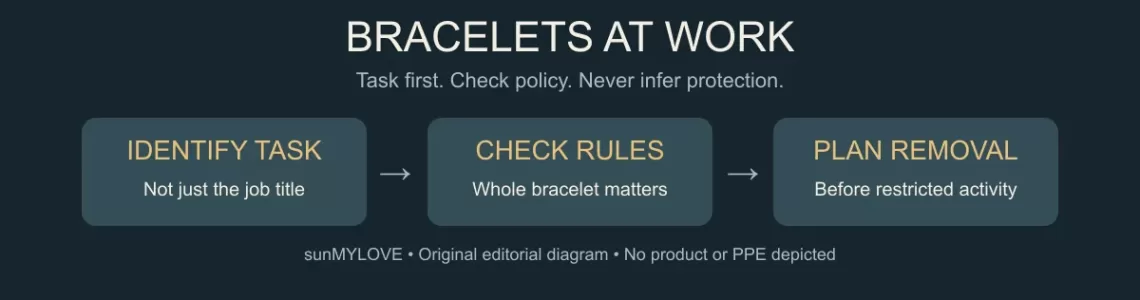
Answer first: Wearing bracelets at work depends on the task, the workplace policy and the entire bracelet, not simply whether its beads are silver, stone or wood. Remove decorative wrist jewelry before operating machinery where it can become entangled, before tasks subject to a no-jewelry food-preparation rule, and whenever your employer's electrical-safety procedures require removal. An ordinary desk setting may permit a bracelet, but permission must be checked rather than inferred from a product photograph. No sunMYLOVE bracelet is represented here as occupational protective equipment.
Research question: What should a bracelet buyer check when a working day combines commuting, desk work and tasks that do not permit wrist jewelry? This guide separates documented restrictions from personal comfort and offers an editorial buying checklist, not legal advice, electrical instruction or a workplace risk assessment.
Scope: the task matters more than the job title
A job title is an incomplete description of a day. Someone with an office role may enter a workshop; a restaurant employee may switch from administration to preparation; a technician may perform both paperwork and equipment work. Our decision framework therefore starts with the activity you will actually perform. It does not declare every workplace unsafe for jewelry or every small bracelet acceptable.
The sources below address U.S. electrical work practices, a U.S. model food code, one state's food rule, Canadian machine-safety guidance and a university workshop policy. Their jurisdictions and purposes differ. They are evidence of specific restrictions, not a worldwide permission system. International readers should check the applicable local requirements and their own employer's written procedures.
For comparing appearance outside restricted tasks, the beaded bracelet collection shows mixed-material designs. A material listing helps identify components; it does not establish workplace approval. Use the process below before choosing any piece for a working-day routine.
Definitions that keep the decision clear
- Decorative wrist jewelry: a bracelet or similar ornament worn for personal appearance, rather than certified protection.
- Whole-piece assessment: considering beads, metal spacers, cord, closure, loose ends and charms together. A bead label describes only one part.
- Task restriction: a condition attached to an activity or work area. Permission at a desk does not automatically continue at a machine.
- Dress-code preference: an appearance requirement that may apply even when a specific hazard is not identified in this guide.
- Removal routine: a planned place and time to take off and store jewelry before entering a restricted activity, rather than improvising beside equipment.
These are editorial working definitions. They help shoppers ask clear questions; they are not replacements for definitions used in regulations or employer training.
Wearing bracelets at work: what the evidence actually says
1. Moving machinery: material substitution is not the answer
The Canadian Centre for Occupational Health and Safety advises against bracelets and other jewelry that could become entangled in moving metalworking-machine parts. The advice addresses what is worn around equipment, not just the jewelry's metal composition. A cord-and-wood design therefore cannot be treated as exempt merely because its main beads are not metal. Source: CCOHS, Metalworking Machines—General.
Cornell University's basic shop rules also exclude loose clothing and jewelry. This is a concrete example of an institution's workshop policy, rather than evidence that every university or office has an identical rule. Source: Cornell Environment, Health and Safety, Tool and Machine Safety.
Buying implication: do not shop for a bracelet to wear during a prohibited machine task. Shop, if appropriate, for use after that task or outside the area. A tighter fit, hidden knot or smaller bead is not a substitute for removal. We have no testing that establishes a safe entanglement threshold for any product.
2. Electrical contact: read the condition and the limitation
The official 2025 annual edition of 29 CFR 1910.333(c)(8) addresses conductive apparel, including bracelets, when it might contact exposed energized parts. The text also contains a conditional provision for rendering such articles nonconductive. This guide does not omit that qualification, but it does not translate it into permission to wrap jewelry yourself. Follow the employer's qualified safety process; this article cannot establish the adequacy of an insulating method. Source: official CFR annual edition, section 1910.333(c)(8), final PDF page.
Buying implication: a bracelet described as stone or wood may still have metal spacers or a closure. The silver bracelet collection is an appearance and material comparison, not a catalogue of electrically approved accessories. No conductivity certification or electrical-work approval is claimed for these items.
3. Food preparation: a model code is not identical to every local rule
FDA Food Code 2022, section 2-303.11, excludes arm and hand jewelry during food preparation, with a plain-ring exception. That exception is not a bracelet exception. The provision also mentions medical-information jewelry; essential medical identification needs a suitable accommodation discussion, not unilateral removal based on a shopping article. Source: FDA Food Code 2022, section 2-303.11, printed page 52.
FDA describes the Food Code as a model used by jurisdictions to develop or update rules. Calling its wording the law in every country or every U.S. locality would overstate its scope. Source: FDA, FDA Food Code overview.
Washington's published WAC 246-215-02330 illustrates why local checking matters: its ring exception uses different wording and includes a glove condition. Its arm-and-hand jewelry restriction still does not create general permission for a covered bracelet. Source: Washington State Legislature, WAC 246-215-02330.
Buying implication: choose a decorative bracelet for permitted off-task use, not on the assumption that washing, a glove or an antibacterial-sounding material claim overrides the applicable rule.
4. Desk work: an evidence gap is not a blanket prohibition
The cited machinery, electrical and food provisions do not establish a universal ban for ordinary desk work. Equally, they do not certify desk use of a particular bracelet. For a permitted setting, appearance, typing comfort, sleeve contact and ease of removal become personal selection questions. Those are preferences to check in your own routine, not measured safety benefits.
A task-first decision table
The following is an editorial triage framework derived from the limited sources above. It is not an official compliance chart.
| Planned activity | First question | Buyer action |
|---|---|---|
| Metalworking machinery | Can jewelry become entangled, or is the area jewelry-free? | Remove before the task; do not substitute another bead material. |
| Work with exposed energized parts | What does the approved electrical-safety procedure require? | Follow the qualified procedure; do not improvise a covering. |
| Food preparation | Which local rule and employer policy apply? | Do not assume a ring exception permits a bracelet. |
| Ordinary permitted desk setting | Does the dress code allow it, and is it comfortable? | Compare fit and structure for preference, not hazard protection. |
| Mixed or uncertain duties | Will the next task change the restriction? | Clarify first and plan removal before the transition. |
A practical buying method for permitted use
Step 1: list the transitions, not just the outfit
Write a short sequence of your usual day: commute, desk, workshop visit, lunch preparation, meeting and return journey. Mark every area where your employer requires jewelry removal. If the same bracelet would have to come off repeatedly, convenient storage may matter more than its visual versatility. This exercise is an organizational suggestion, not a finding from a wearer trial.
Ask the supervisor or designated safety contact: “Are decorative bracelets allowed for this exact task? Does that change when I enter another area?” Avoid asking only whether silver or wooden jewelry is permitted; that may leave the assembly and activity unanswered.
Step 2: inventory the entire design
Record every component stated on the product page. The Obsidian and Brass 12 mm Beaded Bracelet is a relevant example of a listing that names both a stone and a metal. This link identifies the offered design, not proof of independent material testing or permission to wear it at machinery.
Check whether photographs show a dangling ornament, projecting end, clasp or multiple turns. Ask for clarification where details are not given. Do not assume a cord is breakaway-rated, a clasp releases at a particular force or a metal part has an insulating coating. None of those performance claims follows from a picture.
Step 3: measure for comfort only after permission is clear
Use the wrist measurement guide to distinguish the wrist measurement from the finished bracelet dimensions requested by the seller. Measure where you intend to wear it and follow the specific product's sizing instructions. If the meaning of an option is unclear, clarify it before ordering rather than adding an arbitrary allowance.
In a permitted setting, check normal hand movement and sleeve contact without approaching tools or equipment. A fit that feels pleasant while typing is a personal result. It is not an entanglement test. Do not intentionally catch or pull jewelry to see whether it breaks, and do not use a “snug enough” rule to defeat a removal requirement.
Step 4: compare closure access and maintenance questions
For permitted wear, decide whether you can remove the design conveniently using its intended mechanism. A multi-wrap piece and a cuff may suit different preferences, but neither style is inherently approved for a workplace. The brass cuff collection provides a different design format to compare; the collection's legacy URL is not evidence that every item is pure copper.
Ask how the piece should be put on and removed, whether adjustment is intended, and who should repair worn cord or a damaged closure. See the bracelet construction guide for separate cord, hole and knot questions. Do not repeatedly bend a cuff or modify a clasp to make an unverified quick-release system.
Step 5: decide when it will actually be worn
A purchase can still make sense for evenings, commuting or other permitted occasions even when it is unsuitable for an occupational task. Conversely, if your main use is a jewelry-free environment, postponing the purchase may be the more useful decision. Our bracelet buying guide helps organize general material and sizing questions; it does not override a workplace rule.
A removal and care routine without improvised safety fixes
As an editorial convenience suggestion, choose a consistent storage place away from active equipment, exposed food and process areas. Remove decorative jewelry before crossing into a restricted activity, put it in a closed personal container and check that it is accounted for before leaving. Do not reach into operating machinery to retrieve a dropped item; follow the site's established procedure and seek the responsible person's help.
Storage should not turn into an excuse to clean a bracelet with workplace chemicals. Ask for the complete piece's care instructions rather than treating a metal cleaner as suitable for wood, cord or pearl components. The mixed-material bracelet cleaning guide addresses that separate decision. This article does not claim any decorative bracelet can be sterilized, disinfected for professional use or safely exposed to an unspecified chemical.
If the piece has been damaged or contaminated, do not infer continued suitability from the fact that the beads look intact. Describe the event to an appropriate professional and follow workplace procedures for contamination. Product care and occupational protection are different questions.
Common mistakes and the counterarguments
- “It is natural, so it is safe at work.” Natural describes origin, not task approval. Nonmetal designs still need the same policy check.
- “My coworker wears one.” Another person's habit is not the written rule or a task assessment.
- “A glove makes it acceptable.” A glove condition for a ring is not general permission for wrist jewelry.
- “A strong bracelet is safer.” Strength is not a substitute for removing jewelry near an entanglement hazard.
- “A weak cord will protect me.” We have no release-force testing, injury-prevention evidence or certified breakaway claim.
- “All work settings ban bracelets.” The sources have specific scopes. Check the actual task and employer policy instead of inventing a universal ban.
The strongest limitation is that we have not evaluated your workstation or tested these products under occupational conditions. We also cannot determine the law applicable to an individual workplace. Those limits favor checking with the responsible people, not making a more confident sales claim.
Frequently asked questions
Can I wear a bracelet in an ordinary office?
Possibly, if the employer's policy and actual duties permit it. The cited restrictions do not establish a blanket desk-work ban. Check comfort in that permitted setting and remove it before entering a task or area with different requirements.
Is a wood or stone bracelet an approved alternative near machinery?
No approval can be inferred from those materials. CCOHS machinery guidance addresses jewelry that can become entangled. A material change does not replace compliance with a removal rule.
Does silver purity determine electrical-work suitability?
No product approval follows from a purity description. Consider the whole piece and follow the employer's electrical-safety procedure. This guide does not certify conductivity, insulation or electrical protection for any bracelet.
Can a food worker cover a bracelet with a glove?
Do not assume so. FDA's model provision has a plain-ring exception, not a bracelet exception, and local wording can differ. Check the applicable requirement with the person responsible for food safety.
Should I remove medically necessary identification?
Do not change essential medical identification solely because of this article. Discuss an appropriate arrangement with the responsible workplace contact and relevant professional. This guide concerns decorative jewelry and does not prescribe an individual accommodation.
Can I buy a breakaway bracelet for work?
This guide provides no certified breakaway recommendation. Do not assume ordinary cord or a closure releases at a protective force. If jewelry is prohibited for the task, an unverified breakaway claim is not permission to wear it.
Method, references and evidence scope
Method: reviewed the public sunMYLOVE catalogue and sitemap for relevance and distinct intent, then checked the official documents below. Sources were selected for directly relevant rules or guidance, not their ability to endorse a product. The six links represent five institutional sources; two FDA documents are complementary, not independent experiments. No wearer study, laboratory product test or workplace inspection was conducted.
- CCOHS: Metalworking Machines—General. Machinery entanglement guidance; not a consumer bracelet certification.
- Cornell EHS: Tool and Machine Safety. A specific university shop policy; not a worldwide workplace rule.
- GovInfo: 29 CFR 1910.333, 2025 annual edition. Official dated regulatory text; section (c)(8) is relevant. Current applicability requires qualified checking.
- FDA: Food Code 2022. Section 2-303.11 and related explanatory scope; a model provision, not proof of adoption everywhere.
- FDA: Food Code overview. Explains the model-code role; not a separate clinical experiment.
- Washington State Legislature: WAC 246-215-02330. A jurisdiction-specific comparison illustrating different ring-exception wording.
Reviewed: September 17, 2026. sunMYLOVE editorial note: this is a research-informed buying guide by sunMYLOVE, not a safety certification or professional compliance service. Product links identify real catalogue entries only. Personal selection and storage suggestions are labeled editorial advice; no injury reduction, antimicrobial effect, protective release, occupational approval or medical benefit is claimed.
Leave a Comment