
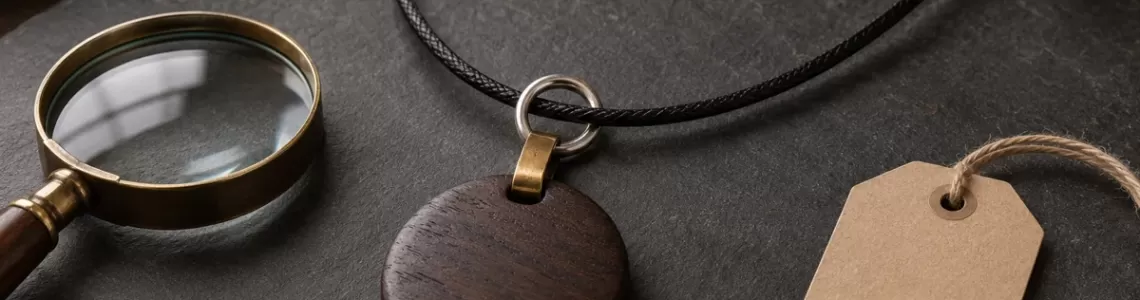
When a necklace combines several materials, read every material claim as applying only to the component it actually names. A “925” mark on a connector does not automatically make the pendant, clasp, accent, cord or complete necklace sterling silver. Likewise, a gold-colored accent is not proven brass, and a dark pendant is not proven ebony, by appearance alone. The safest buying method is to build a component map from the listing, then ask for clarification wherever a part, finish or coating is unnamed.
This guide explains how to read mixed-material necklace descriptions without turning a stamp, color or photograph into a whole-piece certification. It is consumer education, not an assay or legal opinion. Marking rules differ by market, and only the seller, maker or qualified testing body can substantiate the exact composition of a particular item.
Start with a component map, not a single material label
Write down the necklace as separate parts: pendant body, decorative accent, bail or connector, jump ring, clasp or adjustment, cord or chain, coating and any adhesive. Then place each listing claim beside the part it names. “Wood pendant with brass accent on waxed cord” is a component-level description. “Sterling silver necklace” is broader language and should be supported by a clear explanation of what is sterling.
The U.S. Jewelry Guides define deceptive material representations broadly. The current 16 CFR Part 23 purpose and scope, reproduced by Cornell Law School's Legal Information Institute from the federal regulation, covers claims about metallic content, quality, treatment, durability and other material facts. That principle matters most when one assembled object contains materials with very different value, wear and care characteristics.
A component map also keeps unknowns visible. If the listing names the pendant and cord but does not identify the connector, write “connector material: not stated.” Do not fill the gap with “probably silver” because the connector looks bright. Silver color can come from many alloys, plated surfaces and finishes.
What 925 does and does not tell you
The current federal Jewelry Guides provision for silver cautions against describing all or part of an item as sterling silver unless that part is at least 925 parts per thousand pure silver. It separately treats silver-coated or silver-plated products, where silver is applied over another substance.
That definition answers fineness for the part legitimately carrying the claim. It does not identify every attached component. A necklace can have a sterling connector attached to a brass pendant, a sterling pendant on a textile cord or a plated clasp on a chain of another material. The scope of the claim matters as much as the number.
Our guide to whether sterling silver is nickel-free explains another boundary: 925 is a fineness statement, not a complete alloy recipe or a universal “hypoallergenic” guarantee. If skin sensitivity is part of the buying decision, ask about each metal part that touches skin rather than relying on one stamp.
Do not confuse 925 with the standards described in the German silver versus sterling silver guide or the coin silver versus sterling silver guide. Similar names can refer to very different compositions. A responsible listing should use the precise term for the precise component.
A hallmark, a quality mark and a seller description are different evidence
A hallmark is not simply any tiny symbol. In the United Kingdom, a legal hallmark is a structured set of marks applied under the hallmarking system. The British Hallmarking Council's practical hallmarking summary explains the purpose of the sponsor's mark, fineness mark and assay-office mark, as well as exemption weights. A U.S. quality mark and maker's trademark operate under a different framework.
Therefore, do not call every “925” stamp a UK hallmark, and do not call the absence of a UK hallmark proof that an item is fake. Small articles may fall below a jurisdiction's compulsory hallmarking threshold, products may be sold under another legal system, and a quality mark is not the same thing as an independent assay-office hallmark.
Photographs can help you confirm that a mark appears on a particular part, but a photo cannot assay fineness. Ask for a clear image showing where the mark sits, what symbols accompany it and which component the seller says it identifies. Treat a blurred or cropped mark as incomplete evidence, not automatic proof of fraud.
Mixed-material marking shows why scope matters
Government guidance from Competition Bureau Canada on marking mixed metals states that marking must not suggest that an article is precious metal when it is not. Its detailed marking guidance says that when only part of an item is precious metal, the name of that part should be specified with the quality mark.
The Sheffield Assay Office gives a related example under UK rules in its guidance for mixed-metal and mixed-material items. Eligible articles can contain precious metal with base metal or other materials, but the hallmark applies to the precious-metal component; other materials should remain distinguishable, and additional mixed-material marking requirements can apply.
These systems are not interchangeable, but they point to the same practical buyer question: “Which part does this mark describe?” A listing that answers that question directly is more useful than one that places “925” in the title while leaving the pendant, chain, accent and clasp undefined.
Read wood, brass and cord claims independently
Mixed-material necklaces do not need a precious-metal component to require careful reading. The verified record for the S586 handcrafted ebony wood and brass pendant necklace lists black ebony wood, brass and waxed cord. The S592 circle pendant necklace and S664 shield pendant necklace likewise identify wood, brass and waxed cord in their verified records.
Those listings are useful because the component claims are separated. They do not establish an unstated silver part, waterproof finish, brass coating thickness, adhesive, wood treatment or service promise. A buyer should preserve that boundary instead of upgrading a complete description into claims the seller did not make.
The same rule applies to the Q092 long beaded necklace and wrap bracelet. Its verified record identifies approximately 8 mm Bodhi-root beads, brass components and a reproduction-style dZi focal bead. Those are component claims, not proof that every bead is identical, that the focal bead is an archaeological artifact or that any metal part is sterling.
Appearance words and material words should remain separate. “Silver-colored,” “gold-tone,” “black,” “natural-looking” and “antique finish” describe appearance unless the listing supplies a material or process claim. A photograph can support color and design observations, but it cannot replace composition disclosure.
Plating and coatings need their own line in the map
If a metal surface is plated, coated, lacquered, oxidized or intentionally patinated, record that treatment separately from the underlying material. “Silver-plated brass” contains two claims: a brass base and a silver surface layer. It is not equivalent to solid sterling silver, and the expected wear pattern can differ.
Ask whether the finish applies to all metal parts or only one accent. If a listing says “925 silver plated,” ask what the base material is and what the seller means by the phrase. The FTC distinguishes silver plate from silver material, while different countries may prescribe particular marking language. Do not convert an unclear marketing phrase into a thickness or durability promise.
The same caution applies to wood finishes. A glossy dark pendant is not automatically lacquered, and a matte surface is not automatically unfinished. Finish identity affects care, but this article does not infer oil, wax, stain or coating from a photograph. Our wood pendant necklace care guide uses a dry-first routine precisely because mixed surfaces and finishes can be unknown.
Skin-contact claims require more than a precious-metal number
A fineness number does not by itself describe every alloying element, solder, plating, clasp or adjacent base-metal part. The European Chemicals Agency's overview of skin-sensitising chemicals identifies nickel as a major cause of skin allergy and notes restrictions for articles in long-term skin contact, including necklaces.
This does not mean that every mixed-material necklace contains nickel, and it does not diagnose an allergy. It means “925” should not be used as a shortcut for a whole-piece skin-contact claim. If sensitivity matters, ask the seller about the pendant back, connector, clasp, adjustment bead and any metal surface that can touch skin.
Terms such as “hypoallergenic,” “nickel-free” or “safe for sensitive skin” need their own substantiation. They are not automatic consequences of silver color, a 925 stamp or the presence of one sterling component. If you have a known allergy, medical advice and product-specific documentation are more appropriate than an online visual guess.
Questions to ask before buying
Ask the seller to identify the material of each visible and functional part. A concise request can list pendant, accent, bail, jump ring, clasp, chain or cord. If the necklace is adjustable, ask whether the adjustment component has the same material as the cord or introduces another metal.
Ask where any 925 or hallmark appears and which part it describes. Request a clear photograph if the mark matters to the purchase. Ask whether “silver” means sterling material, another silver alloy, silver plate or simply silver color. If plating is claimed, ask for the base material and any care limitations the seller can document.
Ask which facts are verified and which are design descriptions. “Ebony,” “brass,” “sterling silver” and “waxed cord” are material claims. “Vintage,” “tribal,” “artisan,” “healing” and “lucky” may be style or symbolic language unless supported by specific evidence. The natural-stone jewelry meaning guide shows the same discipline for stone claims: category labels should not erase treatment, synthetic or imitation boundaries.
Finally, read the written return policy and keep a copy of the listing. If the received item differs materially from the description, photographs of the item, packaging and component marks can help you communicate the issue. Do not scratch, file, acid-test or disassemble the necklace merely to create evidence.
Red flags and non-red flags
A listing is incomplete when it repeatedly says “925 necklace” but identifies no component, when photographs show several visibly different materials with no explanation, or when “solid,” “plated” and “sterling” are used interchangeably. A copied hallmark image that is not shown on the actual item is also weak evidence.
By contrast, mixed materials are not a defect by themselves. Wood, brass, cord and precious-metal components can be intentionally combined. A small silver part does not need to make the whole piece silver to be accurately described. The quality of the disclosure depends on whether each important component is named and whether broad claims are properly limited.
The absence of a visible stamp in a product photo is not automatic proof of misrepresentation. Marks can be small, hidden by angle or absent under some legal thresholds and markets. The correct response is a clarification question, not a laboratory conclusion from a thumbnail.
A five-minute component audit
First, list every visible part. Second, copy the exact material words from the product page. Third, draw a line from each claim to one component. Fourth, circle every unassigned part or broad phrase. Fifth, ask only the questions needed to close those gaps.
Then separate composition evidence from fit and condition. A component can be accurately described but still be too large, too short, worn or incompatible with another part. Our pendant bail-size guide explains why physical fit is a separate question from material identity.
Save the listing, seller answers and images that influenced the purchase. This record is more useful than trying to remember whether “925” appeared in a title, specification tab or photograph. It also prevents one accurate component claim from being remembered later as a claim about the whole necklace.
FAQ
Does a 925 stamp make the whole necklace sterling silver?
No. It can support a sterling claim for the component that legitimately carries the mark, but the pendant, chain, clasp, accent and cord must be identified separately. Ask which part the stamp describes.
Is silver-colored metal the same as sterling silver?
No. Color alone cannot identify alloy, plating or fineness. Look for a precise written material claim and appropriate marking evidence rather than relying on appearance.
Can a necklace combine sterling silver with brass or wood?
Yes. Mixed-material construction can be intentional. The important buyer check is whether the listing clearly limits each material claim to the correct component.
Is every 925 mark a UK hallmark?
No. A UK hallmark has defined component marks within the UK system. A 925 quality mark or stamp under another market is not automatically an assay-office hallmark.
Does 925 mean nickel-free or hypoallergenic?
Not automatically. 925 states silver fineness, not the full alloy recipe or the composition of solder, plating and other attached parts. Ask for product-specific substantiation when skin sensitivity matters.
What should I do if the listing does not name the connector or clasp?
Record the material as not stated and ask the seller. Do not infer sterling, brass, stainless steel or plating from color or from a mark shown on a different component.
References and evidence boundaries
The references below explain general description, marking, hallmarking and skin-contact principles. They do not assay a sunMYLOVE product, provide a warranty or replace jurisdiction-specific advice. Product examples in this article are limited to the verified local facts ledger. The featured image is an original generic educational still life, not a product photograph or certification.
- 16 CFR § 23.0 via Cornell Legal Information Institute — federal Jewelry Guides purpose and scope for representations about industry products.
- 16 CFR § 23.6 via Cornell Legal Information Institute — sterling-silver fineness and silver-coating distinctions.
- Competition Bureau Canada: Marking Mixed Metals and Detailed Requirements for Marking Precious Metals — truthful mixed-metal marking and naming the precious-metal component.
- British Hallmarking Council and GOV.UK: Hallmarking Practical Guidance — hallmark structure, purpose and exemption weights.
- Sheffield Assay Office: Hallmarking on Mixed-Metal Items — component-level hallmarking in eligible mixed-material articles.
- European Chemicals Agency: Skin-Sensitising Chemicals — nickel and long-term skin-contact boundaries.
Leave a Comment