
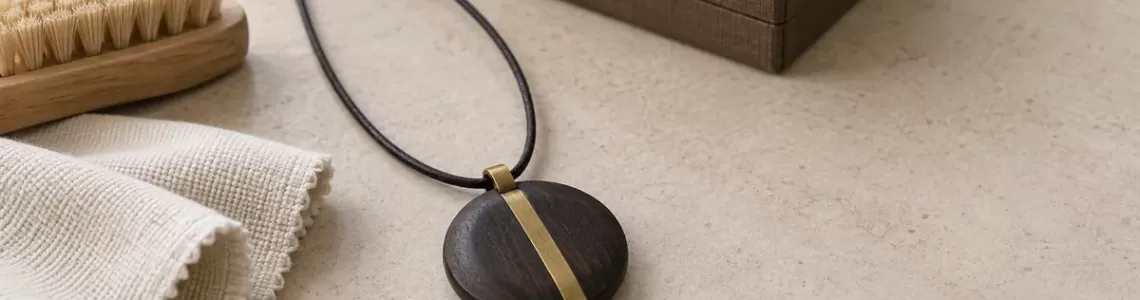
To care for a wood pendant necklace, keep the whole piece dry, limit rapid changes in heat and humidity, wipe it gently after wear and store it so the pendant, metal details and cord are not crushed or tangled. Do not soak a mixed-material necklace or apply oil, wax, metal polish or cleaner unless the maker identifies the exact finish and approves that treatment. Wood, brass and waxed cord can react differently to the same product, so the safest routine is preventive care rather than aggressive cleaning.
This guide is for ordinary ownership decisions, not restoration. It does not assume that every dark wood is ebony, every gold-tone detail is brass or every black cord has the same coating. Use the seller's material list and care instructions for the exact necklace. If the finish, adhesive, attachment or prior treatment is unknown, leave it unknown and choose the least invasive action.
Why a wood pendant necklace needs mixed-material care
A pendant necklace can combine a porous organic material, a metal accent, a coated or waxed cord, adhesives and small connecting parts. Those materials do not share one universal cleaning method. Water that appears harmless on a metal surface can enter unfinished wood or soften an unknown adhesive. A polish intended for bare brass can abrade a coating, stain nearby wood or leave residue in cord fibers.
The Canadian Conservation Institute's basic care guidance for wooden objects explains that wood exchanges moisture with the surrounding air, swelling as humidity rises and shrinking as it falls. Museum guidance addresses objects under controlled conditions, not wearable jewelry, but the material principle is useful: repeated extremes and rapid environmental changes are reasons for caution.
Care should therefore be based on the most vulnerable known part. If a necklace includes wood, cord and metal, a method that is acceptable for one isolated material is not automatically safe for the assembled piece. Treat the necklace as a composite object unless the maker says components can be separated and gives care instructions for each part.
Start by identifying what is actually listed
Read the product description, specification area and option label before deciding how to clean anything. Record the stated wood, metal, cord and finish. Distinguish verified language such as “ebony wood,” “brass” or “waxed cord” from appearance words such as “black,” “gold-tone” or “polished.” A photograph cannot confirm wood species, alloy, plating, lacquer, wax or adhesive.
For example, the S586 handcrafted ebony wood and brass pendant necklace, S592 ebony wood and brass circle pendant necklace and S664 carved ebony wood shield pendant necklace have verified records listing wood, brass and waxed cord. Those facts support a mixed-material care approach. They do not establish an unstated coating, waterproof rating, removable cord, polish compatibility or repair method.
If the listing does not name the finish, do not invent one from sheen. A dark wood surface might be unfinished, oiled, waxed, lacquered, stained or treated in another way. The Canadian Conservation Institute's overview of furniture finishes shows why finish identification matters: different coatings have different vulnerabilities, and even gentle-looking treatments can alter a surface.
Use a dry-first routine after ordinary wear
After wearing the necklace, hold it by supported areas rather than swinging it from the cord or pendant attachment. Use a clean, soft, dry cloth to lift ordinary skin oils from accessible smooth surfaces. For carved recesses, a very soft, clean brush used without pressure can dislodge loose dust. Work over a clear, padded surface so the pendant cannot fall onto a hard floor.
Do not scrub across grain, carved edges, inlays or a plated-looking detail. Stop if color transfers to the cloth, the surface becomes tacky or a fiber catches. Those signs can indicate a vulnerable finish, loose material or residue that needs product-specific advice. More pressure is not a diagnostic test.
Avoid making the necklace “shine” as a routine goal. The appearance may be an intentional matte finish, patina or surface coating. Preventive care removes the conditions that encourage dirt and corrosion without forcing every component toward a bright, newly polished look. This distinction is especially important when wood and brass touch each other and cannot be cleaned separately.
Do not soak the necklace
Do not immerse a wood pendant necklace in a sink, bowl, ultrasonic cleaner or jewelry-cleaning bath. Avoid wearing it in the shower, pool, hot tub or sauna. Water can reach wood pores, cord fibers, knots, drilled passages and adhesive joints. Chlorinated or salty water adds another source of contamination, while heat and prolonged dampness can make the drying cycle less predictable.
The U.S. National Park Service's curatorial guidance for wooden objects discusses controlling moisture, temperature and light because wood and finishes respond to environmental change. A wearable pendant is not a museum artifact, and this article does not prescribe museum humidity targets for a home. The practical takeaway is narrower: avoid preventable extremes and rapid wet-dry cycles.
If the necklace is accidentally splashed, blot rather than rub. Lay it flat in a shaded, ventilated indoor place and allow it to dry naturally. Do not use a hair dryer, heater, radiator, direct sun or sealed plastic bag. Do not pull on a wet cord to test it. If the wood changes shape, a joint opens, a finish clouds or the cord remains damp or distorted, stop wearing the piece and ask the seller or a qualified repair professional what can be assessed safely.
Heat, sunlight and humidity are storage questions too
Do not leave the necklace on a car dashboard, sunny windowsill, bathroom shelf or directly beside a heater or air-conditioning outlet. High heat can affect finishes and adhesives. Strong light can change some organic materials and surface colors over time. A bathroom repeatedly moves between damp and dry conditions, while a car can combine intense heat with rapid temperature change.
Choose an indoor drawer or closed jewelry box away from obvious moisture and heat sources. Store the pendant flat or fully supported, with the cord arranged in a relaxed curve rather than a tight knot. A soft, clean compartment helps prevent the brass detail from rubbing against harder jewelry and keeps the wood from being struck by clasps, chains or stones.
Our necklace storage guide explains how to separate chains, wood pendants and beaded strands. The important point for a cord necklace is not to force it into a tiny pouch. A hard crease can become a persistent bend, and a heavy pendant stored on top of the cord can flatten or mark it.
Brass accents should not be polished by default
Brass can darken with handling and exposure, but the correct response depends on whether the metal is bare, lacquered, plated, intentionally patinated or joined to a sensitive material. The Canadian Conservation Institute's guidance on brass and copper cleaning distinguishes cleaning from polishing and notes that polishing removes surface material. It also warns that coatings and intentional patinas can be damaged by inappropriate treatment.
On an assembled wood-and-brass pendant, do not apply household brass polish, ammonia-based cleaner, abrasive paste, metal dip, vinegar, lemon, baking soda or toothpaste. These common suggestions do not account for the exact alloy, finish, adjacent wood, adhesive or cord. A liquid or paste can migrate into seams and recesses even when it is placed on a small area.
The broader CCI preventive guidance for metal objects identifies fingerprints, salts, dust and polish residues as corrosion risks. For ordinary ownership, that supports wiping accessible metal gently with a clean dry cloth after wear and minimizing unnecessary handling. It does not authorize a museum treatment recipe for consumer jewelry.
If a brass detail develops powdery green material, deep pitting, lifting coating or a sudden uneven color change, do not scrape it. Isolate the necklace from other jewelry and seek advice. A stable color change and active corrosion are not always easy to distinguish from a photograph, so the presence of loose material is a more useful stop signal than a desire for a brighter surface.
Care for the cord as part of the assembly
A waxed cord is not the same as a bare textile string, leather thong, rubber cord or metal chain. Do not substitute care advice across those categories. Waxed surfaces can pick up dust, and repeated rubbing, heat or detergent can alter the coating. Knots and sliding sections also experience different wear from straight lengths.
After wear, let the cord return to a relaxed shape before storage. Keep cosmetics, perfume, sunscreen, hair products and hand cream from being sprayed directly onto it. Put the necklace on after those products have dried, and remove it before exercise, bathing or sleep. This reduces contamination and avoids pulling the cord against bedding, clothing or equipment.
Inspect the full cord in good light. Look for fraying, flattened sections, exposed inner fibers, a knot that has shifted or an adjustment area that no longer holds its position. Also inspect the place where the cord passes through or attaches to the pendant. Do not repeatedly slide a worn section through a narrow opening to see whether it will fail.
The pendant bail-size guide separates attachment geometry from strength. That same boundary matters during care: a cord that still passes through an opening has not been certified for continued wear. Condition, construction and the exact attachment require their own assessment.
Mixed-material cleaning requires the least aggressive method
When a necklace combines materials, start with dry dust removal and stop there unless product-specific instructions support more. The article how to clean mixed-material bracelets applies the same principle to other jewelry: each material introduces a limit, and an assembled object should not be treated according to the most chemically resistant component.
Do not assume that a cleaner labeled “jewelry safe” is safe for wood, cord, coatings and adhesives. That phrase may describe a limited group of metals or stones. Read the product's material exclusions and the necklace maker's instructions. If both do not clearly cover the actual combination, the compatibility is unverified.
Similarly, do not oil the wood because it looks dry. The CCI wood guidance cautions that wood does not need to be “fed,” and commercial products can leave residues or affect finishes. A small pendant differs from furniture, but the warning against guessing a treatment remains relevant. Unknown finish plus unknown product equals an unnecessary experiment.
What to do after sweat, cosmetics or a spill
For light surface moisture from ordinary wear, blot promptly with a clean dry cloth and allow the necklace to air in shade before storage. Do not seal a damp necklace in a pouch. If perfume, sunscreen or another product lands on it, do not add a second chemical in an attempt to neutralize the first. Record what contacted the necklace and ask for material-specific advice if residue, odor or discoloration remains.
For a larger spill, support the piece while lifting it from the liquid. Blot separate areas with clean sections of cloth so residue is not spread across the wood and cord. Avoid vigorous wiping, heat and direct sun. If the liquid was oily, strongly colored, acidic, alkaline or contained salt, professional advice is more appropriate than a generic internet recipe.
When visible damage has already occurred, cleaning is no longer purely routine care. A loose metal strip, opened joint, cracked wood, swollen hole or frayed cord can affect whether the necklace is safe to wear. Do not glue, clamp, drill, sand or recoat it as a test. Those actions can obscure the original problem and complicate a repair.
A monthly inspection takes less time than a deep clean
Under good light, check the pendant's front, back, edge and attachment. Look for a new crack, lifting layer, rough edge, loose fitting or color transfer. Then inspect the cord along its full length, including knots, adjustable sections and ends. Finally, confirm that any fastening or adjustment works without force.
Compare current condition with a clear photograph taken when the necklace was new. A record helps distinguish gradual change from a feature that was present from the beginning. It is also useful when asking the seller or a repair professional for advice. Do not use a photograph to infer hidden strength or material identity.
The necklace clasp guide covers fastening observations in more detail. A cord necklace may use an adjustable knot rather than a conventional clasp, but the same practical rule applies: if a closure or adjustment no longer behaves consistently, stop wearing it until the issue is understood.
When to stop and ask for help
Ask the seller for exact care instructions when the finish is unspecified, when a component is described only by color, or when you are considering a cleaner or polish. Contact a qualified jewelry repair professional when a metal fitting is loose, a cord is frayed near the pendant, a crack reaches an attachment point or a permanent alteration is being considered.
Use a conservator for an object with significant historic, artistic or personal value when preservation of original material matters more than restoring a bright appearance. Consumer jewelry service and conservation are different practices, so describe your goal clearly. “Make it shiny” and “preserve the existing finish” can lead to different decisions.
Do not wear the necklace while waiting for advice if failure could drop the pendant. Keep all detached parts together in a labeled container without applying tape or glue. A careful pause protects both the object and the evidence needed to diagnose what happened.
FAQ
Can I wash a wood pendant necklace with soap and water?
Not by default. An assembled necklace may include porous wood, an unknown finish, adhesive, brass and waxed cord. Use a dry-first routine unless the maker approves a specific wet-cleaning method for that exact combination.
Should I oil an ebony pendant?
Do not assume so. “Ebony” identifies wood, not the existing surface treatment. Oil can change appearance, attract residue or interact with a finish. Ask the maker what finish is present and which product, if any, is approved.
Can I use brass polish on the metal accent?
Not unless the maker confirms that the accent is bare brass, the appearance should be polished and the product will not affect adjacent wood, cord, adhesive or coating. Polishing is abrasive and can remove surface material.
Is a soft toothbrush safe for carved wood?
A very soft, clean, dry brush can lift loose dust when used without pressure, but stop if it catches, moves color or disturbs a coating. Do not use toothpaste, detergent or vigorous brushing.
How should I store an adjustable cord necklace?
Store it dry, shaded and supported, with the cord in a relaxed curve and the pendant separated from harder jewelry. Do not tighten it into a small knot or place a heavy item on the cord.
What if the wood gets wet?
Blot gently, lay the necklace flat in a shaded ventilated place and let it dry naturally. Avoid heat, direct sun and pulling on the wet cord. Seek advice if the wood, finish, joint or cord changes.
References and evidence boundaries
The sources below are conservation and material-care references, not product warranties. Their material principles support a cautious, dry-first approach, while the exact necklace maker remains the authority for its finish and assembly. No waterproof rating, coating, adhesive, polishing schedule, repair method or service promise has been invented for a sunMYLOVE product. The featured photograph is an original generic educational image, not a store product.
- Canadian Conservation Institute: Basic care — furniture and objects made of wood — moisture response, environmental risks and restrained cleaning.
- Canadian Conservation Institute: Care of Furniture Finishes — why finish type changes treatment choices.
- U.S. National Park Service: Curatorial Care of Wooden Objects — environmental and handling principles for wood.
- Canadian Conservation Institute: Cleaning, Polishing and Protective Waxing of Brass and Copper — cleaning versus abrasive polishing and caution around coatings.
- Canadian Conservation Institute: Caring for Metal Objects — fingerprints, dust, salts, residues and preventive care.
Leave a Comment