
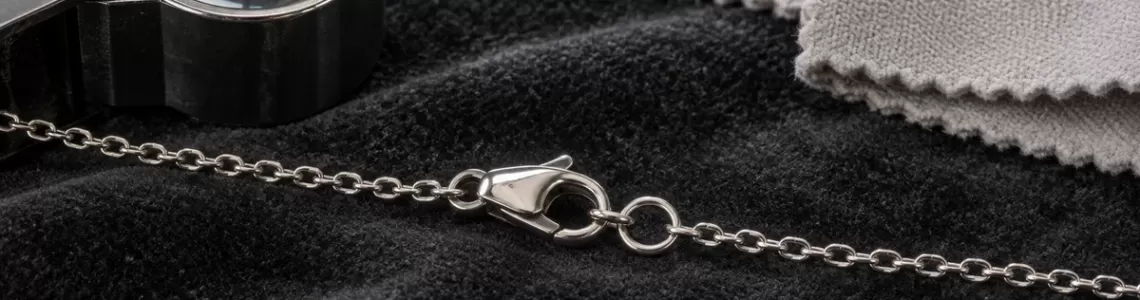
A necklace clasp should suit both the necklace and the person fastening it. Identify the opening mechanism, look at the connecting rings and chain ends, and confirm that the closure works without forcing it. A familiar clasp name is not a strength rating, a metal certificate or a promise against loss. If a closure sticks, stays partly open or has a visibly damaged connection, stop wearing the necklace and ask a qualified jeweler to examine it.
This guide separates clasp identification from a practical buying and inspection checklist. It does not rank every clasp from safest to weakest, prescribe a pull test, or diagnose an internal spring from a photograph. The examples are generic; a sunMYLOVE product has only the closure and materials actually stated in its own listing. An adjustable cord or elastic strand must not be described as a metal-clasp necklace merely because it appears in the same collection.
Start with three separate questions
First ask how the necklace opens. Second ask how that opening connects to the rest of the necklace. Third ask whether you can use it comfortably in the position where you will wear it. These are different questions. A large lever may be easy to see, yet the opposite ring may be difficult to hold. A closure may work on the counter but be awkward behind your neck. A decorative bar may look substantial while an adjoining component needs attention.
For an online purchase, request an image of the actual fastening area, not just the pendant. A full-length photograph helps you understand where the closure sits; a closer photograph helps you distinguish the working part from a decorative element. If the listing does not state the mechanism, treat it as unknown until the seller clarifies it. Do not infer the construction from a model name, price or the color of the metal.
Recognize common necklace clasp types without overreading the name
Blue Nile's clasp overview illustrates spring-operated lobster and spring-ring closures, bar-and-ring toggles, threaded barrels and tab-and-box closures. It is a retailer's educational taxonomy, not a comparative laboratory test. Similar names can cover different sizes and details.
Lobster clasp
A lobster clasp generally has a small operating lever and a spring-operated closing section, as illustrated in the Blue Nile overview above. That identifies a common mechanism; it does not establish the alloy or internal construction of another brand's necklace. On an actual necklace, locate the lever, closing section and receiving ring before trying to fasten it.
Spring ring
A spring-ring closure is usually circular, with a small lever that retracts the opening section. Observe whether you can find and move the lever comfortably. Size and placement matter to the user experience, but a larger photograph cannot tell you how strong the internal mechanism is. Ask for dimensions if the scale of the closure is important to your decision.
Toggle
A toggle uses a bar passing through a receiving ring. Once arranged for wear, the bar lies across the ring rather than acting like a spring-loaded gate. Examine the exact geometry and the necklace's intended wearing arrangement. Do not assume that any loose bar and circle can be paired successfully, or that a decorative toggle is designed to carry an additional pendant.
Box, barrel and other closures
A box closure typically receives a tab; a barrel style joins through a threaded action. Other designs may use hooks, hinges or multiple strand connections. Ask the seller for the specific opening sequence and any secondary closure. A name such as safety clasp should be accompanied by an explanation of what the additional component does. Marketing language alone does not establish a tested load limit.
The fastening area is more than the clasp
Look at the necklace as a sequence of visible connections: chain or strand, end fitting, connecting ring, clasp, receiving ring, and the opposite end. This is an inspection map, not an engineering calculation. Its purpose is to stop a buyer concentrating on one shiny component while overlooking the parts beside it. A closure that appears normal does not explain an open ring, a frayed thread or an unusual gap elsewhere.
Use light and, if comfortable, a magnifier to observe rather than reshape anything. Note whether adjoining components appear misaligned or whether the attachment moves in an unexpected way during ordinary handling. Avoid a forceful tug to prove security. A home pull test has no standardized force, direction or pass threshold here, and it may damage a necklace that already needs repair.
The Canadian Conservation Institute's handling guidance emphasizes support and warns that attachments and old repairs may be weak. Applying that general precaution to jewelry is a reasonable handling inference, not a necklace-specific test result. Support the piece on a clear surface instead of suspending it from a questionable attachment.
A calm arrival inspection
Choose a clean, well-lit surface with enough space to lay out the whole necklace. Keep it away from a sink, a floor gap or the edge of a table. Have the order description and any supplied instructions available so that you can compare the actual mechanism with what was promised. Inspection should not involve solvents, tools, bending or taking the clasp apart.
- Confirm that the supplied item and fastening arrangement match the listing.
- Identify the operating part and the opposite receiving connection.
- Follow the seller's normal opening and closing instructions while supporting the necklace.
- Observe whether the closure reaches its intended closed position without forcing.
- Check the visible adjoining rings, end fittings and strand for obvious damage.
- Record any discrepancy and contact the seller before modifying the item.
This sequence is an original consumer checklist, not a certification procedure. An apparently successful opening cycle cannot establish the long-term condition of hidden parts. Conversely, a difficult first attempt may reflect unfamiliarity rather than a defective item. Ask for instructions before concluding that the mechanism is wrong, and stop if ordinary operation requires force or produces an unexplained change.
Fit and fastening are connected, but not interchangeable
A necklace must leave enough practical room for you to bring its ends together in the intended position. That does not mean adding a universal allowance to every stated length. The necklace's structure, pendant position and closure location affect how you handle it. Use the actual finished length and the seller's measuring convention rather than guessing from a styled photograph.
Our pendant size and cord length guide separates dimensions that are often confused. The clasp's size is another independent measurement. A pendant can be suitable in scale while the fastening is inconvenient; a comfortable fastening does not make an unsuitable necklace length correct. Evaluate both before deciding which listing answers your needs.
If you plan to add an extender or converter, ask whether the specific necklace and accessory are compatible. Adding a component changes the fastening arrangement and may change the finished length. Do not assume that an accessory advertised for necklaces is compatible with every chain, strand or end fitting. Obtain the relevant dimensions and instructions before attaching anything.
Choose for the person, not a generic ease-of-use score
Consider your own practical sequence: holding one end, finding the operating part, bringing the receiving connection into position, closing it, and confirming the result. Try to identify which step is inconvenient. That is more useful than choosing a clasp from a broad easy or difficult label. The same mechanism can feel different when it is larger, placed at the front, or attached to a different necklace.
For a gift, ask about preferences discreetly rather than assuming that an older person, a person with long nails or someone who wears gloves needs a particular mechanism. These details do not establish an individual's dexterity or medical needs. If the wearer has a specific accessibility requirement, discuss it directly and seek an actual demonstration where possible. This guide does not recommend a medical solution.
Write a short buying requirement in observable terms. For example: the wearer wants to see the closure while fastening it, or prefers a lever they can hold comfortably. Avoid vague statements such as strongest clasp available. The seller can answer a concrete question about dimensions and operation; a universal strength claim needs evidence that a normal product photograph cannot supply.
Do not transfer clasp assumptions to cords and elastic strands
Some necklaces use adjustable cords or elastic constructions instead of the metal mechanisms above. Read their own instructions. The S586 ebony-and-brass pendant necklace is described with an adjustable waxed cord, so a metal lobster-clasp guide must not be used to invent its closure specification. Its maximum cord length remains unavailable unless the actual listing establishes it.
The S664 carved shield pendant also requires cord-specific reading. Pendant dimensions and cord length describe different things. Do not pull an adjustment feature harder because it does not behave like a chain clasp. If the normal adjustment sequence is not clear, ask for it; uncertainty is not a reason to experiment with the construction.
A dual-use elastic strand raises a different issue again. The convertible necklace and wrap-bracelet guide distinguishes finished strand length from wrist circumference. A single fastening recommendation cannot cover those wearing modes automatically. This article does not claim that any of these products has the generic clasp shown in its educational image.
Materials and finish do not certify the closure
The FTC explains silver, sterling silver and plated-jewelry terminology in its precious-metal buying guidance. Those descriptions concern material claims, not a mechanism's resistance to opening. A silver-colored clasp is not automatically sterling, and a mark on one component is not a substitute for clear documentation about the whole necklace and its separate findings.
Ask which components the stated metal description covers, particularly when a necklace combines beads, cords and metal parts. Keep material questions separate from operating questions. Is it plated is not the same question as does it close correctly. A visual check can identify the location of a marking but cannot authenticate its meaning or determine the alloy of an unseen spring.
Finish changes also need context. Discoloration does not, by itself, show that a clasp has failed, while a polished surface does not establish that it is sound. Describe both the appearance and the operating symptom when requesting help. This gives the seller or jeweler a clearer starting point without presenting your own observation as a laboratory diagnosis.
Cleaning is not a repair method
GIA's jewelry care guidance explains why chemicals, treatments and cleaning methods must be considered for the complete piece. It cautions that ultrasonic cleaning is unsuitable for some materials and constructions. A clasp attached to pearls, coated stones, wood or an unknown cord should not be treated as an isolated metal object simply because the clasp looks dirty.
Do not add household oil, force a lever, apply glue or immerse a mixed-material necklace to cure a sticking closure. A symptom may require mechanical examination, and a cleaning agent may affect other parts of the piece. Ask for care instructions appropriate to the actual materials. If the seller cannot explain the symptom, stop wearing it until a qualified jeweler assesses it.
For a pearl strand, our pearl restringing guide addresses the surrounding thread and knot inspection separately. A new clasp does not automatically resolve a worn strand, and fresh thread does not automatically resolve a damaged closure. Repair decisions should account for the whole assembly rather than replacing whichever component is easiest to name.
What to document before contacting the seller or jeweler
Photograph the necklace laid flat, then the fastening area from more than one angle. Describe the normal action you attempted and what happened: the lever did not return, the tab did not reach the expected position, or an adjoining ring appeared separated. Keep observations factual. Do not describe an internal spring as broken unless an examination has established that diagnosis.
Include the product description and any supplied care instructions. Ask whether the seller recommends return assessment, repair or a replacement component, and clarify the terms before authorizing work. GIA's buying tips support asking clear questions and understanding the purchase. They do not establish a particular store's warranty or promise that every repair is free.
If the piece has personal or historical significance, explain that before repair. Retaining original components may matter to you, while another wearer may prioritize a different operating arrangement. Neither preference should be silently assumed. Any proposed replacement needs its own material description, attachment method and compatibility assessment; the old clasp's name alone is not a complete repair specification.
A useful buying decision
Choose the necklace whose documented construction, finished dimensions and operation match your needs. If the fastening remains unclear, ask for clarification or choose a listing with better information. A short delay is preferable to treating a photograph as a guarantee. Our necklace storage guide covers what happens after wear; the closure decision belongs before purchase and before each uncertain wearing situation.
FAQ
Which necklace clasp is the safest?
No universal ranking is established here. Condition, dimensions, attachments and intended use matter. Ask about the exact necklace rather than relying on a clasp name.
Is a lobster clasp proof of sterling silver?
No. Lobster describes a mechanism, not an alloy. Request the material specification for the relevant components.
Should I pull hard to check a clasp?
No home strength test is recommended. Observe normal operation with the piece supported; obtain professional assessment if you see damage or unexpected behavior.
Can I replace a clasp with a magnetic converter?
Compatibility is not established by this guide. Ask about the exact assembly and accessory before changing the fastening or finished length.
Does every pendant necklace need a clasp?
No. Some use cords or other constructions. Read the individual product's stated adjustment and wearing instructions.
Can cleaning fix a clasp that stays open?
Do not assume so. Stop wearing it and seek assessment; avoid chemicals, lubricant or bending as an improvised repair.
References and evidence boundaries
- Blue Nile clasp overview: mechanism names only; no universal reliability ranking adopted.
- Canadian Conservation Institute handling guidance: general support and attachment precautions, applied as a clearly labeled inference.
- FTC precious-metal buying guidance: material terminology, not clasp performance certification.
- GIA care guidance: cleaning compatibility and professional care, not a diagnosis of a particular clasp.
- GIA buying tips: buyer questions and documentation, not store-specific warranty terms.
The arrival checklist, question sequence and buying examples are original practical reasoning. No strength experiment, product testing, medical benefit, failure-rate comparison or search-volume measurement was performed. Product links illustrate distinct constructions; they do not imply that the generic featured-image clasp is supplied with those products.
Leave a Comment