
Pendant Size vs Cord Length: How to Read Necklace Measurements
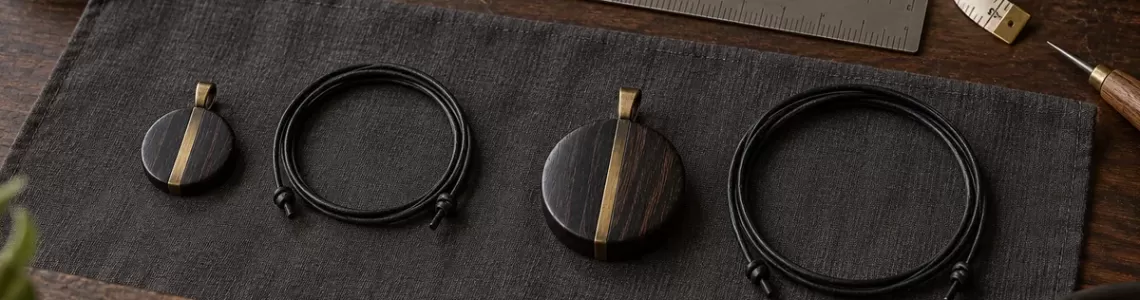
Quick answer: Pendant size and cord length describe different parts of a necklace. Pendant size usually measures the ornament itself, while cord length measures the flexible strand that goes around the neck. Neither number alone tells you exactly where the pendant will sit on a particular body. Before buying, identify the measured object, the endpoints, whether the bail is included, whether the cord is measured end to end or as a closed loop, and the available adjustment range.
A listing can be accurate and still be easy to misread. An 80 mm pendant is not an 80 mm necklace. An 80 cm cord is not an 80 cm vertical drop. A photo that makes two pendants look similar does not make their dimensions equal. The safest approach is to treat every measurement as a statement with four parts: what was measured, between which points, in which unit, and with what approximation.
This guide explains how to read those statements without inventing missing values. It does not promise a universal "ideal" necklace length, calculate exact worn position from a product photo, or replace the current specifications on an individual product page.
Pendant size, cord length and worn drop are not interchangeable
- Pendant height
- The top-to-bottom dimension of the ornament. A listing should say whether a loop, bail, tassel or other hanging component is included.
- Pendant width
- The side-to-side dimension at a stated point, often the widest point. An irregular pendant may also need thickness or depth.
- Cord or chain length
- The length of the flexible necklace component. It may be reported end to end when open, as a circumference when closed, or as a maximum for an adjustable design. The convention must be clear.
- Worn drop
- The vertical distance from a reference point on the wearer to the bottom or center of the pendant. This is a fit outcome, not simply half the cord length.
- Adjustment range
- The shortest and longest usable settings supported by the construction. The word "adjustable" alone does not supply those endpoints.
Museum catalogues illustrate why these fields should be separated. A Smithsonian pendant record lists dimensions for the necklace-and-pendant assembly and a different set for the pendant itself. British Museum records likewise distinguish complete necklace length from a pendant width or from the length of an individual ornament. These records are not retail standards, but they demonstrate a sound evidence habit: name the measured component instead of placing one unexplained number beside the word "size."
How to measure a pendant
Place the pendant on a flat surface without pulling or compressing flexible elements. Use a rigid ruler or caliper appropriate to the scale. Measure height from the lowest point of the pendant body to the stated upper endpoint. If the bail or loop is included, say so. If it is excluded, measure only the body and report the exclusion.
For width, identify whether the value is the maximum width, a central width or the width of one feature. Maximum width is usually the most useful buyer number for an irregular silhouette. Thickness or depth matters when a piece is sculptural, layered or expected to sit away from clothing.
Do not measure a soft cord as though it were part of the pendant height. Do not stretch a loop, tassel or flexible fringe to create a larger number. If a carved surface is curved, the ordinary buyer dimension is usually the straight-line external span, not a path traced across the curve, unless the seller explicitly states otherwise.
Photographs need scale context. Perspective, lens choice, cropping and hand size can make the same pendant appear larger or smaller. The guide to why jewelry can look different online focuses on color, but its core caution also applies to visual scale: camera and display conditions are not calibrated measuring tools.
How to measure cord or chain length
First identify the construction. A fixed chain with a clasp, a continuous cord, a sliding-knot cord and a lariat do not share one obvious measurement method. Lay a flexible necklace naturally on a flat surface, remove twists, and avoid applying tension that changes the length. Then report the endpoints and state whether the result is an open end-to-end length, a closed circumference or a maximum usable setting.
For a conventional clasped necklace, end-to-end length often runs from one functional end of the clasp to the other. For a closed loop measured flat, doubling the straight span is only appropriate when the loop is laid without distortion and the measurement convention is stated. For a sliding-knot cord, the practical range should be measured through its shortest and longest usable settings; the loose tail length is not automatically part of the neck circumference.
Construction can impose limits that a bare number misses. Bulky knots may not pass through a small bail. A large pendant can pull a light cord into a different shape. A cord may have an adjustable maximum but no safely published minimum if the original product record does not specify one. When a range is absent, ask rather than infer.
Why half the cord length is not the pendant drop
A common shortcut divides cord length by two and treats the result as a vertical drop. That only describes the radius of an idealized straight, symmetrical shape under unrealistic assumptions. A real necklace follows the back and sides of the neck, turns over the shoulders or collar area, meets at the front, passes through or attaches to a bail, and may carry a pendant with its own height.
Neck circumference is one variable, but not the only one. Shoulder slope, clothing, posture, cord stiffness, knot location, pendant weight and attachment geometry all affect where the ornament settles. Two people with the same neck circumference can obtain different worn positions from the same necklace. Two necklaces with equal listed length can also sit differently if one uses a rigid chain and the other a soft cord.
For that reason, a listing should not promise an exact anatomical position from cord length alone. A model photograph can be a visual example if the model and setting are documented, but it does not override the measured specifications.
Reading millimeters, centimeters and inches
NIST states that 10 millimeters equal 1 centimeter and that 1 inch is exactly 25.4 millimeters. Those relationships make conversion straightforward, but the converted number should not pretend to be more precise than the original measurement.
- 80 mm equals 8 cm and is approximately 3.15 inches.
- 94 mm equals 9.4 cm and is approximately 3.70 inches.
- 52 mm equals 5.2 cm and is approximately 2.05 inches.
- 80 cm equals 800 mm and is approximately 31.5 inches.
If the source says "about 80 mm," a conversion such as 3.149606 inches would be misleading. The extra digits come from arithmetic, not from a more exact measurement. Keep the approximation visible and round to a sensible level. NIST's metric-writing guidance also uses lowercase unit symbols such as mm and cm and advises against false precision in conversions.
How to read an adjustable cord listing
"Adjustable" describes a mechanism, not a complete measurement. A useful listing answers three separate questions: what moves, what the shortest usable setting is, and what the longest usable setting is. It should also make clear whether the pendant can be removed or whether the cord passes permanently through the ornament.
If a product record publishes only the pendant size and says the waxed cord is adjustable, the honest conclusion is limited: the buyer can change the cord setting, but the exact range remains unpublished. Do not borrow a maximum from a visually similar necklace, a supplier photo or another option. Similar appearance does not prove identical construction.
If a maximum is published, read it as a maximum cord setting, not as the vertical distance from neck to pendant. It also does not prove that every shorter setting is comfortable or mechanically practical. The knot, bail and pendant need to work together at the selected setting.
Make a simple scale check before ordering
A buyer does not need to recreate a product to understand its published dimensions. Mark the stated pendant height on paper, cut a plain rectangle of that height and approximate width, and hold the paper against the intended clothing. This is only a scale check: it will not reproduce the pendant's weight, thickness, silhouette, movement or material. A cardboard or paper outline should never be described as a fit test.
For the cord, use a soft tape or a separate piece of string around the intended neckline. Mark the measured path without tightening it against the skin, then compare that path with the published cord information. Do not place a rigid ruler around the neck. If the listing supplies only a maximum, the exercise can show the largest stated path but cannot reveal an unpublished minimum.
Keep the two mock-ups separate. Adding the pendant height directly to the cord length produces a total material span, not a reliable worn drop. The paper outline helps with ornament scale; the string helps with the neck path. Together they expose missing information without turning an estimate into a product guarantee.
Two live examples with different measurements
The S586 handcrafted ebony wood and brass pendant necklace offers two pendant-size options. The verified product record describes the Small pendant as about 80 mm and the Large pendant as about 94 mm. It also identifies an adjustable waxed cord. The exact cord-length range is not published, so those pendant heights must not be converted into cord length or worn drop.
The S664 carved ebony wood shield pendant necklace uses a different specification. Its pendant is about 52 mm, and its adjustable waxed cord has a published approximate maximum length of 80 cm. Here, 52 mm describes the ornament while 80 cm describes the cord maximum. The two numbers answer different buyer questions.
Neither example establishes a universal best size. A buyer comparing them should consider the pendant silhouette, measured height, cord information, materials, clothing and intended wear. The arrowhead pendant buyer guide and Chinese coin pendant buyer checks add motif-specific questions without changing these measurement principles.
A pre-purchase measurement checklist
- Name the object. Is the number for the pendant body, bail, cord, chain, complete necklace or worn drop?
- Find the endpoints. Ask where the measurement starts and ends and whether flexible parts are included.
- Confirm the convention. Is the cord open end to end, measured as a closed circumference, or listed only at its maximum?
- Read the unit. Keep mm, cm and inches distinct. Convert only after identifying the original measurement.
- Preserve approximation. "About" and "approximately" remain important after conversion.
- Check options separately. A Small/Large selector may change the pendant body, not the cord.
- Ask about the bail. Including or excluding it can materially change the height of a compact pendant.
- Do not infer fit from a photo. Request the model, setting and garment context if the pictured position matters.
- Resolve contradictions. If the title, option label, diagram and description disagree, obtain a written clarification before purchase.
- Save the evidence. Keep the selected option, specification, images and seller answer with the order record.
Materials and care still matter
Measurement is only one part of the decision. Wood, brass and waxed cord respond differently to moisture, friction, cleaning products and storage. A pendant with mixed materials should be cared for according to its most sensitive component rather than treated as an all-metal piece.
The ebony wood buyer guide explains why species, finish and care claims should remain evidence-based. The brass patina and care guide separates normal surface change from active corrosion concerns. Those articles are not specifications for the two necklaces above; the live product page remains controlling for each product.
Avoid soaking a mixed-material pendant merely to clean the cord. Do not pull hard on sliding knots to test the claimed maximum. If the cord, knot or attachment shows fraying, cracking or loosening, stop wearing it until the construction is assessed. Care cannot compensate for an unclear or damaged load-bearing connection.
FAQ
Does pendant size include the bail?
Not always. Some listings include the bail or top loop in the height, while others measure only the pendant body. The listing should state the endpoints; ask if it does not.
Is necklace length the same as cord length?
Sometimes sellers use the terms loosely, but they can differ. Necklace length may refer to the complete wearable assembly, while cord length may exclude a pendant or clasp. Identify the measured component and convention.
Does an 80 cm cord hang 80 cm down the body?
No. An 80 cm cord length follows a path around the neck. Its vertical drop is much shorter and varies with the wearer, setting, construction and pendant.
Can I calculate exact pendant position from cord length?
No. You can estimate with a cord or tape on your own body, but exact position depends on neck circumference, shoulders, clothing, cord behavior, attachment geometry and pendant dimensions.
What does adjustable cord mean?
It means the construction permits a change in setting. It does not disclose the minimum or maximum unless the listing provides those values.
Should I convert millimeters to inches before comparing pendants?
You may convert units, but compare the same dimension and preserve the original approximation. One inch is exactly 25.4 mm; do not add false precision to an approximate measurement.
Which matters more, pendant height or cord length?
They answer different questions. Pendant height describes the visual scale of the ornament; cord length helps estimate the wearable path. A useful purchase decision often needs both.
What should I do if the product page gives pendant size but no cord range?
Treat the cord range as unknown. Do not infer it from a similar product or photograph. Ask the seller if the range is important to the purchase.
Leave a Comment