
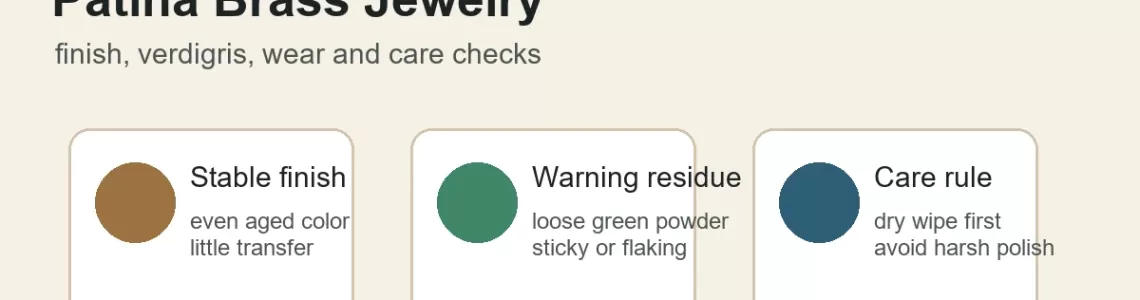
Quick answer: patina on brass jewelry is a visible surface change or finish on a copper-zinc alloy, while verdigris usually refers to green or blue-green copper corrosion products. A stable aged finish can be part of the design. Loose powder, sticky green residue, flaking coating, sharp pitting or skin irritation should be treated as a care warning, not as proof of a special health benefit. Before buying patina brass jewelry, check whether the surface is intentional, sealed, naturally aged, chemically darkened or simply described as antique style.

Why this matters for brass jewelry buyers
Brass jewelry is attractive because it can hold a warm gold tone, a dark aged finish, a satin surface or a deliberate green-blue accent. That visual range is also why buyers need precise words. "Patina" can mean a chosen design finish, a naturally aged surface, a protective surface developed over time, or a general antique look. "Verdigris" is more specific in many conservation and art references: it is associated with green copper compounds and copper-alloy corrosion products. Because brass contains copper, brass can form greenish corrosion products under the wrong moisture, salt, skin-oil or storage conditions.
For everyday jewelry, the practical question is not whether all patina is bad. A stable dark finish on a pendant or cuff can be intentional and durable when the maker designs for it. The risk is when the product page uses romantic wording such as antique, oxidized, vintage, aged or verdigris without explaining how the finish should behave. A buyer should know whether the visible surface is a finish to preserve, a layer that may wear at raised edges, or an active residue that should be kept away from skin and soft materials.
Research questions this guide answers
- What is the difference between a patina finish and problematic green corrosion?
- What can conservation sources tell jewelry buyers without pretending that a bracelet is a museum object?
- How should a shopper read words such as antique brass, patina brass, verdigris and corrosion resistant?
- Which sunMYLOVE products and categories are most relevant to this surface-finish decision?
- What care routine protects a brass finish without over-polishing it away?
Terms: patina, verdigris, lacquer, wax and dezincification
Patina is the broadest buyer-facing word. It can describe a color change on metal, an intentional darkened finish, or the surface character that develops from handling and age. In a product listing, it should be read as a surface description until the seller states the metal, treatment and care instructions clearly.
Verdigris is narrower. Getty conservation publications describe copper greens as copper-based green pigments that can include synthesized pigments such as verdigris, and a University of Pennsylvania conservation reference describes verdigris as copper salts associated with corrosion products on copper, bronze and brass. In jewelry shopping, that does not mean every green accent is the same chemical compound. It does mean green-blue residue on copper alloys deserves careful interpretation rather than being treated as magic, detox or proof of age.
Lacquer and wax are protective coatings used on some brass and copper objects. The Canadian Conservation Institute explains that polished brass is often coated with clear lacquer or wax to slow tarnishing and related deterioration, but coatings have finite lives and need maintenance. For jewelry, the same principle becomes a shopping question: is the finish meant to be left alone, gently wiped, occasionally waxed by a professional, or allowed to darken naturally?
Dezincification is a corrosion process in which zinc is selectively removed from brass under certain conditions. CCI guidance discusses it mainly for brass objects and notes that coatings can help as long as they remain intact. A jewelry buyer should not diagnose dezincification at home from a photo, but a seller also should not promise that brass is corrosion proof in every wearing environment.
What authoritative sources support, and what they do not
Conservation guidance is useful because it is careful about metal surfaces, moisture, polishing and coatings. It is not the same as a product-specific laboratory report. Canadian Conservation Institute metal-object guidance emphasizes preventive care, environment and surface protection. Its brass-and-copper cleaning note warns that polishing is abrasive and should begin with the mildest practical method. Its active-corrosion publication explains that destructive corrosion can be recognized by changes such as loose corrosion products, coating failure, pitting and unstable surface deposits.
Those sources support conservative buyer rules: keep brass dry, avoid harsh abrasion, treat loose green residue as a warning, and ask sellers to describe finishes honestly. They do not prove that a specific bracelet was tested, that a patina is ancient, or that wearing copper-alloy jewelry improves health. There is not enough reliable evidence to treat brass patina, verdigris, copper contact or metal color change as a therapy for circulation, pain, sleep, inflammation, immunity or detox.
Six buyer checks before choosing patina brass jewelry
1. Separate alloy from surface finish
Start with the base material. Brass is a copper-zinc alloy; bronze is usually copper-tin based; silver-colored or gold-tone descriptions may refer only to surface appearance. If a page says brass, patina brass, antique brass or aged brass, read that as a statement about the main metal and its visible finish. If it says only "vintage metal" or "antique gold color," the construction is not clear enough for a material-sensitive buyer.
2. Ask whether the patina is intentional
An intentional patina finish should be described as part of the design. On products such as a patina brass disc pendant necklace or a verdigris patina square pendant necklace, the visible surface is central to the look. That is different from a plain polished cuff that arrives with unexpected powder or green staining. Ask whether the finish was applied, heat-treated, chemically darkened, sealed, waxed or simply allowed to age.
3. Check residue, not just color
Color alone is a weak signal. A dark brown or blue-green finish can be stable; a bright green powder that transfers to a cloth can signal active corrosion or unstable residue. CCI's active-corrosion guidance is useful here because it focuses on behavior: loose powder, blisters, pitting and coating failure matter more than a single color word. For wearable jewelry, do not keep wearing a piece that leaves sticky residue, causes irritation, smells strongly of chemicals or sheds particles onto clothing.
4. Understand that polishing can remove the look you bought
If you buy patina brass jewelry for its aged surface, aggressive polishing can erase the design. CCI's brass-and-copper note treats polishing as an abrasive process and recommends starting with the mildest method when polishing is necessary. Jewelry buyers can translate that into a simpler rule: wipe with a soft dry cloth first, avoid abrasive paste unless the seller recommends it for that exact item, and never polish across soft stones, wood, cord, pearls, glued areas or intentionally dark recesses as if every surface were plain brass sheet.
5. Treat "corrosion resistant" claims carefully
U.S. jewelry advertising guidance in 16 CFR Part 23 includes a section on misuse of "corrosion proof," "noncorrosive," "rust proof" and similar terms. The practical takeaway is that strong durability claims need appropriate qualification. Brass can be durable, but sweat, humidity, salt water, perfumes, lotions, acids, storage bags and friction can all change a finish. A seller can reasonably describe care limits; a seller should not imply that a brass finish is immune to all wear.
6. Read return terms before experimenting
Do not test a finish by scraping, acid testing, soaking in vinegar, using ammonia, heating the metal, or rubbing until bare brass appears. Those steps can permanently alter the item and may complicate a return. Read the store's returns and refunds policy and delivery information before ordering, especially if the piece is a gift or if the finish is the reason you chose it.
Comparison table: finish signals and buyer response
| What you see | Likely interpretation | Buyer response | Evidence limit |
|---|---|---|---|
| Even dark brown or aged gold surface | May be an intentional antique or patina finish. | Preserve it with gentle wiping; do not over-polish. | Color does not prove age, alloy or treatment method. |
| Green-blue accent in recessed areas | May be decorative verdigris-style finish or copper corrosion product. | Check whether it is sealed and whether residue transfers. | A photo cannot identify the exact compound. |
| Loose bright green powder | Care warning; possible active corrosion or unstable residue. | Stop wearing, isolate from textiles, ask seller or jeweler. | Home inspection cannot diagnose full chemistry. |
| Raised edges turning brighter | Normal friction wear on a darkened finish. | Expect high points to polish with wear; compare with listing photos. | Does not prove fraud by itself. |
| Flaking clear layer or sticky surface | Possible coating failure, contamination or poor storage. | Avoid skin contact and request seller guidance. | Cause may require professional inspection. |
How to care for patina brass jewelry
Use the least aggressive routine that solves the actual problem. After wearing, wipe the piece with a clean soft cloth to remove sweat and skin oils. Store it dry, separately from damp leather, perfume, cosmetics and polishing cloth residue. If the piece contains ebony, stone, cord, pearls or glued details, follow the care limits of the most delicate component rather than treating the whole object like plain metal.
For intentional patina, avoid dips and abrasive polishes unless the seller says that product was designed for polishing. Use a dry cloth first. If dirt is present, use a barely damp cloth on compatible surfaces and dry immediately. Do not soak. Do not clean verdigris-style recesses with acidic household recipes. Vinegar, lemon juice and salt are common internet suggestions for copper alloys, but they can strip finishes, attack coatings and leave residues if used casually on mixed-material jewelry.
If the piece has a polished brass area that the seller says may be polished, work only on that area and keep pressure light. Raised textures such as a textured brass bar pendant necklace or a V-shaped aged brass pendant can change visually when high points are rubbed more than recessed areas. That can be desirable over time, but it should be expected rather than treated as a defect.
Where this fits in the sunMYLOVE catalog
Start with the brass cuff bracelet category if you want wearable brass surfaces and wrist-level styling. Use the brass vs bronze jewelry guide when you need alloy terminology before choosing a finish. For pendant-focused patina decisions, compare the product descriptions for the patina disc, verdigris square, textured bar and aged V-shaped pendant pages. Those links are examples for surface and care decisions; they do not replace the exact material line on each product page at the time of purchase.
Common mistakes
- Assuming every patina is natural age rather than an applied design finish.
- Calling every green mark verdigris without checking residue, coating and context.
- Using vinegar, salt, ammonia or abrasive polish on a mixed-material pendant.
- Expecting raised dark finishes to stay identical under bracelet-level friction.
- Treating copper-alloy color change as a health, detox or energy sign.
- Ignoring return terms before performing destructive home tests.
Frequently asked questions
Is patina on brass jewelry bad?
No. A stable intentional patina can be part of the design. The warning signs are transferable powder, sticky residue, flaking coating, sharp pitting, irritation or a mismatch between the listing and delivered item.
Is verdigris the same as patina?
Not exactly. Patina is a broad surface term. Verdigris is associated with green copper compounds and copper-alloy corrosion products. In product copy, "verdigris" may also be used as a style word, so ask how the finish was made and sealed.
Will patina brass turn my skin green?
It can happen with copper-containing alloys when moisture, salts, cosmetics or friction react with the surface. A temporary mark is a material-transfer issue, not evidence of a medical effect. Stop wearing jewelry that irritates your skin.
Can I polish patina brass?
Only if you are willing to change the finish or if the seller recommends a compatible method. Polishing is abrasive and can remove the aged look, especially on high points and edges.
Can a clear coating stop all brass tarnish?
No coating lasts forever. Lacquer or wax can slow surface change when intact, but wear, scratches and time can reduce protection. Jewelry receives more friction than display objects.
Does green brass residue prove a product is old?
No. Green residue can come from environmental exposure, storage, chemicals or corrosion. It does not prove age, authenticity or quality.
Should patina brass jewelry be kept away from water?
Yes, as a conservative care rule. Brief incidental moisture should be dried promptly. Avoid swimming, showering, soaking and storage in humid places.
Does brass patina have health benefits?
There is not enough reliable evidence to treat brass patina or copper-alloy contact as a therapy for pain, circulation, sleep, immunity or detox. Choose it for design, fit, material preference and care expectations.
Method and evidence scope
This guide uses conservation, museum-material and jewelry-advertising sources to build practical buying checks. It does not authenticate a specific product, identify a corrosion compound from a photograph, certify coating chemistry, or provide medical advice. Product examples are live sunMYLOVE pages checked for relevance and HTTP availability during the 2026-08-20 run; shoppers should still read the current product page before ordering.
References
- Canadian Conservation Institute: Caring for metal objects PDF
- Canadian Conservation Institute Notes 9/3: Cleaning, polishing and protective waxing of brass and copper PDF
- Canadian Conservation Institute Notes 9/1: Recognizing active corrosion
- Canadian Conservation Institute Notes: Preventing and treating dezincification of brass
- Getty Publications: copper greens and verdigris glossary
- University of Pennsylvania Architectural Conservation Laboratory: Verdigris
- U.S. National Park Service: Conserve O Grams, metal objects
- 16 CFR 23.11: Misuse of corrosion proof and similar terms
sunMYLOVE editorial note: Prepared by the sunMYLOVE product content team for U.S. and international jewelry buyers. Last reviewed: August 20, 2026. The article is educational, not legal, conservation-treatment, laboratory or medical advice.
Leave a Comment