
Jewelry buying guides
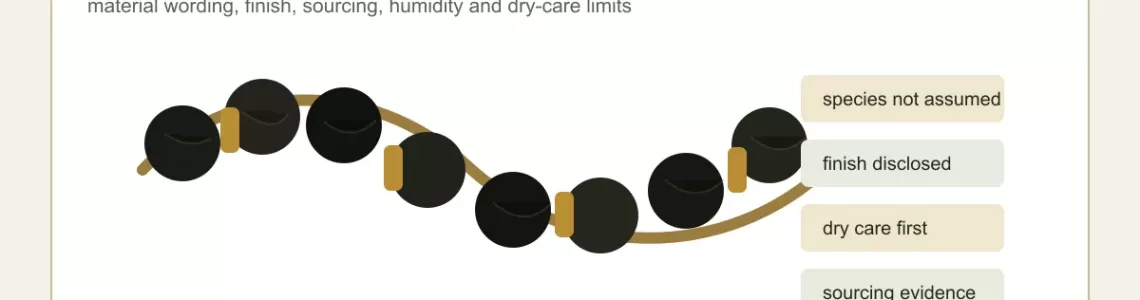
Ebony wood bracelets look simple, but the word ebony can cover species, color, finish, trade and care questions. This buyer guide explains how to read ebony wood bead, brass, cord, coating and sustainability claims before choosing adult fashion jewelry.
Answer first: Buy an ebony wood bracelet when the product page clearly separates the wood component from brass, stone, cord, finish and symbolism. Ebony is a dense dark hardwood group, not a proof of species, origin, age or sustainability by itself. For everyday wear, keep ebony beads dry, avoid heat and humidity swings, do not soak the bracelet, and ask for clearer wording when a listing uses ebony only as a color word or luxury cue.
Research question and scope
This guide answers a practical buying question: when a bracelet, pendant or bead listing says ebony, black wood, ebony wood, ebony bead, brass and ebony, or ebony-style, what can a careful shopper verify before checkout? The scope is adult fashion jewelry sold online. It is not a laboratory wood-identification report, a CITES legal opinion, a sustainability certification, a cultural-authenticity statement or a health claim.
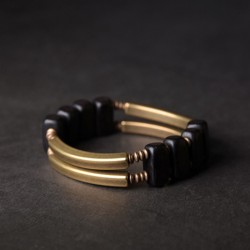
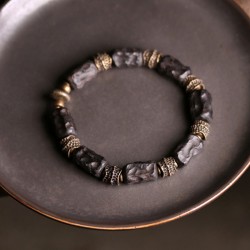
The guidance applies to mixed-material pieces such as the Ebony and Brass Bead Bracelet, Double Brass Pipe Ebony Bracelet, Four Strand Ebony Bracelet, Brass Wire Wrapped Ebony Bracelet, ebony pendants such as the Abstract Ebony Wood Cutout Pendant, and the wider men's beaded bracelets category. It also helps buyers compare ebony with bone, glass, obsidian, bodhi root, brass and silver without assuming facts that are not on the product page.
Useful definitions
Ebony usually refers to very dark, dense woods associated with the genus Diospyros, but the retail word can be loose. A product title may use ebony as a material claim, a color description, or a design mood. Those are not the same thing.
Ebony wood bead should mean that the bead component is made from wood described by the seller as ebony. It does not prove botanical species, country of origin, age, treatment, certification or legal documentation unless those details are separately supplied.
Black wood is broader than ebony. Some dark beads are dyed wood, stained wood, other tropical hardwood, compressed wood, resin, plastic, horn, glass or stone. If the exact material matters, ask for the material line rather than relying on color.
Finish may include oil, wax, lacquer, dye, heat treatment, polishing compound or a surface coating. Finish affects hand feel, water tolerance, color transfer risk and how the bead ages.
Mixed-material bracelet means the care rule is set by the weakest part, not the strongest one. Ebony beads may sit beside brass spacers, elastic cord, waxed cord, knots, stone beads or glued caps; the whole bracelet should be treated according to the most delicate component.
What the strongest evidence says
Canadian Conservation Institute wooden-object guidance is a useful starting point because it treats wood as a moisture-sensitive organic material. CCI's technical bulletin on wooden objects discusses handling, documentation and treatment in a museum environment, and its plant-material guidance reinforces the importance of relative humidity, light and preventive care. That general principle is more useful to a bracelet buyer than a vague promise that ebony is indestructible. Dense wood can still react to repeated soaking, dry heat, sweat, perfume, cleaning solvents and sharp humidity changes.
National Park Service museum guidance makes the same practical point from a preventive-care angle: collections care relies on focused procedures for different object materials and environments. A bracelet is not a museum artifact, but it sees much harsher handling than a display object, so conservative dry care is a sensible baseline.
Trade-control sources add a second boundary. CITES, eCFR and U.S. Fish and Wildlife Service materials show that international trade controls can apply to wildlife and plants, including parts, products and derivatives, and that timber species may require clearance or documentation. That does not mean every finished ebony bracelet is illegal or high risk. It means the word ebony should not be used casually to imply traceable species, sustainable origin or unrestricted international movement unless the seller can support those claims.
Jewelry-description rules add a third boundary. The FTC Jewelry Guides in 16 CFR Part 23 focus on preventing misleading claims about jewelry materials and qualities. For ebony bracelets, the buyer-facing translation is simple: do not treat "ebony tone," "black wood," "natural," "handmade," "spiritual" or "sustainable" as interchangeable claims. Each word needs its own evidence.
What evidence cannot prove from a product photo
A product photograph can show bead size, polish, general color, visible grain, component layout and whether the design matches your taste. It cannot reliably prove botanical species, harvest country, CITES status, moisture content, coating chemistry, dye history, allergy profile, legal provenance or long-term durability. Dark wood photographs can also hide cracks, filled pores and finish variation.
That evidence limit matters because ebony carries a luxury reputation. Buyers sometimes read a dark polished bead as a guarantee of rare species, premium grade, natural black color or cultural meaning. Those assumptions go beyond what a photograph can show. A careful product page should say what the seller knows and avoid implying what has not been documented.
The same boundary applies to health and symbolic wording. There is not enough reliable evidence to claim that ebony beads improve circulation, immunity, sleep, anxiety, pain, luck or protection. A seller may describe personal style, traditional associations in a specific culture, or the tactile appeal of wood, but those ideas should not be written as universal facts or medical outcomes.
Six buyer checks for ebony wood bracelets
1. Confirm whether ebony is a material claim or a color cue
Start with the product's material line, not only the title. "Ebony beads" is a material claim. "Ebony color" or "ebony tone" may mean only dark appearance. "Black wood" is broader and may be honest if the seller does not know the exact species. If a listing uses ebony in the title but the description says alloy, resin or artificial wood, treat the description as the more important field.
2. Check the whole bracelet system
Wood rarely works alone in a bracelet. Look for brass spacers, bead hole finishing, elastic, waxed cord, knots, metal caps, stones and coatings. If you have skin sensitivity, brass or alloy spacers may matter more than the wood. If you wear bracelets tightly, the cord and bead-hole edges may decide durability before the wood itself.
3. Ask what finish is on the bead
A polished ebony bead can be unfinished, oiled, waxed, sealed, dyed or lacquered. The product page may not list finish chemistry, but it should not make impossible promises such as waterproof natural wood. If the bead is dyed or coated, color transfer and finish wear are more relevant than botanical rarity.
4. Treat sustainability claims as evidence claims
Words such as sustainable, reclaimed, certified, legal, ethically sourced or plantation-grown should be supported by a sourcing statement or documentation. Without that, a modest material claim is safer than a broad conservation claim. CITES context makes this especially important for ebonies because trade controls can depend on species, geography, product form and documentation.
5. Use dry care as the default
Do not soak ebony beads, steam them, ultrasonically clean them, oil them heavily, bleach them, use alcohol, scrub with abrasive paste or leave them in a damp bathroom. Wipe after wear with a soft dry cloth. Remove before showering, swimming, workouts, sleep, yard work and any job that puts pressure on the cord or bead holes.
6. Separate symbolism from proof
Ebony can feel grounded, understated and formal because of its dark color and fine polish. That is a style observation, not a medical or spiritual guarantee. If a listing says lucky, protective, healing or cleansing, read it as personal symbolism unless it cites a specific tradition and stays within evidence limits.
Comparison table
| Listing phrase | Best reading | Main risk | Buyer check |
|---|---|---|---|
| Ebony wood beads | Seller claims the bead is ebony wood | Species, origin and finish may still be unknown | Read material line and ask about finish |
| Black wood beads | Dark wood, species unspecified | Could be stained, dyed or another wood | Do not pay for ebony rarity without proof |
| Ebony tone | Dark color or style cue | May not be wood at all | Confirm actual material before checkout |
| Natural ebony | Natural-material claim | May imply more than the seller has documented | Ask whether color, dye and finish are disclosed |
| Sustainable ebony | Sourcing claim | Requires evidence, not mood wording | Look for documentation or choose a clearer listing |
| Ebony and brass | Mixed wood and metal jewelry | Care and skin comfort depend on both materials | Check brass contact points, cord and storage advice |
How this applies to sunMYLOVE products
If you want a straightforward beaded look with dark wood and warm metal, compare the Ebony and Brass Bead Bracelet with the Double Brass Pipe Ebony Bracelet. The design question is not only whether you like ebony; it is whether you prefer small brass accents, longer tube spacers, multiple strands or a quieter bead rhythm.
If you prefer a layered design, the Four Strand Ebony Bracelet and Brass Wire Wrapped Ebony Bracelet are better comparison points. More layers can create stronger visual texture, but they also create more cord paths, metal contact points and possible snag points. Check fit and daily-wear habits before choosing by appearance alone.
For people who like ebony but prefer necklaces, compare the Abstract Ebony Wood Cutout Pendant and Ebony Wood and Brass Arrowhead Pendant. Pendants do not stretch around the wrist, but they can still contact sweat, perfume, collars and metal chains. The same dry-care logic applies.
For fit, category and order context, use the beaded bracelet category, pendant necklaces category, bracelet buying guide and returns and refunds page. Those pages are more useful than trying to infer size, wear feel or post-purchase options from a single product title.
Care checklist for ebony and brass bracelets
- Wipe beads and brass spacers with a soft dry cloth after wear.
- Remove before showering, swimming, workouts, sleep and heavy manual work.
- Keep perfume, sunscreen, alcohol, bleach, vinegar and metal polish away from the wood.
- Do not soak, steam or ultrasonically clean mixed wood bracelets.
- Store dry, away from bathrooms, windowsills, car dashboards and heating vents.
- Separate ebony bracelets from harder stones or sharp metal edges that can scratch the finish.
- Inspect elastic, cord, knots and bead holes before travel or frequent wear.
- Stop wearing the bracelet if a bead cracks, a spacer develops sharp edges, or dye transfers to skin or cloth.
Buyer documentation checklist
For an ordinary ebony wood bracelet, save the product page, material line, photos, care instructions, order record and any seller answer about finish or wood source. That record helps if you later need to remember whether the listing said ebony wood, black wood, ebony tone, dyed wood or mixed material. It also gives the seller a specific page to reference if you ask about repair, replacement or return options.
If the product is expensive because of a rare species, certified sourcing or claimed antique origin, ask for documentation before buying. A high price and dark polish are not documentation. If the seller cannot support the claim, decide whether you still like the design at the stated price without the unsupported premium story.
For international travel or resale, be more cautious. CITES and national wildlife or plant-trade rules can be complex, and finished articles may be treated differently from logs, sawn wood or veneer sheets. Do not assume that a bracelet can move across borders simply because it is small. When provenance matters, keep invoices and seller material statements together.
When ebony is the right choice, and when it is not
Choose ebony when you want a dark, understated, tactile material that pairs naturally with brass, bone-colored beads, obsidian, cord or silver. Ebony can feel quieter than polished stone and warmer than metal. It works especially well when the bracelet design is about contrast: matte against polished, dark against brass, wood against stone, or simple beads against a pendant-like metal accent.
Choose glass, stone, brass or silver instead when you want easier water tolerance, sharper color uniformity, a vegan material with less sourcing ambiguity, or a piece that can tolerate more polishing. Glass and stone can still chip or crack, but they are less affected by humidity. Brass and silver can tarnish, but they can often be cleaned more directly than wood. Bone has its own animal-material and care questions.
The best choice is the clearest listing, not the most dramatic material word. A useful product page names the components, shows the design honestly, avoids medical claims, gives fit guidance and tells you how to care for the bracelet. If those details are missing, choose a clearer piece or ask before checkout.
Common mistakes
- Assuming every black bead is ebony.
- Paying an ebony premium when the product only says ebony color.
- Reading sustainable, reclaimed or certified as true without documentation.
- Cleaning ebony beads with the same polish used on brass or silver.
- Soaking a mixed-material bracelet because one component looks durable.
- Assuming dark wood beads prove spiritual protection, healing or luck.
- Ignoring cord, knots and bead holes when judging durability.
FAQ
Is ebony always a specific species?
No. In careful botanical or trade contexts, ebony may refer to specific Diospyros species. In retail jewelry, the word can also be used loosely for dark wood or a color effect. Ask for the material line if species matters.
Can I tell real ebony from photos?
Photos can show color, polish and grain clues, but they cannot reliably prove species, origin, finish, dye history or legal provenance. Documentation matters for high-value or sustainability claims.
Can ebony wood bracelets get wet?
Brief incidental moisture should be dried promptly, but soaking is a poor default. Wood can respond to humidity and water, and mixed bracelets also include cord, brass, glue or coatings that may be less tolerant.
Should I oil ebony beads?
Do not oil automatically. Unknown finishes can react badly to oils or darken unevenly. A soft dry cloth and dry storage are safer unless the seller gives specific care instructions.
Are ebony bracelets hypoallergenic?
Do not assume that. Skin contact may involve brass, alloy spacers, cord, dyes, coatings and residues, not only wood. People with sensitivities should check all components and stop wearing any item that causes irritation.
Do ebony bracelets have health benefits?
There is not enough reliable evidence to claim that ebony bracelets improve health, circulation, sleep, anxiety, pain, immunity or detoxification. Treat symbolism and style as personal preference.
What is the safest storage method?
Store the bracelet dry, separate from harder jewelry, away from bathrooms, direct sun, heaters and car heat. A small fabric pouch or compartment helps reduce scratches and cord snags.
Method and evidence limits
This guide compares public wood-science, conservation, trade-control and jewelry-description sources, then applies them to ordinary online fashion-jewelry buying. It does not laboratory-test any sunMYLOVE bead, verify botanical species, certify sustainability, determine CITES status for a specific product, or add undocumented material claims. Search-volume data for today's exact informational topic is recorded as UNKNOWN unless available from local GSC or keyword exports.
References and evidence scope
- Canadian Conservation Institute, Technical Bulletin: Wooden Objects - supports handling, documentation, conservation and treatment caution for wooden objects.
- Canadian Conservation Institute, Caring for basketry and plant materials - supports relative-humidity, light and plant-material care boundaries relevant to wood-derived components.
- National Park Service, Conserve O Grams - supports preventive conservation and material-specific care framing.
- U.S. Fish and Wildlife Service, CITES Appendices - supports the general explanation that listed species can require trade controls and documentation.
- U.S. Fish and Wildlife Service, Wood, Timber, and Other Tree Products - supports timber-specific import/export caution and referral to CITES timber procedures.
- 50 CFR Part 23, CITES - supports the legal purpose of CITES for wildlife and plants, including parts, products and derivatives.
- 16 CFR Part 23, Guides for the Jewelry, Precious Metals, and Pewter Industries - supports the material-claim and misrepresentation framework applied to jewelry wording.
Last reviewed: 2026-08-23. Editorial note: sunMYLOVE publishes buying guides to help readers separate material facts, seller disclosures, care limits, sourcing context, symbolism and personal preference before choosing handmade jewelry.
Leave a Comment