
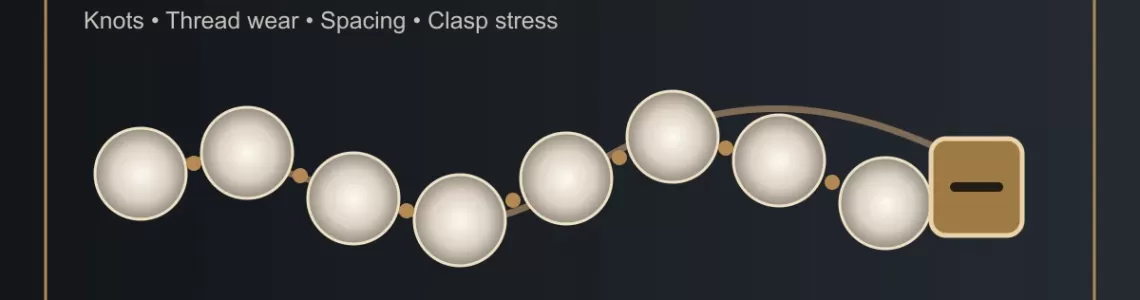
Answer first: a pearl bracelet should be inspected for restringing when the cord looks dark, fuzzy, thin or stretched; knots have loosened; gaps appear between pearls; beads rub together; the clasp area twists; or the bracelet no longer lies in its original shape. Stop wearing it if the string is visibly frayed, a knot is opening, a drill hole is cutting into the cord, or a clasp connection is failing. Individual knots can reduce bead loss if a strand breaks, but not every pearl bracelet is knotted, and knotting does not prove that pearls are genuine or high quality.
What restringing means
Restringing is the controlled replacement of the material that holds a bracelet together. The service may include cleaning, recording the original bead order, replacing thread or cord, tying new knots, rebuilding the clasp connection and checking whether worn findings should be replaced. It is not simply pulling the same beads onto any available string.
Pearl bracelets can be built on silk or synthetic thread, elastic cord, coated wire, cable, links or a mixed system. Some are knotted between every pearl; others are knotted only near a clasp, left unknotted, or spaced with metal or gemstone components. The correct service therefore starts with the actual construction. Advice written for a traditionally knotted necklace cannot automatically be applied to an elastic bracelet or a mixed pearl-and-silver design.
This guide focuses on inspection and the decision to seek repair. For broader cleaning and storage instructions, use the separate freshwater pearl bracelet care guide.
Why knots and string condition matter
A knot between pearls can serve two practical functions. It can limit how many beads are lost if the string breaks, and it can reduce direct bead-to-bead contact. Those benefits depend on knots being secure, correctly sized and close enough to the pearls to control movement. An uneven or loose knot may create gaps without providing reliable separation.
GIA notes that pearl string can darken, stretch and wear thin and advises periodic restringing. Its pearl buyer guidance also describes knots as a way to reduce loss and rubbing. These are reasons to inspect the construction, not a rule that every pearl bracelet must be individually knotted. A contemporary design may intentionally use another system.
The string is only one part of the structure. Drill-hole edges, clasp loops, crimp covers, metal spacers and hard neighboring beads can concentrate stress. A cord may look acceptable in the center while failing where it bends repeatedly at the clasp. The bead bracelet construction guide explains these load paths in more detail.
Seven signs that justify a closer inspection
- Visible fuzz or thinning: fibers stand away from the cord, a section looks narrower, or the string changes texture near a knot or finding.
- Darkening that is not superficial dirt: thread color has changed within high-contact areas. Darkening alone does not prove imminent failure, but it can make wear easier to see.
- New gaps: spaces appear between pearls and knots or between adjacent beads. Compare with earlier photographs because some designs intentionally include spacing.
- Loose or migrating knots: a knot no longer sits close to its pearl, changes size, or slides under gentle observation. Do not pull it tight while the bracelet is assembled.
- Bead-to-bead contact: pearls that were separated now strike or rub one another as the bracelet moves.
- Clasp-area distortion: the last pearl, end knot, jump ring or connector sits at an unusual angle, or the bracelet twists where it fastens.
- Shape or fit change: the bracelet hangs longer, feels unexpectedly loose, or no longer forms the same curve when laid flat.
One sign does not always mean immediate failure. Several signs together, rapid change, or damage at a high-stress point should lower the threshold for stopping wear. If a bead is already loose, place the whole bracelet in a small container rather than carrying it by the damaged end.
A five-minute inspection without stressing the bracelet
Work over a clean towel or tray in bright, diffuse light. Remove rings and watches that could scratch the pearls. Do not stretch the bracelet, pull knots, bend the clasp repeatedly or test strength by applying force.
- Photograph the complete bracelet. Capture the clasp, both sides and any pattern in bead size, color or shape.
- Lay it flat. Note whether it forms a natural curve or shows a kink, twist or long gap.
- Follow the string path. Inspect every visible segment, knot and drill-hole entrance. Use magnification only to observe, not to diagnose pearl origin.
- Check the ends first. Look at the cord where it meets the clasp, jump ring, bead tip, crimp or end knot. Repeated bending makes these important stress points.
- Check the clasp without force. Open and close it once if normal operation is safe. Stop if the connection flexes, separates or grinds.
- Compare with an earlier record. A new gap or changed fit is more useful than an unsupported guess about how thread should look.
Record observations in plain language: “three-millimeter gap beside the fifth pearl” is stronger than “bad string.” If you plan to request service, count the pearls and note distinctive beads. GIA's pearl quality factors include matching; a before-service record helps preserve an intentional progression or balanced arrangement without turning the repair into a grading exercise.
Knotted, elastic, wire and mixed constructions
- Individually knotted thread
- Inspect every knot for looseness, uneven spacing and abrasion. The end knots and clasp transitions deserve special attention. Do not assume the visible outer fiber reveals the entire remaining strength.
- Unknotted thread
- Look for bead-to-bead contact, stretched spacing and wear at drill holes. A break may release multiple beads quickly, so stop wearing at the first clear sign of failure.
- Elastic cord
- Look for flattening, whitening, cracks, exposed inner fibers and loss of recovery. Do not repeatedly stretch it to “test” strength. Roll the bracelet over the hand instead of pulling one side hard.
- Coated wire or cable
- Inspect bends, kinks, exposed metal, crimp areas and abrasion near holes. A wire-strung design is not serviced with the same knotting method as silk.
- Mixed construction
- Use the most vulnerable component to set care limits. Pearls, cord, adhesive, oxidized silver and porous companion beads may each exclude a different cleaning or repair method.
Bead diameter also changes the visual and mechanical scale of a bracelet. The 6 mm, 8 mm and 10 mm bead-size guide can help document the original proportions before service.
How often should a pearl bracelet be restrung?
There is no universal interval. Jewelers of America and GIA publish conservative guidance that frequently worn pearl strands may benefit from periodic or annual professional restringing. That is useful as a reminder, not a warranty deadline. Wear rate depends on frequency, thread, construction, weight, perspiration, cosmetics, moisture, storage, clasp geometry and previous repairs.
A lightly worn bracelet stored correctly may not need yearly work. A bracelet worn several times a week can require attention sooner. Inspection evidence should decide: visible wear, stretch, looseness, abrasion or a failing finding matters more than the calendar alone. Ask a repairer whether the current construction is serviceable and what signs should trigger the next inspection.
Cleaning before or after repair
Pearls are relatively soft and surface-sensitive. GIA advises against ultrasonic and steam cleaning. If a strung piece becomes damp during an approved cleaning method, the stringing material should dry completely before wear. GIA and Jewelers of America recommend laying pearl strands flat to dry because hanging wet thread can encourage stretching.
Do not soak a damaged bracelet, use silver dip across mixed materials, or apply solvent to see whether thread or color changes. Water and chemicals can make a repair harder by changing cord tension, weakening adhesive or affecting pearl surfaces and neighboring components. If the bracelet is visibly dirty and also needs repair, ask the repairer whether cleaning should occur before or after restringing.
For pearl-and-silver pieces, clean for the pearl first and treat metal locally only when the product instructions permit it. The pearl versus mother-of-pearl care comparison explains why visually related nacre materials still require precise identification.
What to document before handing over a bracelet
- full-length photographs from both sides;
- close photographs of the clasp, end connections and damaged section;
- the total pearl count and any spacers or charms;
- the original order, especially for graduated or intentionally varied pearls;
- bracelet length or inner circumference measured without stretching;
- the seller's material and construction description;
- which parts may be replaced and whether old parts should be returned;
- the proposed thread, knotting pattern, clasp work and final length.
Ask whether the quote includes cleaning, new findings, clasp repair and post-service inspection. A repair description should distinguish restringing from pearl replacement, polishing or appraisal. If identity, treatment or value is disputed, a routine restringing service does not replace appropriate gemological testing.
Questions to ask the repairer
- What is the present construction, and which visible condition makes service advisable?
- What replacement material and knotting pattern will be used, and why is it appropriate for this bracelet?
- Will the original bead order, total length and clasp orientation be preserved?
- Are any end findings, rings or clasps too worn to reuse?
- Could cleaning, drilling, polishing or adhesive work change the pearls or mixed components?
- What tolerance should be expected for final length and spacing?
- How will the completed bracelet be checked before return?
A clear answer separates necessary structural work from optional cosmetic work. Ask for approval before substitutions, especially if a finding carries a hallmark, the design has intentional oxidation, or replacing a component would change the bracelet's appearance. After service, compare the finished piece with the photographs and count, then inspect the clasp and spacing before wearing it away from home.
Buyer checks for a new pearl bracelet
Before purchase, zoom in on the clasp, drill holes and spaces between pearls. Ask whether the design is knotted, elastic, wire-strung or linked; what the size option measures; and whether the bracelet can be restrung. A clear construction answer helps set realistic care and repair expectations.
Compare claims against the exact listing rather than applying this article to every product. The freshwater pearl and sterling silver bracelet and the moonstone, pearl and sterling silver bracelet are different mixed-material designs; their live pages control their stated specifications. Browse the beaded bracelets category to compare construction and sizing, but do not infer stringing material from appearance alone.
For pearl appearance and matching, use the freshwater pearl quality guide. Quality comparison and string-condition inspection answer different questions: a beautiful pearl can be on worn thread, and a newly strung bracelet can still carry unsupported material claims.
Stop-wearing and repair decision
- Continue normal observation: no visible damage, no changed spacing, secure clasp and no fit change.
- Schedule service soon: mild stretch, loosening knots, dark or fuzzy thread, recurring twist, or a clasp connection beginning to deform.
- Stop wearing now: frayed or exposed fibers, opening knot, cracked elastic, kinked wire, detached finding, loose pearl, or cord cutting against a drill hole.
When uncertain, choose the reversible action: stop wearing, store the bracelet flat in a soft container, retain every loose component and request a written repair scope. Continuing to wear a visibly failing strand can turn a simple restringing job into lost pearls and damaged findings.
Frequently asked questions
Does every pearl bracelet need knots between each pearl?
No. Individual knotting is one construction method. Elastic, wire, linked and mixed designs use different systems. Evaluate the actual bracelet rather than imposing a traditional necklace rule.
Do knots prove pearls are real?
No. Knotting is a construction choice. It does not authenticate pearl origin, treatment, quality or value.
Can I tighten loose pearl knots myself?
Pulling an assembled strand can stress thread, drill holes and clasp connections without restoring an even structure. Document the gap and seek appropriate repair if the knot is moving or opening.
Should pearl bracelets be restrung every year?
Frequently worn pearl strands are often advised to receive periodic or annual service, but there is no universal deadline. Construction, use and observed wear should determine timing.
Can I hang a pearl bracelet to dry?
Lay a strung pearl bracelet flat when drying. Wet thread can stretch, and the stringing material should be completely dry before wear.
Can an ultrasonic cleaner prepare pearls for restringing?
No. GIA advises that pearls should never be cleaned in an ultrasonic or steam cleaner. Use a method compatible with every component and coordinate cleaning with the repairer.
What if one pearl has come off?
Stop wearing the bracelet, collect all beads and findings in a closed container, photograph the remaining sequence and avoid trying to force the loose pearl back onto damaged cord.
Method, evidence limits and editorial note
We compared current GIA pearl-care, buyer and quality guidance with Jewelers of America consumer guidance, the live sunMYLOVE pearl listings and existing pearl, sizing and construction guides. Search volume and an exact GSC query for this topic were not disclosed and are recorded UNKNOWN.
Reviewed: September 23, 2026. sunMYLOVE editorial note: construction and service needs vary by item. This guide does not establish the stringing material, knotting pattern, identity, treatment, grade or repairability of a specific bracelet. Product-specific instructions and a qualified repair assessment take priority.
References and evidence scope
- GIA, How should I care for my pearls? - string wear, knot function and periodic restringing.
- GIA, Pearl Care and Cleaning Guide - cleaning limits and complete drying of stringing material.
- GIA, Pearl Buyer's Guide - string inspection, stretching, knotting and repair timing.
- Jewelers of America, Pearl Buying Guide - knot inspection, cord observations and flat drying.
- GIA, Pearl Quality Factors - matching and arrangement context.
Leave a Comment