
Convertible Necklace or Wrap Bracelet: How to Read Length and Wrist Size
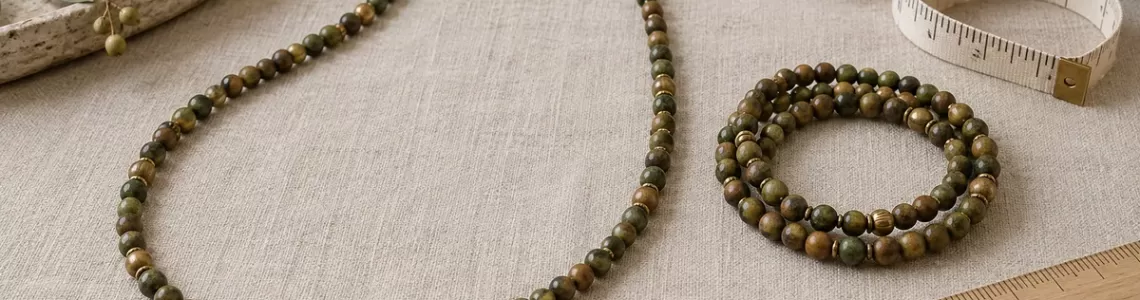
Quick answer: For a convertible necklace or wrap bracelet, your wrist circumference and the jewelry's finished strand length are different measurements. Measure your bare wrist at the wrist point for the bracelet option; read finished strand length as the length of the jewelry itself. Do not divide strand length by wrist size and assume an exact number of wraps. Bead thickness, focal pieces, spacing, stretch, overlap and the comfort allowance all change the result.
Dual-use jewelry solves two styling jobs with one construction, but it also creates an unusually easy sizing mistake. A product page may list an 81 cm strand and offer 15, 16, 17 or 18 cm wrist options. Those numbers do not compete with each other. The first describes the finished object used as a necklace; the second records the wearer's actual wrist circumference for wrapped wear.
This guide explains how to separate those measurements, check a listing and make a reasonable pre-purchase decision. It does not promise an exact wrap count, calculate an anatomical necklace drop, or replace the current specifications and option instructions on an individual product page.
Three measurements that answer different questions
- Actual wrist circumference
- A body measurement taken around the wrist at the point specified by the seller. ISO terminology describes wrist girth as a measurement at the wrist point. This is not the length of a finished bracelet.
- Finished strand length
- The measured length of the completed jewelry strand under the seller's stated convention. It includes the construction that exists on the product, but it is not automatically the same as necklace drop, wrist size or usable elastic extension.
- Resulting wrap count
- The number of turns the strand makes around a particular wrist when worn. This is a fit outcome influenced by the strand, components, wearer and desired looseness; it is not a universal specification derived from one division problem.
Keeping these fields separate prevents a common category error. A 16 cm wrist option should not be read as a 16 cm finished bracelet. Likewise, an 81 cm finished strand should not be read as five guaranteed wraps around a 16 cm wrist. The arithmetic may look tidy, but the physical object does not behave like a zero-thickness line.
How to measure the wrist for wrapped wear
Use a flexible, non-stretch measuring tape. Place it around the bare wrist at the location stated by the product's option instructions, usually near the wrist point rather than higher on the forearm. Keep the tape in contact with the skin without pulling it tight enough to compress the wrist. Read the circumference where the tape meets itself.
If a soft tape is unavailable, use a non-stretch strip of paper or cord, mark the meeting point, and measure the marked length against a rigid ruler. Do not use the jewelry itself as the measuring tool: an elastic or beaded strand has thickness and may stretch, while a chain can drape differently from the body path being measured.
Follow the seller's requested input. If the option asks for actual wrist circumference, enter the measured body value rather than adding your own allowance. If it asks for finished bracelet length, the requested number is different. A buyer should not silently convert between the two because the maker may already incorporate construction and comfort allowance.
Measure twice under ordinary conditions. A tape placed at a different point, pulled with different tension or measured over a sleeve can produce another result. If the value falls between offered options, ask how the product's construction is intended to fit rather than rounding by habit.
How to read finished strand length
Finished strand length belongs to the product, not the wearer. Before comparing it, identify the seller's endpoints and method. Is the strand measured end to end while open, around a closed loop, or along a flexible centerline? Are a clasp, tassel or focal component included? Is the item measured relaxed or under tension?
For a long elastic beaded loop, a relaxed finished length is not an instruction to stretch the strand to that number. It is also not a statement of the maximum safe extension. Elastic behavior depends on the cord, age, knot, load and assembly, and an unpublished extension limit should never be invented from a photograph.
When units differ, convert only after identifying the measured object. NIST conversion factors support approximately 2.54 centimeters per inch. Thus 81 cm is about 31.9 inches. That conversion describes the same product length in another unit; it does not transform the number into wrist circumference, necklace drop or wrap count. Preserve the source's level of precision: “81 cm or longer” should not become an exact multi-decimal promise.
Why length divided by wrist size does not guarantee wraps
A simple calculation ignores the volume and movement of real jewelry. Each turn follows a path around the outside of the previous turn and the outside of the wrist. Thick beads make that path longer than the skin-level circumference. A large focal bead or connector can consume additional length and may need to sit only once at the front.
Spacing matters too. Knots, brass separators and gaps alter the centerline path. Elastic can change under load, but its available stretch should not be treated as free length. A strand worn tightly may produce more turns while creating pressure and stressing the cord; a looser, safer fit may produce fewer turns. The end or focal section may also need overlap to settle properly.
Suppose a listing states an 81 cm strand and a buyer has a 16 cm wrist. Dividing gives just over five, but that result is only a rough mathematical ratio. It does not account for bead diameter, the expanding radius of successive turns, the focal section, stretch or comfort. It should not be advertised as five guaranteed wraps.
The same reasoning appears in the guide to double-wrap bracelet fit: turns, bead size and closure construction work together. A purpose-built double-wrap bracelet and a long convertible strand can share buyer questions without sharing one sizing formula.
Bead size changes the path around the wrist
Bead diameter is not merely visual. Larger beads hold the strand farther from the wrist, which increases the circumference of the path traveled by each wrap. Irregular beads can also create local gaps or pressure points. Two strands with equal finished length but different bead diameters may therefore make a different number of comfortable turns.
The existing 6 mm, 8 mm and 10 mm bead-size guide explains why bead diameter affects profile and fit. Use that principle to evaluate a convertible piece, but keep the live product record in control. A category guide cannot prove the diameter, spacing or construction of a particular strand.
A prominent focal bead deserves separate attention. It may be wider, longer or heavier than the surrounding beads. When the strand is wrapped, the focal element may sit on top of one turn rather than passing evenly through every layer. Product photographs can show an example arrangement, but they do not calibrate the fit for every wrist.
Necklace wear uses a different geometry
When worn as a necklace, the same strand follows the neck and upper torso rather than circling a wrist repeatedly. Finished length still does not equal vertical drop. The loop curves around the neck, while bead diameter, stiffness, focal weight, clothing and body shape influence where it settles.
If the necklace is doubled, knotted or looped through itself, the effective arrangement changes again. Only use a configuration that the product construction supports. Do not force an elastic strand through a small opening, pull a focal component as a clasp, or assume that every styling example is mechanically interchangeable.
For a pendant-and-cord design, see the separate guide to pendant size versus cord length. A dual-use beaded strand is a different construction, but the evidence rule is the same: name the measured component and do not turn total material length into a promised anatomical position.
A verified dual-use example
The Q092 Bodhi-root long beaded necklace and wrap bracelet provides a concrete example of separate inputs. Its verified record describes approximately 8 mm green Bodhi-root beads, brass components and a reproduction-style dZi focal bead on a long elastic strand. The finished strand length is 81 cm or longer, while the available wrist options are 15, 16, 17 and 18 cm.
For this product, the wrist option represents actual wrist circumference for wrapped wear. The finished strand length describes the necklace construction. These values are deliberately not interchangeable. The listing does not provide a universal number of wraps for every wrist, and this guide does not add one.
The material description is also bounded. “Reproduction-style” identifies the focal bead as a design reference rather than an authenticated antique. The verified record does not establish a historical origin, certification or special property. Accurate sizing should be paired with equally accurate material language.
A buyer checklist before selecting an option
- Identify what the option requests. Look for “actual wrist circumference,” “finished length” or another explicit term.
- Measure the body only when requested. Use a flexible tape on the bare wrist and avoid adding an allowance unless instructed.
- Read the product length separately. Confirm endpoints, whether the strand is open or closed, and whether the measurement is relaxed.
- Check bead and focal dimensions. Thickness affects the path around the wrist and can change the resulting turns.
- Do not promise wraps by division. Use any ratio only as a rough question-forming aid, never as a guarantee.
- Check the construction. Elastic, clasped, knotted and adjustable designs behave differently.
- Compare the option to the current listing. A saved screenshot or old description may not reflect the current product record.
- Ask about an in-between measurement. Do not round up or down without understanding the intended allowance.
- Keep necklace and bracelet expectations separate. One finished strand can support two wearing modes without producing identical fit logic.
- Save the selected option and seller answer. Keep them with the order record in case a later fit question arises.
Care checks for a convertible mixed-material strand
A convertible strand is handled, bent and repositioned more often than jewelry worn in one fixed form. Inspect the elastic or stringing material, knot and junctions before wrapping. Stop using the piece if the strand shows fraying, cracking, permanent elongation or a loose connection. Do not keep wrapping simply because another turn appears mathematically possible.
Mixed components should be cared for according to the most sensitive part. Canadian Conservation Institute guidance warns that wet cleaning can be unsuitable for composite objects that combine textile-like material, beads and metal. It also notes that metal corrosion and weak stringing material can threaten beaded objects. For a wearable product, this supports a cautious principle: avoid soaking, harsh chemicals and unverified cleaning methods.
Brass may change at the surface, but aggressive polishing removes material and can affect nearby beads or cord. Start with a dry soft cloth and follow product-specific care information. The guide to cleaning mixed-material bracelets gives a compatibility-first method, while the textured brass guide explains why a surface finish should not be treated as unlimited polishing stock.
What a clear product page should state
A useful dual-use listing labels the finished strand length, the wrist measurement requested at checkout and the construction. It should identify bead size where relevant, describe the focal component accurately, and avoid a guaranteed wrap count unless the seller has tested and defined the exact conditions. Photos should show the two wearing modes without replacing measured specifications.
If any field is missing, the honest answer is “not published,” not a guess copied from a similar item. The FTC Jewelry Guides emphasize truthful representation of jewelry characteristics. Although they do not prescribe wrap-bracelet sizing, the same principle applies: a precise-looking number is not helpful when it describes the wrong thing.
Good sizing language reduces uncertainty without pretending every wearer or arrangement is identical. It tells the buyer which number belongs to the body, which belongs to the product, what the option controls and where variability remains.
FAQ
Is wrist circumference the same as bracelet length?
No. Wrist circumference is a body measurement. Bracelet or strand length is a product measurement that may include construction and fit allowance. Follow the exact input requested by the product page.
Can I divide necklace length by my wrist size to find the number of wraps?
You can calculate a rough ratio, but it cannot guarantee the result. Bead thickness, focal pieces, spacing, stretch, overlap and desired looseness all consume or change the usable path.
Should I add comfort allowance to my wrist measurement?
Only if the seller's instructions tell you to. If the option requests actual wrist circumference, submit the measured body value; the maker may already account for construction and fit.
Does an 81 cm strand make five wraps on a 16 cm wrist?
Not necessarily. The arithmetic ratio is slightly above five, but real wraps travel around bead thickness and successive layers and must accommodate focal components, stretch and comfort.
Can the same size be used for necklace and bracelet wear?
A dual-use product can use one physical strand for both modes, but the measurements still mean different things. Finished length describes the strand; wrist circumference guides the bracelet option or fit.
How tightly should I measure my wrist?
Keep a flexible tape in contact with the bare wrist without compressing the skin. Use the location and allowance rule stated by the seller, and repeat the measurement for consistency.
References
- ISO Online Browsing Platform: ISO 11610 terminology
- NIST: Approximate Conversions from Metric to U.S. Customary Measures
- U.S. Federal Trade Commission: Jewelry Guides
- Canadian Conservation Institute: Guidelines for Textiles and Costumes
- Canadian Conservation Institute: Washing Non-Coloured Textiles
- Canadian Conservation Institute: Care and Cleaning of Brass
- Canadian Conservation Institute: Care of Objects Made of Glass Beads
Measurement note: Product specifications can change. Confirm the current listing and selected option before purchase. This educational guide does not authenticate materials, predict an exact fit or replace a seller's written product instructions.
Leave a Comment