
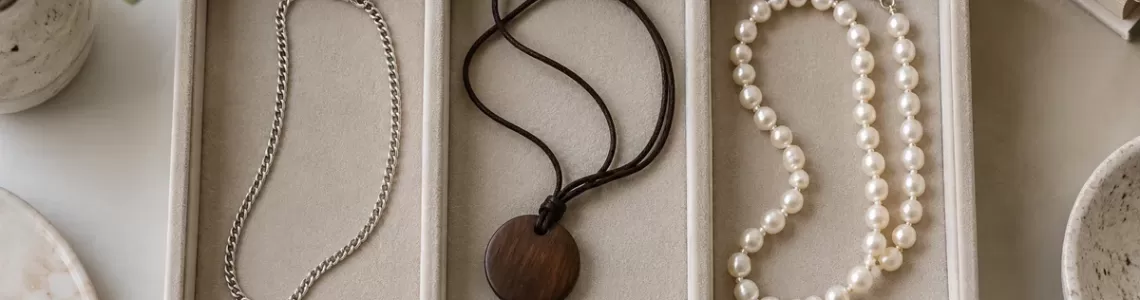
Store necklaces separately, with enough room to lift each piece without pulling another one. Support a pendant rather than leaving its weight on a delicate cord, keep chains away from harder components, and choose storage for the whole necklace, not just its metal. A silver-only chain, an ebony-and-brass pendant on waxed cord, and a pearl strand do not automatically belong in the same tightly sealed, aggressively dry container.
The useful question is not simply whether a jewelry box is attractive. It is whether its compartments suit your necklace's shape, materials and construction. This guide explains everyday home organization, the checks to make before putting a piece away, and the limits of common storage shortcuts. It does not promise that a particular box prevents every scratch, knot or change in appearance.
Start with the necklace, not the organizer
Put one necklace on a clean surface and identify its parts. Look for a chain or cord, a clasp or sliding adjustment, a pendant, beads, knots and any coating mentioned in the listing. Record an unknown component as unknown rather than guessing from color. A silver-colored clasp is not proof that every component is sterling silver; a black bead is not proof of ebony, obsidian or another particular material.
Next, decide what needs physical support. A light chain and a large pendant present different handling problems. Long strands need space for a loose arrangement, while short chains may fit a smaller compartment. The practical goal is to remove the necklace in one controlled movement without catching a neighboring piece. This is an organization decision, not a material-authentication test.
When choosing space for a pendant, use its dimensions and the complete necklace's shape. The pendant size versus cord length guide explains why those measurements describe different things. Neither tells you the exact dimensions of a storage compartment by itself. Place the actual necklace gently in the proposed space and check whether the lid closes without pressing its parts.
Three risks to keep separate
Contact between pieces
GIA advises against tossing jewelry into a drawer and identifies padded slots, necklace posts and suitable pouches or boxes as useful storage options. Its guidance also recommends anti-tarnish protection for sterling silver. These are general care principles, not approval of every organizer sold under the label “jewelry storage.” Source: GIA, Tips on Caring for Jewelry.
In practice, separation means more than assigning necklaces to the same large drawer. Give each one its own accessible area. If a pendant can slide into the next compartment when you open the drawer, the divider is not doing the job you want. If a necklace needs to be pulled out from beneath several bracelets, rearrange the collection before adding another layer.
Weight and strain
Ask what carries the pendant's weight while the piece is stored. A stand may be convenient for a lightweight chain, but convenience does not establish suitability for a heavy pendant, worn thread or elastic strand. A supported, loose arrangement is a conservative option when the maker has not provided hanging instructions. Do not use a tight knot, pin or clamp to make the necklace fit an organizer.
The storage environment
A protected compartment and a chemically compatible environment are different requirements. Canadian Conservation Institute guidance discusses supporting metal objects and avoiding damaging storage materials. It also notes that poorly controlled conditions can create condensation inside containers. Museum guidance is a useful warning about risks, but its detailed conservation methods are not a universal home prescription for mixed-material jewelry. Source: CCI, Storage of Metals.
Avoid treating “airtight,” “velvet,” “wooden” or “anti-tarnish” as a complete compatibility statement. Check the organizer's maker information and the necklace's care instructions. If either is vague, choose a simple arrangement that avoids compression and obvious dampness while you ask for clarification. Do not improvise a chemical treatment to compensate for an unsuitable box.
A daily put-away sequence
- Remove necklaces one at a time over a clear surface, not over a sink.
- Look for a caught link, worn cord, loose component or incomplete closure before storing.
- Follow the piece's own cleaning instructions if care is needed; do not automatically wash every necklace.
- Do not enclose a visibly damp piece. If cleaning involved water, follow the maker's drying directions for every component.
- Place it in its own compartment with the pendant and strand supported.
- Check that no part crosses a hinge or lies where the lid will press it.
- Leave enough access to lift the piece without dragging it across neighboring jewelry.
This sequence is a practical household checklist rather than a tested guarantee of longer service life. Adapt it to the construction you actually own. If a problem appears at the inspection step, separate the necklace for repair instead of hiding it in its usual compartment. Keep any loose part with the piece in a clearly identified container so it is not mistaken for unrelated jewelry.
Chains: organize the route, not a tight bundle
For a chain, think about how it will leave the compartment. A loose arrangement with a visible end is easier to inspect than a tight ball. Do not wind it forcefully around a small object to create a compact package. A necklace post can be useful if it allows the chain to rest without catching, but inspect the contact point and the space below it before using it.
If the clasp closes normally and its maker permits that storage arrangement, keeping its parts together may make the necklace easier to retrieve. It does not make tangling impossible. An attached pendant, extension chain or decorative link can still catch on another object. Keep extra chains in separate spaces rather than assuming a closed clasp makes communal storage safe.
When a chain is tangled, pause. Identify whether the problem is a loose loop, a caught clasp or a deformed link before applying force. Pulling two ends apart can turn a storage problem into a repair problem. If you cannot release it gently without stressing the necklace, ask a jeweler. This guide does not recommend needles, oils or solvents as a universal untangling method.
Ebony-and-brass pendants: protect all three components
For a wood pendant on cord, the wood, brass and cord all matter. CCI describes wood as responsive to humidity: changes can cause swelling or shrinkage and damage finishes. Its wooden-object guidance is not an ebony-jewelry test, so it does not establish a precise safe humidity range or prove a particular pendant's finish. The reasonable home-storage implication is to avoid obvious wet conditions and direct heat, not to invent a treatment recipe. Source: CCI, Basic Care of Wooden Objects.
The S586 ebony wood and brass pendant necklace has approximately 80 mm Small and 94 mm Large pendant options with adjustable waxed cord. Its exact cord-length range is not published. Those pendant sizes help you compare compartment space; they do not establish cord strength, a hanging-storage rating or a maximum adjustment length.
The S664 shield pendant necklace has an approximately 52 mm pendant and adjustable waxed cord listed up to approximately 80 cm. Keep the distinction between pendant dimension and cord length. A long available cord does not mean it should be tightly wound around the pendant. Arrange the cord loosely beside a supported pendant without forcing its sliding adjustment.
Before putting either necklace away, look at where the cord meets the pendant or fittings. If that area appears frayed, detached or damaged, treat it as a repair question. Do not use oil on the wood merely because it looks lighter in one photograph, and do not polish the brass through the cord or wood. For separate care questions, consult the mixed-material cleaning guide and the current product instructions; the shared principle is component compatibility, not identical treatment for every piece.
Pearl and beaded strands: do not assume metal-only rules
GIA explains that pearls are readily scratched, can be harmed by chemicals, and need protection from excessive heat and dehydration. Its pearl guide recommends a very soft clean cloth for routine wiping and requires a wet string to dry before wearing. This does not identify the stringing material of your necklace or authorize soaking a mixed strand. Source: GIA, Pearl Care and Cleaning Guide.
Give a strand enough space to lie without a sharp bend or forced knot. Keep exposed metal fittings from lying against delicate beads when arranging it. Do not insert a drying packet just because the same packet is used with a silver chain. Pearl, wood, elastic, coatings and metal may have different care requirements, and a package selected for one component may not suit the complete necklace.
For a convertible strand, store the actual construction rather than recreating its wearing configuration under tension. The Q092 long beaded necklace and wrap bracelet is a dual-use elastic strand, not a metal chain. A loose supported arrangement avoids using storage as an elastic-extension experiment. The convertible necklace and wrap-bracelet sizing guide explains why wrist circumference, finished strand length and number of turns are different measurements.
Silver storage is not a promise of permanent brightness
CCI explains that silver tarnish involves sulfur-containing gases and that conditions influence the reaction. The presence or absence of tarnish does not, by itself, prove a necklace's silver content. Nor does a closed box guarantee that pollutants are excluded or that its own materials are compatible. Source: CCI, Understanding How Silver Objects Tarnish.
Use anti-tarnish products only as directed and for compatible pieces. Do not put household chemicals in a compartment to “protect” jewelry. If you notice darkening, check the stated finish before deciding that cleaning is necessary. The oxidized silver versus tarnish guide distinguishes intentional appearance from an unwanted change. Storage cannot settle that distinction without the product record.
Choose a box by answering five questions
- Can each necklace be retrieved without lifting another piece first?
- Does the pendant rest on support rather than hang from an uncertain or worn strand?
- Will opening and closing the drawer move jewelry into adjacent compartments?
- Does the lid clear every component without pressing it?
- Are the organizer's materials and care directions clear enough for the necklace's components?
Try an arrangement with the box stationary before committing the whole collection. You do not need to buy a large organizer simply because a small one looks crowded; reducing the number of pieces in each compartment may solve the immediate access problem. On the other hand, a tightly packed compartment does not become suitable just because its lining feels soft. Space and access remain separate checks.
Keep a simple identification note outside the contact area when similar pieces are hard to distinguish. Record the model, material wording and care source rather than adding an unverified label such as “untreated stone” or “solid silver.” A storage inventory is useful for finding instructions later; it should not become a new source of invented product facts.
Make everyday access work for your collection
Imagine a small collection containing one pendant you wear frequently, a chain reserved for occasional use and a long strand used in two wearing modes. An accessible compartment for the frequently worn piece may be useful, but avoid putting it on top of the occasional chain. Give the long strand a separate space where its ends are visible. This arrangement is a worked organization example, not a recommendation that every collection needs three particular products.
If you move an organizer between rooms, check the arrangement again after moving it. A compartment that works in a stationary drawer may allow pieces to shift when carried. A home jewelry box should not automatically be treated as travel packaging. Likewise, if someone else uses the same drawer, make the separated spaces easy to understand rather than relying on a placement only you recognize.
The best system is one you can use without rushing. If taking a necklace out regularly requires untangling several others, change the layout instead of accepting the problem as inevitable. Review the system when adding a larger pendant or longer strand. Reuse suitable storage where possible, but do not force a new piece into a space designed around a different necklace.
Inspect after storage before you wear
Lift the piece with support and check the closure, adjustment and connecting points. Look for a new catch, a cord change, a separated component or a surface change. Compare against the actual earlier condition if you have a photograph; lighting differences alone are not proof of damage. If something is uncertain, set the necklace aside and ask about its repair or care requirements before wearing it.
Do not establish a universal replacement date for every cord or elastic strand. The product's construction, use and condition matter, and an online storage guide cannot inspect them. A clean-looking necklace can still have a worn connection. Conversely, a natural wood-grain variation is not automatically a storage fault. Keep the observation specific: what changed, where it changed, and when you first noticed it.
Frequently asked questions
Should every necklace hang on a stand?
No. Choose by construction and condition. A stand may be convenient, but support a heavy pendant or uncertain strand rather than assuming hanging is appropriate.
Can necklaces share one pouch?
Separate compartments are easier to inspect and retrieve. A shared pouch allows contact and catching; softness alone does not remove those risks.
Is an airtight bag best for all necklaces?
No. Consider the complete material combination and the bag's instructions. Do not apply metal-only protection or aggressive drying indiscriminately to pearls, wood or mixed strands.
Does anti-tarnish storage prove a chain is silver?
No. Storage behavior is not an authentication method. Use the product's disclosure and appropriate professional evidence where needed.
Can I wrap an adjustable cord tightly around its pendant?
A loose supported arrangement is the more conservative choice. Do not force the sliding adjustment or use a tight wrap to make the necklace fit.
Does S586 have a published maximum cord length?
No exact range is published. Its approximately 80 mm and 94 mm options describe pendant sizes, not cord length or wrist circumference.
Should a wrap-bracelet necklace stay wrapped in storage?
Not under forced tension. Store the strand loosely with support and follow its maker's construction-specific instructions.
References
These sources support the specific care principles cited above. Conservation guidance is not a certification of sunMYLOVE products, and the storage checklist is practical interpretation rather than a controlled product test.
Leave a Comment