
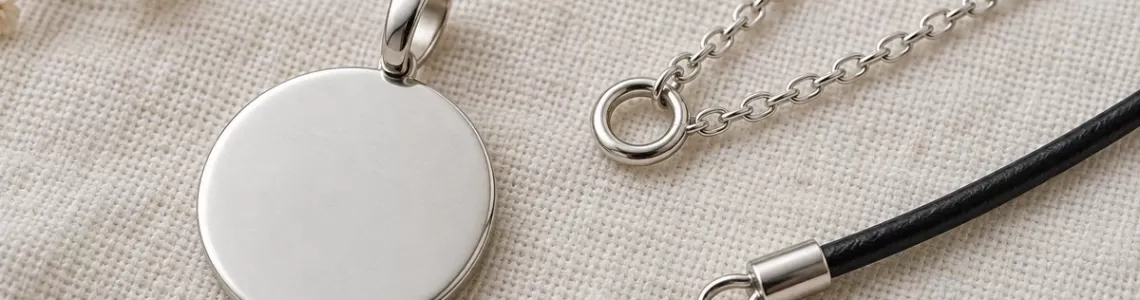
A pendant fits a chain or cord only when its usable opening accommodates the part that must pass through it, not merely the advertised chain width. Check the bail's internal opening, the chain's largest end fitting, the route through the attachment and the condition of both pieces. A pendant that slides onto a necklace has passed a geometric check, not a strength test. If measurements or construction details are missing, ask for confirmation before buying a replacement chain or attempting a change.
This guide separates attachment compatibility from necklace length, metal purity and appearance. It is a consumer checklist, not a jewelry-making tutorial or a load-rating certificate. No universal pendant-weight limit can be inferred from a photograph. A jeweler should assess a worn, valuable, delicate or unfamiliar assembly rather than asking the wearer to pull, bend or modify it at home.
Start with the attachment, not the pendant's overall size
A bail is the connecting component through which a necklace may carry a pendant. Some pendants instead use a drilled hole, an integral loop or an arrangement that is not intended to be opened by the wearer. Fire Mountain Gems' guide to bails illustrates several attachment families. Its range is a useful reminder that two pendants with similar silhouettes need not accept the same stringing method.
Look at front, side and rear photographs. Identify the actual passage for the chain or cord and distinguish it from decoration. A large ornamental loop may contain a narrower passage behind it. A circular pendant may have a small separate attachment at the top. An opening visible in the design itself is not automatically an approved suspension point. If the seller's photograph does not show the construction clearly, leave compatibility unresolved.
Overall pendant dimensions answer a different question: how large the focal piece will look. Our pendant size versus cord length guide keeps those measurements separate. An approximately 50 mm pendant diameter, for example, says nothing by itself about the usable width of a bail. Treating the diameter as an attachment measurement can lead to buying a necklace that cannot be threaded through the pendant.
Compare the opening with the whole threading route
Rio Grande's Guide to Jewelry Chain specifically draws attention to the end ring when matching a finished chain to a bail. That is the practical distinction many online comparisons miss: a chain's links may be slim while its terminal ring or connector is larger. Inspect the end that would actually travel through the opening, rather than assuming the clasp must be the threading end.
Record three things separately: the chain body, the end fitting and the pendant's opening. Ask which dimensions describe width and thickness, and whether the opening is measured internally. A flat component can be narrow in one view and wide in another. Rotation may change its presented profile, but a seller's single dimension does not establish that the component can navigate the complete passage without force.
An illustrative comparison can help: imagine a chain described as 2 mm wide and an end fitting described as 4 mm wide. A 3 mm opening does not establish that the finished chain can be installed. These numbers are hypothetical, not specifications for a sunMYLOVE product. They do not prescribe a clearance allowance, a safe weight or a modification. The correct answer remains dependent on the real shapes and attachment route.
Internal opening is not external bail size
Catalog dimensions may describe the outside of a component, its overall height or its opening. Those values are not interchangeable. Fire Mountain Gems' bail-sizing answer uses a slide gauge as a way to visualize a proposed size against a pendant. For a finished necklace purchase, ask the seller to identify what each dimension means rather than interpreting an unlabeled number from a scaled photograph.
If an opening is oval or rectangular, request both internal dimensions and a view showing their orientation. If the passage curves or narrows behind the visible face, ask whether the stated opening is the smallest usable passage. A nominal measurement is still not a fit guarantee. Photography, manufacturing variation and difficult access can make a close comparison uncertain, particularly when the parts belong to different manufacturers.
Use a ruler in a seller-provided image to understand scale, not to certify a near-threshold fit. Perspective and lens angle can distort a small opening. Do not insert a sharp measuring tool into a delicate pendant or scrape a finish just to obtain a number. When accurate measurement cannot be taken gently, a professional assessment is more useful than a home estimate reported with false precision.
Closed bails and hinged bails need different checks
A closed passage normally requires a compatible necklace end to travel through it, unless the necklace is assembled around the pendant by a professional. A hinged connector can provide a different attachment route. Stuller's discussion of hinged bails describes their role in attaching and removing components. This establishes that openable designs exist; it does not mean every visible seam is a user-operated hinge.
Before opening anything, identify the maker's intended mechanism. A seam may be part of a cast component, a solder joint or a split construction used during assembly. A loop that appears flexible is not permission to bend it. Ask for operating instructions and confirmation that the piece is intended for repeated opening. An unknown construction should stay untouched until it can be assessed.
For an attachment explicitly intended to open, evaluate whether you can operate and verify its closure comfortably without tugging on the pendant. Keep the process over a soft, contained surface. If the closure fails to align, feels irregular or cannot be confirmed visually, stop. Do not improvise with glue, tape or pliers. Changing the attachment may also affect service or return conditions, which should be checked before alteration.
Cord thickness does not describe knots or cord ends
A cord necklace may have an unadorned end, a terminal fitting, a knot or an adjustable arrangement. Compare the part that would actually need to pass through the pendant, not just the cord's nominal thickness. A supplied necklace may be assembled in a sequence that cannot be recreated by sliding the pendant off the finished cord. An adjustable cord is not automatically a removable cord.
Do not compress a knot, pull a finished end apart or repeatedly drag cord through an uncertain edge to prove that a replacement fits. That would change the item being assessed. The safer buying question is whether the manufacturer intends the pendant and cord to be separable, and which replacement dimensions and construction are supported. If the answer is unavailable, keep the original assembly rather than experimenting on it.
The S592 ebony wood and brass circle pendant necklace is a relevant example of why separate measurements matter. Its verified record describes an approximately 50 mm pendant and approximately 2 mm waxed cord. It does not supply a verified attachment opening or a universal replacement-chain specification. Those facts support understanding the listed necklace, not a promise that a separately purchased chain will fit.
Fit, movement and strength are different decisions
First establish whether the assembly can be attached in the intended way. Then consider how the pendant rests and moves during ordinary handling. Finally, have the suitability of the complete assembly assessed when it is uncertain. These are separate questions. A chain passing through a bail does not establish that its clasp, connecting rings, links and pendant attachment are appropriate for the proposed use.
Rio Grande's chain guide treats support requirements as part of chain selection, but it does not provide a universal consumer formula for every pendant. Do not turn chain width into a weight allowance or assume that a decorative bail is stronger because it looks substantial. Metal, construction, joints, wear and the pendant's attachment all matter. Manufacturer ratings, where available, belong to the exact specified combination.
Inspect without a destructive test. An obvious gap, bent component, worn contact point or unreliable closure is a reason to pause wearing and seek assessment, not to increase pulling force. A home tug test can damage an assembly and still cannot certify its behavior during future wear. The necklace clasp guide covers fastening observations separately; a good clasp cannot compensate for an unresolved pendant attachment.
Read product listings as specific combinations
A listing may offer a complete necklace, a pendant only, a chain only or a set of components. Confirm which items are included before interpreting a photograph. A styled image can show a chain that is not part of the purchase. Ask whether the pictured combination is the actual supplied configuration and whether any choices change the attachment construction. Keep the answer associated with the exact option you intend to order.
The S586 handcrafted ebony wood and brass pendant necklace and S664 carved ebony wood shield pendant necklace are listed cord-based designs, not compatibility certificates for unrelated chains. Their pendant dimensions and cord information should be read independently. An unavailable opening dimension should remain unknown rather than being inferred from the size of the wood focal piece or the appearance of brass details.
For another useful distinction, a long beaded necklace that can be worn as a wrap bracelet is not a substitute for a loose chain selected for a pendant. The convertible necklace and wrap-bracelet sizing guide addresses wearing modes and lengths. Combining parts across product types introduces a new compatibility question that the original length or wrist-size description cannot answer.
A short message that gets a useful seller answer
Describe the exact pendant and necklace rather than asking whether it fits a standard chain. Include the model or product link, the necklace body's stated width and thickness, the end fitting's measurements and a clear photograph if you already own it. Ask for the pendant's internal opening, the intended threading route and whether the supplied cord or chain is designed to be removed by the wearer.
A practical question is: can this complete necklace end pass through this pendant's smallest usable opening without alteration, and is this combination intended for ordinary wear? Ask the seller to distinguish a measured fact from an estimate. If the seller cannot confirm compatibility, consider buying the supplied complete necklace or arranging a jeweler's assessment before purchasing separate parts. That is a decision boundary, not a judgment about the seller's honesty.
Keep the response with your purchase records and check applicable return and alteration conditions. Do not ask the seller to infer strength from a picture or to approve a home bending procedure. Your aim is to resolve inclusion, geometry and intended use. A clear answer about what is unknown can prevent an unsuitable purchase just as effectively as a confirmed fit.
When to involve a jeweler
Professional help is appropriate when the pendant is valuable, delicate, visibly worn or not designed for user removal. It is also useful when a new bail, a different end fitting or any permanent alteration is being considered. Ask for an assessment of the whole assembly and a clear explanation of the proposed work. Replacing one part can change appearance, movement and future service requirements.
Do not heat, enlarge, file or drill an attachment at home to make a chain fit. Such changes are outside this buying checklist and may damage the pendant or finish. GIA's jewelry care guidance emphasizes professional check-ups and material-aware care. It is not a bail engineering standard, but it supports treating uncertain condition and construction as reasons for qualified inspection.
FAQ
Will a 2 mm chain fit every 3 mm bail?
No. The end fitting, thickness, shape and smallest usable passage also matter. The two nominal numbers alone cannot confirm installation or safe wear.
Can I use the pendant's diameter to estimate its bail?
No. Overall pendant size and attachment opening are separate specifications. Request the internal opening directly or keep it unknown.
Does an adjustable cord mean the pendant is removable?
No. Adjustment describes wearing length, not necessarily the assembly sequence or removability. Ask about the exact construction before changing parts.
Should I bend a small loop to get the chain through?
Not without a professional assessment. A loop may not be intended to open, and bending can damage it. Do not modify a new item to test compatibility.
Is a hinged bail always the safest option?
No universal ranking follows from the mechanism alone. Its suitability depends on the exact components, closure, condition and intended use.
Does passing through the opening prove enough strength?
No. Geometric fit is not a load rating. The complete necklace and pendant assembly require a separate suitability assessment when that is uncertain.
References and evidence scope
This article uses first-party component guidance for terminology and bounded compatibility principles. The seller-question checklist is editorial reasoning, not a tested standard. No sunMYLOVE attachment opening, load capacity, metal assay, service promise or replacement compatibility has been invented. The featured photograph is a generic educational illustration, not a store product.
- Rio Grande: Guide to Jewelry Chain — chain selection and finished end-ring compatibility.
- Fire Mountain Gems: A Guide to Bails — attachment families, not universal interchangeability.
- Fire Mountain Gems: Choosing the Right Bail — visualizing component size with a gauge.
- Stuller: Charm Jewelry and Componentry — the role of hinged bails.
- GIA: Tips on Caring for Jewelry — material-aware care and professional inspection.
Leave a Comment