
Coin Silver vs Sterling Silver: 900, 925 and Buyer Checks
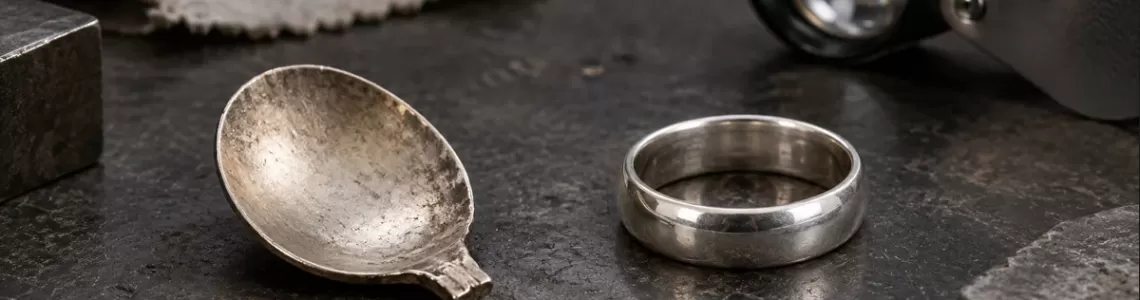
Quick answer: In current U.S. jewelry guidance, coin silver means an alloy containing at least 900 parts pure silver per thousand, while sterling silver means at least 925 parts per thousand. That is a 90% versus 92.5% silver distinction, not proof of age, origin, maker or value. When comparing coin silver vs sterling silver, read the complete mark, identify the legal and historical context, separate solid metal from plating or added parts, and use qualified testing when the claim matters.
The phrase "coin silver" often appears in antique listings, inherited-object descriptions and discussions of older American silver. It sounds self-explanatory, but the name invites several wrong shortcuts. It does not automatically mean a maker literally melted coins for the object. It does not make an item antique. It does not guarantee a particular date, city, workshop or collectible price. It is first a fineness description in the U.S. context.
This guide explains the buyer evidence that can support a coin-silver or sterling-silver claim. It does not authenticate a particular ring, spoon or bracelet, date an object from photographs, identify a maker from an unclear stamp, or estimate value. Historical markings and regional trade practices can be complicated, and regulations differ between countries.
Coin silver vs sterling silver at a glance
- Coin silver
- In current U.S. consumer guidance, an item marked coin silver is 90% pure silver, or 900 parts per thousand. The remaining portion is alloying material. The term does not by itself establish when, where or how the object was made.
- Sterling silver
- A silver alloy represented as at least 92.5% pure silver, or 925 parts per thousand, under the cited U.S. standard. "Sterling," "sterling silver" and 925 are composition-related statements, not automatic proof of independent assay or authenticity.
- Silver plate
- A layer of silver over a base material. Plating is a construction description, not the same thing as a solid 900 or 925 alloy. Surface wear and a base-metal core can change care and testing decisions.
- Silver-colored metal
- An appearance description only. Several metals, alloys and coatings can look silver-colored. Color cannot establish fineness.
The numerical difference between 900 and 925 is 25 parts of pure silver per thousand parts of alloy. That difference is real, but buyers should not exaggerate what it predicts. Design, thickness, work hardening, manufacturing method, repairs, solder, hollow construction and condition can matter more to how a finished object feels or performs than the fineness number alone.
What does "coin silver" mean?
The U.S. Federal Trade Commission's consumer guidance states that items marked coin silver are made with 90% pure silver. The current federal Jewelry Guides distinguish a coin-silver representation from sterling. This creates a useful modern buyer rule: treat "coin" as a 900-fineness claim in the U.S. market, not as a poetic synonym for sterling.
The historical name is not a manufacturing certificate. In different periods, silversmiths had access to coins, refined metal, scrap and other silver sources. Even if documentary research shows that coinage was commonly used as material in a time or place, the words "coin silver" on one listing cannot prove the source of that object's silver. Composition and provenance are separate questions.
The same separation applies to age. A modern maker can produce a 900-fineness alloy, and an old object may be sterling, lower-fineness silver, plated metal or something else. Style can suggest a research path, but the metal term alone does not date the piece.
What does sterling silver mean?
Sterling is a higher minimum silver fineness than coin silver in the cited U.S. framework: 925 rather than 900 parts per thousand. The FTC explains 925 as 92.5% pure silver. The remainder is alloying material used to provide practical properties, but a fineness mark does not identify every alloying element, coating or component of a finished object.
A complete product can include solder, springs, clasps, pins, findings, stones, adhesives or repairs. A sterling claim should be read with its scope. For example, a sterling pendant on a base-metal chain is not the same construction as an all-sterling assembly. When a listing is ambiguous, ask which component the claim describes.
The silver hallmark and maker-mark guide explains why a number, sponsor or maker mark and assay context answer different questions. A 925 stamp can support a claim, but it does not make every surrounding story true.
Does coin silver literally come from coins?
Not necessarily. The phrase should not be read as a guaranteed recipe or chain of custody. A seller who claims that a specific object was made from particular coins has made a provenance statement that needs evidence beyond a 900 mark or a material name.
Useful provenance evidence may include maker records, dated invoices, family documentation, workshop archives, contemporary catalogues, inscriptions, comparable documented objects and specialist research. None of those is replaced by a home purity test. Conversely, an assay can help investigate metal composition but normally cannot identify the original source of the silver atoms.
For a buyer, the disciplined approach is to write down the claims separately:
- Fineness claim: Is the object described as 900, coin silver, 925 or sterling?
- Construction claim: Is it solid alloy, hollow, weighted, filled, plated or assembled from mixed components?
- Age claim: What date or period is represented, and what supports it?
- Maker claim: Is there a documented maker, a readable mark or only a resemblance?
- Provenance claim: Is there a documented ownership or manufacturing history?
When all five are collapsed into the word "coin," a buyer can easily pay for a story that has not been demonstrated.
Marks to inspect without over-reading them
Look for every number, letter, symbol and word, not just the largest stamp. Photograph the mark straight on, in diffuse light, with a scale reference. Record where it appears and whether it looks original, worn, recut or added near a repair. Do not scratch or polish the area while a return option remains available.
Potentially relevant U.S. wording includes "coin," "coin silver," "900," "sterling" and "925." Maker names, initials and retailer marks may also help research. Their presence does not remove the need to check the whole object. A mark can be incomplete, misread, copied or applied to only one component.
Jurisdiction matters. Canadian federal guidance uses .925 as the minimum for a silver quality mark and lists accepted Canadian marking forms. UK hallmarking uses a different system in which a complete hallmark includes compulsory sponsor or maker, fineness and assay-office marks, subject to weight thresholds and exemptions. A U.S. "coin" mark should not be treated as a complete UK hallmark or a Canadian quality designation.
If a listing combines incompatible descriptions - for example, "coin silver 925," "solid sterling plated" or "900 silver tone" - ask the seller to clarify the body material, surface and mark. Preserve the written answer and the original listing.
Why appearance cannot settle 900 vs 925
Coin silver and sterling can both look bright white, gray, warm, polished, matte, tarnished or intentionally darkened. Surface texture, lighting, camera white balance, wear, lacquer and cleaning history can overwhelm the subtle effect of a small fineness difference. A photograph cannot measure the silver percentage.
Tarnish is not a purity meter. The Canadian Conservation Institute notes that silver tarnish can appear yellow when thin, show rainbow colors, and look black when thick. Sulfur-containing gases and materials contribute to tarnish. Environment and surface history therefore matter; darker or faster tarnish does not establish that one object is 900 and another is 925.
The same caution applies to wear. A different-colored layer at an edge may suggest plating, but it could also involve solder, a repair, a separate component, dirt or a coating. Review the solid sterling versus silver-plated guide before treating a worn surface as a bulk-composition result.
Home tests that do not prove coin silver or sterling
- Magnet test: weak or absent attraction does not distinguish 900 from 925 and does not prove silver. Springs and added parts can respond differently from the body. See the silver magnet test guide.
- Ice test: an uncontrolled thermal comparison is affected by mass, shape, temperature and contact area. It is not a fineness assay.
- Sound or ring test: geometry, thickness, cracks, joins and how an object is supported change the sound.
- Polishing-cloth residue: dark residue shows surface material and polish action, not a numerical silver percentage.
- Scratch, file or acid test: these can damage an item, sample only a small area and be confused by plating, solder or operator error.
- Weight or density guess: hollow sections, filling, stones and undocumented dimensions make casual calculations unreliable.
Home observations can help form questions, but they should not be promoted into proof. If the claim affects a meaningful purchase, insurance, resale or conservation decision, define what must be established and use a qualified jeweler, assay office, conservator or laboratory.
Professional testing and its limits
X-ray fluorescence can provide non-destructive elemental screening at the measured area. It can be useful, but the result is local and surface-sensitive. Plating, enrichment, curvature, calibration, access and sampling location can affect interpretation. Ask for the instrument, calibration approach, measurement locations and uncertainty.
Other assay methods may require sampling or may be governed by a legal hallmarking system. A seller's informal tester reading, an appraisal and a laboratory report are not interchangeable. The appraisal versus lab-report guide explains how to match a document to the question it actually answers.
Testing still does not prove age or maker. A result near 900 can support a composition finding, while attribution and provenance require documentary and connoisseurship evidence. Keep those conclusions separate in any report.
Care for coin silver and sterling silver
Both alloys deserve conservative care, especially when an object may be old, repaired, intentionally patinated, lacquered, plated, hollow, weighted or combined with organic materials. The National Park Service warns that inappropriate cleaning can remove coatings or patina and permanently damage an object.
Start by examining construction and condition. If the object is stable and its finish is known, follow product-specific instructions. For an unknown or potentially historic item, use a soft dry cloth, limit handling, keep it dry, and avoid aggressive dips, abrasives and repeated polishing until a specialist has evaluated the surface.
Do not polish merely to "see if it is silver." Cleaning changes evidence. It can soften marks, expose a plated base, erase intentional darkening, remove residues relevant to history or create bright patches that lower visual coherence. The oxidized silver versus tarnish guide explains why a dark surface should be identified before removal.
Storage principles overlap: keep pieces dry, separate them to reduce scratching, avoid direct contact with sulfur-emitting materials, and do not trap moisture or household chemical residue. Fragile or valuable objects deserve conservation-grade advice rather than a one-size-fits-all recipe.
A practical buyer checklist
- Save the listing. Keep the title, description, photographs, selected option, seller identity, date and return terms.
- Write down each claim. Separate fineness, construction, age, maker, provenance and value.
- Inspect all marks. Request sharp photographs of every stamp and the entire object, including clasps, backs and repaired areas.
- Check jurisdiction. Ask where the item was made, marked and sold. Do not apply one country's hallmark system globally.
- Resolve contradictions. If the title, specification and photographs disagree, obtain a written explanation before purchase.
- Match price to evidence. Pay for documented material and provenance, not an unsupported story.
- Use proportionate testing. Prefer non-destructive qualified screening while return rights remain open; use destructive assay only when justified and authorized.
- Review care needs. Unknown coatings, repairs, stones and intentional finishes can make routine silver cleaning unsuitable.
When browsing the live sterling and fine silver bracelet collection, verify each product independently. A collection link is not an assay report, and this educational comparison should not be transferred to a specific design. Read the current material, component, finish, dimension, care and return statements on the individual product page.
FAQ
Is coin silver real silver?
Yes, in the current U.S. consumer and regulatory context, coin silver is a silver alloy represented as at least 900 parts pure silver per thousand. That does not prove age, maker or coin-derived provenance.
Is coin silver the same as sterling silver?
No. Coin silver is 900 fineness in the cited U.S. framework, while sterling is 925 fineness. Both are solid silver alloys when the claims are accurate, but the terms are not interchangeable.
Is 900 silver always coin silver?
A 900 mark can indicate 900 parts silver per thousand, but terminology and marking systems vary. Inspect the complete mark and jurisdiction rather than translating every 900 stamp into a U.S. historical story.
Does coin silver mean the object was made from melted coins?
No. The material term does not prove the source of the silver. A specific coin-origin claim requires provenance or manufacturing evidence separate from fineness.
Is coin silver always antique?
No. Fineness does not establish age. A modern object can use a 900 alloy, and an antique object can be sterling, plated or another material.
Can a magnet tell coin silver from sterling?
No. Little or no attraction is not specific enough to distinguish 900 from 925. Components such as springs can also behave differently from the main body.
Which is more valuable, coin silver or sterling?
Sterling contains slightly more silver by weight, but object value can depend far more on maker, design, workmanship, age, condition, provenance, rarity and demand. Fineness alone is not an appraisal.
What is the safest way to verify a claim?
Begin with the complete listing and marks, preserve return rights, and use a qualified jeweler, assay office or laboratory when the claim matters. Ask how plating, solder, repairs and sampling locations are handled.
References
- U.S. FTC: Buying Platinum, Gold, and Silver Jewelry
- eCFR: 16 CFR 23.5 - Misrepresentation as to Silver Content
- U.S. FTC: Jewelry Guides
- Competition Bureau Canada: Detailed Requirements for Marking Precious Metals
- UK Government: Hallmarking Practical Guidance Summary
- Canadian Conservation Institute: Recognizing Metals and Their Corrosion Products
- U.S. National Park Service: Caring for Silver and Copper Alloy Objects
Leave a Comment