
Jewelry Appraisal vs Lab Report: Bracelet Documents and Buyer Checks
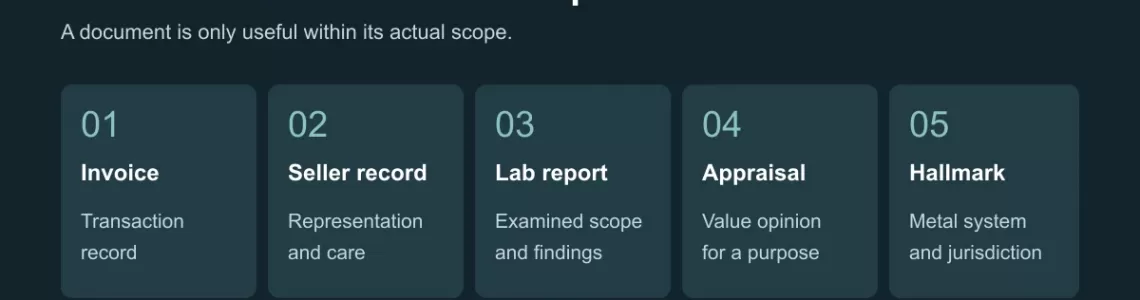
Answer first: A jewelry appraisal and a gem laboratory report answer different questions. An appraisal gives a value opinion for a stated purpose and date; a laboratory report records the identification or grading work within its scope. Neither a high value figure nor an impressive document title proves that every bead in a bracelet was examined. When comparing jewelry appraisal vs lab report, match the document to the actual object, check who issued it, and read what it does not cover. GIA explains that its grading reports are not financial appraisals in its description of gem grading and analysis.
Research question: Which records help a bracelet buyer understand a seller's claims, and when does another kind of document become necessary? This guide covers ordinary finished bracelets purchased online, including bead strands and metal jewelry. It does not appraise inventory, authenticate a particular product, advise on insurance coverage, or establish a resale price. The shopping links below are examples of real catalog destinations, not certified specimens. No sunMYLOVE product is represented here as having a GIA report, independent appraisal or UK hallmark unless its individual listing supplies verifiable evidence.
Jewelry appraisal vs lab report: five documents, five different jobs
Begin with the question, not the logo. Are you trying to record a purchase, understand a material description, investigate gem identity, obtain a value opinion, or interpret a metal mark? One bracelet may have several records, but collecting documents is useful only when their contents correspond to your decision. A receipt cannot become an independent gem identification because it includes the word “natural.” A lab report cannot become an appraisal because a seller places a price beside it.
| Record | Useful question and evidence limit |
|---|---|
| Invoice or receipt | What was sold, by whom and for what recorded amount? It is a transaction record, not independent testing. |
| Seller's written description | What materials, dimensions and care were represented? Keep the wording; distinguish representations from measured findings. |
| Gem laboratory report | What identity, grade or detectable treatment was investigated for the submitted object? Unreported characteristics remain unreported. |
| Appraisal | What value opinion was reached for a stated purpose and date? That figure is not automatically a purchase price or resale offer. |
| Precious-metal hallmark | What recognized metal-marking system applies? Jurisdiction, exemptions and complete marks matter; this is not a gem or value report. |
This comparison is an editorial decision framework, not a legal ranking of documents. GIA's appraisal guidance distinguishes valuation work from gemological knowledge. The FTC recommends keeping relevant gemstone descriptions and care information in sales paperwork in its gemstone buying guidance. For UK metal marks, use the British Hallmarking Council's UK consumer protection explanation, not a universal rule inferred from a stamp.
Match the record to the bracelet, not just its name
A document is most useful when it can be connected to the object you are considering. Start with the product reference, description, photographs and dimensions. Does it describe a loose gemstone, one bead, a complete strand, or a metal component? Does the seller show the same object or merely a sample from a similar batch? Do not silently replace “sample tested” with “this entire bracelet tested.” Ask the issuer or seller to explain ambiguous scope before making an origin-dependent purchase.
For a strand, record bead count, approximate stated bead diameter, arrangement, accents and closure. A report about a loose stone does not necessarily address cord, hardware, every bead or assembly condition. For a cuff, distinguish a representation about its metal from any claims about finish, construction or value. Browse the beaded bracelet catalog and the silver bracelet catalog with those separate questions in mind; neither category heading certifies each item.
The listed black obsidian and brass bead bracelet illustrates a mixed-component purchasing task. Its title is a seller description, not a laboratory conclusion reached by this article. A buyer can ask which parts the material wording refers to, what treatments are disclosed, and which measurements apply to the wearable assembly. That is a more precise request than “Is everything certified?”
What a laboratory report can establish—and what it cannot
GIA describes colored-stone analysis as a process that can involve observation and instrumentation, identification and investigation of detectable treatments. Geographic origin is a separate question offered for selected materials and only where an opinion can be reached. Read its original account, How GIA Analyzes Colored Stones from Start to Finish, for the actual boundaries. Do not interpret a geographic opinion as a chain-of-custody record or a complete history of an object.
Read the fields that are actually present. A description of one material is not an assurance about another. A photograph helps with correspondence, but a similar-looking photograph alone cannot establish specimen identity. A report number should lead to the issuing organization's own verification procedure where available; a screenshot hosted only by the seller is not the same verification channel. Never enter payment details or account credentials into an unfamiliar “certificate verification” page simply because a seller supplied a link.
Ask what was submitted and whether mounting, sampling or access limited the examination. Unknown treatment status, an omitted field and a finding of no detectable treatment are different statements. Even a well-supported material finding cannot establish comfort, exact remaining cord strength, compatibility with a particular person's skin, or a promised service life. Those are separate questions. Our hardness, toughness and bracelet durability guide explains why one material characteristic should not stand in for assembly performance.
When an appraisal is the relevant document
If you need a value opinion, specify why before commissioning one. GIA's appraisal guidance advises looking for both gemological competence and appraisal training, and examining the information and limitations in the report. The purpose and date matter. Do not turn a value opinion into a guarantee that a retailer, insurer or secondhand buyer will offer that amount. This guide does not decide what documentation any particular insurer or jurisdiction requires; ask the relevant organization directly.
For ordinary comparison shopping, start by checking description, fit, care and return terms rather than treating a large stated appraisal figure as proof of a bargain. An appraisal might be useful for a particular purpose, but it need not answer the initial “Which bracelet fits my needs?” question. If value depends heavily on a material or origin claim, ask whether the appraiser relied on a laboratory finding, a seller representation, or their own examination. Record that distinction rather than assuming all three are interchangeable.
A buyer's practical worksheet can include the purpose, issuer, examination date, object description, stated assumptions and unanswered questions. Keep value fields separate from transaction price and any actual resale offer. This worksheet is an organizational suggestion, not a valuation method: it does not produce a numerical estimate and should not be used for tax, insurance or lending decisions.
Why a hallmark is not a whole-bracelet certificate
UK hallmarking is a specific precious-metal consumer-protection system with defined marks and weight-related exemptions. The British Hallmarking Council explains that online selling is covered by the applicable requirements. That does not mean every bracelet worldwide must carry the same marks. Nor does a metal mark answer gemstone identity, treatment, origin, cord construction or financial valuation. Check the applicable jurisdiction and the complete mark rather than relying on a single familiar number.
Keep this distinction particularly clear for mixed-material jewelry. A finding or mark concerning a silver component would not automatically authenticate an adjacent bead. Conversely, a gem report would not settle the metal's fineness. If you cannot identify a marking system reliably, ask a competent professional instead of polishing aggressively to make a mark more legible. This article does not infer fineness or legal compliance from product photographs.
A six-step buyer workflow
- Write the purchase question. Choose one main uncertainty: fit, appearance, material identity, documented treatment, condition or valuation. An attractive report should not distract from your actual use.
- Copy the exact claim. Keep the product reference, description and seller's answer together. Use “seller states” where that is the evidence you have, not “laboratory proved.”
- Match the specimen. Compare object type, dimensions, component arrangement and the submitted-item description. Flag batch samples or partial examination explicitly.
- Check the issuer and scope. Identify who produced the document, what work they describe and what verification route they provide. Separate an institution's own service explanation from independent endorsement.
- Resolve practical buying details. Confirm usable size, closure, care and return terms. A document about material identity is not a fit test.
- Choose or pause. If an unanswered claim materially determines your decision, ask for clarification or appropriate examination. You need not damage the item or accept uncertainty merely because a sale is presented as urgent.
For fit, measure your wrist at the intended wearing position without tightening the tape, then compare that measurement with the seller's stated usable size and design guidance. Wrist circumference and total strand length are not interchangeable. Larger beads, wraps and closures change the geometry; do not add a universal allowance to every design. Our double-wrap bracelet fit guide addresses multi-turn sizing specifically.
For construction, inspect available views of drill holes, cord, knots and closure without performing destructive tests. Ask about uncertain components before cleaning. Keep any material-specific instructions with the purchase record, but do not assume a laboratory identity statement endorses soaking or ultrasonic cleaning of an assembled piece. The bead bracelet construction guide separates these assembly questions from material names.
Three scenarios: use the right evidence
A gift with no special origin requirement. Your priorities may be size, closure, appearance and a workable return process. Save the seller's material description and dimensions, and ask for the recipient's size discreetly. A value document does not solve an unknown wrist measurement. Personal preference is legitimate, but it should not be restated as a technical grade or medical benefit.
A material-dependent purchase. If your willingness to buy changes depending on whether a bead is the claimed material, request precise identification wording and the scope of any offered examination. Ask whether the report concerns the actual strand. If there is no independent report, record that absence; it is not automatic proof of misrepresentation. Decide whether the available representation and return terms are adequate for your own risk tolerance.
A bracelet you already own. If you need a value opinion for a specified purpose, describe that purpose to a qualified appraiser. If you need to investigate a material, discuss an appropriate gemological examination instead. Do not estimate either from an online listing that merely looks similar. Your own photographs are useful condition records but not a substitute for the relevant professional work.
Common document mistakes and counter-evidence
“Certified” without an issuer, scope or object match is incomplete information. GIA's distinction between analysis and financial appraisal directly challenges the idea that one document answers everything. “Untreated” copied from a title is still a seller statement unless supported by the relevant examination. The FTC's guidance about treatments and written records supports asking clearer questions, not declaring every gemstone treated or every seller unreliable.
An impressive photograph is not a measured identification result. Lighting and display differences can change how an object appears, as our online jewelry color guide discusses. Likewise, a report's existence does not establish market demand, a guaranteed return on purchase, universal durability or health benefits. These sources provide no sufficient human evidence that wearing a documented bracelet treats or prevents disease. Choose documented characteristics and personal aesthetics, not a promised therapeutic outcome.
Frequently asked questions
Is a jewelry appraisal the same as a gem lab report?
No. An appraisal addresses value for a stated purpose and date; a gem lab report addresses the identification or grading work it specifies. Read the actual scope rather than substituting one for the other.
Does a lab report guarantee resale value?
No. Material analysis and financial valuation are different tasks. Neither this guide nor a material finding supplies an actual resale offer or guarantees what another buyer will pay.
Does a report for one bead cover every bead?
Not automatically. Ask what was submitted and examined, and whether the report concerns a sample, selected components or the whole object. Do not extend findings beyond the stated scope.
Does a bracelet without a report have to be fake?
No. Missing independent testing leaves a particular question unverified; it does not by itself prove the seller's statement false. Consider precise wording, available evidence and your purchase requirements.
Does a silver hallmark also authenticate the gemstones?
No. A relevant precious-metal marking system concerns metal, not adjacent gem identity or value. UK rules also have specific scope and exemptions; do not apply them indiscriminately worldwide.
What should I keep after an online bracelet purchase?
Keep the invoice, exact product reference, written material and care statements, dimensions, relevant reports and return terms. Read our returns and refunds information before buying; this guide does not decide an individual refund claim.
Method and References and evidence scope
Reviewed 2026-09-15. sunMYLOVE compared catalog destinations, existing article intents and institutional consumer and gemological sources. The framework separates verified institutional statements, seller representations, editorial suggestions, personal preferences and unknowns. No inventory was tested or appraised. Search demand volume is unknown; no search volume, certification, sale or review was invented. GIA's first-party service pages explain its own work and are not an independent endorsement of sunMYLOVE. FTC advice is U.S.-specific, and hallmarking guidance is UK-specific. This is a research-led buying guide, not an academic paper or personal legal or financial advice.
- GIA 4Cs, Tips on Getting a Jewelry Appraisal: purpose, professional competence and appraisal documentation; not a valuation of our products.
- GIA, Why Turn to GIA for Gem Grading and Analysis?: institutional report scope and distinction from financial appraisal.
- Phoebe Shang / GIA, How GIA Analyzes Colored Stones from Start to Finish: identification, detectable treatments and limits of origin opinions.
- U.S. FTC, Buying Gemstones, Diamonds, and Pearls: terminology, treatment questions and written shopping records.
- British Hallmarking Council, Hallmarking in the UK: consumer protection: UK precious-metal marking scope and exemptions.
sunMYLOVE editorial note: Catalog links help readers apply a document-reading workflow to actual shopping pages. They do not imply that linked items were tested, appraised or certified. Recheck the individual listing, source scope and current terms before purchasing.
Leave a Comment