
Silver Magnet Test: What It Can and Cannot Prove
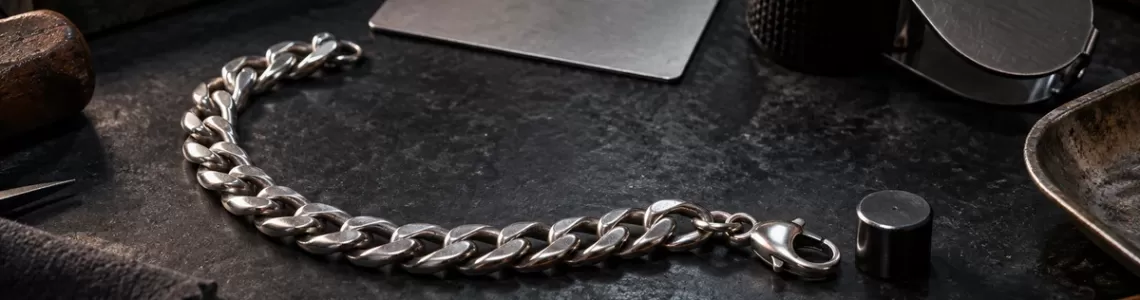
Quick answer: a strong attraction between a magnet and the main body of a piece is a reason to investigate, but no attraction does not prove that the piece is silver. Many non-silver metals are also non-magnetic, while a genuine silver item may contain a steel clasp spring, pin or other small magnetic part. Use the silver magnet test as one screening observation, then check the exact component, written material description, marks, seller identity and—when the value or dispute justifies it—independent professional testing.
This guide is for buyers who want to inspect silver-colored rings, bracelets and chains without damaging them. It explains what a magnet result can exclude, why it cannot establish fineness, how to separate a clasp response from the main body, and when documentation or professional analysis provides stronger evidence. It does not authenticate a particular item or replace an assay, appraisal or product-specific warranty decision.
The silver magnet test is a screening step, not a verdict
The useful question is not simply “did the magnet move?” It is “which exact component responded, how strongly, and what claim was made about that component?” A powerful magnet that snaps firmly to the broad body of an item gives you a meaningful inconsistency to investigate if the seller claimed that body was sterling or fine silver throughout. That observation still does not identify the underlying metal, prove intentional fraud or tell you whether a surface coating is present.
The opposite result is much weaker. If the item shows no obvious attraction, you have only learned that the tested area did not respond strongly under those conditions. Copper, brass, zinc alloys and several other materials used in jewelry can also be non-magnetic. A non-magnetic base metal can be silver colored, silver plated or coated. Therefore “the magnet did not stick” is not equivalent to “the item is sterling silver.”
Jewelry is also an assembly rather than a single test coupon. A lobster clasp may contain a small spring. A hinge, safety catch, pin, screw or reinforcement can differ from the visible body. Mixed-material bracelets can combine silver components with cord, beads, steel findings or plated parts. Testing the whole object without locating the response can turn a legitimate component difference into a false accusation.
What sterling silver and 925 actually mean
The U.S. Federal Trade Commission’s consumer guidance explains that “silver,” “sterling” and “sterling silver” describe products containing 92.5 percent pure silver, and that 925 expresses 925 parts silver per thousand. The current U.S. Jewelry Guides address misleading silver-content and coating descriptions and distinguish material that is silver throughout from a product with only a silver surface layer.
Those are composition and disclosure concepts. A magnet does not measure parts per thousand. It cannot distinguish 925 from 950 or 999 silver, calculate how much copper is in an alloy, establish whether solder is present, or determine the thickness of a coating. Even a consistent “no attraction” result cannot turn a silver-colored object into a verified 925 object.
A simple 925 stamp also has a limited role. It is a claim or fineness indication that should be evaluated with the rest of the mark, the seller and the applicable legal system. It does not reveal the laboratory method, identify every component, prove origin, certify a gemstone, or tell you whether an item is solid, hollow, plated, repaired or coated. The solid sterling versus silver-plated bracelet guide explains how bulk material and surface-layer claims differ.
A complete hallmark is stronger evidence than a lone number
Hallmark systems vary by jurisdiction. In the United Kingdom, the British Hallmarking Council describes a complete hallmark as including a sponsor’s mark, a metal-and-fineness mark, and an assay-office mark, with other optional marks. The Goldsmiths’ Company Assay Office explains that a hallmark means an article has been independently tested and meets the applicable legal fineness standard.
That independent-assay structure is different from a lone “925” impression. It does not mean every country uses the UK system, nor does it mean every lightweight item must carry the same marks. It does show why buyers should read a mark as a system instead of treating three digits as self-proving evidence.
Use the site’s silver hallmark and maker-mark guide to record the complete set of visible marks. Photograph their location and shape in neutral light. Do not enlarge, scratch or chemically expose the mark to make it easier to read while a return question remains open.
How to perform a conservative magnet screening
1. Read the product claim first. Save the listing, order confirmation, material line, component description and return terms. “Sterling silver charm on a steel chain” creates a different expectation from “solid sterling silver chain.” “Silver tone” is a color description, not a fineness claim.
2. Remove nearby interference. Work on a stable, non-metallic surface away from phones, watches, cards, tools and loose steel objects. Do not perform the test near medical devices. A strong magnet can pinch skin, chip, jump unexpectedly or damage nearby equipment, so handle it carefully and keep it away from children.
3. Inspect before moving the magnet. Look for separate clasps, springs, pins, jump rings, solder areas, stones, cords and decorative inserts. Note which components the seller actually described as silver. This map prevents a clasp response from being assigned to the entire piece.
4. Approach each area slowly. Bring the magnet near the main body, then separately near the clasp, hinge, pin and attachments. Do not drag a magnet across polished metal or stones. A sudden snap can scratch a finish, strike a setting or pull a delicate chain.
5. Record location and strength. “Clasp spring reacts slightly” is more useful than “bracelet is magnetic.” A firm attraction across many main links is a different observation from a tiny response confined to a spring mechanism. Record the result with photographs or video if a seller dispute may follow.
6. Stop before destructive escalation. Do not proceed automatically to acid, filing, scraping, hot-pin or deep scratch tests. Those actions can damage plating, remove return eligibility, expose base metal, affect stones or create safety risks. Preserve the item and ask for product-specific next steps.
How to interpret four common results
- Strong attraction across the claimed silver body
- Treat this as a material inconsistency that needs explanation. Recheck that the magnet is responding to the body rather than a hidden fixture underneath. Preserve the listing and contact the seller before altering the piece. The result does not identify the actual alloy by itself.
- Attraction limited to a clasp, spring, hinge or pin
- This can be consistent with a mixed-component mechanism. Compare the exact listing language and ask whether that component is excluded from the silver claim. Do not extend one small component’s response to every link or bead.
- No obvious attraction anywhere
- This result is compatible with silver, but also with many non-silver metals. Continue with marks, construction, seller documentation and purchase records. Do not publish or repeat a claim that the piece “passed as sterling” from this result alone.
- Weak or ambiguous movement
- Surface angle, a suspended chain, a moving magnet, nearby metal and the item’s geometry can make small motion hard to interpret. Repeat only under safe, controlled conditions and record the uncertainty. Ambiguity is not proof.
Why non-attraction cannot prove authenticity
A household magnet reports a magnetic interaction, not chemical composition. The Royal Society of Chemistry describes silver as a soft, lustrous metal and notes that sterling silver contains 92.5 percent silver with the balance made from copper or another metal. That material context does not supply a consumer magnet accuracy rate, and it does not make all silver alloys or assembled jewelry behave identically in a casual setup.
More importantly, a counterfeit or inaccurately described item does not need to be made from iron or steel. It can be built from a non-magnetic base alloy and still avoid obvious attraction. It can also have a thin silver surface over another material. A magnet cannot see through the disclosure problem or tell you whether the composition is uniform below the surface.
This is why a useful buyer workflow combines independent clues. Confirm the seller and return policy, read the exact material claim, inspect marks, separate components, compare weight and dimensions only when a reliable specification exists, and keep the invoice. No single home observation should be promoted beyond its evidence.
What professional testing adds—and its limits
When value, insurance, resale or a serious dispute justifies stronger evidence, ask a qualified jeweler, appraiser or assay office which method fits the object. The Gemological Institute of America describes X-ray fluorescence, or XRF, as a professional elemental-analysis technique used in laboratories and portable instruments. It can support precious-metal analysis without the same visible damage as filing or acid testing, but instrument capability, calibration, test location, surface condition and the object’s construction still matter.
A professional result should identify the instrument or assay method, tested location, reported elements or fineness, uncertainty and any limitation caused by plating, geometry or mixed components. “Tested” without a method or scope is not enough to resolve every question. A surface-sensitive result may require careful interpretation for plated or layered objects.
Formal hallmarking provides a different type of evidence because an authorized assay office applies marks under a defined legal framework. Which route is appropriate depends on country, item, value and purpose. A routine low-value purchase dispute may be resolved through accurate listing evidence and a return rather than paying for laboratory analysis.
Buyer evidence that matters more than a viral test
- Exact material wording: sterling silver, fine silver, silver plated, silver tone and stainless steel are not interchangeable.
- Component scope: identify whether the claim applies to the main body, charm, clasp, chain, bead, setting or every component.
- Complete marks: record sponsor or maker marks, fineness numbers and assay-office symbols where applicable.
- Seller identity: keep the business name, contact route, invoice and written response to material questions.
- Return and warranty terms: know whether testing or polishing could change the accepted condition.
- Independent report: for high-value items, prefer a report that states method, location, result and limitations.
The FTC recommends researching the seller and preserving refund or return terms. If a delivered item conflicts with its description, the online jewelry return guide provides a non-destructive evidence checklist. Keep packaging, avoid wear, and contact the seller before changing the surface.
Applying the framework to rings, chains and bracelets
For a plain ring, map the band, setting, stone and any internal insert separately. For a chain, test several main links away from the clasp, then test the clasp mechanism by itself. For a bead bracelet, distinguish decorative silver beads from spacers, cord, crimps and the closure. The mixed-material bracelet guide explains why the most sensitive or least-certain component should control handling.
When browsing the current sterling and fine silver bracelet collection, read each live page rather than transferring one item’s description to another. The SUERTE fine-silver bead bracelet and the Eye of God sterling-silver and cord bracelet have different stated constructions. This article does not claim that either product has been magnet tested or laboratory assayed.
If surface appearance is also a concern, use the oxidized silver versus tarnish guide before cleaning. Tarnish, oxidation, plating and metal composition are separate questions. A dark surface does not establish authenticity, and a bright surface does not establish plating.
A practical decision path
If the main body attracts strongly, pause the purchase or dispute process and request a written component explanation. If only a mechanism reacts, compare that mechanism with the listing scope. If nothing reacts, continue checking rather than declaring success. If the marks and description remain inconsistent, decide whether a return or qualified professional test is proportionate to the item’s value.
Use a reversible sequence: document, isolate components, screen gently, compare claims, ask the seller, then escalate to professional evidence only when needed. This protects the jewelry and preserves the facts. A dramatic home test is less useful than a careful record that identifies exactly what was claimed, what was observed and what remains unknown.
FAQ
Does real silver stick to a magnet?
The main silver body should not show the kind of strong attraction associated with common ferromagnetic steel, but an assembled silver item can include a magnetic clasp spring, pin or other component. Test and describe components separately.
If a magnet does not stick, is the item sterling silver?
No. Many non-silver metals are also non-magnetic. Non-attraction is compatible with silver but does not prove 925 fineness or rule out plating.
Can a 925 stamp prove an item is genuine?
No. It states a fineness claim but is not self-authenticating. Evaluate the complete mark, seller, construction and applicable hallmark system.
Why might only the clasp attract a magnet?
A clasp can contain a steel spring, pin or mechanism even when adjacent components are silver. The written component description determines whether that is consistent with the sale claim.
Should I use acid after the magnet test?
Not by default. Acid and scratch testing can damage finishes, expose base metal and affect return eligibility. Ask a qualified professional which method fits the object.
Is XRF a definitive test for every piece?
XRF provides professional elemental evidence, but instrument settings, surface layers, geometry, calibration and test location affect interpretation. Ask for the method, tested area, result and limitations.
What should I do if the main body attracts strongly?
Preserve the listing and item condition, repeat only a safe component-specific observation, and ask the seller for a written explanation. Do not mark the item paid, genuine or counterfeit without adequate evidence.
References
- U.S. Federal Trade Commission, Buying Platinum, Gold, and Silver Jewelry.
- 16 CFR 23.5, Misrepresentation as to silver content.
- British Hallmarking Council, Hallmarking: practical guidance.
- Goldsmiths’ Company Assay Office London, What is a Hallmark?.
- Royal Society of Chemistry, Silver.
- Gemological Institute of America, Chemical Analysis in the Gemological Laboratory: XRF and LA-ICP-MS.
- Canadian Conservation Institute, Caring for metal objects.
Evidence boundary: This article explains consumer screening, disclosure and escalation. It does not authenticate a sunMYLOVE item, provide a universal magnet-test accuracy rate, replace a hallmark or assay, or authorize destructive testing. Last reviewed: September 28, 2026.
Leave a Comment