
Hollow vs Solid Sterling Silver Rings: Weight, Dents and Buyer Checks
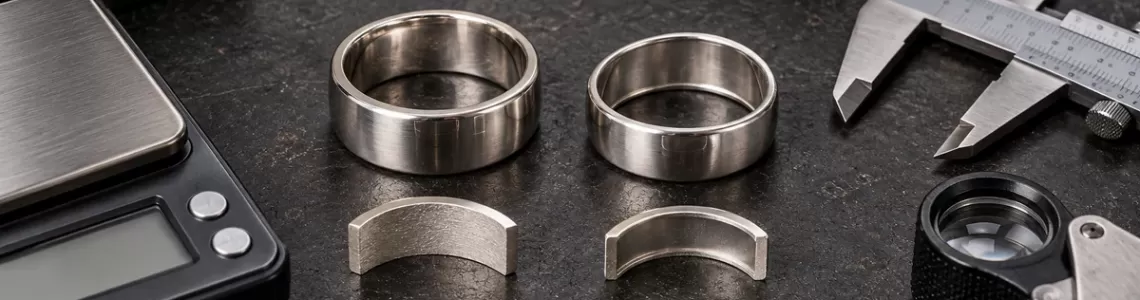
A hollow sterling-silver ring and a solid sterling-silver ring can both be genuine 925 silver, but they are not the same construction. A solid band has metal through the relevant cross-section, while a hollow or shell-built band contains an enclosed or open cavity. The difference can affect weight, dent behavior, cleaning, resizing and repair. It does not make every solid ring durable or every hollow ring poor quality.
The safest buying approach is to separate three questions: What is the alloy? How is the ring built? What are the dimensions of its most vulnerable section? A 925 mark mainly addresses the first question. It does not answer the other two. Ask the seller directly, compare like-for-like measurements, and treat missing construction details as unknown rather than guessing from a photograph or a single weight figure.
What hollow and solid mean in a ring
In everyday jewellery descriptions, a solid band generally means the body of the band is metal through its cross-section rather than a thin shell around a cavity. A hollow ring may be made from formed walls that are joined, from tubing, or from a larger decorative form with an open or enclosed interior. Some rings combine methods: the lower shank may be solid while the head is hollow, open-backed or assembled from multiple pieces.
This is a geometry question, not automatically a fineness question. The U.S. Federal Trade Commission explains that sterling silver is 92.5 percent silver and that 925 indicates 925 parts silver per thousand. That composition statement does not reveal whether a band is hollow, how thick its walls are, where its solder seams sit, or whether every attached component has the same composition. Our guide to 925 stamps and hallmarks explains why a fineness mark should not be stretched into a workmanship or construction guarantee.
The word "solid" can also be ambiguous in marketing. Federal Trade Commission consumer guidance explains a specific use of "solid gold" in the gold context, but shoppers should not automatically transfer that terminology to an unknown silver listing. For a sterling-silver ring, ask a literal question: Is the shank solid through its cross-section, hollow, open-backed or assembled around a cavity? A written answer is more useful than relying on a broad adjective.
Why construction matters to a buyer
Weight and wearing feel
Hollow construction can create a larger visual form with less metal. That can make a broad ring feel lighter and may improve comfort for someone who dislikes a heavy band. A solid ring of similar outside dimensions will often weigh more because more of the internal volume is metal, but total weight alone does not prove construction. Stones, steel findings, decorative heads, size, width and thickness all change the number on a scale.
Compare weights only when the rings have the same size, similar external dimensions and clearly stated material scope. A size 13 ring naturally needs more material than a size 8 version of the same profile. A broad face can add weight far from the lower shank. A lightweight ring may be thin rather than hollow, and a hollow ring can still be fairly heavy if its walls and head are substantial.
Dents, creases and shape changes
Silver is a relatively soft metal, and the Canadian Conservation Institute notes that soft metals are vulnerable to dents, scratches and abrasion. A hollow shell can dent or crease when a localized force pushes a wall inward. A solid section cannot collapse into an empty cavity in the same way, but it can still bend, flatten, crack at a weak area or distort around a setting.
Wall thickness, cross-section, temper, joints and load direction all matter. A well-designed hollow ring is not automatically fragile, and a very thin solid ring may deform more easily than a carefully engineered hollow form. The practical boundary is simple: construction changes the possible failure modes, but it does not let a shopper predict an exact lifespan. For the broader material and geometry factors, see our guide to why sterling-silver rings bend.
Cleaning and trapped moisture
Hollow parts deserve conservative cleaning. Canadian Conservation Institute guidance tells conservators to inspect silver construction, including solder joins and hollow sections, before treatment. It warns that liquids can enter sealed hollow components and become difficult to rinse or remove. U.S. National Park Service guidance similarly cautions against allowing liquids into hollow parts that are difficult to rinse and dry.
Those museum-care sources are intentionally conservative and are not a home repair manual. They do support one buyer rule: if the construction is uncertain, do not soak the ring or use a chemical dip merely because the surface is silver. Use a clean, soft cloth for routine handling and ask a qualified jeweller about safe cleaning for the particular ring, especially if it has seams, porous areas, stones, adhesives, patina, plating or enclosed cavities.
Resizing and repair
A solid plain shank may offer a jeweller more predictable metal to cut, add, solder and reshape. A hollow shank can require different techniques because cutting it may open a cavity and heat may affect thin walls or seams. Some shell-built designs are repairable; others are impractical to resize without visible reconstruction. Open backs, coatings, stones and previous repairs can add further limits.
Do not treat "sterling silver" as a promise that resizing is simple. Ask whether the exact design can be resized, by how many sizes, and what happens to seams, finish, engraving and symmetry. Our sterling-silver ring resizing guide explains why construction, setting and prior work must be assessed together.
What a 925 stamp proves - and what it does not
A legitimate 925 fineness claim means 925 parts per thousand silver in the represented sterling-silver material. It does not prove that a ring is solid through every section. It also does not establish wall thickness, total weight, manufacturing method, temper, solder quality, repair history, country of origin or resistance to dents.
A stamp cannot show hidden cavities. It can also appear on one part of a multi-component ring while stones, solder, springs, coatings or other findings have different material roles. Conversely, the absence of an easily visible stamp is not a safe basis for a home authenticity conclusion. Marking rules, location, age and design vary. Use the listing, invoice, seller identity, testing by an appropriate professional and applicable consumer protections as separate evidence.
Do not file, drill, cut or crush a ring to investigate construction. Destructive tests damage the item and may complicate a return or warranty claim. Acid and electronic tests address metal composition at the tested area, not necessarily whether the object is hollow or how it was assembled.
Can you identify a hollow ring by weight?
Weight can raise a useful question, but it rarely settles the answer by itself. Imagine two bands with the same outside diameter and width. If one has a continuous thick cross-section and the other is a thin shell around a cavity, the shell-built version should generally use less metal. Real listings are seldom controlled comparisons, however. Ring size, interior profile, taper, head dimensions, stones and wall thickness vary.
A seller-provided gram weight is most useful when it names the ring size and whether the figure includes stones or other components. If a listing says "approximately 12 g," ask what size was weighed and how much variation is expected. If the answer is unavailable, record the field as unknown. Do not convert a missing number into a claim that the ring is hollow.
A digital scale at home can confirm the delivered total weight against the seller's written specification, but it still cannot map where the metal sits. It is a discrepancy check, not a construction scan. If the delivered ring is materially lighter than the documented specification, photograph the scale reading and contact the seller before wearing, polishing or modifying it.
Non-destructive visual checks before purchase
Look at the inside and underside
Front-facing product photos often hide the most informative surfaces. Ask for clear views of the inside of the shank, the underside of the head, the shoulder transitions and any open gallery. An open-backed head is visible construction, but it does not prove the lower shank is hollow. A smooth interior can belong to either a solid or shell-built form.
Look for seams without diagnosing them
A faint line may indicate a solder joint, a sizing seam, a casting boundary, decoration or simply a reflection. Multiple joined surfaces can be normal in an assembled design. The useful buyer question is whether the seller discloses assembly and whether the seam is covered by the return and repair terms. A photograph alone cannot determine joint quality.
Ask for actual dimensions
Request band width and minimum shank thickness, ideally at the thinnest lower point. Face dimensions do not describe the whole ring. A wide face can sit on a narrow or tapered shank. Width also affects fit: a wide band may feel tighter than a narrow band at the same nominal size. Review the ring width and fit guide before comparing sizes.
Ask whether the weight is size-specific
A reliable answer should state the measured sample size or explain the range. Approximate weight can be reasonable for handmade items, but the tolerance should not hide a fundamentally different construction. Save the listing and the seller's answer so you can compare them with the delivered ring.
Questions to send the seller
- Is the lower shank solid through its cross-section, hollow, open-backed or tube-formed?
- Is the decorative head solid, hollow, open-backed or assembled separately?
- What ring size was used for the listed gram weight?
- What are the band width and minimum shank thickness?
- Does the 925 claim apply to the entire ring body or only specified components?
- Are there soldered seams, plating, coatings, adhesives or non-silver findings?
- Can this exact design be resized or repaired, and what limits apply?
- What is the remedy if the delivered construction or weight differs from the listing?
Specific answers reduce uncertainty better than words such as "premium," "heavy" or "durable." If the seller cannot confirm construction, decide whether the return policy and price justify that unknown. Do not assume the most favorable answer.
Checks when the ring arrives
Inspect the ring before regular wear. Use a padded, well-lit surface and photograph the top, sides, inside, underside, hallmark area and any seam. Compare the shape, dimensions and weight with the saved listing. Our post-delivery ring inspection guide gives a non-destructive sequence for checking settings, stones and finish.
Check whether the ring sits symmetrically, whether the shank is already oval, and whether any wall shows a dent or sharp crease. A smooth intentional opening under the head is different from a split seam or crack. Do not push on a questionable area to see whether it moves. Do not use pliers, a ring mandrel or a hammer to test strength.
Confirm fit without forcing the ring over a swollen knuckle. A ring that is too tight can be difficult to remove, while a loose ring can rotate and strike objects. If you are translating diameter or circumference into a size, use the ring size chart guide, then account separately for width, knuckle clearance and climate.
If construction, weight or dimensions materially differ from the written listing, stop before cleaning, polishing, resizing or wearing the ring. Contact the seller with the saved description and clear photographs. Modification may remove useful evidence and may affect return rights.
Care boundaries for hollow and solid bands
Both constructions benefit from avoiding hard impacts, abrasive storage and unnecessary polishing. Store the ring separately in a clean, dry, padded place. Remove it for weight training, manual work, climbing, contact sports and tasks involving rotating machinery. These activities can crush or snag any ring and can injure the finger.
For uncertain hollow construction, avoid prolonged soaking and chemical dips. Do not assume that a small opening will let all liquid drain. Residue can remain in a cavity or near a seam. A professional jeweller can assess whether ultrasonic or immersion cleaning is appropriate for the complete object, including stones, treatments and joints.
Polishing cannot repair a dent, crease or crack. The Canadian Conservation Institute notes that polishing removes silver along with tarnish, and repeated polishing can reduce detail and expose vulnerable surfaces. If a wall is pushed inward or a seam is opening, surface brightness is not the problem. Stop wearing the ring and seek a repair assessment.
How to choose between hollow and solid construction
Choose based on disclosed facts and intended use. A hollow ring can be sensible when a large visual form and lighter wearing feel matter, provided the construction is clearly stated and the care and repair limits suit you. A solid band may be preferable when you value a more substantial feel, straightforward dimensional comparison and potentially broader repair options. Neither choice removes the need to protect the ring from crushing and snagging loads.
For frequent wear, prioritize a comfortable fit, adequate shank dimensions, protected design, clear material scope and an understandable remedy. For occasional statement wear, a lighter hollow form may be acceptable if you are willing to handle and store it more carefully. When the listing does not reveal enough, ask before purchase rather than using price, shine or a 925 stamp as a shortcut.
Frequently asked questions
Is a hollow sterling-silver ring fake?
No. Hollow describes construction, while sterling describes silver fineness. A hollow ring can be genuine sterling silver if the material claim is accurate.
Does 925 mean the ring is solid?
No. A 925 mark is a fineness claim. It does not show whether the band or head contains a cavity, how thick the walls are, or whether every component has the same composition.
Is a solid sterling-silver ring always heavier?
It is often heavier than a hollow ring with the same size and outside dimensions, but real rings differ in width, thickness, head design, stones and components. Weight alone is not proof.
Do hollow silver rings dent more easily?
A thin hollow wall can dent or crease under localized force because it can move into the cavity. Actual behavior still depends on wall thickness, shape, seams, temper and the force applied.
Can a hollow sterling-silver ring be resized?
Sometimes, but the job can be more complex because cutting may open the cavity and heat can affect thin walls or seams. The exact ring needs professional inspection before a method or result is promised.
Can I tap a ring to hear whether it is hollow?
Sound is not a reliable construction test. Size, shape, contact surface and attached parts change the sound, and striking the ring can damage it. Ask the seller or a qualified jeweller.
Should I soak a hollow silver ring?
Not when liquid could enter a cavity or seam and become difficult to remove. If construction is uncertain, use conservative surface care and ask a professional about safe cleaning.
Can a jeweller tell whether a ring is hollow?
Often, through inspection, dimensions, weight and professional tools, but hidden construction may still require specialized examination. Ask for a non-destructive assessment when possible.
References
- U.S. Federal Trade Commission: Buying Platinum, Gold, and Silver Jewelry
- U.S. Federal Trade Commission: Jewelry Guides statement of basis and purpose
- Canadian Conservation Institute: Silver - Care and Tarnish Removal
- Canadian Conservation Institute: Metal objects preventive conservation guidelines
- U.S. National Park Service: Caring for Silver and Copper Alloy Objects
- Gemological Institute of America: Quality Assurance Benchmarks for jewelry
Evidence boundary: This guide explains general construction, care and buyer checks. It does not authenticate a ring, reveal hidden construction from a photograph, calculate strength, prescribe repair, or replace inspection by a qualified jeweller.
Leave a Comment