
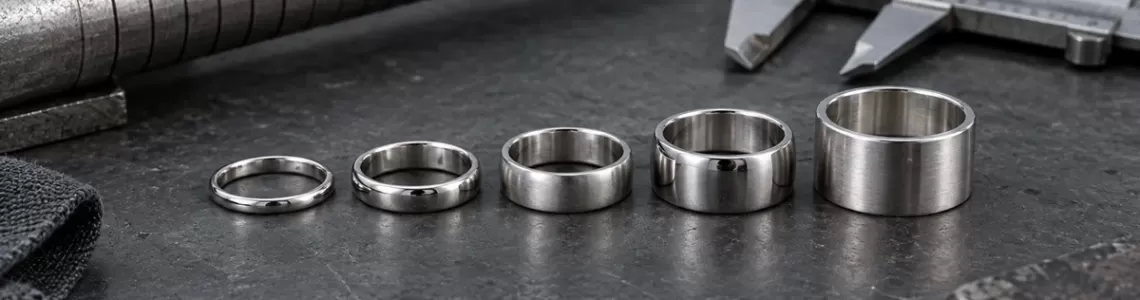
A wide ring can feel tighter than a narrow ring in the same nominal size because more metal contacts more of the finger. The wider band resists the small changes in finger shape that a narrow band can accommodate, and it may be harder to pass over the knuckle. That is why a familiar size is a starting point, not a guarantee, when band width or inner profile changes.
There is no safe universal rule to “add half a size” or “add one size.” The correct result depends on the ring’s width, inside shape, measurement system, the wearer’s knuckle and finger base, and normal changes in the finger during the day. For a valuable, very wide or difficult-to-resize ring, use the seller’s product-specific guidance and a professional fitting with a sample close to the final ring.
Why band width changes the way a ring feels
A narrow ring touches a shorter section of the finger. A wide band covers more skin, creates more friction and has less room to settle into a single soft area. Even when two rings share the same measured inside circumference, the wide one can feel more resistant during movement and warmer as the finger expands.
The Gemological Institute of America’s quality-assurance benchmark for finger and ring size separates narrow and wide measurement tools. It specifies narrow finger gauges for rings about 1–4 mm wide and wide gauges for wider rings. That distinction is important: a thin sizing loop may not reproduce the contact area of a broad finished band.
GIA’s consumer ring-size guide also notes that a wider shank may require a larger size. It does not prescribe the same increase for everyone. Treat width as a reason to recheck fit, not as permission to apply a fixed conversion.
Ring size is a measurement system, not a feeling
A ring-size label represents a defined measurement, but the label alone does not describe band width, inner contour or how the ring crosses a particular knuckle. Different regional systems may express size as a number, letter or circumference-related value. Do not convert by eye or assume that identical labels from different charts are interchangeable.
ISO 8653:2016 defines the measurement and designation of ring sizes using ring sticks and finger gauges. A standardized method helps tools agree, but it cannot remove wearer-specific variables. The ring still has to pass the knuckle and sit securely at the finger base.
Use millimetres when comparing inside diameter, circumference and band width. NIST’s SI length guidance establishes the millimetre as a length unit, while its measurement guidance distinguishes diameter from circumference. Record which value you measured; a 20 mm inside diameter is not a 20 mm circumference.
Width and inside profile are separate variables
Band width is measured along the finger, from one edge of the ring to the other. Band thickness is the depth of metal from the inner surface to the outer surface. Inside profile describes the shape of the surface against the finger. These terms are often confused, but each can change fit and feel.
A flat interior presents more continuous contact. A convex or “comfort-fit” interior curves away near the edges and may reduce edge pressure, yet it does not automatically make every ring fit one size looser. GIA’s benchmark treats convex interiors as a distinct measurement case. Ask for the actual inside profile rather than assuming that a rounded exterior means a comfort-fit interior.
Decorative edges, rails, liners and rotating sections can also change the contact area. Product photos may show the exterior clearly while hiding the inside edge. If fit is important, request a straight-on interior photograph and the seller’s stated width at the widest part.
Measure an existing ring correctly
An existing ring is useful only if it already fits the intended finger in the way you want and has a similar width and inner profile. A narrow ring from another finger is weak evidence for a broad band.
- Choose a ring worn on the same finger and hand. Left and right fingers may differ.
- Place it on a rigid, accurate ring stick, or measure the clear inside diameter across the center with an appropriate tool.
- Measure from inside edge to inside edge. Do not include the metal wall.
- Repeat at another angle. An out-of-round ring can produce different readings.
- Record the ring’s width and inner profile with the size result.
The Cartier printable guide instructs users to print at 100%, verify the reference scale and align an existing ring’s inner edge with a sizing circle. Those controls matter because browser or printer scaling can make every circle wrong. If the ring falls between two printed sizes, the guide advises using the larger one.
Measure the finger, including the knuckle
A ring must pass the knuckle without being so loose at the base that it spins or slips off. Measure both places. If the knuckle is much larger than the finger base, the best fit may be a compromise that requires a jeweler’s advice or a design-specific solution.
Tiffany’s ring-size guide directs buyers to consider both the finger and knuckle. A paper strip or string can provide a rough circumference, but it bends, stretches and compresses differently from metal. Do not pull it tight enough to indent the skin.
Professional finger gauges are better when a purchase is costly, the band is wide, the fit history is inconsistent or resizing may be limited. Ask to try a wide gauge close to the intended band width. The gauge should pass the knuckle with controlled resistance and sit securely without forcing it.
When comparing two candidate sizes, wear each gauge briefly with the hand relaxed, then make a fist and perform normal gentle movements. A secure ring can leave a temporary light impression, but it should not cause pain, tingling or a pronounced colour change. Also check removal after the hand has warmed naturally. This is a practical comfort check, not a medical test, and it should never involve prolonged restriction.
Measure more than once
Finger size changes. Heat, recent activity, hydration, cold and time of day can alter how a ring feels. GIA recommends avoiding measurements when hands are unusually hot or cold and checking more than once. The goal is not to chase every temporary change but to avoid sizing from an extreme condition.
Take several readings on different ordinary days and record the range. If the finger is persistently painful, numb, discoloured or unusually swollen, stop the fitting exercise and seek appropriate medical advice; a jewelry guide cannot diagnose the cause.
Do not force a gauge or finished ring over the joint. GIA’s benchmark explicitly cautions against forcing a ring over the knuckle. If removal becomes difficult, address it promptly rather than waiting for swelling to increase.
Use printable charts as a controlled cross-check
A printable chart can be convenient, but it is unusually sensitive to setup. Download the file rather than measuring an image preview, select actual size or 100%, disable fit-to-page scaling and confirm the printed reference with a physical card or ruler. If that reference is wrong, do not use any ring circle on the page.
Place a known, round ring flat over the chart and view it directly from above. The printed circle should meet the clear inside edge, not the outside edge or the center of the metal wall. Shadows and an angled camera can make the opening look smaller. Repeat the comparison under good light and use a second method when the result sits between sizes.
A phone-screen chart is not automatically accurate. Display zoom, browser controls, pixel density and screenshots can all change scale. Use an on-screen tool only when it includes a physical calibration step and the seller accepts that method. For a wide band, the final check should still account for width and inner profile.
Plan for removal, exchange and resizing before purchase
Fit is not only about putting a ring on. Confirm that it can be removed under ordinary conditions without twisting aggressively or pulling against pain. If the ring is difficult to remove during a fitting, stop rather than repeatedly forcing it over the knuckle.
Resizing options depend on construction. Continuous plain bands may be more straightforward than rings with stones around the full circumference, patterned edges, coatings, mixed materials or moving parts, but only a qualified jeweler who inspects the exact ring can confirm what is possible. Do not buy an incorrect size on the assumption that every ring can be altered later.
Before engraving or wearing the ring, check the seller’s exchange window, condition requirements and measurement process. Keep packaging and written size guidance until fit is confirmed. The store’s home page can be used to return to current navigation and policies, but the product listing and written seller response remain the primary evidence for a particular ring.
A wide-band fitting checklist
- Intended finger: confirm the exact finger and hand.
- Band width: obtain the width in millimetres at the widest part.
- Inside profile: ask whether it is flat, convex comfort fit, lined or otherwise shaped.
- Comparable gauge: use a wide gauge for a wide ring rather than relying only on a thin loop.
- Knuckle clearance: confirm that the ring passes without force.
- Base security: check that it does not slip off or spin excessively during normal movement.
- Repeated readings: measure under ordinary conditions more than once.
- Seller chart: use the chart and sizing system for that specific product.
- Resize policy: confirm whether the construction, engraving and material permit later resizing.
- Return boundary: read the return or exchange conditions before engraving or alteration.
Questions to ask on a product page
A useful ring listing should separate size from width and construction. Ask: What is the band width in millimetres? Is that the average or the maximum? Is the interior flat or comfort fit? Which regional size system is used? Was the ring measured on a calibrated mandrel? Is the ring circular, open or adjustable? Can this exact construction be resized?
Do not infer sterling-silver content from color or a size photo. Our guide to 925 and nickel-free claims explains why alloy and sensitivity statements need their own evidence. The silver magnet-test guide explains why one home test cannot prove composition.
Save the listing, size chart and seller answer that informed the purchase. Our online jewelry buying checklist shows how to preserve product-page and checkout evidence, while the online jewelry return guide covers documentation before alteration. Browse all products only after the measurement method and product-specific terms are clear.
Common ring-sizing mistakes
Applying one automatic size increase. Wide bands often need more room, but the amount varies. Use a comparable gauge and seller-specific chart.
Measuring only the finger base. The ring must also cross the knuckle.
Using a narrow ring as the only reference. Match width and inner profile as closely as possible.
Printing without a scale check. A fit-to-page setting can invalidate a printable guide.
Confusing diameter and circumference. Label every number and unit.
Assuming all size systems match. Use the seller’s declared system and a reputable conversion only when necessary.
Forcing the ring. Pain and strong resistance are not proof of a secure fit.
Engraving before confirming fit. Personalization can affect returns and resizing options.
FAQ
Do wide rings always need a larger size?
No. Wide rings often feel tighter and may require a larger size, but the amount depends on width, inside profile, finger shape and the seller’s size system. Test with a gauge close to the finished width.
How wide is a “wide” ring?
For its quality-assurance measurement procedure, GIA uses narrow gauges for rings about 1–4 mm wide and wide gauges for rings wider than that. A seller may use different marketing language, so rely on the actual millimetre width.
Is comfort fit the same as a larger size?
No. Comfort fit describes a convex interior profile. It can change pressure and measurement, but it is not a universal size conversion.
Can I size a wide ring with string?
String can give a rough circumference, but it stretches and compresses unlike a rigid band. For a wide, valuable or hard-to-resize ring, use professional gauges of comparable width.
Should I measure in the morning or evening?
Measure more than once under ordinary conditions rather than relying on one extreme. Avoid unusually cold or hot hands and record the range.
What if the knuckle and finger base differ greatly?
A professional fitting is appropriate. The ring must clear the knuckle yet remain secure at the base, and the best solution can depend on the exact design.
References and evidence boundaries
These sources support measurement and fitting principles. They do not identify the correct size, width, alloy, resizing tolerance or medical cause of swelling for a specific person or product. The featured image is an original generic educational still life, not a store product or measurement certificate.
Leave a Comment