
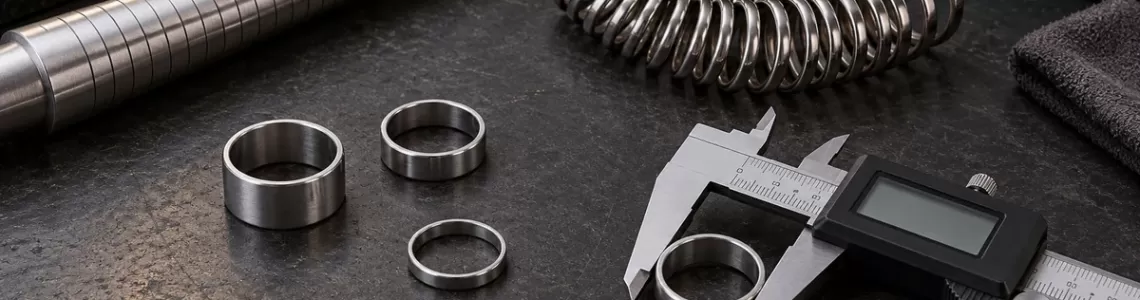
A ring-size chart is a translation tool. It converts a physical measurement - usually a ring's inside circumference or inside diameter - into a label such as a US number, a UK letter or a European millimetre size. Before using any chart, identify what you measured, keep the value in millimetres, and use the chart supplied by the seller or maker when one is available.
Diameter and circumference are related, but they are not interchangeable entries. The inside circumference is the distance around the inner wall of a round ring. The inside diameter is the straight-line distance across the opening through its centre. For a truly circular ring, circumference is approximately diameter multiplied by pi. A 17.2 mm diameter is therefore about a 54.0 mm circumference, but that result is still a measurement - not an automatic promise that every chart will assign the same US or UK label.
What does a ring size actually measure?
The international reference point is the space inside the ring, not the outside width of the metal. ISO 8653 covers the definition, measurement and designation of jewellery ring sizes. The ISO catalogue describes ring size through the inner circumference measured in millimetres and specifies a standardized measurement method used in jewellery work.
Retail systems then label that internal size in different ways. A European chart may use a number close to the inner circumference in millimetres. US charts commonly use ascending numbers and half or quarter sizes. UK and Australian charts commonly use letters. Japan and other markets use their own sequences. These labels are not measurements you can safely compare without a chart.
That is why a bare statement such as "size 10" is incomplete when the market is unclear. Ask whether it is a US, Japanese or another size system, and ask for either inside diameter or inside circumference in millimetres. A physical dimension gives you a stable point to compare even when the label changes.
Inside diameter versus inside circumference
Inside diameter is easiest to obtain from an existing round ring that already fits the intended finger. Place the ring flat, measure the widest internal opening through the centre, and exclude the metal walls. A digital caliper can be more repeatable than a ruler, but its jaws should touch the inner surfaces lightly; pressure and angle can change a small reading.
Inside circumference describes the full distance around the opening. In a perfectly round ring, you can estimate it from diameter with the circle relationship C = pi x D. Use the unrounded diameter for the calculation and round only at the end. Repeatedly rounding a small measurement can move the result toward a neighbouring chart size.
The reverse estimate is D = C / pi. This is useful when one chart gives circumference and another gives diameter. It is not reliable for an oval, bent or deliberately non-circular ring because one width no longer represents the whole perimeter. The GIA professional sizing benchmark specifically notes that charting an inside measurement requires a perfectly round ring.
Do not include band width in either diameter or circumference. Band width is the distance from one edge of the band to the other along the finger. It affects feel and may affect the practical size choice, but it is a different dimension. Our ring width and fit guide explains why a wide band can feel tighter even when the nominal size matches a narrow ring.
Why US, UK and European charts do not show the same label
Ring-size systems are naming systems laid over physical dimensions. A US size is not a length in inches or millimetres. A UK letter is not a quality grade. A European number may resemble circumference in millimetres, but the exact sequence and rounding still need the chart in front of you.
Professional conversion charts, including Stuller's table of comparative ring-size equivalents, are useful for comparison. Treat the result as the nearest practical equivalent rather than a mathematical identity. Different charts may round at different points, include quarter sizes differently or use a maker's own tolerances.
When shopping online, preserve all three pieces of information if possible:
- System label: for example, US 8.5 or UK Q.
- Inside diameter: recorded in millimetres.
- Inside circumference: recorded in millimetres or calculated from an unrounded round-ring diameter.
If those values disagree with the seller's chart, do not silently choose one. Ask which value controls production or fulfilment. A clear written answer is stronger evidence than a generic conversion image copied from another website.
How to measure a ring that already fits
- Choose the correct reference ring. It should fit the same finger, on the same hand, in a similar band width and interior profile.
- Check its shape. Do not use one diameter from a visibly oval, bent or open ring.
- Clean the contact points. Dirt or thick residue can alter a caliper reading.
- Measure the inner opening. Keep the tool level through the centre and exclude the metal walls.
- Repeat after rotating the ring. Similar readings at several angles support that the ring is round. Different readings identify an out-of-round reference.
- Record the raw millimetres. Keep at least one decimal place; do not convert to a size label yet.
- Use the seller's chart. Match the physical measurement to the closest listed value and ask how ties are handled.
A professional jeweler will normally use a ring stick or mandrel for the reference ring. GIA notes that the reading point changes with tapered, convex-interior and other profiles. Stuller's mandrel guidance likewise emphasizes reading the correct edge or centre and matching the measuring tools to ring width and fit.
Do not push a stone-set ring down a plain mandrel if a low stone or culet projects into the opening. GIA recommends a grooved tool where needed to avoid contact with the stone. Home measurement should never risk damaging the reference ring.
How to measure a finger without confusing fit with circumference
A paper strip or flexible tape measures the finger, not the finished ring. Wrap it where the ring will sit, keep it flat, and mark the overlap without pulling so tightly that it indents the skin. Repeat several times and compare the results. String is less reliable because it can stretch, twist and settle into the skin.
The knuckle matters. A ring must pass over the largest part of the route and then sit securely at the base. Jewelers of America recommends professional sizing that checks the knuckle and the finger. GIA describes the correct professional gauge as just loose enough to pass the joint and settle where the ring will be worn.
Measure under ordinary conditions. Cold can temporarily reduce finger size, while heat, exercise, travel, salt, injury and normal daily changes can increase it. If repeated readings vary materially, the uncertainty is part of the result. Do not average away a fit problem that needs a jeweler's assessment.
For a surprise gift, borrowing a truly comparable ring is usually stronger than guessing from age, height, glove size or a photograph. Confirm which finger and hand the borrowed ring fits. The same person's corresponding fingers can differ.
Wide bands, comfort fit and stacked rings
A nominal size does not describe every contact surface. GIA uses different finger gauges for narrow rings and rings wider than 4 mm. A broad straight interior contacts more skin than a narrow band, while a convex or "comfort-fit" interior can change how the ring passes the knuckle and sits on the finger.
Several rings worn together act like a wider combined band. Measure for the actual arrangement, not one slim sample ring. A tapered ring may have a narrow underside and a broad top; a jeweler may read it at a different mandrel point than a uniform band. Open or adjustable designs introduce another variable and should follow the maker's intended adjustment range rather than a closed-ring chart alone.
This is why the best comparison ring has a similar width, profile and weight distribution. A chart can translate dimensions, but it cannot model pressure, swelling, top-heavy rotation or a large knuckle. Those are fit questions.
Printable and on-screen ring sizers: what to verify
A printable guide can be useful only when its scale is verified after printing. Set the file to 100 percent or actual size, disable "fit to page," and check the guide's calibration line with a physical ruler. Printer margins, PDF scaling and phone-to-printer workflows can change the output.
Do not place a ring against an on-screen circle unless the page provides a calibration step that you have completed on that exact device. Browser zoom, display scaling, screen density and screenshots can all change apparent size. The safest use of a brand's guide is to follow that brand's current instructions. Tiffany's official size guide, for example, tells shoppers to measure the interior diameter of an existing ring in millimetres and match it to the company's chart.
Save the chart version or a screenshot with the order record. If the merchant later changes a chart, you still have evidence of the information used when choosing. Our online jewelry buying checklist explains how to preserve product-page details before checkout.
What a ring-size chart cannot tell you
- Whether the finished ring will match the chart within a particular production tolerance.
- Whether the design can pass a large knuckle and remain stable at a smaller finger base.
- How a wide, comfort-fit, tapered, open or stacked design will feel.
- Whether a stone-set, patterned, hollow or multi-metal ring can be resized safely.
- Whether normal swelling will make one static measurement unsuitable at another time.
- Whether a size label belongs to the US, UK, EU, Japanese or a maker-specific system.
Material and size are also separate claims. A 925 mark concerns represented silver fineness, not the ring's internal dimension or fit. See our 925 stamp versus hallmark guide for that evidence boundary. Likewise, a sterling or plated description does not answer whether resizing is practical.
Questions to ask before ordering a ring online
- Which ring-size system does the listing use?
- What are the matching inside diameter and circumference in millimetres?
- Is the finished ring narrow, wide, comfort fit, tapered, open or adjustable?
- Does the seller recommend a different gauge or size for this width?
- What manufacturing tolerance applies to the finished internal dimension?
- Is the selected size made to order, final sale or eligible for exchange?
- Can this exact construction be resized, and by how much, without risking stones or surface treatments?
- Who pays shipping, duties or service costs if the fit is wrong?
Keep the selected size, chart, dimensions, product description and return terms together. If fit is disputed, compare the finished ring's professional mandrel reading with the chart that governed the order. Our guide to returning jewelry bought online covers condition and evidence, while the warranty versus service-plan guide explains why resizing coverage should be confirmed separately.
A practical decision sequence
- Name the system. Do not accept a bare number or letter.
- Prefer millimetres. Record inside diameter or circumference and label which one it is.
- Check roundness. Use diameter conversion only for a round, closed ring.
- Match the design. Compare width, interior profile and intended finger.
- Repeat the measurement. Preserve variation rather than choosing the most convenient result.
- Use the maker's chart. Treat cross-system charts as approximate equivalents.
- Resolve conflicts in writing. Ask which dimension controls the order.
- Preserve fit remedies. Save return, exchange and resizing terms before payment.
If the ring is expensive, made to order, difficult to resize or set with stones around the shank, professional sizing is the proportionate next step. Bring a comparable ring and tell the jeweler the planned width and profile.
FAQ
Is ring size based on diameter or circumference?
Both can be used as physical references, but a chart must say which one it expects. ISO ring-size designation is based on inner circumference in millimetres; many retail guides also accept the inside diameter of a round existing ring.
Can I calculate circumference from diameter?
For a round ring, multiply the inside diameter by pi. Keep the unrounded diameter during the calculation. Do not use one diameter for an oval, bent or open ring.
Is a European size the circumference in millimetres?
Many European charts use a number close to inner circumference, but confirm the seller's chart and rounding. Do not assume that every number called "European" follows an identical convention.
Why do two charts give different US sizes?
Charts can use different reference standards, rounding, quarter-size treatment or maker tolerances. Compare the underlying millimetres and ask which chart controls the order.
Should I size up for a wide ring?
A wide band often feels tighter than a narrow gauge of the same nominal size, but the adjustment depends on width, interior profile, knuckle and finger shape. Use a width-matched gauge or professional fitting rather than a universal increment.
Can I measure with string?
String is a rough fallback because it can stretch, twist and compress skin. A non-stretch paper strip or flexible tape repeated under ordinary conditions is better; professional gauges are stronger evidence.
Does a printable ring sizer work?
It can provide an estimate if printed at actual size and verified against a physical calibration line. Incorrect printer scaling makes the result unreliable.
Can every ring be resized if I choose wrong?
No. Stones around the shank, plating, engraving, hollow construction, mixed metals, tension settings and limited material can restrict resizing. Confirm the exact design and service terms before purchase.
What is the most reliable way to choose?
Have a jeweler size the intended finger with gauges that resemble the planned ring's width and interior profile, then compare the result with the seller's current chart in writing.
References and evidence boundaries
These sources describe professional sizing, physical ring dimensions and practical chart use. They do not prescribe a size for a particular reader or guarantee the tolerances of a store product. Personal fit remains affected by anatomy, conditions, design and manufacturing.
- ISO 8653:2016 - Jewellery - Ring-sizes.
- GIA: Accurate Determination of Finger and Ring Sizes.
- GIA 4Cs: How to Determine Ring Size.
- Jewelers of America: Ring Style Guide.
- Stuller: How To Read a Ring Mandrel.
- Stuller: Table of Comparative Ring Size Equivalents.
- Tiffany & Co.: Ring Size Chart and Guide.
Leave a Comment