
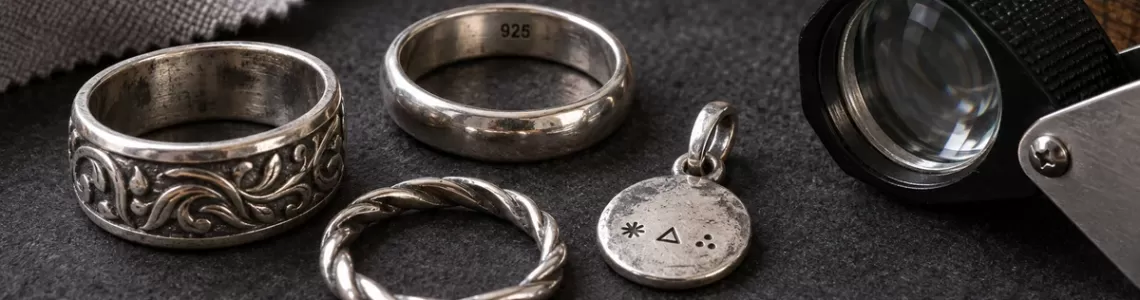
A 925 stamp is a fineness claim: it represents 925 parts of silver per 1,000 parts of alloy, the composition commonly called sterling silver. A hallmark, in systems that use independent assay offices, is more than that number. It is an official control mark or a required group of marks showing that an authorized body tested the article under a defined legal system.
Those terms should not be treated as universal synonyms. A lone 925 mark can be meaningful, but it does not by itself identify who made the piece, where it was tested, when it was made, whether every similar-looking part has the same composition, or whether the stamp is truthful. Marking law also differs by country, item type and weight. Read the physical mark together with the written product description, seller identity, jurisdiction and any independent assay marks.
What does 925 mean on jewelry?
The number uses millesimal fineness: parts per thousand by weight. A 925 claim means the alloy is represented as at least 92.5 percent silver, with the remaining portion made from other alloying elements. Pure silver is soft, so sterling alloys use other elements to provide practical strength and working properties. The number does not tell you which elements make up the remaining 7.5 percent.
The US Federal Trade Commission's consumer guidance on silver jewelry explains that items are sometimes marked 925 to indicate 925 parts per thousand silver. The US rule in 16 CFR 23.5 says that describing an item as “sterling silver,” “sterling” or “Ster.” can be deceptive unless it is at least 925/1,000 silver, subject to the applicable assay tolerances.
That is a composition threshold, not a complete biography. A 925 stamp does not prove geographic origin, manufacturing date, workshop, value, handmade status or rarity. It also does not mean the piece is pure silver. Our coin silver versus sterling guide explains why 900 and 925 are distinct fineness claims rather than quality grades for craftsmanship.
Quality mark, responsibility mark and hallmark are different
A quality or fineness mark states or implies metal content. Examples include 925, Sterling or Ster. A maker's, sponsor's or responsibility mark identifies the party responsible for placing an article into the market or submitting it for control, depending on the legal system. An assay-office or control mark indicates independent official testing in jurisdictions that use that model.
The FTC's Jewelry Guides overview emphasizes truthful descriptions of metallic content. US guidance in 16 CFR 23.10 defines quality marks and notes identity-disclosure requirements under the National Stamping Act when manufacturers, dealers or importers apply certain gold or silver quality marks. This is not the same structure as a compulsory UK assay-office hallmark.
International industry terminology also separates these ideas. The CIBJO Precious Metals Blue Book lists recognized silver finenesses including 925 and describes official hallmarking as testing and marking by an assay office in countries that use such offices. It notes that national systems differ.
What makes a complete UK hallmark?
The United Kingdom provides a useful example because its system clearly distinguishes one fineness number from a full hallmark. The British Hallmarking Council's practical guidance states that a complete UK hallmark contains three compulsory elements:
- Sponsor's mark: the registered party that submitted the article for hallmarking.
- Metal and fineness mark: the metal type and minimum purity in parts per thousand, such as the silver 925 mark in its prescribed surround.
- Assay Office mark: the office that tested and marked the article.
A date letter can be added, but it is optional under the current system. Traditional fineness symbols are also optional. The Sheffield Assay Office guide likewise identifies the sponsor, fineness and assay-office marks as compulsory and the date letter as voluntary.
This means a bare “925” is not a complete UK hallmark. It may still be a fineness mark, but buyers should not describe it as independently assayed in the UK unless the required official components are present and identifiable. Weight exemptions and other legal details also exist, so absence of a UK hallmark is not automatically proof that an item is counterfeit. It may be below an exemption threshold, sold under another jurisdiction or inadequately documented. Item-specific legal conclusions require the applicable rules.
How international Common Control Marks fit in
The Convention on the Control and Marking of Articles of Precious Metals created the Common Control Mark, or CCM, to help recognized articles move among contracting states. According to the Hallmarking Convention FAQ, only an authorized assay office can apply the CCM. It accompanies the national assay-office mark, responsibility mark and fineness information required by the Convention format.
The important buyer lesson is independence: an official control mark represents testing by an authorized third party, while an ordinary fineness stamp is a claim placed on the article. Both can be useful, but they provide different levels and types of evidence. The CCM is not mandatory everywhere, and countries outside the Convention may use other systems.
What a 925 stamp cannot prove
It cannot prove authenticity by itself. Stamps can be copied, misapplied or placed on a component that does not represent the whole piece. A genuine-looking font is not an assay.
It cannot prove nickel-free status. The number describes silver fineness, not the identity of every alloying element. Our 925 and nickel-free guide explains why sensitivity claims need separate evidence.
It cannot prove that a surface is unplated. Sterling silver can carry rhodium, gold or another permitted surface treatment. Conversely, silver-colored base metal may be plated with silver. Product descriptions should disclose coatings accurately. See our rhodium-plated silver guide for the difference between substrate and surface.
It cannot prove age or origin. A modern item can carry 925, and similar numbers appear across many markets. Dating requires the correct system, mark sequence, registered responsibility mark and other provenance.
It cannot prove every component is sterling. Clasps, solder, pins, springs, chains, stones and decorative inserts can require separate descriptions. US guidance warns against a quality mark that misleadingly appears to apply to parts it does not cover.
It cannot prove craftsmanship or value. Fineness is one material property. Construction, mass, condition, design, finishing, provenance and seller support remain separate.
How to inspect marks in a listing photograph
Start with orientation. A mark photographed at an angle can turn 925 into an ambiguous sequence. Ask for a sharp, straight-on macro image with scale and neutral light. The photo should show the mark's location on the whole item, not only an isolated crop.
- Record every character and symbol. Do not fill uncertain gaps from expectation. Write “unclear” where the image is unreadable.
- Separate the groups. A number, initials, pictorial symbol and date-style letter may serve different functions.
- Check the surround. In some systems, the shape around a fineness number identifies the metal. The number alone may omit that context.
- Locate the mark. Ring interiors, clasp tongues and pendant backs are common places, but location alone does not authenticate the mark.
- Compare both parts of a detachable item. A pendant and chain may have different makers, metals or marks.
- Match the seller's claim. If the listing says solid sterling but the visible mark belongs only to a clasp, ask whether the claim covers the entire article.
Image enhancement can improve legibility but can also invent edges through sharpening and compression. Keep the original file. Ask the seller to rotate the article and provide a second photograph rather than relying on one aggressively processed image.
Worn, partial and missing marks
Marks can be shallow, polished, damaged or hidden by later repairs. A partial mark should be transcribed as partial. Do not identify an assay office from one blurred outline when several symbols are similar. Registered sponsor or responsibility marks may also be reused over long periods, so the initials alone may not name a unique individual without the correct office register and surround.
A missing stamp is not conclusive proof of base metal. Small items may fall within exemptions in some jurisdictions; older, repaired or imported pieces may follow different systems; and marks can wear. Equally, presence of a stamp is not conclusive proof of sterling. The correct next step is more evidence, not a stronger guess.
Home tests have limits. Magnet response can sometimes reveal strongly magnetic components, but many non-silver metals are also nonmagnetic. Our silver magnet-test guide explains why that result cannot establish fineness. Acid, electronic and X-ray fluorescence methods also have sampling, surface and interpretation limits; destructive tests should be left to qualified professionals.
Read the listing as carefully as the stamp
A trustworthy product page should describe the metal in plain language, identify coatings or mixed materials, show useful dimensions and connect the claim to the correct component. “Silver tone,” “silver color,” “silver plated,” “sterling silver” and “925” are not interchangeable descriptions.
Save the listing, mark photographs, seller identity, written answers and return terms before purchase. The online jewelry buying checklist explains how to preserve product-page and checkout evidence. If a description uses “German silver,” remember that this traditionally names a copper-nickel-zinc alloy rather than a silver fineness; our German silver versus sterling guide covers that distinction.
Before buying, ask: Which parts are sterling? Is the item plated or coated? What does each visible mark represent? Was any mark applied by an independent assay office? Which country's system applies? Can the seller provide a clear full-item photograph and the relevant responsibility-mark identity? What return remedy applies if qualified testing contradicts the description?
A practical buyer decision sequence
- Identify the written claim. Note exactly whether the listing says sterling silver, 925, plated or merely silver-colored.
- Map the claim to components. Separate ring, setting, chain, clasp, pendant, spring and decorative insert.
- Transcribe the marks. Keep number, letters, symbols and surrounds separate.
- Determine the governing system. Seller location, market and assay-office evidence matter; do not force UK terminology onto a US-only quality mark or vice versa.
- Look for responsible identity. A registered sponsor or manufacturer identity is different from the fineness number.
- Check independent control. Verify assay-office or Convention marks only through authoritative directories and clear photographs.
- Preserve uncertainty. If the mark is unreadable or the jurisdiction is unknown, write UNKNOWN rather than guessing.
- Escalate proportionately. For a high-value, antique or disputed item, use a qualified appraiser or assay service and agree on testing methods before alteration.
Red flags that deserve a follow-up question
- The listing calls one 925 stamp a “certified hallmark” but shows no assay-office or responsibility mark.
- The mark photo is detached from the full item, heavily blurred or digitally sharpened.
- The description alternates between solid sterling, silver plated and silver tone.
- A chain clasp is marked but the pendant or setting material is not described.
- The seller claims 925 proves nickel-free, handmade, antique or from a specific country.
- A low price is used as proof of a bargain while weight, dimensions and return terms are missing.
- The seller refuses a straight-on mark photo or a component-by-component material answer.
One red flag does not automatically prove fraud. It identifies a gap between the evidence and the claim. Resolve that gap before purchase, especially when returns are limited.
FAQ
Is 925 the same as sterling silver?
As a fineness claim, 925 represents 925 parts silver per thousand and is the usual sterling threshold. The stamp alone is not independent proof that a particular item actually meets that composition.
Is a 925 stamp a hallmark?
Not necessarily. It is a fineness or quality mark. In the UK, a complete hallmark also needs a registered sponsor's mark and an assay-office mark. Other countries use different systems.
Does every genuine sterling-silver item have a stamp?
No universal rule covers every country, age, item and weight. Exemptions, wear, repairs and different legal systems exist. Absence calls for more evidence; it does not by itself settle authenticity.
Does 925 mean nickel-free?
No. It states the claimed silver proportion, not the identity of every material in the remaining alloy or in separate components.
Can plated jewelry be stamped 925?
A sterling-silver base may be plated with another metal and still carry a sterling fineness mark, provided the description and marking are not misleading. A base-metal item merely coated with silver should not be represented as solid sterling.
Can I date jewelry from a hallmark?
Sometimes a verified hallmark system includes a date letter or historical mark, but many marks are not date marks. The exact office, symbol set, surround and register must be checked.
What should I do if the mark is unclear?
Ask for an unedited macro photo from two angles, showing the mark's location on the complete item. For valuable pieces, use a qualified appraiser or assay service rather than guessing from a blurred image.
References and evidence boundaries
The following sources define fineness claims, quality marks and selected official hallmark systems. They do not authenticate the generic jewelry shown in the featured image or any store product. Marking requirements vary by jurisdiction, category and weight; this guide is educational, not legal or appraisal advice.
- FTC Consumer Advice: Buying Platinum, Gold, and Silver Jewelry.
- Federal Trade Commission: Jewelry Guides.
- 16 CFR 23.5: Misrepresentation as to silver content.
- 16 CFR 23.10: Additional guidance for quality marks.
- British Hallmarking Council: Hallmarking practical guidance.
- Sheffield Assay Office: UK Hallmarks.
- Convention on the Control and Marking of Articles of Precious Metals: FAQ.
- CIBJO Precious Metals Blue Book.
Leave a Comment