
Why Do Sterling Silver Rings Bend? Thickness, Temper and Repairs
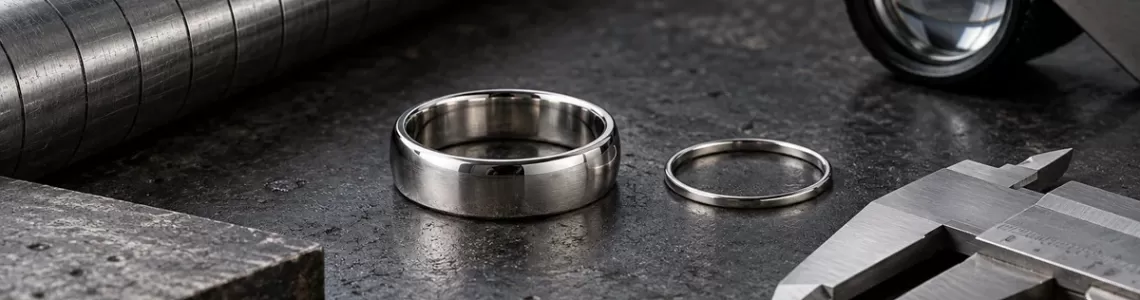
Yes, a sterling-silver ring can bend. A 925 mark describes silver fineness, not the ring's resistance to deformation. Whether a band keeps its shape depends on its thickness, width, profile, construction, manufacturing history, joints, settings and the force applied. A substantial solid band may tolerate ordinary wear well, while a very thin, hollow, open or already damaged ring can distort under much less load.
If a ring becomes oval, pinches the finger, shows a new crease or no longer holds a stone securely, stop wearing it and ask a qualified jeweller to inspect it. Do not repeatedly bend it back by hand. Repeated correction can work-harden some areas, concentrate strain at others and hide a crack or weak joint without restoring the original condition.
What the 925 mark does and does not prove
The U.S. Federal Trade Commission explains that sterling silver contains 92.5% pure silver and that 925 means 925 parts silver per thousand. The British Hallmarking Council likewise treats 925 as a recognized sterling-silver fineness. These are composition statements. They do not certify a particular ring's thickness, temper, casting quality, solder joints, stone setting, repair history or load capacity.
That distinction is the first buyer check. A genuine sterling-silver ring can still be thin, hollow, adjustable, heavily pierced or poorly supported. A substantial ring can also be genuine sterling. The stamp alone cannot rank the two designs for shape retention. Our guide to 925 stamps and hallmarks explains how to separate a fineness claim from broader conclusions about workmanship or performance.
The Canadian Conservation Institute describes sterling silver as an alloy of 92.5% silver and 7.5% copper. Alloying makes sterling more practical than fine silver for many jewellery forms, but the finished object's geometry and processing still matter. Do not translate “sterling” into “cannot bend,” just as you would not translate “stainless” into “cannot scratch.”
Why some sterling-silver rings bend more easily
Band thickness and cross-section
A ring shank behaves like a small structural section. A thin section generally has less material resisting a bending load than a thicker one of the same material and condition. Profile matters too: a deep, substantial cross-section may resist deformation differently from a broad but paper-thin shell. Product photos alone often hide the underside and interior wall, so ask for dimensions rather than judging only by face width.
Width and thickness are different measurements. A wide ring can look substantial from above yet have a thin wall. A narrow ring can be relatively deep and solid. The ring width and fit guide covers comfort and sizing; for deformation risk, also ask for minimum shank thickness at the thinnest point.
Solid, hollow and open construction
“Solid sterling silver” usually means that the silver component is sterling through that component rather than a silver coating over base metal. It does not necessarily mean every part is a single, thick block. A ring may contain cavities, assembled walls, soldered seams, pierced galleries or attached decorative elements.
Hollow construction is not automatically defective. It can reduce weight and make a large design wearable. It does, however, change the questions a buyer should ask. Thin walls can dent, trapped moisture can be difficult to remove, and a seam or opening can become a local weak point. Canadian Conservation Institute and U.S. National Park Service silver-care guidance both warn that liquids can enter hollow parts and become difficult to rinse or dry. Those museum-care sources do not predict a ring's strength, but they confirm why construction must be identified before cleaning or repair.
Temper, cold work and heat history
Metal condition is not visible in a 925 stamp. Working silver changes its structure and hardness, while annealing can make it more workable. Rio Grande's technical silver-hardness guidance shows that sterling can exist in different hardness conditions and that heat treatment or cold work changes those conditions. Peer-reviewed studies of silver-copper alloys likewise show that deformation and heat treatment can materially change hardness and strength.
This does not let a shopper calculate the exact strength of an unknown ring. It does explain why two bands with the same fineness can behave differently. Casting, rolling, forming, soldering, resizing and finishing may leave different sections in different conditions. A seller's generic alloy certificate cannot replace information about the finished ring.
Sizing seams, solder joints and previous repairs
A resized ring may contain an added or removed section and one or more soldered joints. A competent repair can be durable, but it changes the ring's history. New distortion near a seam, color difference, visible line, porosity or cracking deserves professional inspection. The sterling-silver ring resizing guide explains why stones, coatings, engraving and construction affect the repair plan.
Do not assume a bend proves a bad solder joint. Force may deform an intact section away from the seam. Conversely, a ring that looks nearly round can still have a cracked joint. Condition must be examined rather than inferred from shape alone.
Settings, stones and decorative openings
A plain band spreads load differently from a ring with a tall setting, open gallery, channel, tension-like design or many cut-outs. A blow to the head of a ring can twist the setting even when the lower shank remains round. A bent shank can also change prong alignment and stone security.
Our comparison of prong, bezel and channel settings explains the visible inspection points for each setting type. If a stone moves, a prong catches fabric, a channel gap changes or the setting leans, stop wearing the ring. Do not test security by pushing hard on the stone.
Forces that commonly deform a ring
Most bends are not caused by ordinary finger motion alone. The more concerning loads are concentrated, sudden or repeated: gripping a hard tool, lifting weights with the ring against a bar, catching the ring on equipment, closing it in a door, striking a hard surface, or forcing an undersized ring over a swollen knuckle. Work, sports and machinery add snagging and crush hazards beyond cosmetic damage.
Fit changes the load pattern. A loose ring can rotate and strike objects. A very tight ring may be difficult to remove and can be forced during swelling. A wide band often feels tighter than a narrow band at the same nominal size. Use the ring size chart guide to understand measurement terms, but treat comfort, knuckle clearance and band width as separate checks.
Remove rings before weight training, manual work, climbing, contact sports or tasks involving rotating machinery. This is a safety boundary, not merely a jewellery-care preference. If a ring is crushed on the finger or the finger becomes numb, blue, severely swollen or painful, seek urgent medical help rather than attempting a jewellery repair.
How to inspect a ring without making damage worse
1. Stop loading it
Take the ring off if it comes off without force. Do not continue wearing a visibly distorted band “to see if it gets worse.” Continued wear can enlarge a crack, loosen a setting or pinch the finger. If the ring is stuck and the finger is compromised, prioritize medical care.
2. Document the condition
Place the ring on a clean, padded, well-lit surface. Photograph the top, sides, inside, underside, hallmark area and any seam. Include one image beside a ruler for scale without forcing the ring against it. Save the listing, order confirmation, delivery photos and prior repair records.
3. Look for shape and surface clues
Check whether the band is oval, flattened or kinked. Look for a sharp crease, thinning, a bright new line, a dark crack, lifted plating, open seam, displaced ornament or change in symmetry. A smooth oval can reflect gradual compression; a localized kink suggests a concentrated load. Neither observation proves the root cause by itself.
4. Inspect the setting without force
Over a tray or folded towel, look for changed prong spacing, a leaning head, widened channel gap or stone that appears off-center. Do not shake the ring beside a sink, press the stone, pull prongs or use a home ultrasonic cleaner. The post-delivery ring inspection guide provides a non-destructive sequence for recording condition.
5. Ask for a repair assessment
A jeweller can determine whether the ring can be rounded on a mandrel, whether metal must be added, whether a seam needs resoldering, and whether stones or coatings create heat limits. Ask for the proposed method, effect on engraving or finish, expected shape, price and warranty before authorizing work.
Why repeatedly bending it back is risky
Hand-straightening feels simple because sterling silver can be workable. The problem is control. Fingers and household pliers apply uneven force, and bare steel jaws can scratch or notch the surface. A small notch can become a stress concentrator. Repeated back-and-forth deformation can also harden worked areas and eventually promote cracking.
Heating the ring at home is worse. Solder may flow before the main alloy behaves as expected; stones can fracture or change; treatments, adhesives, enamel, oxidized finishes and plating can be damaged; and heat can alter hardness. A repair that looks round is not necessarily structurally restored.
Polishing is not a structural repair either. The National Park Service notes that cleaning and polishing remove original metal, while Canadian Conservation Institute guidance explains that repeated polishing removes both tarnish and underlying silver. Polishing can make a damaged area look smoother while reducing detail or wall thickness. It cannot replace missing metal or close a crack reliably.
Buyer questions that reduce uncertainty
- Is the band solid through the shank, hollow, open-backed or assembled from multiple parts?
- What are the width and minimum thickness of the shank, not only the face dimensions?
- Does the 925 claim apply to the complete ring or only named components?
- Has the ring been resized, soldered, plated, coated, oxidized or repaired?
- Are there care or activity restrictions for the setting, stones or finish?
- Can the design be resized or rounded if it deforms?
- What evidence and remedy apply if the ring arrives oval, cracked or with a loose stone?
Dimensions and construction disclosures are more useful than vague words such as “heavy,” “premium” or “durable.” Weight can help comparison only when size, design and material scope are comparable. A large stone, hollow head or wide face can change total weight without strengthening the thinnest part of the shank.
How to compare two listings without inventing durability
Start with the same ring size and comparable design. Record the listed metal, total weight, band width, minimum shank thickness, setting type and whether the construction is solid, hollow, open-backed or adjustable. If one listing omits the underside, dimensions or material scope, mark that field unknown rather than assuming the most favorable construction.
Next, separate observable facts from predictions. A side photograph may show a deeper shank or an open gallery, but it cannot reveal temper, internal porosity, hidden repairs or the quality of every solder joint. A heavier ring may contain more metal, yet weight can sit in the head rather than the lower shank. Reviews describing bends can identify questions worth asking, but they do not establish how an unworn unit will behave because size, use, impact and prior condition differ.
Finally, compare remedies. A clear return window, written construction answer, repair policy and local service option can be more useful than an unsupported lifetime claim. Save the version of the listing you relied on. If the delivered ring differs in shape, dimensions or construction, photograph it before wearing or modifying it and contact the seller with the specific mismatch.
Frequently asked questions
Is a bent sterling-silver ring fake?
No. Genuine sterling silver can bend. Deformation does not authenticate or disprove fineness. Composition requires appropriate evidence, while bending reflects geometry, condition, processing and force.
Does 925 mean a ring is solid silver?
925 is a sterling-fineness claim. It does not by itself prove that every component is sterling, that the ring is not hollow, or that no solder, stone, coating or non-silver finding is present.
Can a jeweller straighten a bent silver ring?
Often, but not always. Repairability depends on the severity and location of the bend, cracks, wall thickness, seams, stones, settings, coatings and previous repairs. An inspection is needed before a method or outcome can be promised.
Can I use pliers to make the ring round again?
That is not recommended. Pliers can scratch, notch or flatten the band and may place uneven force on a stone setting or seam. Repeated bending can worsen hidden damage.
Is a thicker ring always stronger?
Thickness generally changes resistance to bending, but “stronger” still depends on profile, alloy condition, construction, defects and load direction. A thick-looking face does not prove a thick shank.
Does a hollow ring mean poor quality?
No. Hollow construction can be a deliberate weight and design choice. It should be disclosed clearly because it changes denting, cleaning and repair considerations.
Should I wear a slightly bent ring?
Stop wearing it until it is checked if the ring pinches, has a crease or crack, changes setting alignment, or makes a stone feel insecure. Continued wear can worsen damage or trap the ring on the finger.
Can polishing remove a bend or crack?
No. Polishing changes the surface and removes a small amount of material. It does not restore lost cross-section, close a structural crack or realign a setting.
References
- U.S. Federal Trade Commission: Buying Platinum, Gold, and Silver Jewelry
- British Hallmarking Council: Hallmarking practical guidance summary
- Canadian Conservation Institute: Basic care—recognizing metals and corrosion products
- Canadian Conservation Institute: Silver—Care and Tarnish Removal
- U.S. National Park Service: Caring for Silver and Copper Alloy Objects
- U.S. National Park Service Museum Handbook: Curatorial Care of Metal Objects
- Rio Grande: Silver Hardness Charts and Heat-Hardening Sterling Silver
- AGH University repository: Homogenization conditions and hardness of 925 silver alloy
Evidence boundary: This guide explains general material, construction and buyer checks. It does not authenticate a ring, calculate the strength of an unknown design, prescribe a repair, replace a jeweller's inspection or provide medical advice.
Leave a Comment