
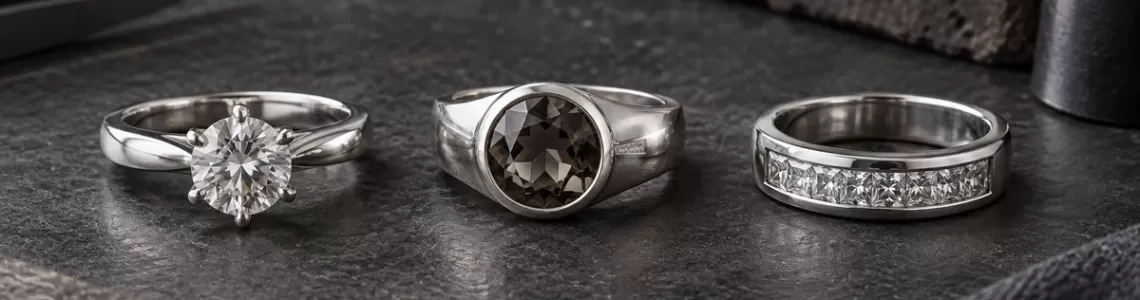
A ring setting is the metal structure that holds a stone, and its design changes what is exposed, what can snag, what is easy to inspect and what may complicate repair. Prongs leave much of a stone visible; a bezel surrounds more of its edge; channel walls hold a row of stones; pavé or bead settings use small areas of raised metal; flush settings seat stones within the ring surface; and tension settings depend on engineered pressure. None is automatically “best.” The useful question is whether the setting matches the actual stone, metal, wearer and intended use.
This guide explains those structures in buyer-friendly terms. It does not identify an unknown gemstone, grade workmanship from one photograph or tell you to tighten a setting at home. A loose stone, bent prong, cracked gem, opened seam or sudden rattle is a reason to stop wearing the ring and ask a qualified jeweler to inspect it.
Setting type and ring style are not the same thing
The Gemological Institute of America distinguishes the setting—the metal mounting and stone-holding structure—from the broader style of a ring. “Solitaire,” “halo” and “three-stone” describe arrangements or styles. “Prong,” “bezel,” “channel,” “flush” and “tension” describe ways a gemstone may be secured. A halo ring can use prongs for the center stone and bead settings for small surrounding stones, so one ring may contain several setting types.
That distinction matters when reading a product page. A style name tells you how the ring is composed visually, but it may not tell you how every stone is held. Look for clear side, top and underside photographs, a material description and a statement identifying the stones or substitutes. The FTC Jewelry Guides emphasize truthful descriptions of metal content, gemstone identity, treatments, durability and serviceability. A “925” mark, meanwhile, speaks to a claimed silver fineness; it does not identify the stone or certify the quality of the mounting. For that boundary, see our guide to 925 stamps and hallmarks.
Prong settings: open display with exposed contact points
Prongs are narrow metal supports that rise around a gemstone and bend over part of its edge or crown. Four- and six-prong arrangements are familiar, although the appropriate number and geometry depend on the design and stone. The open construction can expose more of the gem to light and makes much of the outline visible. It can also leave more edges and corners exposed than a full bezel.
When reviewing a prong-set ring, examine close-up images for symmetry and contact. The tips should appear to reach the stone rather than ending above it, and the stone should not look obviously tilted. GIA's discussion of melee setting notes that prong tips should be in solid contact with a gemstone's crown. That is a workmanship principle, not a home test requiring pressure. Do not press a stone with a tool, bend a prong or use glue.
After purchase, pay attention to changes rather than relying on a universal inspection schedule. A newly catching edge, visible gap, shifted stone, rattle or prong that no longer mirrors its neighbors deserves professional review. Raised prongs can snag knitted fabric or gloves; the risk depends on their profile, finish and wear. If the wearer works with gloves, tools or repeated impact, ask whether a lower-profile setting is more appropriate.
Bezel settings: a surrounding rim, but not a guarantee
A bezel uses a metal rim around all or part of a gemstone's perimeter. A full bezel surrounds more of the edge; a partial bezel leaves sections open. The rim can protect vulnerable edges and create a smoother outer profile than prominent prongs. It can also conceal more of the stone's outline and make underside access different from an open basket.
Check whether the rim appears continuous where the design calls for continuity, whether the stone sits evenly and whether there are dents, gaps or lifting sections. A photo cannot establish what lies beneath the rim, whether a stone is chipped under it or whether the metal has adequate thickness. “Bezel set” therefore describes the holding method, not an assurance of condition.
Cleaning should account for the whole object. Residue may collect around a close metal-to-stone boundary, but aggressive probing can scratch metal or damage a soft or treated gem. The Canadian Conservation Institute recommends examining construction, joins, plating, inlays and non-metal parts before choosing a cleaning method. For wearable jewelry, use that as a conservative reminder: identify the materials first and ask for professional care when they are uncertain.
Channel settings: a row held between metal walls
In a channel setting, stones sit in a groove between parallel metal walls, often with little visible metal between neighboring stones. The walls can protect stone edges and produce a smooth line across a band. This structure is common for accent rows, but its security depends on the continuity and geometry of the channel as well as the fit of each stone.
Look along the row rather than judging only one stone. The stones should appear consistently seated; the channel walls should not show obvious spreading, deep impacts or interruptions; and missing or shifted stones should be treated as structural warnings. Small stones can make a problem hard to see in a low-resolution listing, so request sharp close-ups and confirm what the seller's return or service policy covers.
Channel-set stones that extend far around a band can also affect alteration options. Changing the ring's circumference may change the channel geometry or pressure on the stones. That does not mean every channel ring is impossible to resize, but it makes remote promises unreliable. Our separate guide on sterling-silver ring resizing explains why the actual construction, stone arrangement, finish and requested change must be assessed together.
Pavé and bead settings: many small contact points
Pavé is a visual effect created by closely set small stones; bead setting is one method used to secure them with small raised portions of metal. A ring described as pavé may use bead-set stones, tiny prongs or related variations. Because there are many stones and many contact points, an overall sparkle photograph is not enough to judge every seat.
Use magnified images to look for a regular pattern, stones sitting at comparable levels and metal beads that appear present rather than flattened away. Expect normal handmade variation, but distinguish variation from an obvious empty seat or displaced stone. Ask whether replacement stones, sizing or refinishing could affect the pattern, and preserve the listing and arrival photographs if serviceability matters to you.
Small stones do not make the structure maintenance-free. A ring that has taken a blow can lose alignment without showing dramatic damage from a normal viewing distance. If one stone is missing, stop wearing the ring until the surrounding area is checked; neighboring seats may have shared the same impact or deformation.
Flush settings: low profile with a stone seated in metal
A flush-set stone sits in a recess in the ring, with surrounding metal worked over part of its edge. The top of the stone is often close to the metal surface. This can create a low-profile design with fewer projecting elements, but “flush” does not mean impact-proof. The exposed face can still be scratched or chipped depending on the gemstone, and the seat still relies on accurately worked metal.
Inspect whether the stone appears level, whether the surrounding metal forms a consistent boundary and whether there is a visible gap or crushed edge. Deep scratches across both metal and stone may indicate hard contact. A flush setting can be especially sensitive to aggressive refinishing if polishing changes the metal around the seat, so discuss the exact finish and stone before authorizing work.
Tension settings: engineered pressure and limited assumptions
A true tension setting holds a gemstone between open ends of a ring using carefully engineered pressure. It can create a floating appearance and expose much of the stone. It is not the same as a look-alike design that uses a concealed support below the stone. The difference may be difficult to confirm from a top photograph.
Because the holding force depends on the ring's geometry and metal, resizing or reshaping may be difficult and sometimes inappropriate. The stone's toughness and stability also matter. GIA's durability reference separates hardness—the resistance to scratching—from toughness—the resistance to breaking or chipping—and stability under heat, light or chemicals. A hard stone is not automatically safe from impact, pressure or repair heat.
Ask the seller or maker whether the ring is a true tension setting, what stone is used, whether treatments are disclosed, and what service route is recommended. Do not attempt to spread the band, test the stone with leverage or copy a generic repair method.
Choose by the whole ring, not one feature
The setting is only one part of suitability. Consider the wearer’s activities, the profile of the ring, the number and identity of stones, the band width, the interior fit, the metal and any plating or deliberate oxidation. A smooth bezel may be attractive for someone who dislikes snagging, while an open prong setting may appeal to someone who prioritizes an exposed stone outline. Those are trade-offs, not absolute rankings.
Fit also affects wear. A ring that rotates constantly may expose a raised setting to repeated contact, while a ring that is too tight creates a different problem. Read the stated dimensions and use a consistent measurement method. Our guides to ring-size charts and wide-band fit explain why diameter, circumference, width and interior profile should not be treated as interchangeable labels.
A practical online buyer checklist
Before ordering
- Identify the setting type for the center stone and any accent stones.
- Confirm the claimed metal and stone materials; do not infer them from color.
- Ask about disclosed gemstone treatments, composites or imitations when relevant.
- Review sharp top, side and underside photographs at useful magnification.
- Check the height and exposed edges against the wearer’s work, gloves and daily activities.
- Read the return, repair and service terms before purchase.
- Confirm the size and band width rather than relying on a familiar size label alone.
When the ring arrives
- Photograph the ring before regular wear, including the setting from several angles.
- Compare the received materials, stone count, finish and dimensions with the listing.
- Look for obvious gaps, bent contact points, a tilted stone or damage from transit.
- Do not perform a destructive scratch, acid, magnet or bend test.
- If a stone moves, rattles or looks displaced, stop wearing the ring and contact the seller or a qualified jeweler.
For a wider transaction review, use the online jewelry buying checklist. It covers listing evidence, seller terms and the handoff from product page to checkout without assuming that a polished photograph proves composition.
Care boundaries for sterling-silver settings
Sterling silver can tarnish, and polishing removes a small amount of material. That matters around prong tips, bead settings, engraved edges and intentional dark finishes. The Canadian Conservation Institute cautions that frequent tarnish removal removes underlying silver and that plated or composite objects can be damaged by unsuitable methods. A wearable ring is not a museum object, but the same material logic supports conservative care.
Start by identifying all materials. A cleaning method suitable for plain sterling silver may be unsuitable for a porous, treated, fracture-filled, glued or heat-sensitive stone. Immersion may also be a poor choice where liquids can enter hollow spaces or where non-metal components are present. Avoid assuming that an ultrasonic cleaner is safe simply because the band is silver; our ultrasonic-cleaning compatibility checklist explains why stone identity, treatment, construction and condition must come first.
Use gentle handling and follow material-specific seller or professional guidance. Do not polish directly across a loose setting, use chemical dips on an unidentified assembly, force debris from beneath a stone with a hard point or apply adhesive. If the ring has deliberate oxidation, plating or mixed metals, confirm whether the appearance is an intentional finish before trying to remove it.
When professional inspection is the sensible next step
Seek an in-person assessment when a stone moves, a prong is bent or missing, a bezel edge lifts, a channel wall is distorted, a flush-set stone is no longer level, a tension-set stone shifts, or the ring has taken a hard impact. Inspection is also prudent before resizing a stone-set band, refinishing metal close to small stones or using heat near an unidentified or treated gem.
Bring the listing, invoices, treatment disclosures and earlier photographs. Ask the jeweler to describe the observed condition and proposed scope before work begins. Useful acceptance checks after service include the stone count, alignment, absence of new tool marks, the intended finish, the ring size and whether the repaired area matches the agreed scope. A professional still may need to say that an exact material or hidden condition cannot be confirmed without additional testing.
Frequently asked questions
Is a bezel setting always safer than prongs?
No. A bezel covers more of a stone’s edge and can provide a smoother profile, but security still depends on the metal thickness, workmanship, stone, wear and damage. A poorly made or damaged bezel is not automatically safer than sound prongs.
Do six prongs always hold a stone better than four?
Not as a universal rule. The number, position, dimensions and condition of the prongs must suit the stone and design. More contact points do not compensate for poor fit, weak metal or damaged tips.
Can a channel-set ring be resized?
Sometimes, but stones extending around the band can make resizing more difficult because changing the circumference may alter channel geometry. The actual ring and requested size change need professional assessment.
Is a flush-set stone impossible to lose?
No. Flush settings are low profile, but they still rely on a correctly cut seat and worked metal. Impact, wear or inappropriate refinishing can affect the setting.
Can I tighten a loose prong with pliers?
That is not a safe general home repair. Pressure can chip a stone, deform the setting or break fatigued metal. Stop wearing the ring and seek a qualified jeweler.
Does a 925 mark prove the setting is sterling silver?
A 925 mark is a fineness claim, not an independent assay or workmanship certificate. It also does not identify the gemstone, disclose treatments or prove that every component has the same composition.
Can every stone-set silver ring go in an ultrasonic cleaner?
No. Suitability depends on stone identity, treatments, inclusions, adhesives, construction and condition. If any of those are uncertain, use a more conservative route and obtain material-specific advice.
What is the most useful evidence when buying online?
Clear multi-angle photographs, specific metal and stone descriptions, treatment disclosures, dimensions, size and width, seller service terms, and arrival-condition photographs are more useful than a setting name alone.
References
- Gemological Institute of America: Complete Guide to Engagement Ring Settings
- Gemological Institute of America: Gemstone Durability—Design to Display
- Gemological Institute of America: Melee—Building Blocks of Contemporary Design
- U.S. Federal Trade Commission: Jewelry Guides
- Canadian Conservation Institute: Silver—Care and Tarnish Removal
Evidence boundary: This article describes common setting structures and conservative buyer checks. It does not identify a stone or metal, assess a specific ring from photographs, prescribe a repair, or guarantee security, durability or serviceability.
Leave a Comment