
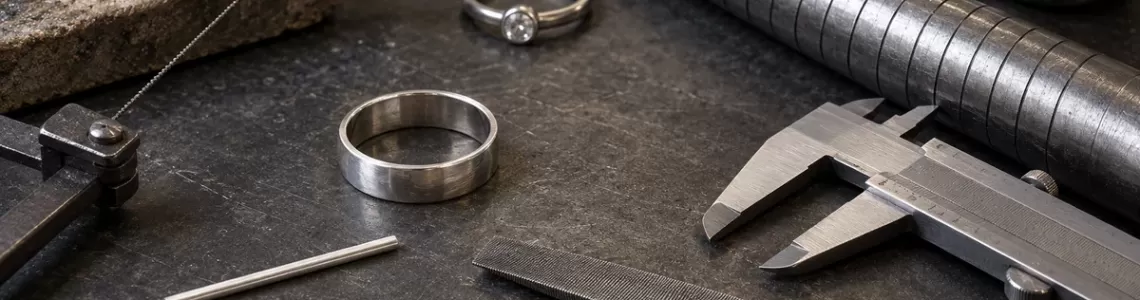
Most sterling-silver rings can be resized, but “sterling silver” alone does not determine whether a particular ring is a safe candidate. A jeweler also has to inspect the shank thickness, how far the size must change, whether the band is patterned or hollow, where stones and heat-sensitive finishes sit, and whether a previous repair has altered the metal. A plain solid band is usually a more straightforward job than an eternity-style setting, a hollow ring or a ring with a continuous surface pattern.
This guide explains the evidence a buyer or owner can collect before asking for a resize. It does not diagnose a ring from photographs, promise that a repair will be invisible, or replace an in-person bench assessment. The final decision belongs to the jeweler who can inspect the actual ring, confirm its construction and agree a repair scope with you.
What resizing actually changes
Traditional ring resizing changes the circumference of the shank. For a larger size, a jeweler may cut the shank and add compatible metal; for a smaller size, the jeweler may remove a section and join the ends. Jewelers of America describes cutting and soldering as a common approach and says the finished area should not show a seam, tool marks or a mismatch in color and luster. Its consumer repair guidance also notes that sizing beads can address a small fit discrepancy without changing the whole circumference.
Stuller’s bench guidance describes the same basic principle: adding or removing metal changes the ring diameter and therefore the size. That description is a process outline, not a promise that every ring can accept every size change. A bench jeweler still has to decide whether the shank has enough sound metal, whether heat or mechanical force could disturb the design, and whether the final proportions will remain useful.
Before discussing repair, make sure the requested size is based on the right measurement. Our guide to ring-size charts, diameter and circumference explains why a US number, UK letter, internal diameter and internal circumference are not interchangeable fields. A repair quote based on a misread chart can solve the wrong problem.
Why a plain solid band is the simplest case
A plain solid band gives the jeweler an uninterrupted section of shank to assess, cut, join, reshape and refinish. There are no stone seats to keep aligned and no repeating pattern that has to meet perfectly at the repair. Even then, “simple” does not mean automatic. The jeweler must identify the metal, measure the band, look for porosity or earlier solder seams, and confirm that the ring is not hollow or plated over a different substrate.
Stuller’s technical discussion of ring sizing warns that forcing a ring smaller by swaging is appropriate only for certain plain half-round bands. Flat bands, tapered bands, previously sized bands and patterned surfaces can distort. That is why a repair method should follow the construction rather than a generic rule such as “all silver is soft enough to stretch.” Sterling silver is workable, but design geometry still controls the risk.
Band width also affects the target fit. A wide band covers more skin and often feels tighter than a narrow gauge in the same nominal size. Read why wide bands can feel tighter before using an old narrow ring as the only reference. The jeweler may use gauges that better match the width and inside profile of the ring you intend to wear.
Stone settings can limit the safe change
Resizing changes the curve of the shank. On a plain ring, that curve can usually be restored and checked on a mandrel. On a ring with stones, changing the curve can also change the geometry of prongs, bezels, channels or shared settings. A channel-set row is especially dependent on consistent spacing and pressure; altering the circumference too far may open or compress the channel and reduce stone security.
Stuller’s channel-setting guidance treats this as a bench problem that may require stone inspection, support and corrective work rather than a one-step size change. Jewelers of America likewise says repaired jewelry should return with stones tight and secure. A responsible estimate therefore may include checking and tightening stones, or it may decline the resize if the setting cannot be preserved predictably.
Heat is another factor. Some resizing techniques use a torch; some shops use laser welding to localize the work. Neither label alone proves a ring is safe. Gem materials differ in toughness and stability, and treatments, inclusions or prior damage may change how they respond. GIA’s durability guidance separates hardness from toughness and stability: a stone can resist scratches yet still be vulnerable to chipping, heat, light or chemicals. The jeweler needs to identify what is set in the ring and how close it is to the work area.
If the ring contains an unknown stone, resin, enamel, adhesive, pearl or other heat-sensitive component, disclose that uncertainty. Do not assume a colorless stone is diamond or that a red stone can tolerate a standard torch process. A jeweler may recommend removal and resetting, a different joining method, a limited size adjustment or no work at all.
Patterns, engravings and finishes may not reconnect cleanly
A continuous pattern creates an alignment problem. Rope, geometric, granulated, hammered or relief decoration may have to be recreated across the join. If the pattern extends around the full circumference, adding or removing metal changes the rhythm and spacing. A competent repair can still be possible, but the result depends on how much matching work is practical and whether the owner accepts a locally reconstructed area.
Engravings, hallmarks and maker marks can also occupy the part of the shank where a jeweler would normally work. Jewelers of America advises placing a sizing cut at the center bottom of the shank unless marks or an inscription prevent it. Record every mark before leaving the ring. Our guide to 925 stamps and hallmarks explains why a “925” mark is a fineness claim, not proof of maker identity, origin or repair history.
Surface finishes create another boundary. Oxidized recesses, intentional patina, plating and selective polishing may change during cutting, soldering, cleaning and refinishing. The repaired zone may need its finish rebuilt, and a plated or oxidized ring may require a wider restoration than the seam itself. For a practical distinction between deliberate darkening and ordinary tarnish, see oxidized silver versus tarnish.
Ask the jeweler which finish is included in the quote. “Resize and polish” can mean a bright overall polish, while your ring may have intentional dark details or a satin surface you want retained. Photographs taken in neutral light are useful evidence of the pre-repair appearance, but they do not replace a written finish instruction.
Hollow, hinged and multi-part rings need special caution
A ring that looks substantial may be hollow. Cutting it can expose thin walls, internal filler or construction seams that were not visible from the outside. Hinged rings, spinner rings, puzzle rings and rings with moving components depend on precise relationships between parts. Changing one circumference can affect clearance, balance or movement elsewhere.
Multi-metal rings add compatibility questions. A silver-colored exterior may be sterling silver, silver plate over another metal, rhodium over silver, or a mixed construction. Different metals and finishes can require different joining and restoration choices. Do not authorize heat or polishing based only on color. Ask the jeweler to record the observed construction and explain any test limitations before work begins.
This is also why a magnet result is not a resizing diagnosis. Our silver magnet test guide explains that a magnetic response can reveal some components but cannot confirm sterling fineness or the complete structure of a ring.
How much can a sterling-silver ring be resized?
There is no universal number of sizes that is safe for every sterling-silver ring. A plain, thick, solid band offers different options from a thin shank, a full-pattern band or a setting with stones around the entire circumference. The useful range also depends on the target size, the original proportions and the repair method available to the shop.
Published bench examples can explain technique, but they should not be converted into a consumer guarantee. Stuller’s reference guide gives a dimensional relationship for changing a US size and discusses acceptable measuring tolerance. That is valuable bench context; it does not establish that every design can be altered by that amount without consequences. The actual ring must be inspected.
Be cautious with absolute sales claims such as “resizable up to three sizes” when no construction assessment accompanies them. Such a range might be reasonable for a specific model, metal and setting, but it is not a property of the words “925 sterling silver.” If future resizing matters, request the model-specific policy in writing before purchase.
Alternatives when a full resize is unsuitable
Sizing beads for a slightly loose ring
Small beads attached inside the lower shank can reduce the effective fit and may help a ring pass a larger knuckle while sitting more securely at the base of the finger. Jewelers of America presents sizing beads as an option for relatively small discrepancies. They still change how the ring feels, and their placement must avoid pressure points.
A fitted insert or guard
An internal insert or ring guard may be reversible and avoid cutting the original shank. Comfort, hygiene, visibility and material compatibility vary. Loose clip-on adjusters can trap moisture or scratch a finish, so treat them as fit aids rather than universal permanent repairs.
Remaking or replacing the shank
When the lower shank is too thin, cracked or repeatedly repaired, a larger shank replacement may be more appropriate than another narrow seam repair. This is a more extensive reconstruction. The jeweler should explain what original metal remains, how stones will be protected and what finish will be restored.
Exchange or return
For a recently purchased ring, an exchange may preserve the original construction better than immediate alteration. Check the seller’s written conditions before removing tags, wearing the ring or authorizing work. Our online jewelry return guide explains how condition evidence, packaging and written policy affect the practical options.
A buyer’s pre-resize evidence checklist
- Confirm the target size. Use a professional gauge when possible and account for band width, knuckle passage, temperature and time-of-day variation.
- Photograph every side. Record the top, shoulders, lower shank, inside marks, engraving, finish and any existing damage in neutral light.
- List known materials. Include metal claims, plating, stone identity, treatments, enamel, resin, adhesive and prior repairs. Mark uncertain information as unknown.
- Ask where the ring will be cut. The answer should account for marks, inscription, pattern and the strongest available section of shank.
- Define the finish. State whether the ring is bright, satin, hammered, oxidized or plated and whether the whole ring or only the work area will be refinished.
- Request a stone-security check. Have the estimate state whether stones will be removed, protected, tightened and rechecked after sizing.
- Agree the final acceptance test. Size, roundness, seam visibility, stone security, finish match and inscription preservation are clearer than a vague promise to “make it fit.”
- Keep the receipt and work order. Record the requested size, approved method, known risks, estimated completion date and responsibility for unexpected findings.
How to evaluate the ring after resizing
Check the result before leaving the shop. The ring should be round unless the design intentionally uses another shape. It should slide over the knuckle with controlled resistance and sit without painful pressure. The inside should not have a sharp edge or obvious depression at the join.
Look at the surface under diffuse light. A well-finished repair should not show obvious tool marks, a sunken seam or a mismatched patch. Pattern and oxidation should meet the agreed scope. If stones are present, ask the jeweler to demonstrate that they were checked; do not test them by pushing with a household tool.
Finally, compare the marks and engraving with your photographs. A hallmark may be softened during polishing even when the repair is otherwise sound, so preservation should be discussed in advance. If the appearance differs from the work order, document it promptly rather than wearing the ring for weeks and losing the condition trail.
Frequently asked questions
Can every 925 sterling-silver ring be resized?
No. The 925 claim describes silver fineness, not whether the ring is solid, hollow, plated, stone-set, patterned or previously repaired. Construction and condition determine the repair options.
Is making a ring smaller easier than making it larger?
Not always. Removing metal can be straightforward on a plain band, while a patterned or stone-set ring may distort when its circumference is reduced. Making a ring larger may require adding compatible metal. Both directions need an inspection.
Can a sterling-silver ring be stretched?
Some plain, suitable bands may accept controlled mechanical enlargement, but flat, patterned, tapered, hollow, stone-set or previously sized rings can distort. “Stretching” is a method decision for the bench jeweler, not a general home procedure.
Will resizing remove a 925 mark?
It can if the mark lies in the work or polishing area. Photograph the mark and ask the jeweler where the cut and refinishing will occur. A mark should not be treated as expendable without discussion.
Can an oxidized silver ring be resized without changing its color?
The local finish may change during joining, cleaning and polishing. A jeweler may be able to restore oxidation, but the match and scope should be agreed in advance. Do not assume the seam alone will be affected.
Can a ring with stones all the way around be resized?
It may be difficult or unsuitable because changing circumference alters stone spacing and setting pressure. The answer depends on the setting, stones, available blank shank and requested change.
Is laser resizing always safer than soldering?
No single tool makes every ring safe. Laser welding can localize heat, but the jeweler must still assess metal compatibility, settings, stones, finishes and prior repairs. Ask why a method suits the actual ring.
Should I resize a new ring or exchange it?
If the correct size is available and the seller permits an exchange, replacement may preserve the original construction. Compare the written return policy, repair risk, timing and sentimental importance before authorizing alteration.
References
- Jewelers of America — Jewelry Repair
- Stuller — Ring Sizing
- Stuller Bench Jeweler — Ring Size Reference Guide and Chart
- Stuller — Sizing a Channel-Set Mounting
- Gemological Institute of America — Gemstone Durability: Design to Display
- Gemological Institute of America — Accurate Determination of Finger and Ring Sizes
- Jewelers of America — Bench Professional Certification Sample Test
Evidence boundary: This article describes common bench considerations and consumer documentation practices. It does not identify the metal or stones in a particular ring, prescribe a repair technique, guarantee that resizing is possible, or estimate cost. Those decisions require physical inspection by a qualified jeweler.
Leave a Comment