
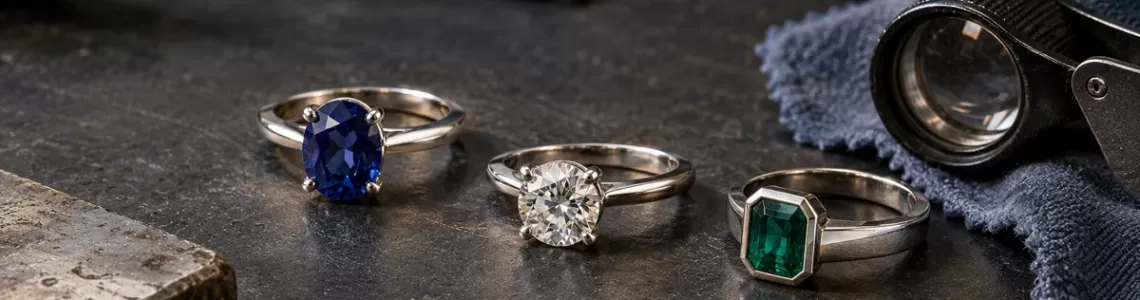
Gemstone durability in a ring is not one number. Hardness describes resistance to scratching, toughness describes resistance to chipping or breaking, and stability describes resistance to heat, light, chemicals and changes in temperature or humidity. A stone can score highly in one category and still be vulnerable in another. For a ring buyer, the practical choice depends on the actual stone, any treatment, the setting, the wearer’s routine and what care or repair the piece may face.
That is why “Mohs 9,” “natural,” “precious” or “daily wear” should not be treated as a complete durability promise. A listing photograph cannot establish internal fractures, treatment, setting quality or future life. Use the material name as the start of a decision, then verify disclosure, construction, dimensions, condition and service terms.
Hardness, toughness and stability answer different questions
The Gemological Institute of America defines gemstone durability through three separate properties. Hardness is resistance to scratches and abrasion. Toughness is resistance to breaking, chipping or cracking. Stability is resistance to heat, light, chemicals and environmental change. None of those words means indestructible.
The Mohs scale ranks relative scratch hardness from 1 to 10, but it is not linear. The gap in actual scratch resistance between neighboring numbers is not constant. A stone at 9 is not simply ten percent less durable than one at 10, and the number says nothing by itself about cleavage, internal strain, treatment, thermal shock or a vulnerable edge.
Diamond is the familiar example of the distinction. It is the hardest common gem, yet a sufficiently placed blow can cleave or fracture it. Quartz resists many everyday scratches but can still chip. Jade materials are famous for toughness even though their Mohs numbers are below diamond. The useful lesson is not to rank every gem in a single league table; it is to ask which kind of stress the ring will actually meet.
Why rings create a demanding wear environment
A ring sits on a hand that reaches into pockets, grips tools, touches door handles, washes, types, lifts and contacts hard surfaces. The stone may project above the band, expose a corner or sit close to neighboring jewelry. Repeated light contact can abrade a surface, while one hard impact can chip an edge or deform the setting. Household chemicals and sudden temperature changes create different risks.
The wearing routine matters more than a generic “everyday” label. Desk work, gardening, weight training, food preparation, workshop tasks and glove use expose a ring to different combinations of impact, grit, pressure, moisture and chemicals. Removing a ring for a hazardous task is not an admission that the gemstone is poor quality; it is ordinary risk control.
Fit also changes exposure. A loose ring that rotates may place a raised stone against more surfaces. A very tight ring creates its own comfort and removal problems. Review our guides to ring width and comfort fit and ring-size charts before assuming that a familiar size label solves the wear question.
High hardness does not eliminate impact risk
Ruby and sapphire are varieties of corundum and rank 9 on the Mohs scale. GIA describes them as highly resistant to scratching and generally tough, which helps explain their long use in rings. That does not make every ruby or sapphire ring equally durable. Fractures, cavities, cut corners, inclusions, treatments and the setting can change the practical risk.
A hard stone can also damage a softer neighbor. Rings worn together may rub at repeated contact points; raised stone edges and metal settings can mark adjacent bands. Dirt containing hard mineral particles can act as an abrasive during wiping. Gentle cleaning begins with removing loose grit rather than rubbing it across polished metal or stone.
Do not run a scratch test on finished jewelry. It damages the surface, may strike a setting and still does not provide a reliable identity conclusion. A result can be confused by coatings, dirt, contact angle and the material of the test point. Professional identification uses controlled observation and instruments, not a destructive internet shortcut.
Good scratch resistance can coexist with fracture concerns
Emerald illustrates why the three-part model matters. It has useful scratch resistance, but emeralds commonly contain fractures, and many are treated with oil, resin or another filler to improve apparent clarity. GIA advises warm soapy water as the safest general cleaning route and warns that heat, chemicals, ultrasonic energy and steam can affect fractures or fillers.
That does not mean every emerald is fragile in the same way, or that treatment is automatically unacceptable. It means the buyer should ask what the material is, whether it is treated, whether the treatment changes care, and what documentation accompanies the claim. The FTC Jewelry Guides say sellers should disclose gemstone treatment when it is not permanent, creates special care requirements or significantly affects value.
A listing that says only “green stone” leaves identity unresolved. “Natural emerald, clarity enhanced with oil” is more informative, while a laboratory report may be appropriate when identity or treatment materially affects price. Keep the scope precise: a report on one stone does not authenticate every item in a collection.
Lower hardness can still work when design and wear are matched
Opal is usually less scratch resistant than quartz and can vary widely in toughness. GIA notes that some opal can contain substantial water and may craze under heat or sudden temperature change. Those properties do not ban opal from rings. They make protective design, careful wear and material-specific cleaning more important.
A lower-profile setting with metal around more of the edge may reduce some contact, while a high exposed stone may suit occasional rather than rough daily wear. Protection is never absolute: metal can dent, a bezel can lift and the visible face of a stone remains exposed. Our guide to prong, bezel, channel and other ring settings explains how mounting structures change exposure and inspection points.
Ask whether the seller recommends limits on heat, immersion, ultrasonic cleaning, steam, solvents or prolonged light. Treat those instructions as material information, not an inconvenience to be hidden. If a care method is incompatible with the weakest component, choose a gentler method or professional service.
Setting design can reduce exposure but cannot rewrite the stone
A bezel may cover more of a stone’s edge than open prongs. Six prongs may provide more contact points than four in a particular design. A low flush setting may snag less than a tall basket. Those are structural observations, not automatic grades. Metal thickness, geometry, workmanship, wear and damage determine whether the actual setting performs as intended.
Pay special attention to corners, points and thin edges. Pear, marquise, princess and other angular cuts can present vulnerable areas that benefit from suitable protection. A smooth-looking top photograph may not show the side profile or underside support. Request sharp top, side and underside views, and check whether the received ring matches them.
Resizing can add another constraint. Heat, bending and changing the circumference may affect a stone, treatment, setting or finish. A channel of stones or a tension-dependent mounting can be especially sensitive to geometry. The guide on resizing sterling-silver rings explains why construction must be assessed before a size change is promised.
Treatment disclosure belongs in the durability decision
Heating, dyeing, filling, impregnation, coating, diffusion and irradiation are different processes with different effects. Some are stable in ordinary wear; others may create limits involving heat, solvents, abrasion, light or cleaning equipment. “Treated” is not a synonym for fake, and “natural” does not mean untreated.
The FTC’s consumer guidance recommends asking whether a gemstone has been treated and explains when disclosure is material. CIBJO’s Coloured Stone Blue Book provides professional nomenclature for treated, synthetic, composite and imitation materials. Clear terms help a buyer compare like with like and choose suitable care. Vague euphemisms, tiny footnotes or an unexplained asterisk are weaker evidence.
For a deeper treatment checklist, read the gemstone treatment disclosure guide. The same evidence principle applies to rings: record the seller’s exact wording rather than replacing it with a guess based on color or price.
What to verify on an online product page
Identity and treatment
- Look for a specific material name instead of a color alone.
- Check whether the stone is mined, laboratory-grown, composite or imitation when that distinction is relevant.
- Ask what treatments were used and whether they change care, durability or value.
- Do not infer origin, treatment or quality from a photograph.
Construction and dimensions
- Review top, side and underside photographs at useful magnification.
- Confirm the ring size, band width, face dimensions and profile height.
- Identify exposed corners, projecting prongs and stone rows that extend around the band.
- Ask whether resizing, refinishing or repair has material-specific limits.
Care and service
- Look for instructions that address the stone, treatment, metal and setting together.
- Read return, warranty and repair terms before ordering.
- Ask who evaluates a loose or damaged stone and whether inspection is local or mail-in.
- Preserve the listing, disclosures and correspondence that informed the purchase.
The broader online jewelry buying checklist helps connect this material review to seller identity, policies and checkout evidence.
Arrival checks establish a useful baseline
Photograph the unopened parcel if it is damaged, then document the ring under neutral light from several angles. Compare stone count, color description, dimensions, setting, finish and disclosed treatment with the listing. Look for an obviously shifted stone, bent contact point, chipped edge, deep scratch, crack or missing component.
Do not press, tap, twist or lever the stone to “prove” security. Do not expose it to heat, chemicals, an ultrasonic bath or a hardness test. If something appears loose, rattles or differs materially from the description, stop handling it unnecessarily and use the seller’s return or service route. Early documentation is more useful than a destructive home test.
A phone photograph can document visible condition but cannot reveal every internal feature. Keep uncertainty explicit. “A line is visible near the edge” is an observation; “the stone is definitely cracked and untreated” is a diagnosis that the image may not support.
Care follows the least tolerant component
Begin with the seller’s material-specific instructions. When the complete assembly is known to tolerate it, gentle cleaning may involve lukewarm water, mild soap, a soft brush and careful drying. But that is not universal. Porous stones, fillers, coatings, adhesives, deliberate oxidation, plating, hollow construction and unstable settings may require a different route.
Remove rings before tasks involving impact, machinery, strong chemicals or trapped pressure. Store them so stones and metal do not abrade one another. Avoid placing a ring loose among harder gems. A separate soft compartment also makes it easier to notice changes in condition.
Stop wearing the ring after a hard impact or when a stone moves, a prong bends, a bezel lifts, a channel distorts or a crack appears to spread. Ask a qualified jeweler to assess the actual piece before cleaning, polishing, resizing or heating it. A professional may still need gemological testing to determine identity or treatment.
Frequently asked questions
Is Mohs hardness the same as overall durability?
No. Mohs hardness describes relative scratch resistance. Overall durability also includes toughness against breaking and stability under heat, light, chemicals and environmental change.
Is a diamond ring impossible to chip?
No. Diamond is exceptionally hard, but it has cleavage directions and can fracture from a sufficiently placed impact. Setting protection and wear still matter.
Are ruby and sapphire always safe for everyday rings?
They generally have high hardness and good toughness, but the actual stone, fractures, treatment, cut, setting and wearer’s routine determine suitability. No material name creates a guarantee.
Does an emerald’s Mohs rating mean it can go in an ultrasonic cleaner?
No. Fractures and clarity-enhancing fillers can make ultrasonic or steam cleaning unsuitable. Use the specific treatment and condition, not the hardness number, to choose care.
Can opal be used in a ring?
Yes, with matched expectations. Opal is comparatively vulnerable to scratches, impact, heat and sudden temperature change, so protective design and careful wear may be important.
Does “natural gemstone” mean untreated?
No. A mined gemstone can be treated. Ask for the treatment status in writing and whether it changes care, durability or value.
Can a bezel make any gemstone durable enough for rough work?
No. A bezel can protect more of an edge, but it cannot change the stone’s intrinsic properties or eliminate impact, surface and environmental risks.
What evidence is most useful before buying?
A precise stone identity, treatment disclosure, clear multi-angle images, dimensions, setting description, care instructions and return or service terms provide a stronger basis than a hardness number or marketing adjective alone.
References
- GIA: More Than the Mohs Scale — Understanding Gem Durability
- GIA: Colored Gemstone Engagement Rings Buying Guide
- GIA: Ruby Care and Cleaning Guide
- GIA: Emerald Care and Cleaning Guide
- GIA: Opal Care and Cleaning Guide
- U.S. Federal Trade Commission: Jewelry Guides
- CIBJO: Coloured Stone Blue Book
Evidence boundary: This guide explains durability concepts and conservative buyer checks. It does not identify or grade a gemstone, determine treatment from an image, assess a particular ring’s workmanship, prescribe repair, or guarantee wear life.
Leave a Comment