
Cast vs Fabricated Sterling Silver Rings: Process, Seams and Buyer Checks
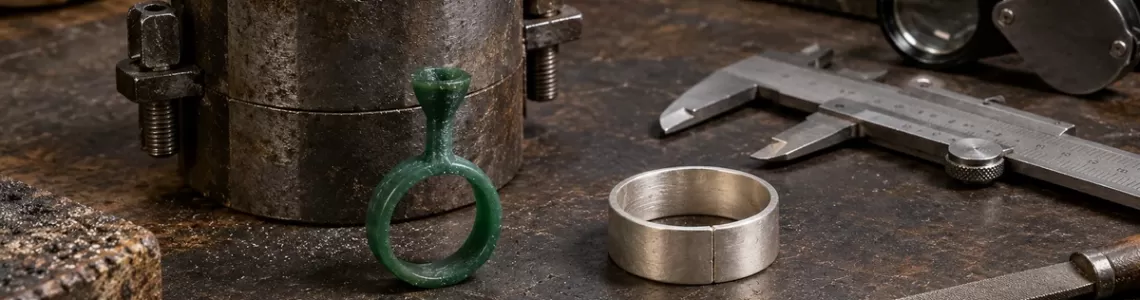
Cast and fabricated sterling-silver rings can both be well made, durable and genuinely 925 silver. The words describe different manufacturing routes, not automatic quality grades. A cast ring begins as a model and is reproduced in metal through a mold, while a fabricated ring is built by cutting, forming, joining and finishing metal stock such as sheet, wire or tube. Either route can produce excellent work, and either can show problems when design, process control or finishing is poor.
For a buyer, the useful questions are specific: Which parts were cast or fabricated? Are there soldered joints? Has the surface been intentionally textured? Were visible pits, seams or tool marks disclosed? Can the ring be resized or repaired? A 925 stamp mainly addresses fineness. It does not reveal manufacturing method, internal soundness, hardness, joint quality or the skill of the maker.
Cast versus fabricated in plain language
In lost-wax casting, a maker creates or reproduces a wax model, connects it to a channel called a sprue, surrounds it with investment material and removes the wax with heat. Molten metal enters the resulting cavity. After cooling, the investment is broken away, the sprue is removed and the metal ring is finished. The Metropolitan Museum's documentation of wax models and molds, and the Victoria and Albert Museum's overview of lost-wax casting, show why the process can reproduce forms that would be difficult to build from sheet and wire alone.
Fabrication starts with metal stock. A maker may saw a strip from sheet, bend it around a mandrel, bring the ends together, solder the joint, shape the band, add separate shoulders or a setting, then file and polish the assembly. Forging, bending, drawing, stamping, riveting and soldering can all appear within a fabricated piece. Some work is constructed without solder, while other rings contain several carefully planned joints.
Many rings are hybrids. A cast head may be soldered to a fabricated shank. A fabricated setting may hold a cast decorative element. A cast blank may be forged, engraved or assembled after casting. Marketing that reduces a complex ring to one word can therefore be incomplete even when it is not false. Ask which component the description covers.
Does casting mean mass-produced?
No. Casting is a process, not a production-volume label. A jeweller can carve one wax model, cast one ring and finish it by hand. A manufacturer can also reproduce the same model many times. The amount of hand work varies before and after the metal is cast. Digital modeling, molded waxes and direct carving are different routes to the model, but none of them alone tells you how carefully the metal was melted, poured, cooled, cleaned and finished.
Likewise, "handmade" is not a synonym for fabricated. The Federal Trade Commission's Jewelry Guides materials treat handmade and hand-wrought statements as representations about how an article was made. The exact legal meaning can depend on wording and jurisdiction. A seller should explain the process rather than expecting a broad adjective to carry every implication. If a listing says "handmade," ask whether that means hand-carved wax, hand fabrication from metal stock, hand finishing, or a combination.
Does fabrication mean stronger?
Not automatically. Mechanical working can change a metal's condition. Bending, rolling, hammering and drawing can work-harden sterling silver, while annealing and soldering heat can soften it again. The final hardness depends on alloy, thermal history, amount of deformation and any subsequent treatment. A fabricated band may contain work-hardened areas and softened areas near a solder operation. A cast ring may be further forged or heat treated after casting.
Geometry often matters more to daily wear than the process label. A thick, well-supported cast shank may resist deformation better than a very thin fabricated one. A fabricated band with a poorly fitted joint can fail at the seam, while a properly prepared and soldered joint can perform well. Our guide to why sterling-silver rings bend separates alloy, thickness, profile and load direction from simplistic manufacturing claims.
What a solder seam means
A solder seam is not automatically a defect. In traditional fabrication, joining the ends of a band is normal. Jewelry solder is designed to flow at a lower temperature than the pieces being joined. Correct preparation requires closely fitted surfaces, clean metal, appropriate flux, controlled heat and enough solder to fill the joint. The completed seam may be nearly invisible after finishing, but the solder and surrounding sterling can respond differently to oxidation, polishing or future heat.
A visible line can also have other causes: a prior resizing, a decorative boundary, plating wear, a casting parting line or a reflection. Do not diagnose a weak joint from one product photograph. Request a clear interior view and ask whether the ring has been resized or assembled. If a delivered seam is open, offset or surrounded by a crack, stop wearing the ring and document it rather than flexing it to "test" the joint.
Resizing frequently involves cutting and joining a shank, so even a ring that began as one casting can later contain a soldered or welded repair. The practical question is not whether any seam exists; it is whether the exact design, material and prior work allow a sound repair. See the sterling-silver ring resizing guide for the limits imposed by stones, finishes, engraving and construction.
What porosity means in casting
Porosity is a general term for voids in cast metal. Gas, shrinkage, incomplete feeding, temperature control, contamination and investment behavior can contribute to different pore patterns. Casting suppliers address these risks through material, sprue, melting, flask, temperature and cooling instructions. That process context does not allow a shopper to label every small surface mark as porosity.
A pit can be a casting pore exposed during finishing, but it can also be an intentional texture, a tool mark, a scratch, corrosion, plating loss or trapped polishing compound. Some internal porosity cannot be seen at all. A few photographs cannot measure its depth or structural effect. If a seller calls the surface intentionally rustic or sand-cast, ask for close images and a written description of what variation is expected.
Repeated pits concentrated near a thin section, a joint or a crack deserve professional assessment. Do not drill, file, acid-test or bend the ring to investigate. Destructive checking may enlarge damage and interfere with a return. A qualified jeweller may use magnification, cleaning, measurement and, when justified, specialized imaging to distinguish surface finish from a deeper problem.
Tool marks, texture and finishing
Fabrication can leave saw, file, hammer and forming marks. Casting can leave sprue-removal marks, investment texture and surface irregularities. Good finishing removes unwanted traces while preserving intentional detail and enough metal. Mirror polishing is not the only acceptable finish: brushed, hammered, oxidized and carved surfaces may deliberately retain texture.
Judge consistency against the listing. An intentionally hammered ring should have a coherent pattern rather than an isolated sharp gouge. A brushed finish should not hide an open seam. An oxidized recess can be intentional, while dark material emerging from a crack may indicate something else. The guide to oxidized silver versus tarnish explains why color alone is not a safe diagnosis.
Over-finishing creates its own risks. Aggressive grinding can thin a shank, soften edges or erase detail. Repeated polishing removes metal. A high shine therefore does not prove sound casting or careful fabrication, and a matte surface does not prove poor work. Compare dimensions, symmetry, edge comfort, joint closure and setting security together.
What a 925 mark can and cannot tell you
Sterling silver is conventionally 92.5 percent silver with the remainder made up of other metals. A 925 mark communicates a fineness claim for the represented silver material. Formal hallmarking systems may add sponsor, assay-office and date information, but the mark still does not identify whether a ring was cast, forged or fabricated.
A stamp also does not prove that a piece is free of pores, that a solder joint is sound, that every finding has the same composition, or that the ring is suitable for a particular use. Our comparison of a 925 stamp and a hallmark explains the difference between a simple fineness mark and a controlled hallmarking system.
Do not infer process from stamp shape or location. A maker can stamp fabricated stock before forming, stamp a cast ring after finishing, or use laser marking. If manufacturing method matters to you, obtain it as a separate written disclosure.
Questions to ask before buying
- Is the ring cast, fabricated from metal stock, or made with both methods?
- If it is cast, was the model hand-carved, molded, digitally produced or otherwise created?
- Which parts, if any, are soldered together?
- Has the sample shown in the photos been resized or repaired?
- Are pits, hammer marks, oxidation or irregular edges intentional features?
- What are the minimum shank thickness and width at the most vulnerable point?
- Can the exact design be resized, and what method would be used?
- What remedy applies if the delivered surface, seam or construction differs from the listing?
Save the listing and the seller's answers. Specific construction language is more useful than "artisan," "premium" or "hand-finished." If the process is unknown, record it as unknown rather than selecting the most attractive interpretation.
How to inspect the ring after delivery
Inspect on a padded, well-lit surface before regular wear. Photograph the top, profile, inside, underside, hallmark area and any visible joint. Compare the delivered finish with the listing. The post-delivery inspection guide provides a non-destructive sequence for settings, stones, shape and finish.
Look for symmetry, comfortable edges and a closed joint. A solder line that is visible under magnification is not necessarily open. An open seam usually shows separation, a catchable edge or movement; do not create movement by pulling on it. Check the lower shank for unexpected thinness and compare measurements only with an appropriate caliper used gently.
If the ring has stones, inspect prongs, bezels and seats independently of the metal-making method. A cast setting can be secure or insecure, and a fabricated setting can be secure or insecure. The guide to sterling-silver ring settings explains the different retention structures and what to observe without forcing the stone.
Stop before polishing, resizing or wearing the ring when the delivered construction materially differs from the written description, a seam is open, a crack extends from a pit, a setting moves, or a sharp edge creates a safety concern. Contact the seller with the saved description and photographs. Modification can erase evidence and affect return options.
Choosing between cast and fabricated rings
Choose for design, disclosure, dimensions and workmanship rather than treating one route as superior. Casting is useful for complex, sculptural or repeatable forms. Fabrication is useful for designs built from shaped stock, deliberate joints and forged or hammered elements. Hybrid construction often combines those advantages.
For frequent wear, prioritize a protected profile, adequate shank thickness, comfortable fit, secure setting, clear material scope and realistic repair path. Construction can influence how a repair is planned, but it does not replace inspection. A hollow cast head, for example, raises different questions from a solid cast band; review the hollow versus solid ring guide when internal geometry is also relevant.
The best listing makes uncertainty smaller. It tells you what the ring is made from, how major parts are made and joined, which surface features are intentional, and what happens if the delivered item differs. When those details are missing, ask before purchase rather than relying on a 925 stamp, price, shine or the word handmade.
Frequently asked questions
Are cast sterling-silver rings lower quality?
No. Casting can produce excellent rings. Quality depends on design, alloy control, spruing, melting, cooling, cleanup, finishing and inspection, not the process name alone.
Are fabricated rings always handmade?
No. Fabrication describes building from metal stock. Hand tools, machines, purchased components and automated steps can all be involved. Ask what the seller means by handmade.
Does a solder seam make a ring weak?
Not automatically. A well-fitted, correctly soldered joint is a normal part of many fabricated and resized rings. An open, misaligned or cracked joint requires assessment.
Can a 925 stamp tell me how a ring was made?
No. It is a fineness claim, not a manufacturing record. Cast, fabricated and hybrid rings can all carry 925 marks.
Is every tiny pit casting porosity?
No. A mark may be texture, a scratch, corrosion, plating loss, trapped compound or an exposed pore. Photographs alone may not distinguish them.
Can cast rings be resized?
Many can, but the answer depends on shank geometry, porosity, stones, coatings, engraving and previous work. The exact ring needs professional inspection.
Is a one-piece cast ring seamless?
It may begin without a soldered shank joint, but sprue removal and finishing still occur, and later sizing or assembly can add joints. One-piece does not mean process-free.
Which method is best for daily wear?
Neither method wins by default. Adequate dimensions, protected geometry, sound joints, controlled casting, secure settings and appropriate care matter more than the label.
References
- U.S. Federal Trade Commission: Jewelry Guides
- U.S. Federal Trade Commission: Jewelry Guides Statement
- Victoria and Albert Museum: Metalworking techniques
- Metropolitan Museum of Art: Ring mold and wax model
- Rio Grande: Types of silver metals for jewelry
- Rio Grande: Get started with soldering jewelry
- Rio Grande: Sterling-silver casting grain instructions
- UK Government: Hallmarking guidance summary
Leave a Comment