
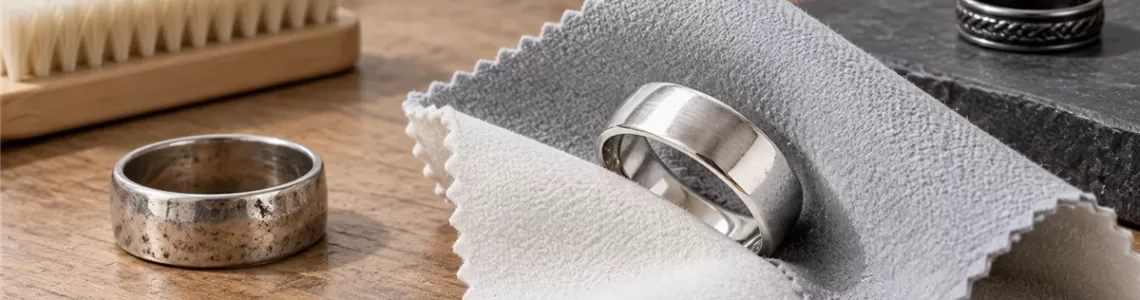
Use a silver polishing cloth only after you know what surface you are touching. A cloth can lift light tarnish and fingerprints from compatible sterling silver, but it is still a polishing tool: its treated or mildly abrasive layer removes material. On a plated, intentionally oxidized, brushed, engraved, stone-set or repaired ring, repeated rubbing can thin a coating, brighten dark recesses, round crisp details or leave an uneven patch.
The safest buyer rule is simple. Identify the metal, plating, finish, stones and previous repairs first; use the maker's approved method; work gently on a small compatible area; and stop when the cloth changes the finish rather than merely removing surface tarnish. Unknown construction is a reason to pause, not a reason to polish harder.
What a polishing cloth actually does
A jewelry polishing cloth is not the same as an untreated dusting cloth. Many silver cloths contain a fine polishing compound or tarnish-removing treatment. The cloth may look soft, but the cleaning action is mechanical, chemical or both. That action can be useful on an appropriate solid-silver surface, yet it is not lossless.
The Canadian Conservation Institute explains that polishing is abrasive and removes a small amount of metal along with tarnish. Frequent or vigorous polishing gradually changes a surface. On an object with plating, engraving, intentional patina or delicate details, the removed material may be part of the finish a buyer wants to preserve.
That is why a blackened cloth is not proof that a ring was dirty, fake or damaged. The dark transfer can include tarnish, polishing compound and material lifted from the surface. Judge the ring by verified construction and the visible result, not by the color left on the cloth.
Light tarnish is different from intentional oxidation
Silver tarnish commonly forms when silver reacts with sulfur-containing substances in the environment. It can appear yellow, brown, gray or black and may develop unevenly around edges, under a ring head and inside engraving. A light tarnish film on compatible plain sterling may respond to careful cloth polishing.
Intentional oxidation is a design finish. Makers often darken recesses to create contrast around a pattern, rope edge, skull, signet detail or texture. Rubbing those areas can erase the contrast and leave bright islands that no longer match the design. Before polishing a dark ring, compare the product photographs and read the guide to oxidized silver versus tarnish.
Do not use a cloth as an identification test. A dark area that stays in a recessed pattern may be deliberate; a dark area on a high point may be environmental tarnish; and a color change at an edge may reveal plating wear. If the listing does not say, ask the seller or a qualified jeweler before changing the surface.
Confirm solid sterling, plating and coatings
A 925 mark is a fineness claim, not a complete construction record. It does not tell you whether the ring is rhodium plated, gold plated, lacquered, selectively oxidized, repaired or made from several assembled parts. It also does not authenticate itself. The separate guide to 925 stamps and hallmarks explains what a mark can and cannot establish.
Plated sterling has an outer layer over the silver alloy. Polishing the outer surface may thin that layer, especially at corners, high points and the lower shank where wear is already concentrated. The Canadian Conservation Institute specifically cautions that plated surfaces are vulnerable to polishing. A result that looks brighter for one session can accelerate visible boundary lines between intact and worn coating.
Ask whether the ring is rhodium plated, gold vermeil, gold plated, lacquered or otherwise coated. Follow the exact care instructions for that construction. The guides to rhodium-plated silver and vermeil versus gold-plated silver separate the surface layer from the sterling substrate.
Polished, satin and brushed finishes need different expectations
A mirror-polished band is designed to reflect sharply. A satin or brushed band uses controlled directional texture to soften reflection. Rubbing a treated cloth back and forth across a satin surface can create a bright patch or cross-grain marks, even when the metal itself is compatible with silver polishing.
Do not try to recreate a brushed finish with a kitchen scouring pad, abrasive paper or random compound. The abrasive grade, direction and pressure determine the result, and an uneven home repair can be harder to correct than the original mark. For finish-specific expectations, use the guide to polished versus satin sterling-silver rings.
Normal wear scratches are also not proof that silver is low quality. Sterling is a workable jewelry alloy, and a polished ring can show small marks quickly. A cloth may reduce the appearance of very fine haze, but it will not safely erase every scratch. The guide to sterling-silver scratches and care explains when to accept wear and when to seek professional refinishing.
Engraving, relief and recesses can trap residue
Engraved letters, cast relief, rope borders and textured shoulders create high and low areas. Polishing pressure naturally concentrates on the high points. Repeated work can soften edges while leaving compound in the recesses. The Canadian Conservation Institute warns that polish residues can lodge in decoration and become difficult to remove.
Do not push compound into a pattern with a pin, metal pick or stiff brush. Do not rub until every dark recess matches the bright top surface; that dark contrast may be intentional. If residue is already packed into details, stop and ask a jeweler for a finish-appropriate cleaning method.
Photograph the ring before care. Include the face, shoulders, lower shank, inside marks and any seam under neutral light. A baseline helps distinguish an existing casting texture, solder line or darkened recess from a change caused by polishing.
Stones, inlays and settings create separate limits
A cloth approved for silver is not automatically approved for every stone or inlay. Fine polishing particles can haze a softer material, collect around a bezel, catch on a prong or leave residue near an adhesive. Porous, organic, coated, filled or dyed materials may have care limits unrelated to the silver shank.
Keep the treated portion of a cloth away from unknown stones and decorative inserts. Do not pull a cloth across raised prongs, because fibers can snag and reveal or worsen a loose tip. If a stone moves, a bezel edge lifts, a setting rattles or an inlay has a gap, stop before cleaning. The guide to gemstone durability explains why hardness alone is not a cleaning approval.
When a ring combines metal and stones, ask for instructions for the complete ring. A method that is gentle to sterling can still be wrong for a pearl, turquoise, opal, enamel, resin inlay, fracture-filled stone or glued component. Do not infer treatment status from a marketing name or appearance.
A conservative cloth-polishing method
- Read the listing and care card. Confirm sterling content, plating, coating, intentional oxidation, finish, stones and inlays.
- Inspect before cleaning. Stop for a loose stone, lifted edge, crack, split seam, flaking coating or unknown repair.
- Separate treated and untreated cloths. Use a clean untreated soft cloth for dust and fingerprints; reserve the silver cloth for compatible exposed metal.
- Test a small inconspicuous area. Use light pressure and a few controlled strokes rather than rapid back-and-forth rubbing.
- Protect the design. Avoid plated areas, darkened recesses, satin texture, stones, inlays, enamel and adhesives unless the maker expressly approves the cloth.
- Inspect after each short pass. Stop if color, texture, edge definition or coating changes.
- Remove loose residue conservatively. Follow the cloth and ring makers' instructions; do not add household chemicals or force residue deeper into details.
- Store the ring dry and separately. Prevention reduces the need for repeated polishing.
This is a decision framework, not a universal recipe. If the ring maker gives different instructions, follow the piece-specific guidance. If any material is unknown, use an untreated soft cloth only for loose dust and fingerprints until a professional identifies a safe method.
What not to combine with a polishing cloth
Do not add toothpaste, baking soda, scouring powder, metal polish, silver dip, bleach, ammonia or an improvised chemical mixture. These products have different abrasive and chemical actions, and combining them makes the result harder to predict. Never mix household cleaners.
Do not polish a wet ring unless the product instructions specifically require it. Moisture can carry compound into seams and under settings. Do not chase a stain with increasing pressure. A persistent dark area may be deep tarnish, intentional oxidation, fire stain, plating loss, solder color or a different material.
Do not use the cloth on a ring immediately after hand sanitizer, lotion, sunscreen or household chemical exposure without first following the maker's cleaning guidance. Residue can alter friction and spread across the surface. The guide to hand sanitizer and sterling-silver rings provides a separate exposure checklist.
When professional refinishing is the better choice
A jeweler can examine the ring under magnification, identify obvious plating or intentional contrast, check settings and choose a finish-specific process. Professional service is especially useful for deep scratches, uneven satin texture, worn plating, damaged oxidation, packed residue, stone-set rings and pieces with previous soldering or resizing.
Ask what will be removed, what will be preserved and whether plating or oxidation will need renewal. Refinishing changes a surface; it is not simply a stronger version of wiping. If crisp engraving, maker marks or historic wear matter, say so before work begins.
Give the jeweler any care card, product listing, laboratory report and repair history. The goal is not maximum brightness. It is a stable, consistent finish that preserves the ring's construction and design.
Ask for realistic expectations before authorizing work. Deep marks may remain if removing them would thin the shank or soften an edge. Replating may restore a coating but will not identify why the original layer wore quickly. Re-oxidizing a design can restore contrast, yet the result may not exactly match old product photographs. A careful service decision balances appearance with the amount of original material and detail that should remain.
Storage can reduce how often polishing is needed
Because sulfur-containing gases and materials contribute to silver tarnish, good storage matters. Keep a clean, dry ring in a closed container made from jewelry-safe materials, separate from pieces that can scratch it. Avoid rubber, unknown foam, newspaper and sulfur-emitting storage materials.
Remove lotion, sweat and ordinary surface residue using the maker-approved method before storage. Let the ring dry fully. Do not seal a damp ring in a plastic bag. Anti-tarnish products can help in suitable closed storage, but they do not make an incompatible polishing method safe.
Prevention is valuable because every polishing session has a material cost, even when that cost is small. Less tarnish means fewer interventions and a lower chance of gradually changing plating, texture, relief or intentional patina.
Review stored rings periodically instead of waiting for heavy discoloration. If one ring tarnishes much faster than the others, inspect the box, inserts and nearby materials rather than immediately increasing polishing frequency. A storage problem should be corrected at its source.
Buyer questions to save with the listing
- Is the ring solid sterling throughout, or is it plated, coated, lacquered or selectively oxidized?
- Is the finish mirror polished, satin, brushed, hammered, antiqued or a combination?
- Are any areas intentionally darkened?
- What are all stones, inlays and decorative materials, and are any glued or treated?
- Has the ring been resized, soldered, repaired or replated?
- Which exact polishing cloth or care method is approved?
- Which areas should not be rubbed?
- What changes indicate plating wear or a need for professional service?
Save the answers, listing photographs and receipt. The post-delivery ring inspection guide gives a non-destructive baseline checklist before any care attempt.
Frequently asked questions
Can I use a silver polishing cloth on every 925 ring?
No. A 925 mark does not reveal plating, coating, intentional oxidation, stones, adhesives, finish or repair history. Confirm the complete construction and follow the maker's instructions first.
Why does a polishing cloth turn black?
The transfer can include tarnish, polishing compound and material removed from the surface. The black color does not authenticate the ring or prove that more rubbing is needed.
Will a polishing cloth remove scratches?
It may reduce very fine surface haze on a compatible polished surface, but deeper scratches and controlled satin finishes need finish-specific assessment. Aggressive rubbing can create an uneven bright patch.
Can a polishing cloth remove intentional oxidation?
Yes, rubbing can brighten intentionally darkened high points or recesses and reduce contrast. Treat an unknown dark finish as a reason to pause.
Is a polishing cloth safe for rhodium-plated sterling silver?
Not automatically. Polishing can thin plating, especially on edges and worn areas. Use only the method approved for the exact plated ring.
Can I polish around gemstones?
Only when the maker confirms compatibility. Keep treated compound away from unknown stones, inlays, adhesives and loose settings, and avoid snagging prongs.
Should I wash a treated polishing cloth?
Follow the cloth maker's instructions. Washing can remove the treatment from some products, while reusing a contaminated cloth can transfer grit. Replace it when the manufacturer recommends.
When should I stop and see a jeweler?
Stop for flaking or color change, exposed coating boundaries, a loose stone, lifted bezel, crack, split seam, packed residue, altered texture, unknown darkening or any conflict between care instructions.
References
- Canadian Conservation Institute - Caring for metal objects
- Canadian Conservation Institute - Silver: Care and Tarnish Removal
- Canadian Conservation Institute - How to Make and Use a Precipitated Calcium Carbonate Silver Polish
- Canadian Conservation Institute - Understanding how silver objects tarnish
- Gemological Institute of America - How to Clean Jewelry
- U.S. Federal Trade Commission - Buying Platinum, Gold, and Silver Jewelry
Leave a Comment