
Polished vs Satin Sterling Silver Rings: Finish, Wear and Care
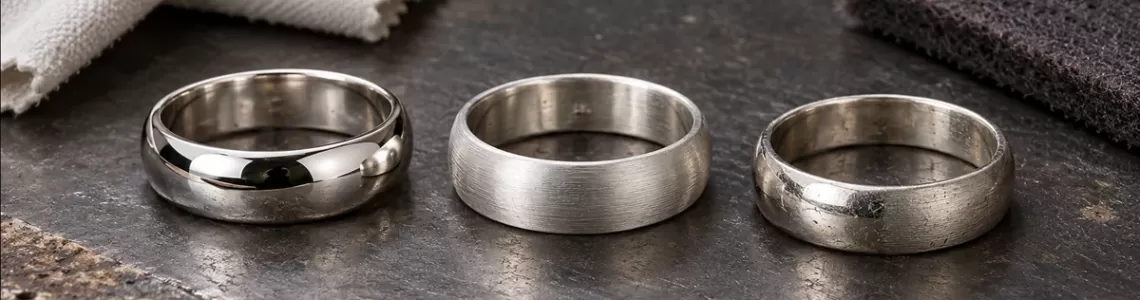
Polished and satin sterling-silver rings can use the same alloy and construction yet look very different because their surfaces reflect light differently. A polished finish produces clearer reflections and tends to show isolated scratches, fingerprints and tarnish contrast. A satin finish uses fine directional or diffuse texture to soften reflections, so everyday marks may blend at first, although rubbing can gradually create brighter patches. Neither finish is automatically more authentic, durable or valuable. The useful buyer questions are how the finish was described, how evenly it was applied, how it will change with wear and whether cleaning could alter it.
Polished versus satin: the short answer
A mirror-polished ring has been refined through progressively finer abrasives and buffing until the surface reflects its surroundings. A satin ring is intentionally given a fine, low-luster texture, often with an abrasive pad, brush or wheel. Rio Grande's finishing guidance distinguishes these outcomes: polishing wheels can produce a high or mirror shine, while abrasive pads can create a satin surface. That describes a finishing method, not a purity test. Rio Grande: Working With Fine Silver.
Both finishes can acquire scratches because silver is a relatively soft metal. The Canadian Conservation Institute notes that silver is vulnerable to scratching and abrasion. A finish changes how marks are seen; it does not make the underlying metal immune to contact. Canadian Conservation Institute: Metal Objects.
How a polished finish looks and wears
On a well-polished ring, the surface acts more like a small curved mirror than a white metal strip. Bright highlights have clear edges, dark surroundings appear as dark reflections, and the transitions move when the ring is turned. This high contrast is why polished silver often looks crisp in product photographs.
The same contrast makes individual scratches easy to notice. A new hairline mark interrupts an otherwise continuous reflection. Fingerprints, skin oils and tarnish can also appear as patches because the surrounding surface is so reflective. This does not necessarily mean that a polished ring is wearing faster than a satin one; it means the visual evidence is less concealed.
With repeated contact, many fine marks can accumulate into a softer overall sheen. High points may remain brighter, while protected recesses tarnish or retain the original polish differently. The sterling-silver scratch and care guide explains why a cosmetic line should be separated from a crack, deep gouge or structural problem.
How a satin finish looks and wears
A satin finish scatters light through many fine surface lines or a uniform diffuse texture. It should look intentional and reasonably consistent, not randomly damaged. On a directional satin, the lines generally follow a deliberate path around or along the band. On a more diffuse satin, the reflection is soft without a strong visible grain.
Fresh minor marks can blend into this texture better than they do on a mirror surface. That is a visual advantage, not scratch resistance. Contact with desks, tools, handlebars, door hardware or other jewelry still changes the surface. Repeated rubbing can smooth the fine texture at the highest points, producing brighter areas. A deep cross-grain scratch can remain conspicuous because it cuts across the intended pattern.
Satin is also different from tarnish or intentional oxidation. Tarnish is a chemical surface change; a satin texture is created mechanically. Intentional darkening may be combined with polished or satin areas, but it should be described separately. Use the oxidized silver versus tarnish guide before assuming that every dark or matte area has the same cause.
Neither finish proves sterling silver
The U.S. Federal Trade Commission explains that sterling silver and the 925 mark refer to 925 parts silver per thousand. Surface shine is not part of that definition. Base metals can be polished, plated objects can look bright, and genuine sterling silver can be satin, oxidized, hammered or deliberately antiqued. FTC: Buying Platinum, Gold, and Silver Jewelry.
A finish therefore cannot authenticate a ring from a photograph. Check the written material disclosure, maker or responsibility mark where relevant, complete hallmarking context, return terms and any independent assay evidence offered by the seller. The 925 stamp versus hallmark guide explains why a single numeral and a complete hallmark are not interchangeable.
Likewise, a mirror finish does not prove high workmanship by itself. Strong lighting, image retouching and a strategic camera angle can hide waviness, pits or incomplete finishing. A satin finish can also conceal small casting or preparation defects. Judge the consistency of the whole ring, including the inside, edges, joins and lower shank.
What product photographs can and cannot show
A useful listing should include at least one neutral-light photograph, a side view, an interior view and a close image of the finish. For polished rings, look for continuous reflection rather than isolated bright spots created by direct flash. Distorted reflections may be caused by the ring's curvature, but abrupt ripples can also reveal uneven preparation. For satin rings, look for a consistent grain and for clean transitions where polished and matte zones meet.
Photographs cannot reliably prove silver fineness, the depth of a plated layer, the remaining wall thickness or how the finish will look under your lighting. They also cannot tell you whether a seller will refinish the ring after wear. Ask for those details in writing and save the response with the listing.
When the ring arrives, inspect it before wearing, cleaning or resizing it. The after-delivery inspection guide provides a sequence for checking the setting, stones, finish, dimensions and condition while return evidence is still intact.
Why preparation matters before either finish
A finish is only the last visible stage of a longer surface-preparation process. Casting texture, file marks, solder residue, pits and earlier abrasive scratches generally need to be corrected before the final polish or satin texture is applied. Putting a fine finish over coarse defects does not remove them; it may make them more obvious.
GIA's quality-assurance benchmark for platinum describes polishing as a controlled sequence that moves from coarser to finer abrasives and requires cleaning between stages. The material in that benchmark is platinum, so it is not a silver-specific care instruction. It is useful as a workmanship principle: a consistent final surface depends on disciplined preparation rather than one quick buff. GIA: Prefinish, Polish and Buff Benchmark.
Construction can influence how safely a ring is refinished. Thin walls, sharp relief, soldered assemblies, soft stones, plating and intentional oxidation all need separate consideration. Read the cast versus fabricated ring guide and the hollow versus solid guide before treating every band as a simple solid surface.
Does satin hide scratches better?
Often, but only within limits. A fine mark that follows an existing satin grain may be less visible than the same mark on a mirror polish. A deep groove, flattened patch or cross-grain line can still stand out. Meanwhile, a polished ring may show each early mark clearly, but many fine marks can eventually blend into a natural patina.
This is why “scratch resistant” is usually the wrong promise for either finish. The contact pattern matters. Rings worn beside another ring may rub along a narrow repeated line. Desk work can polish or mark one lower section. Lifting weights, using tools or handling abrasive materials can create deeper and less predictable damage. Remove the ring when an activity can trap, bend or deeply abrade it; finish preservation is secondary to finger safety and structural condition.
Cleaning without unintentionally changing the finish
Start with the least aggressive method allowed by the maker: a clean, very soft cloth and, when product-specific instructions permit, mild soap in lukewarm water followed by thorough rinsing and drying. Avoid assuming that a product sold as “silver polish” is neutral. Polishes work through chemical action, abrasion or both, and can remove material.
The Canadian Conservation Institute states that polishing removes some silver and that the scratch pattern can depend on the polish and the operator. That is why repeated polishing should not be routine merely to chase a factory-new look. Canadian Conservation Institute: Silver - Care and Tarnish Removal.
On satin silver, rubbing with a polishing cloth can brighten the high points or create a local glossy patch. On a polished ring, a coarse pad can replace the mirror surface with visible directional scratches. Do not use toothpaste, kitchen scouring pads or an unknown abrasive. If the ring combines silver with stones, enamel, resin, wood, pearl, plating or intentional oxidation, follow the limits of the most sensitive component.
Can polished be changed to satin, or satin to polished?
In many plain-metal rings, a competent jeweler can change one finish to the other. The decision is not purely cosmetic. Converting to satin intentionally abrades the surface to create a consistent texture. Converting to a mirror finish requires removing the satin texture and progressively refining the surface. Both processes remove some material, and repeated cycles can soften edges, lettering or relief.
A jeweler should first identify the construction, plating, stones, soldered elements and any intentional oxidation. A plated ring may reveal a different underlying layer if aggressively refinished. A ring with crisp engraving or a stamped border can lose definition. A hollow piece or thin lower shank may have less margin for repeated work.
Tiffany's sterling-silver care guidance similarly warns that overzealous cleaning can remove an oxidized finish and recommends careful polishing and dry storage. That advice is maker-specific, but the boundary is broadly useful: cleaning and refinishing can change an intentional surface. Tiffany & Co.: Sterling Silver Care.
What to ask before buying
- Is the finish mirror polished, satin, brushed, bead-blasted, hammered, oxidized or a combination?
- Is the texture directional, and should small variations be expected?
- Does the finish cover the inside and edges or only the visible exterior?
- Is the ring solid sterling silver, plated, hollow, open-back or multi-part?
- Are stones, inlays, engraving or darkened recesses sensitive to polishing?
- What cleaning method does the maker authorize?
- Can the seller or maker restore the original finish, and what details may soften during refinishing?
- Will a finish change affect returns, warranty or personalization terms?
For a fair comparison, use listings with similar geometry and construction. A satin wide band and a polished narrow band do not differ only by finish. The sterling-silver ring weight guide explains why size, width, thickness and construction must be controlled before interpreting another measurement.
How to live with normal finish evolution
A worn ring will not remain visually identical to a studio photograph. Polished silver gains hairlines and may become softer in appearance. Satin silver can develop brighter high points and irregular contact zones. Tarnish can add another layer of contrast. These changes are normal surface history when they are gradual and not accompanied by cracks, open seams, severe dents, looseness or distortion.
Choose the finish whose changing appearance you can tolerate, not merely the one that looks best on day one. If you prefer crisp reflections and are comfortable with visible hairlines, polished may suit you. If you prefer low glare and a texture that initially blends minor marks, satin may suit you. If preserving a precise factory finish is essential, confirm a professional restoration path before buying.
Frequently asked questions
Is a satin sterling-silver ring less likely to scratch?
No. Satin texture can make some fine marks less obvious, but the underlying silver is still vulnerable to abrasion. Deep or cross-grain scratches may remain highly visible.
Can a polished ring be changed to satin?
Often, yes, especially on a plain solid-metal band. A jeweler should first check plating, stones, engraving, thin walls, soldered parts and intentional oxidation because refinishing can affect them.
Can a satin ring be polished to a mirror?
Often, but removing the existing texture requires progressive abrasion and polishing. The process removes some material and can soften sharp edges or details if repeated.
Does a shiny or satin surface prove the ring is sterling silver?
No. Finish is not a fineness test. Use the written material claim, appropriate marks, seller evidence and, when necessary, professional testing.
How should I clean a satin ring without making it shiny?
Follow the maker's instructions and begin with the least aggressive method. Avoid polishing cloths or abrasive compounds unless they are specifically approved for that finish, because localized rubbing can brighten the texture.
How often should sterling silver be polished?
There is no universal schedule. Polish only when needed and when the ring's construction and finish permit it. Tiffany notes that polishing removes metal and should be limited, while museum guidance also stresses conservative treatment. Tiffany & Co.: How Often Should You Polish Silver?
References
- Canadian Conservation Institute: Metal Objects - Preventive Conservation Guidelines
- Canadian Conservation Institute: Silver - Care and Tarnish Removal
- U.S. Federal Trade Commission: Buying Platinum, Gold, and Silver Jewelry
- Gemological Institute of America: Prefinish, Polish and Buff Benchmark
- Rio Grande: Working With Fine Silver
- Rio Grande: Guide to Mass Finishing
- Tiffany & Co.: How Do I Care for Sterling Silver?
- Tiffany & Co.: How Often Should You Polish Silver?
Evidence boundary: These sources support general principles about silver fineness, surface finishing, abrasion and conservative care. They do not assay or authenticate any ring sold by this store, guarantee how long a finish will last, or replace maker-specific instructions and a jeweler's examination of a particular piece.
Leave a Comment