
Sterling Silver Ring Weight: What Grams Can and Cannot Tell You
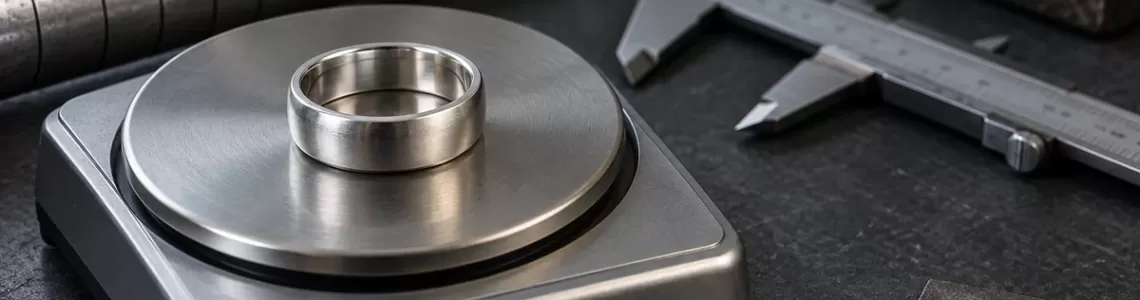
A sterling-silver ring's weight can help you compare two genuinely similar rings, but grams alone cannot prove purity, solid construction, durability or value. Mass changes with ring size, width, thickness, profile, hollow spaces, stones, inserts, solder and finishing. The useful buyer question is therefore not "Is this ring heavy enough?" but "What exactly is being weighed, and are the comparison conditions the same?"
What does a ring's gram weight measure?
A seller who lists a ring at a certain number of grams is reporting mass. The National Institute of Standards and Technology identifies the gram, symbol g, as a named submultiple used for mass. That makes grams a sensible unit for a small object such as a ring, but the unit itself says nothing about material quality. NIST: SI Units - Mass.
A complete weight disclosure should also state whether the figure is exact, approximate or an average; which ring size was weighed; and whether stones, moving bands or removable inserts are included. A size 13 ring ordinarily contains more material than the same design in size 8 if other dimensions remain equal. A wide or thick ring can also weigh more than a narrow one even when both use the same alloy.
Product photography is a poor substitute for those details. Perspective, crop and surface reflection can make a thin wall look substantial. Ask for interior, side and edge photographs plus actual dimensions. The ring-size chart guide explains why a size label must be connected to diameter or circumference before two listings can be compared.
Why the same outer look can produce different weights
Mass depends on both material density and the volume of material present. The Royal Society of Chemistry reports a density of about 10.5 grams per cubic centimetre for pure silver. A U.S. Geological Survey reference gives 10.49 g/cm3 for annealed pure silver at room temperature. These values help explain why more silver volume generally means more mass. They are not a formula for authenticating a finished sterling ring. Royal Society of Chemistry: Silver. USGS: Silver.
Sterling silver is an alloy, not pure silver. The exact alloying metals, soldered areas, porosity, cavities and non-silver parts can change the finished piece's average density. Even two rings with the same outside diameter and width can differ because one has a thicker shank, a deeper interior curve, a raised face, an undercut gallery or a hidden hollow section.
This is why an isolated internet claim such as "a real men's ring should weigh at least X grams" is unreliable. It ignores size and geometry. It can also encourage buyers to mistake unnecessary bulk for better workmanship. A comfortable, well-made ring can be lighter by design, while a heavy ring can still have poor joins, sharp edges or inaccurate material claims.
Control size, width and thickness before comparing grams
Useful comparison starts with matching the variables that change volume. Check the delivered ring size first. Then compare band width, minimum shank thickness, maximum face dimensions and inside profile. If one listing supplies only a top-view diameter, there is not enough information for a controlled weight comparison.
Width also affects fit. A broad band can feel tighter than a narrow band in the same nominal size because more skin is covered and less room remains for movement. A heavier ring may therefore need different fit consideration, but mass itself does not tell you whether the ring will pass the knuckle or sit securely. Use the wide-band fit guide for that separate question.
Thickness should be measured where it matters. A signet-style ring may be thick at the face and thin at the lower shank. A seller's single maximum thickness can hide the point most likely to flex or wear. Ask for a minimum shank thickness and, where relevant, a cross-section or side photograph. The guide to why sterling-silver rings bend explains why geometry and condition matter more than a simple heavy-versus-light label.
Hollow, solid and open construction
A hollow ring can have a large visual presence with less metal than a solid ring of similar outer dimensions. Hollow construction is not automatically deceptive or defective. It becomes a buyer problem when the listing allows a solid construction to be assumed, fails to disclose a sealed cavity or does not explain care limits.
Open-back signet faces, pierced shoulders and undercut relief also remove material without creating a sealed hollow body. These designs should not all be grouped together as "lightweight." Each construction has different inspection points. Look for wall thickness, accessible openings, seams, vents and areas where pressure could dent or distort the ring.
Weight can support a seller's construction description only when dimensions and size match. It cannot reveal every cavity or tell you whether a seam is sound. Read the hollow versus solid ring guide before treating grams as proof.
Cast, fabricated and multi-part rings
Cast and fabricated rings can both be durable when properly designed and finished. A casting can contain variable wall thickness or porosity; a fabricated ring can contain soldered joins and assembled components. Neither route has a universal weight advantage.
Multi-part designs add another complication. A spinner ring may include a fixed base and one or more captured outer bands. A signet may have a separate top. An inlay ring may combine silver with stone, wood, enamel or resin. The reported total may be accurate while the mass of silver alone remains unknown.
Ask whether the weight includes every component and whether the parts use the same metal. The cast versus fabricated guide covers process evidence, while the spinner-ring guide explains why moving components must also be judged for fit and clearance.
Stones, inlays and internal fillers can dominate the number
A stone-set ring should not be compared by total grams with a plain silver band. Gemstones and imitation materials have their own densities, and a large setting can contain less silver than its outline suggests. Resin, enamel, wood, ceramic, glass and base-metal inserts can move the total in either direction.
Do not subtract a guessed stone weight from the total. Without measured component data, the result is speculation. Instead, ask the seller for the ring's material breakdown, whether the listed weight includes the stone or insert, and whether the figure varies by size.
Hidden filler is a separate issue from a legitimate non-silver component. A clearly disclosed inlay is part of the design. Undisclosed weighting or filling may affect the material description and, in some jurisdictions, hallmarking treatment. Buyer evidence should preserve the exact listing language rather than trying to diagnose construction from a kitchen scale.
What 925 and a hallmark prove
The U.S. Federal Trade Commission explains that the words sterling and sterling silver describe products containing 92.5% pure silver, and that such products may be marked 925. That is a fineness claim: 925 parts per thousand are silver. It is not a claim that the ring is solid, a particular weight, free of solder, made by one process or guaranteed against bending. FTC: Buying Platinum, Gold, and Silver Jewelry.
In the UK, a complete hallmark contains a sponsor's mark, a fineness mark and an assay-office mark. Government guidance says the hallmark independently verifies precious-metal fineness and notes that silver articles below 7.78 grams are exempt from compulsory hallmarking. That threshold belongs to UK hallmarking law. It does not mean a 7.7 g ring is low quality, fake or legally unmarketable everywhere else. British Hallmarking Council: Hallmarking Practical Guidance.
The Goldsmiths' Company Assay Office further explains that the millesimal fineness mark states precious-metal content in parts per thousand and recognizes 925 as a silver fineness. A lone 925 numeral is still not the same thing as a complete UK hallmark. Goldsmiths' Company Assay Office: What Is a Hallmark?
Use weight and marks as different pieces of evidence. The 925 stamp versus hallmark guide explains the distinction in more detail.
How to compare two online listings fairly
Start by writing down the variables rather than ranking the gram figures immediately. A useful listing comparison includes:
- the exact ring size connected to the stated weight;
- whether the weight is exact, approximate or an average;
- band width, minimum shank thickness and maximum face dimensions;
- solid, hollow, open-back or multi-part construction;
- plain metal versus stones, inlays, enamel or moving bands;
- sterling-silver disclosure for each significant component;
- plating, intentional oxidation or other surface finishes;
- the seller's measurement tolerance and return process.
Only after those fields match does the difference in grams become easier to interpret. Even then, it is evidence of a difference, not its cause. Ask the seller to explain a large unexplained gap instead of inventing a hidden construction story.
When a listing says "approximately" or provides a range, confirm whether variation is caused by size, hand finishing or natural inserts. Save the answer with the order. A screen capture of the exact measurements and materials is more useful in a delivery dispute than a general claim that the ring felt too light.
Weighing a delivered ring without overclaiming
A home scale can check whether the delivered mass is broadly consistent with the listing, but it is not an assay instrument. Place the scale on a stable, level surface, follow its calibration instructions, keep the ring clean and dry, and weigh only the ring. Remove packaging, tags and detachable parts unless the listing clearly included them.
Record the scale model, displayed resolution and repeated readings. Do not report more precision than the display provides. A scale that shows whole grams cannot establish a difference of tenths of a gram. Temperature, vibration, an unlevel surface and low battery can also affect a small reading.
If the result differs from an approximate listing, check ring size and included components before alleging misrepresentation. Ask which size the seller's reference weight covered and what tolerance applies. If the difference remains material, preserve photographs and contact the seller before polishing, bending, resizing or otherwise changing the ring.
Weight does not measure workmanship or condition
A heavy ring can still have an uneven interior, porous casting, rough joins, a weak lower shank or a loose setting. A lighter ring can be intentionally engineered with a comfortable interior and adequate wall thickness. Visual and tactile inspection remain necessary.
Check for symmetry, roundness, sharp edges, cracks, open seams, loose stones and finish inconsistencies. The after-delivery inspection guide provides a sequence that does not depend on weight. If the ring is polished, remember that repeated abrasive treatment removes material; the Canadian Conservation Institute recommends examining construction, plating and decoration before choosing a silver treatment. Canadian Conservation Institute: Silver - Care and Tarnish Removal.
Normal wear can change surface appearance without producing a meaningful scale difference. The scratch and finish guide explains why cosmetic marks and structural damage should be evaluated separately.
A buyer checklist for ring weight
- Ask which ring size the gram figure represents.
- Confirm whether the number is exact, approximate or averaged.
- Compare width, minimum thickness, face dimensions and inside profile.
- Ask whether construction is solid, hollow, open-back or multi-part.
- Confirm whether stones, inlays and moving components are included.
- Read 925 as a fineness claim, not a weight or workmanship guarantee.
- Apply hallmarking thresholds only in the correct jurisdiction.
- Save the listing, seller explanation and return terms before ordering.
- On delivery, inspect construction and condition as well as mass.
The strongest listing does not rely on a single heavy-sounding number. It connects weight to size, dimensions, construction and materials, then gives the buyer a practical tolerance and return path.
Frequently asked questions
What is a good weight for a men's sterling-silver ring?
There is no universal good weight. Size, width, thickness, profile, construction and non-silver components all change the total. Compare grams only after those variables match.
Does a heavier ring contain more silver?
Not necessarily. It may contain more material, but stones, base-metal parts, inserts, solder or filler can contribute to total mass. Written component disclosure is needed.
Can weight prove that a ring is solid sterling silver?
No. A scale cannot reveal every cavity, alloying metal, soldered part or insert. Weight can flag an unexplained difference in a controlled comparison, but it is not an assay.
Does 925 mean the ring should have a certain gram weight?
No. 925 is a fineness claim indicating 925 parts silver per thousand in the alloy. It does not set the ring's dimensions, construction or total mass.
Why do two sizes of the same ring have different weights?
A larger size normally requires more circumference and therefore more material if the cross-section stays similar. Hand finishing, stones and construction tolerances can add further variation.
Is a ring under 7.78 grams fake?
No. The 7.78 g figure is a UK threshold for compulsory silver hallmarking, not a global authenticity or quality cutoff. Lighter genuine sterling-silver rings exist.
References
- National Institute of Standards and Technology: SI Units - Mass
- Royal Society of Chemistry: Silver - Element Information, Properties and Uses
- U.S. Geological Survey: Silver
- U.S. Federal Trade Commission: Buying Platinum, Gold, and Silver Jewelry
- British Hallmarking Council: Hallmarking Practical Guidance
- Goldsmiths' Company Assay Office: What Is a Hallmark?
- Canadian Conservation Institute: Silver - Care and Tarnish Removal
Leave a Comment