
Sterling Silver Spinner Rings: Fit, Movement and Buyer Checks
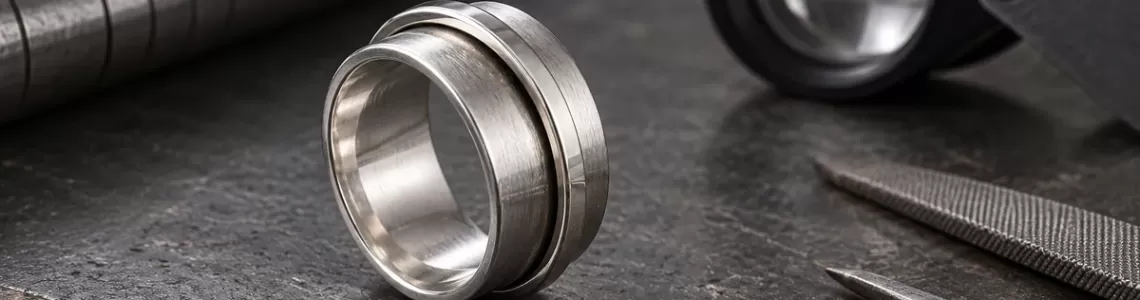
A sterling-silver spinner ring is a two-part moving design, not a plain band with decoration painted on. A fixed inner band sits on the finger while one or more outer bands rotate around it. Good buying checks therefore cover two separate questions: whether the inner band fits securely and whether the moving band has even clearance without scraping, catching or lifting. A 925 mark can describe silver fineness, but it does not guarantee smooth movement, a particular service life or a medical benefit.
What is a spinner ring?
A spinner ring, sometimes called a spinning, motion or kinetic ring, normally has a broad base band and a narrower outer band that can turn around the base. The moving band is retained by raised edges, flared rims or another captured geometry. It should remain attached during ordinary handling, yet have enough clearance to move.
That definition is about construction. It does not prove which metal is used, how the parts were made, whether the ring is solid or hollow, or how freely a particular sample will spin. Product photographs can also hide the side profile that reveals how the outer band is retained. Ask for front, side, inside and edge views rather than relying on one face-on image.
Some sellers call any rotating ring a "fidget ring" and may attach broad relaxation or anxiety claims. Movement can be tactile, but a jewelry listing is not clinical evidence. This guide evaluates fit, construction, disclosure and care. It does not diagnose a condition or promise a therapeutic result.
Fit the inner band before judging the spinner
The inner band determines whether the ring can pass over the knuckle and sit safely at the base of the finger. Spinner rings are often wider than a simple band because the base must support the moving part. A familiar size label can therefore feel tighter than expected.
The Gemological Institute of America recommends professional measurement and notes that wide shanks usually need special sizing consideration. It also advises that a ring should pass over the knuckle without falling off during normal activity. Those principles apply to the stationary base band; they do not create a universal size conversion for every spinner design. GIA: How to Determine Ring Size.
Before ordering, ask for the inner diameter or circumference, total ring width, inner-band width and inside profile. If the interior is curved or described as comfort fit, do not assume that it equals a larger standard size. Compare the seller's actual measurements with the ring-size chart guide and the explanation of why wide bands can feel tighter.
A ring that is too loose may rotate as a whole even when the outer band works perfectly. A ring that is too tight can be difficult to remove and can make finger swelling more important. Do not use resistance in the spinner as a substitute for checking the base fit.
How the moving band should behave
A new spinner does not need to rotate for a dramatic number of seconds. The useful checks are more basic: the outer band should stay captured, move without a sharp catch, and maintain reasonably even spacing around the ring. The exact feel can vary with width, texture, finish, edge shape and manufacturing tolerances.
- Even clearance: inspect both edges while slowly rotating the outer band. One tight point can indicate debris, an uneven rim or distortion.
- Retention: the moving band should not climb over a retaining edge or reveal a gap that looks capable of releasing it.
- No sharp contact: a faint sound is not automatically damage, but scraping that leaves fresh bright lines or metal dust deserves inspection.
- No wobble that exposes an edge: some side play may be part of the design; a lifted or tilted band that catches skin or fabric is different.
- Independent movement: rotate the outer band while holding the base. This separates spinner action from the whole ring turning on the finger.
There is no responsible universal rule for how loose the clearance should be or how many rotations prove quality. Those values depend on the exact geometry, materials and finish. Ask the seller for the intended behavior of that design and preserve the answer with the order record.
Friction and wear: useful principles, limited predictions
Two metal surfaces sliding against each other experience friction and can wear. A NASA technical report on friction and wear explains that surface condition and the way a surface is produced can materially affect friction and wear behavior. The report concerns engineering surfaces, not consumer ring testing, so it cannot predict the lifetime of a sterling-silver spinner. It supports a narrower point: finish, contact geometry, debris and surface damage can change how a moving interface behaves. NASA Technical Reports Server: Friction, Wear, and the Influence of Surfaces.
A polished outer band may develop fine contact lines where it rides against the base. A textured or oxidized finish may brighten at high-contact points. Neither change automatically proves a defect, but rapid scoring, a growing catch, metal particles or an outer band that begins to tilt are stronger reasons to stop using the ring and request inspection.
Do not add household oil, penetrating lubricant or an unknown jewelry cleaner merely to make the ring spin faster. Residue can trap dirt, contact skin, affect coatings or stones, and complicate a seller's inspection. Use only care instructions supplied for the exact materials and construction.
What 925 proves and what it does not
In the United States, the Federal Trade Commission explains that sterling silver and 925 refer to an alloy containing 92.5% silver. That is a fineness claim. It does not identify the exact alloying metals, hardness, temper, manufacturing method, clearance, retaining geometry or quality of assembly. FTC: Buying Platinum, Gold, and Silver Jewelry.
A mark can also be incomplete evidence. In the UK, a complete hallmark contains a sponsor's mark, a fineness mark and an assay-office mark. The British Hallmarking Council explains that qualifying precious-metal items above legal weight thresholds must carry a recognized hallmark, while lighter items may be exempt. Apply those rules only in the relevant market. British Hallmarking Council: Hallmarking Practical Guidance.
Use marks together with written material disclosure for both parts of the ring. The inner band and spinner may not always be the same material. Ask whether either part is plated, coated, oxidized, filled, hollow or set with another material. The 925 stamp versus hallmark guide explains why a simple numeral is not a complete product history.
Construction questions that matter before buying
A good listing should make the moving construction understandable without asking the buyer to infer it from marketing language. Look for:
- the delivered ring size and total width;
- the inner-band width, thickness and inside profile;
- the number, width and material of moving bands;
- clear side photographs of both retaining edges;
- whether the base is solid, hollow, lined, cast or fabricated;
- whether finishes, plating or oxidation are intentionally different between parts;
- care instructions for the moving interface;
- the seller's return process if the band binds or releases.
Cast and fabricated components can both be sound when properly made. The relevant buyer question is not which route is automatically superior, but whether joins, edges and moving clearances are even and disclosed. Review the cast versus fabricated ring guide for process boundaries.
A substantial-looking base may also be hollow. Hollow construction is not automatically poor quality, but dents or deformation can change the clearance around a captured outer band. The hollow versus solid ring guide explains which observations are useful and which cannot be proven from weight alone.
Cleaning a ring with moving parts
Debris can collect under a spinner where it is difficult to see. Start with the least aggressive method allowed by the seller: remove the ring, inspect it under neutral light, and use a soft dry brush or a mild cleaning approach only when all materials permit it. Rinse and dry thoroughly if water is authorized, because liquid retained between bands can leave residue.
The Canadian Conservation Institute advises examining silver for joins, hollow sections, plating and decoration before selecting a treatment. It also explains that polishing removes some underlying silver. This is museum guidance, not a product-specific jewelry recipe, but the construction-first principle is valuable: identify the most sensitive component before cleaning. Canadian Conservation Institute: Silver - Care and Tarnish Removal.
Do not push abrasive paste into the gap or use floss, blades or metal picks that can score the interface. Polishing the visible face while leaving residue beneath it can make movement worse. If the ring has stones, enamel, glue, plating or intentional oxidation, those features may set a stricter care limit than the silver base.
Fine contact marks should be evaluated separately from ordinary surface scratches. The guide to scratches, finish and care explains why polishing is not a neutral reset.
When stiffness is a warning
A spinner may feel different after hand lotion, soap residue, dust or temperature changes. Stop and inspect rather than forcing it through a hard point. A band that suddenly binds can be carrying trapped debris, but it can also be tilted, dented or constrained by a changed retaining edge.
Seek a jeweler's inspection when:
- the outer band stops at the same point on every rotation;
- a new scraping line grows around the base;
- the moving band lifts, tilts or threatens to pass a retaining rim;
- the base ring is no longer round;
- a seam, crack or sharp edge becomes visible;
- the ring pinches skin between moving parts;
- a stone, inlay or decorative insert moves.
Before wearing a delivered ring, photograph the outside, inside, marks and both retaining edges. The post-delivery ring inspection guide provides a broader sequence for settings and finish.
Can a spinner ring be resized?
Sometimes, but the moving assembly makes the answer more design-specific than for a plain band. Cutting or reshaping the base can alter roundness and clearance. Heat can affect finishes, soldered parts, stones or inserts. A change that fits the finger may still leave the spinner too tight, too loose or unable to pass over a modified retaining edge.
Do not assume that a wide base can be resized by the same amount as a simple sterling band. Ask whether the maker supports resizing, which component will be altered, how movement will be tested afterward, and whether the finish can be restored. The guide to resizing sterling-silver rings explains the general limits, but only inspection of the actual spinner can answer the final question.
A conservative after-delivery test
First, inspect off the finger. Confirm that the outer band is captured, the edges are smooth and the base is round. Rotate the spinner slowly through a full turn while watching both sides. Do not judge quality by speed alone.
Second, test fit without prolonged wear. The inner band should pass the knuckle and settle without painful pressure. Check that moving edges do not catch skin. If the whole ring spins because the base is loose, that is a sizing issue, not proof of excellent spinner action.
Third, compare with the listing. Match the delivered width, materials, number of moving bands, finish and mark against the saved product description. If a seller promised free movement, record a short video of any repeatable catch before cleaning or altering the ring.
Fourth, preserve the return condition. If the ring binds, sheds material, releases a band or has a sharp edge, stop. Do not oil, bend, sand or aggressively polish it before contacting the seller. An unaltered condition is easier to evaluate.
Buyer checklist for sterling-silver spinner rings
- Confirm the exact inner size, total width and inner profile.
- Ask which parts are sterling silver and whether any part is plated, coated or oxidized.
- Require side and underside images that show the retaining edges.
- Check whether the base is solid or hollow and whether stones or inserts are present.
- Ask what movement is normal for that design and whether slight sound or side play is expected.
- Read cleaning instructions before applying polish or liquid near the moving interface.
- Confirm whether the maker supports resizing or repair.
- Save the listing, measurements, care guidance and return terms.
A well-described spinner ring does not need exaggerated performance or wellness promises. Accurate dimensions, clear construction photographs, honest material disclosure and a usable return path are stronger evidence than claims that the band will spin forever or change how a wearer feels.
Frequently asked questions
Should a spinner ring spin freely for a long time?
Not necessarily. Rotation time depends on geometry, surface finish, contact, debris and how the ring is moved. Check for even, safe motion rather than a universal speed or duration.
Does 925 mean both bands are sterling silver?
Not by itself. A 925 mark is a fineness claim, but a multi-part ring can contain different materials or finishes. Ask for written disclosure covering the inner band, outer band and any inserts.
Can I oil a stiff spinner ring?
Do not use an unapproved household lubricant. It can trap dirt, affect skin, coatings or stones, and complicate inspection. Follow the seller's material-specific care instructions or ask a jeweler to inspect the ring.
Why does the outer band leave bright lines?
Contact can polish high points or wear an oxidized or textured finish. Fine, stable lines differ from deep scoring, metal particles or a growing catch. Stop and seek inspection if the change progresses quickly.
Can a spinner ring be used for anxiety?
It can provide tactile movement, but a jewelry product is not a substitute for clinical advice or treatment. Avoid treating marketing language as medical evidence.
References
- Gemological Institute of America: How to Determine Ring Size
- Gemological Institute of America: Accurate Determination of Finger and Ring Sizes
- U.S. Federal Trade Commission: Buying Platinum, Gold, and Silver Jewelry
- British Hallmarking Council: Hallmarking Practical Guidance
- Canadian Conservation Institute: Silver - Care and Tarnish Removal
- NASA Technical Reports Server: Friction, Wear, and the Influence of Surfaces
Leave a Comment