
Gold Vermeil vs Gold-Plated Silver: Definitions, Thickness and Buyer Checks
Quick answer: in the United States, “vermeil” is not simply a stylish synonym for any gold-coloured silver. The FTC Jewelry Guides describe vermeil as sterling silver coated on all significant surfaces with gold of at least 10-karat fineness and a fine-gold-equivalent thickness of at least 2.5 microns. A general “gold plated” description can cover different bases, processes and thicknesses, so buyers should ask for the base metal, gold fineness, coating method and stated thickness separately.
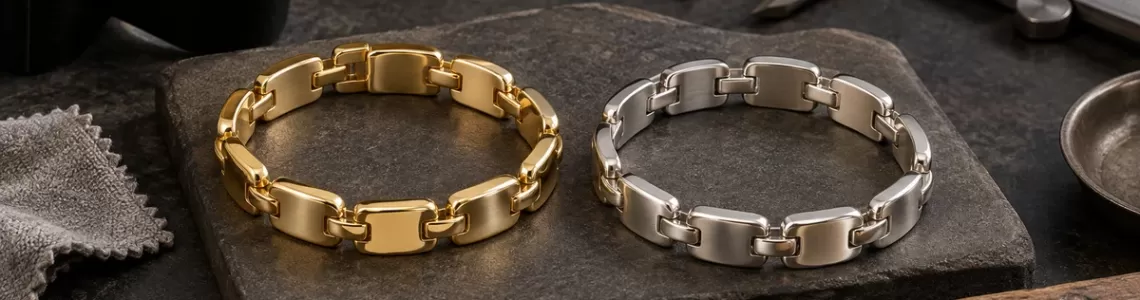
This guide explains claim language, not the composition of a particular bracelet. A photograph cannot establish plating thickness, karat fineness or the metal hidden below a surface. A “925” mark addresses a silver fineness claim; by itself it does not prove that the overlying colour is gold, establish coating thickness or make an item vermeil. Product-specific specifications, seller records and appropriate testing control those questions.
Why “vermeil” and “gold plated” should not be treated as interchangeable
Both terms describe a surface application rather than a solid-gold article, but they do not carry the same information. Under 16 CFR 23.4, the U.S. vermeil description combines four elements: a sterling-silver base, coverage of significant surfaces, gold or gold alloy of at least 10-karat fineness, and a minimum thickness equivalent to 2.5 microns of fine gold. The rule also says that an intervening base-metal layer, such as nickel, must be disclosed rather than hidden inside the vermeil claim.
By contrast, “gold plated” needs more context. The FTC’s gold-content guidance in 16 CFR 23.3 distinguishes mechanically applied overlays from electroplated surfaces and sets conditions for specific descriptions. It also makes clear that “gold filled,” “gold overlay,” “rolled gold plate,” “gold electroplate” and “heavy gold electroplate” are not free-form equivalents. A responsible listing should use the term that matches the actual construction rather than combining prestige words.
Jurisdiction matters. The British Hallmarking Council’s guidance for gold-plated silver in the UK requires descriptions to make both the silver base and the plated nature clear when gold fineness language is used. Its permitted wording and thickness approach are not identical to the U.S. vermeil rule. That is a useful warning against copying a definition from one market and assuming it applies everywhere.
A practical construction map
- Solid gold
- The article is made from a gold alloy rather than a base article carrying only a gold-coloured surface. Hollow construction can still exist, so “solid” and “heavy” are not synonyms.
- Gold vermeil under the U.S. FTC description
- Sterling silver forms the base, while qualifying gold covers significant surfaces to the stated fine-gold-equivalent thickness. The construction remains a coated silver article, not solid gold.
- Gold electroplated
- Gold or qualifying gold alloy is deposited by an electrolytic process. The base may be silver or another metal, and the exact description depends on construction and applicable market rules.
- Gold filled or rolled gold plate
- A gold-alloy layer is mechanically affixed. FTC terminology links these descriptions to the proportion of the article’s metal weight represented by the layer. This is not the same construction as ordinary electroplating.
- Gold tone
- A colour description alone. It does not identify gold content, base metal, process or thickness.
The CIBJO Blue Books provide internationally used nomenclature and standards for precious metals and other jewellery materials. CIBJO notes that its standards are voluntary and living documents, so they are best used as a terminology reference rather than as proof that an individual seller followed them.
What “925” can prove—and what it cannot
A 925 mark is commonly used for a silver fineness claim. If genuine and properly applied, it refers to the base precious-metal fineness, not the colour of the surface. A gold-plated silver item can therefore legitimately carry a silver hallmark or 925 stamp while appearing gold. The UK guidance explicitly says gold-plated silver articles are hallmarked as silver.
That creates a common buyer mistake: reading “925” plus a gold colour as proof of vermeil. The mark does not state that the coating is gold, that it is at least 10 karat, that all significant surfaces are covered, or that the thickness reaches a particular threshold. Likewise, a standalone gold-fineness number can be misleading on a plated-silver article if the description does not make the layered construction clear.
If silver authenticity is the main concern, start with the separate guide to solid sterling silver versus silver-plated bracelets. If the listing says the silver itself is rhodium coated rather than gold coated, use the rhodium-plated silver buyer checks; rhodium and gold are different coating claims.
Why thickness numbers need context
A micron is a unit of length, not a durability guarantee. Even when a seller provides a thickness, wear depends on where the coating sits, how the article is constructed, how often it contacts skin and hard surfaces, and how it is cleaned. Edges, clasp contact points, raised details and the underside of a bracelet can experience different abrasion from broad decorative faces.
The FTC vermeil provision uses a fine-gold-equivalent thickness. That phrase matters because a coating described by physical thickness and karat fineness may not be directly comparable to a pure-gold thickness figure without accounting for fineness. The note in 16 CFR 23.3 gives an example: one micron of 12-karat gold is equivalent to one-half micron of 24-karat gold for this purpose.
Do not infer a micron value from colour, shine or price. Photography, polishing, lighting, white balance and display settings can make two surfaces look similar even when their construction differs. The guide to why jewellery colours look different online explains those image limits.
Seven questions to ask before buying
- What is the base metal? Ask whether it is sterling silver, another silver alloy, brass, steel or something else. “Gold tone” is not an answer to this question.
- What exact surface term is being used? Vermeil, electroplated, filled, overlay and tone should not be collapsed into one phrase.
- What is the gold fineness? If a karat claim appears, it should identify the coating rather than imply the whole article is that gold alloy.
- Is thickness disclosed? Record the number, unit and whether it is stated as physical thickness or fine-gold equivalent. Do not invent a value when none is provided.
- Is there an intervening layer? Ask whether nickel, palladium or another material sits between silver and gold. This matters for complete composition disclosure and can matter to buyers with known sensitivities.
- Which surfaces are coated? A listing should not create the impression of all-over coverage if hidden or functional areas are intentionally uncoated.
- What care and service terms apply? Ask what cleaning is recommended, whether normal wear is excluded, and whether replating is available or chargeable. Compare the answer with the jewellery warranty and service-plan checklist.
Care without making the coating problem worse
Care advice should be conservative because the buyer usually cannot verify remaining coating thickness at home. Start with a soft, dry cloth and light pressure. If cleaning beyond that is needed, follow the seller’s written instructions for the exact article. Avoid treating a coated surface as if it were an uncoated block of metal that can simply be polished back to brightness.
Abrasive compounds, stiff brushes and repeated polishing can remove material from a surface. Strong chemicals can also affect non-metal components, adhesives, stones, patina or protective finishes. For mixed construction, the most sensitive component should usually control the cleaning method; see the mixed-material bracelet cleaning guide. Do not use an ultrasonic cleaner merely because the underlying metal is silver; the ultrasonic compatibility checklist explains why the whole assembly matters.
Store coated pieces dry, separated from hard jewellery and protected from rubbing. Remove a bracelet before tasks that bring repeated contact with tools, gym equipment or abrasive surfaces. Normal wear is not evidence that the original listing was false, but unusually rapid or patchy change is a reason to compare the item with the seller’s stated construction, care limits and warranty record.
How to compare a listing without overclaiming
Use a written comparison rather than relying on a single prestige word. Record the base, surface term, process if stated, gold fineness, thickness, intervening layer, hallmark, care instructions, warranty and return window. Save the listing and order confirmation because wording can change later. If the description is internally inconsistent—for example, “solid gold vermeil,” “925 gold” with no silver explanation, or several incompatible coating terms—ask the seller to clarify in writing before buying.
Photos can help document colour consistency, exposed edges and wear, but they do not authenticate the metal stack. Home magnet, scratch, acid or electronic tests can be incomplete, destructive or easy to misread. For a high-value dispute, use an appropriately qualified independent professional and tell them the question you need answered: base-metal fineness, surface composition, thickness, or all three.
Where this leaves a silver-bracelet shopper
If a product page does not say “vermeil” or “gold plated,” do not add that claim yourself. The safest commercial path is to read each item’s actual specification. Buyers who prefer a silver-coloured surface can browse the sterling silver bracelet collection and then verify the individual listing rather than assuming every item has the same finish. For example, the SUERTE silver bracelet listing and the Eye of God silver and cord bracelet listing describe different constructions; neither should be assigned a gold-coating claim unless its own page states one.
If a gold-coloured silver item is the goal, require a layered description: silver base, gold fineness, process and thickness where applicable. That approach is more useful than asking whether vermeil is universally “better.” Suitability depends on accurate disclosure, expected wear, care habits, budget and the buyer’s tolerance for future replating.
Three comparison scenarios
A listing says “18K gold vermeil” and shows 925
The wording supplies two useful clues but is not the complete evidence packet. Ask whether the base is sterling silver throughout the significant parts, whether 18K describes the surface alloy, what thickness standard is being claimed, and whether any intervening layer exists. A 925 mark is consistent with a sterling-silver base, but consistency is not the same as independent verification. Keep the written answer and do not treat colour photographs as a substitute for it.
A listing says “18K gold plated” but never names the base
The missing base is commercially important. It may affect value, care, repair options, hallmark interpretation and what becomes visible as the surface wears. Ask the seller to identify the base explicitly. If the answer is vague—“premium metal,” “jewellery alloy” or “gold material”—do not silently convert that phrase into sterling silver. Compare the clarified description with the price and return terms before purchase.
Two listings disclose the same micron number
The same number does not make the articles identical. Check whether both numbers describe the same measurement basis, whether the gold fineness is the same, which surfaces are included, and whether the construction, contact points and care terms differ. A bracelet with exposed edges and moving links may wear differently from a pendant even when the headline thickness is identical. Thickness is one input, not a complete quality score.
Red flags that deserve clarification
- A description switches among “solid gold,” “vermeil,” “filled” and “plated” as though they were interchangeable.
- The title advertises a gold karat but the body never says whether that karat applies to a surface layer or the whole article.
- A 925 mark is presented as proof of gold purity or coating thickness.
- The seller promises that the finish can never fade, regardless of use or cleaning.
- A precise micron claim appears without identifying the gold fineness or the surfaces measured.
- Care instructions recommend aggressive polishing while the warranty excludes all surface loss.
A red flag is not automatically proof of deception; it is a reason to pause and obtain a coherent written description. If the seller corrects the wording, save the corrected version with the order. If the explanation remains contradictory, choose a listing whose material stack and service terms are easier to verify.
FAQ
Is gold vermeil solid gold?
No. Under the U.S. FTC description, vermeil is a qualifying gold surface over a sterling-silver base. It is a layered precious-metal construction, not an article made throughout from gold alloy.
Does a 925 stamp prove an item is vermeil?
No. It addresses a silver-fineness claim. Vermeil also requires specific information about the gold surface, including fineness and minimum fine-gold-equivalent thickness under the U.S. rule.
Is every gold-plated silver item vermeil?
No. A plated-silver item may not meet the applicable vermeil definition, and terminology differs by jurisdiction. Ask for the base, coating fineness, process and thickness.
Is gold filled the same as vermeil?
No. FTC guidance treats gold-filled and rolled-overlay terms as mechanically applied constructions linked to the layer’s proportion of article weight. Vermeil is a gold surface over sterling silver under its own conditions.
Can a photograph show plating thickness?
No. A photograph can document appearance, but it cannot establish micron thickness, gold fineness or hidden base metal.
Will vermeil last forever?
No universal lifetime can be promised. Wear depends on coating construction, contact points, use, cleaning, storage and service. A qualifying term does not eliminate surface wear.
Should I polish gold vermeil with silver polish?
Not by default. Abrasive polishing can remove surface material. Follow the article-specific care instructions and use the least aggressive method that is appropriate.
What records should I keep?
Save the listing, coating description, stated thickness, care instructions, warranty, order confirmation and dated photos. These records make later clarification or service easier.
References
- Electronic Code of Federal Regulations — 16 CFR 23.4, misuse of “vermeil”
- Electronic Code of Federal Regulations — 16 CFR 23.3, gold content and surface applications
- Federal Trade Commission — statement of basis and purpose for the revised Jewelry Guides
- British Hallmarking Council — permitted descriptions for gold-plated silver
- UK Government — hallmarking guidance notes
- CIBJO — Blue Books and precious-metals nomenclature standards
Leave a Comment