
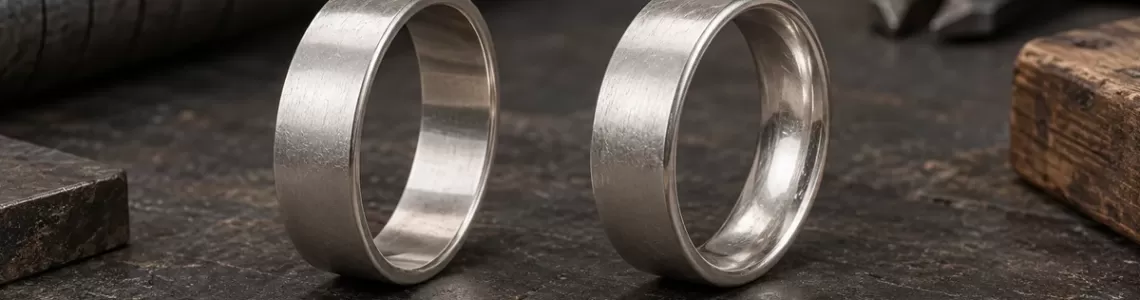
Comfort-fit and flat-interior rings can share the same stated size yet feel different because their inner surfaces contact the finger differently. A flat interior has a broad, relatively straight inner wall. A comfort-fit interior is gently convex, so its center sits closer to the finger while its edges curve away. Neither profile is automatically better, looser, more durable or more valuable. The useful comparison is profile plus width, thickness, inside measurement, finger shape and the seller's sizing method.
For an online buyer, “comfort fit” should be treated as a construction description that needs evidence, not as a promise that one nominal size will suit everyone. Ask for an interior photograph, the ring width, the sizing system, and the method used to measure the finished ring. If possible, try a gauge or sample band with a similar width and inner profile. Do not rely on a generic size-up rule or assume that a 925 mark answers a fit question.
What flat interior and comfort fit mean
A flat-interior band has an inner surface that is comparatively straight across its width. The edges may still be softened or chamfered, and the outside can be flat, domed, faceted or textured. “Flat interior” therefore does not mean sharp edges, and it does not describe the exterior styling.
A comfort-fit band has a convex inner profile. Instead of meeting the finger with a broad straight wall from edge to edge, the inside rises gently toward the center and recedes near the edges. Sellers may also use terms such as rounded inside, court profile or domed interior. Those labels are not a universal geometry specification. One maker may use a subtle curve and another a much fuller one, so photographs and measurements matter.
The comparison is easiest to see from an end view or a close interior photograph. A face-on product image can hide the profile completely. If a listing says “comfort fit” but shows only the top of the ring, request a side or interior view before treating the claim as verified.
Inside profile is not the same as outside profile
A ring can be flat outside and comfort-fit inside, domed outside and flat inside, or rounded on both surfaces. The exterior affects appearance, edge exposure and how the ring meets adjacent jewelry. The interior affects the contact shape against the finger and how a sizing tool reads the ring.
This distinction prevents a common shopping error: choosing from a front photo and assuming the visible outer dome proves a rounded interior. Ask for both profiles separately. If thickness matters, ask where it is measured, because a convex interior can make the center of the shank thicker than its edges even when the outside looks uniform.
Why the two profiles can feel different
Fit is a relationship between the ring and the finger, not a property of the ring alone. A flat interior may distribute contact across more of the band width. A convex interior concentrates contact more toward the center and relieves the inner edges. Some wearers find that rounded edges pass over a prominent knuckle more smoothly or feel less abrupt during finger flexion. Others prefer the stable, even contact of a flatter interior.
Those are plausible fit effects, not universal outcomes. Finger shape, skin moisture, temperature, time of day, activity and ring width can change the experience. A ring that slides easily over the knuckle may rotate at the wearing position. A ring that feels secure in cool conditions may become uncomfortable when the finger swells. The existing guide to ring width and fit explains why broader bands usually require special sizing attention.
Do not use pain, numbness, persistent discoloration or difficulty removing the ring as a normal “break-in” test. Remove a ring before swelling becomes severe and seek appropriate help if it cannot be removed safely. Fit language on a product page is not medical advice.
Nominal size does not describe every dimension
International Organization for Standardization standard ISO 8653 defines ring-size measurement with a ring stick of specified characteristics and notes that consumer finger gauges should correspond to the same diameter and tolerance. That is a measurement framework, not a guarantee that every seller, marketplace conversion chart or finished profile is calibrated identically.
GIA's quality-assurance guidance separately identifies standard even-width rings, wide bands, tapered rings, convex-interior bands and open designs. For a convex interior, GIA describes where the ring contacts the sizing stick and applies a specific benchmark adjustment. The practical buyer lesson is not to copy that workshop adjustment at home. It is to recognize that profile changes how a finished ring is read and to ask how the seller assigned the displayed size.
If a seller provides only “US 10” without width, profile or a millimetre measurement, important comparison information is missing. The guide to ring-size charts, diameter and circumference explains why conversions should be checked rather than treated as exact across every chart.
Width often matters more than the comfort-fit label
GIA advises using wide-finger sizing gauges for rings wider than 4 mm. A broad band covers more skin and commonly feels snugger than a narrow gauge of the same nominal size. That effect can remain even when the broad ring has a convex interior. “Comfort fit” does not cancel width.
Compare like with like. If the intended ring is 8 mm wide, trying a 2 mm sample may not predict the fit. A better test uses a gauge or inexpensive sample band near the intended width and with a similar interior profile. When that is impossible, ask the seller whether the stated size was checked with a standard, wide-band or profile-specific method.
Also check whether the band is even width, tapered toward the palm, open at the top or interrupted by a setting. Less metal contact can change how freely a ring turns. An adjustable ring with an open gap is a different construction problem and should not be sized by assuming it behaves like a closed comfort-fit band.
There is no safe universal size-up formula
Online advice often reduces profile and width to a fixed instruction such as “size up one quarter” or “comfort fit always runs large.” That can be wrong for a particular finger, maker or size system. Even GIA's detailed benchmark distinguishes several constructions rather than giving one rule for all rings.
A seller-specific recommendation may be useful when it is based on the actual ring and a documented size system. Treat it as product guidance, not a law that transfers to another brand. If two listings use different charts, compare the disclosed inside measurement and test method before comparing their size labels.
When a ring already fits well, record its inner profile, width and measurement method before using it as a reference. A perfectly round ring can be checked on an appropriate mandrel; an out-of-round, tapered or open ring needs construction-aware interpretation. Avoid forcing a ring onto a stick or using a hard tool against stones that protrude into the finger opening.
How to measure before ordering
Measure under ordinary conditions rather than immediately after cold exposure, heat, exercise or another cause of unusual swelling. GIA notes that temperature, humidity, altitude and time of day can change finger size. Take more than one reading and pay attention to both the knuckle and the place where the ring rests.
The most reliable route is a jeweler's gauge that resembles the intended band. A paper strip or printable chart can be a preliminary screen, but printing scale, tension, overlap and finger compression can introduce error. If using an existing ring, confirm that it is round and that its width and interior profile are comparable.
Keep units explicit. Inside diameter is a straight line across the opening; inside circumference is the distance around it. They are related but not interchangeable labels. Do not use the outside diameter, because wall thickness is included. Record millimetres as well as the named size when the seller provides them.
Questions to ask an online seller
- Is the interior flat, lightly rounded or fully convex?
- What is the finished band width in millimetres?
- Is the width even, tapered or interrupted by an opening?
- Which sizing system is used, and how was the finished ring measured?
- Can the seller provide the inside diameter or circumference for the selected size?
- Does the product-specific advice account for the band's width and profile?
- Has the ring been resized, and did that work preserve the interior contour?
- What return or exchange process applies if the delivered fit differs materially from the listing?
Save the product description, size selection and seller reply before purchase. The online jewelry buying checklist shows how to preserve listing evidence without changing the cart or completing a test order.
What 925 can and cannot tell you
The U.S. Federal Trade Commission explains that sterling silver contains 92.5% silver and that 925 means 925 parts per thousand are pure silver. That information concerns fineness. It does not specify the inside profile, ring width, nominal size accuracy, wall thickness, temper, solder work or future resizing options.
A mark also does not prove that the photographed ring and the delivered ring share identical dimensions. Use the mark as one disclosure clue and assess fit information separately. The guide to 925 stamps versus hallmarks explains why a simple numeral is not the same as a complete controlled hallmark.
Resizing can change an interior profile
Resizing may involve cutting, adding or removing metal, joining the shank, reshaping, filing and refinishing. A jeweler must preserve the ring's roundness, dimensions, finish and intended inner curve while protecting any stones, engraving, plating or hollow construction. The more specialized the profile, the less useful a generic resizing promise becomes.
Ask whether the specific ring can be resized and whether the work would preserve the comfort-fit contour. A narrow local repair can create a flatter or thinner section if the profile is not rebuilt consistently. That does not mean every resized ring is defective; it means the work should be evaluated on the finished ring. See the sterling-silver ring resizing guide for broader design and stone limitations.
Do not sand or grind the inside at home to imitate comfort fit. Removing metal changes dimensions, can introduce unevenness and can erase marks or damage finishes. It may also affect return rights. If the ring is uncomfortable, document the fit and use the seller's exchange route or consult a qualified jeweler.
Care for the interior without changing it
The Canadian Conservation Institute warns that polishing removes silver and leaves a fine scratch pattern. It also advises examining construction, solder joins, hollow sections and surface treatments before cleaning. For a ring, that means cleaning should preserve the intended profile and finish rather than chase a permanently mirror-bright interior.
Dust or abrasive residue trapped against the finger can make any profile feel rough. Use maker-appropriate care, rinse and dry thoroughly when the construction allows, and avoid aggressive general-purpose metal polishes. The polished versus satin finish guide explains why cleaning that suits one surface may alter another.
Normal contact marks inside a ring do not by themselves prove poor fit or low purity. Look instead for sharp edges, a catchable seam, a sudden profile step, distortion, deep cracks or material that differs from the listing. Our guide to sterling-silver ring scratches separates ordinary wear from signs that deserve closer review.
Inspect the ring after delivery
Before regular wear, place the ring on a clean padded surface and compare it with the saved listing. Photograph the outside, both edges, the inside profile, the mark area and any visible joint. Confirm the selected size, width and profile. Check that the opening is round unless the design intentionally says otherwise.
Try the ring when the finger is at a normal temperature. It should pass the knuckle without force and settle securely without pain or numbness. Rotate it gently; do not bend, pull open, file or polish it as a “test.” If the fit or interior construction materially differs from the listing, stop before modification and contact the seller.
The post-delivery ring inspection guide provides a broader non-destructive sequence for shape, settings, stones and finish. If the ring bends or arrives distorted, use the separate guide to sterling-silver ring bending rather than assuming the inside profile caused the problem.
Which interior should you choose?
Choose the profile that matches your tested preference and the evidence available for the exact ring. Comfort fit can reduce abrupt inner-edge contact for some wearers. Flat interiors can provide a familiar, broad contact surface and may be easier to compare with a flat sample. Neither label replaces correct width-aware measurement.
When buying remotely, the strongest listing combines a named size with millimetre dimensions, band width, interior profile, clear photographs, product-specific sizing advice and a workable return policy. A vague comfort claim without those details is weaker evidence than a well-documented flat-interior ring.
Frequently asked questions
Does comfort fit mean I should order a smaller size?
Not automatically. Profile, width, finger shape and the seller's sizing method all matter. Use a comparable gauge or follow product-specific advice supported by actual measurements.
Are comfort-fit rings always easier to remove?
No. Rounded inner edges may feel smoother over a knuckle for some wearers, but swelling, width and the difference between knuckle and finger-base size can still make removal difficult.
Is a flat interior uncomfortable?
Not by definition. Properly sized flat-interior rings with finished edges can be comfortable. Preference depends on dimensions, edge treatment and the wearer.
Can two rings with the same inside diameter fit differently?
Yes. Width, taper, interior curvature, openings and finger contact can change the wearing feel. Also confirm that the diameter was measured at the correct point.
Does comfort fit make a ring stronger?
Not by itself. Strength and deformation resistance depend on alloy, dimensions, construction, heat and work history, design and loading. The label describes the inner contour.
Can a jeweler convert a flat interior to comfort fit?
Possibly for some designs, but metal removal or rebuilding may change thickness, size, marks and finish. A qualified jeweler must inspect the exact ring before recommending work.
Does a 925 stamp confirm comfort fit?
No. A 925 mark concerns silver fineness, not interior geometry, size accuracy, workmanship or fit.
How should I compare an existing ring with an online listing?
Record the existing ring's width, inner profile, roundness and inside measurement. Compare those features with the listing instead of matching only the named size.
References
- ISO 8653:2016 — Jewellery — Ring-sizes — Definition, measurement and designation
- GIA — Accurate Determination of Finger and Ring Sizes
- GIA 4Cs — Ring Size Guide: Tips and Ring Size Chart
- GIA — What Are the Quality Assurance Benchmarks?
- U.S. Federal Trade Commission — Buying Platinum, Gold, and Silver Jewelry
- Canadian Conservation Institute — Silver: Care and Tarnish Removal
- Canadian Conservation Institute — Caring for Metal Objects
Leave a Comment