
Adjustable Sterling Silver Rings: Fit, Gap and Buyer Checks
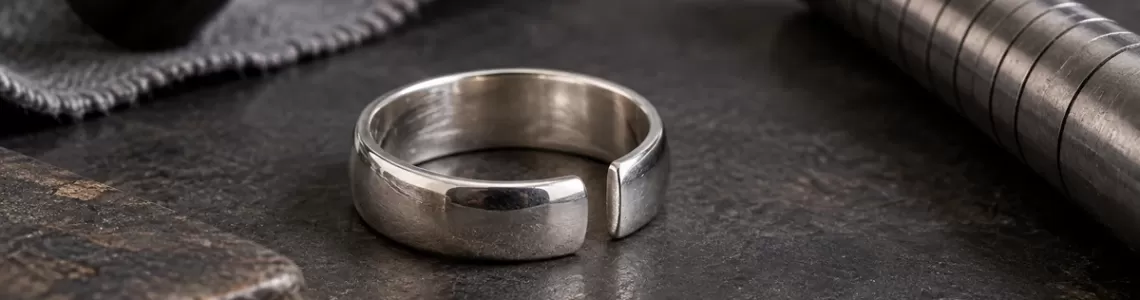
An adjustable sterling-silver ring is not a one-size-fits-all ring. Its open shank can provide a limited fitting range, but the gap, band width, thickness, decoration and stone setting determine how safely it can move. The best buying approach is to choose the nearest stated size, adjust as little as possible, and avoid repeatedly opening and closing the band. A ring that pinches, spins, develops a kink or shows a line near the gap needs inspection rather than more force.
What “adjustable” should mean on a ring listing
An adjustable ring normally has an intentional opening in the shank. That opening allows the circumference to change within a designed range. It does not mean that every wearer can bend the ring to any size, or that the ring can be reshaped indefinitely without consequences.
A useful product page should state a starting size or a narrow size range, show the gap from more than one angle and identify whether the ends overlap, meet edge-to-edge or terminate beneath a decorative top. If the listing simply says “adjustable” without dimensions, ask for the inside diameter or circumference in the delivered position and the maker’s intended adjustment range.
The Gemological Institute of America explains that a correct ring size should pass over the finger joint and settle where it will be worn. It also notes that rings with an open space above the finger fit differently because less metal contacts the finger. That is a measurement issue, not proof that any open ring can cover a broad range. GIA: Accurate Determination of Finger and Ring Sizes.
Start with the closest size, not the widest possible adjustment
Adjustment should refine fit, not rescue a large mismatch. If a ring begins far too small, spreading it substantially can leave a large, uncomfortable gap and change the curve of the shank. If it begins far too large, squeezing the ends together can create overlap, pressure points or distortion beneath the decorative top.
Measure the finger at the time and conditions in which the ring will usually be worn. Fingers can change with temperature, activity and time of day. A measurement taken only at the narrow base of the finger can also fail at the knuckle. GIA recommends professional finger gauges and distinguishes narrow gauges from wide-band gauges because width changes perceived fit. Its consumer guide likewise warns that string and paper methods can be inaccurate. GIA: Ring Size Guide.
For a practical explanation of diameter, circumference and US sizing, use the ring-size chart guide. If the band is broad, also review why wide rings can feel tighter. Neither chart replaces the seller’s stated range for a particular adjustable design.
Why repeated bending deserves caution
Metal can deform elastically, returning to its original shape, or plastically, retaining a permanent change. An adjustable ring relies on controlled permanent movement when its opening is changed. Repeating that movement in opposite directions concentrates strain in a small part of the shank.
The general engineering principle is metal fatigue: repeated or fluctuating loads can initiate and grow cracks at stresses lower than those required for a single static fracture. A U.S. Bureau of Standards reference describes fatigue as progressive crack formation under repeated loading. That source concerns engineering metals in service, not a lifespan test for a particular sterling ring, so it cannot predict how many adjustments any ring will survive. It does support a conservative buyer rule: fit once or rarely, rather than flexing the ring every time it is put on. U.S. Bureau of Standards: Mechanical Failures of Metals in Service.
A sterling-silver description also does not specify hardness, temper or construction. In the United States, the Federal Trade Commission explains that “sterling” and “sterling silver” describe material containing 92.5% pure silver. A 925 mark therefore addresses fineness, not adjustment range, strength, workmanship or fatigue life. FTC: Buying Platinum, Gold, and Silver Jewelry.
Band shape and decoration change the safe range
Plain open bands
A plain band with a smooth, even cross-section may distribute a small adjustment more predictably than a thin decorative shank. Even then, the intended range should come from the maker or seller. A wide band can feel tight while a narrow edge can dig into the finger if the ring becomes oval.
Signet and top-heavy rings
A heavy top can rotate even when the shank feels snug. Closing the gap until the finger is pinched is not a sound solution. The ring may need a more appropriate base size or a professional sizing aid. GIA notes that sizing beads can help keep certain rings upright, but whether they suit an open sterling design requires a jeweller’s assessment.
Stone-set adjustable rings
Movement in the shank can transfer force toward a setting. A prong, bezel or channel may appear distant from the opening yet still be part of the same structure. Before changing the fit, inspect whether the setting remains symmetrical and whether the stone moves. The guide to prong, bezel and channel settings explains the different visual checks.
Hollow, plated or oxidized designs
Hollow construction may dent or crease rather than move like a solid-looking band. Plating can crack or wear at a flex point, and intentional oxidation can brighten where the surface is rubbed. These are separate from silver fineness. Review hollow versus solid ring checks and the guide to oxidized silver versus tarnish before treating every surface change as dirt.
How to adjust an open ring conservatively
First, read the seller’s care and sizing instructions. If no adjustment is authorized, ask before bending. Remove the ring from the finger rather than using the finger as a mandrel. Apply slow, even pressure to both sides of a plain open band, moving the ends by the smallest amount needed. Avoid twisting one end upward or downward, creating a sharp corner or pressing directly on a stone setting.
After each small movement, stop and inspect the ring in neutral light. Look at the gap, the roundness of the shank, the inside surface and any nearby join or decoration. If the gap becomes visibly uneven, the shank forms a kink, a stone loosens or a new line appears, stop. Do not alternate between too tight and too loose to “work” the metal into place.
This is a conservative handling framework, not a repair instruction. Some designs should be adjusted only by the maker or a jeweller. If a seller promises a specific technique or range, preserve that written statement with the order record.
Fit checks after adjustment
- Knuckle: the ring should pass over the joint without force that hurts the finger or deforms the ring.
- Base of finger: the band should settle without pinching, deep indentation or numbness.
- Rotation: some movement is normal, but a heavy top should not spin constantly because the gap has been closed against the skin.
- Gap position: the open ends should not catch on clothing or press sharply into the adjacent finger.
- Roundness: an intentionally open ring may not be a perfect circle, but a sudden flat spot or kink is a warning.
- Setting: stones, prongs and decorative elements should remain secure and aligned.
If the fit varies sharply through the day, do not chase each change by bending the ring repeatedly. A different starting size, band profile or professionally fitted ring may be safer and more comfortable.
What a 925 mark can and cannot tell you
“925” is a fineness statement when it is genuine and properly applied. It does not, by itself, identify the maker, construction method, exact alloying metals, heat treatment, coating, sizing range or quality of a setting. In the UK, a complete hallmark includes a sponsor’s mark, fineness mark and assay-office mark; qualifying silver articles above the legal exemption weight must be hallmarked. Requirements vary by market, so do not apply one jurisdiction’s rules universally. British Hallmarking Council: Hallmarking Practical Guidance.
Use marks together with the seller’s written material description, weight, dimensions, finish disclosures and return terms. The 925 stamp versus hallmark guide explains the evidence hierarchy in more detail.
Cleaning and polishing around the opening
Open ends and textured recesses can trap soap, skin products and polish residue. Clean according to the declared materials and finish, then dry thoroughly. Do not use polishing as a way to erase a structural line or test whether the ring is silver.
The Canadian Conservation Institute explains that tarnish removal is abrasive and takes away some underlying silver. It also advises examining silver for solder joins, hollow sections, plating and surface decoration before choosing a method. Museum guidance is intentionally conservative and is not a product-specific home recipe, but the principle is useful: identify construction and finish before cleaning. CCI Notes 9/7: Silver — Care and Tarnish Removal.
If the ring has plating, an intentionally dark finish, glued components, porous stones or mixed materials, the most sensitive component should set the care limit. Frequent polishing near the gap can also round edges or change contrast without correcting fit.
When to stop wearing the ring
Remove the ring if it becomes painful, traps swelling, cuts the skin, shows a sharp edge, develops a visible crack, changes shape during normal wear or allows a stone to move. A skin mark is not automatically proof of allergy or defective silver, but persistent redness, itching, broken skin or swelling should be treated as a health issue rather than solved by tighter adjustment. The ring rash and skin-mark guide separates residue, moisture, friction and possible allergic contact dermatitis.
Do not wear a questionable ring while lifting, using tools, playing contact sports or doing work where the gap can catch. If the ring will not come off because of swelling, seek appropriate medical or emergency help rather than forcing the metal against the finger.
Buyer checklist for an adjustable sterling-silver ring
- Ask for the starting size and the intended minimum and maximum range.
- Confirm band width, thickness, inside shape and gap dimensions.
- Check whether the ring is solid, hollow, plated, oxidized, stone-set or mixed-material.
- Look for clear side, underside and gap photographs rather than relying on one front view.
- Read exactly which part is sterling silver and what the mark represents.
- Ask whether the ring may be adjusted by the wearer and how often.
- Save the listing, size promise, care instructions and return terms.
- Inspect the delivered ring before bending it. Use the post-delivery ring checklist.
If a listing cannot provide a starting size or realistic range, “adjustable” is too vague to predict fit. A returnable, accurately described ring is a safer purchase than a design that depends on large home reshaping.
A simple decision path after delivery
If the ring already fits: do not flex it merely to test the claim. Photograph the delivered gap, underside, mark and setting, then keep the ring at that shape. An adjustable feature can be useful without being exercised repeatedly.
If the ring is only slightly loose or tight: compare the condition with the seller’s stated range and instructions. For a plain band that is expressly user-adjustable, make one small, even correction off the finger and recheck. If the listing limits adjustment to a jeweller, follow that limit.
If the size difference is large: stop before forcing the ring. A big change can alter gap geometry, roundness, setting alignment and comfort. Use the return or exchange route while the delivered condition is still documented. Do not create avoidable tool marks that could complicate a condition claim.
If the ring changes after wear: separate fit evidence from surface evidence. A gradually widening gap, new flat spot, lifted end, moving stone or line that appears to open deserves professional inspection. Tarnish, polishing residue or a reflection may look dramatic without being structural, while a fine crack may be easy to miss. A photograph can preserve evidence but cannot settle the diagnosis.
If the description was incomplete: ask a narrow written question: “What is the delivered size, intended adjustment range, construction, finish and approved adjustment method?” Keep the reply with the product page and order record. The FTC’s Jewelry Guides are built around accurate representation of precious-metal and product characteristics, but a dispute still depends on the actual listing, market and evidence. FTC: Jewelry Guides.
This sequence protects both the ring and the evidence. It also prevents a vague “adjustable” label from shifting every sizing risk to the buyer.
Frequently asked questions
Can an adjustable sterling-silver ring fit every finger?
No. An open shank usually offers a limited range. Band width, thickness, gap, decoration and setting all restrict how far it can move. Choose the closest stated size.
Should I bend an adjustable ring every time I wear it?
Avoid making that a routine. Repeated back-and-forth bending concentrates strain. Fit it conservatively, leave it at that size when practical, and stop if the shank develops a kink, line or loss of symmetry.
Does a 925 stamp guarantee that the ring is durable?
No. A 925 mark concerns silver fineness. It does not guarantee construction, hardness, workmanship, stone security, coating durability or adjustment range.
Can a jeweller resize an adjustable ring?
Sometimes, but the answer depends on construction, gap design, stones, finish and the amount of change required. Review the broader guide to resizing sterling-silver rings and ask a qualified jeweller to inspect the actual piece.
Is a dark line near the gap a crack?
Not necessarily. It could be a reflection, tarnish, finish contrast, surface scratch, tool mark or structural damage. Stop flexing the ring, photograph the area in neutral light and seek inspection if the line opens, catches a fingernail or changes under gentle handling.
References
- Gemological Institute of America: Accurate Determination of Finger and Ring Sizes
- Gemological Institute of America: Ring Size Guide
- U.S. Federal Trade Commission: Buying Platinum, Gold, and Silver Jewelry
- British Hallmarking Council: Hallmarking Practical Guidance
- Canadian Conservation Institute: Silver — Care and Tarnish Removal
- U.S. Bureau of Standards: Mechanical Failures of Metals in Service
Leave a Comment