
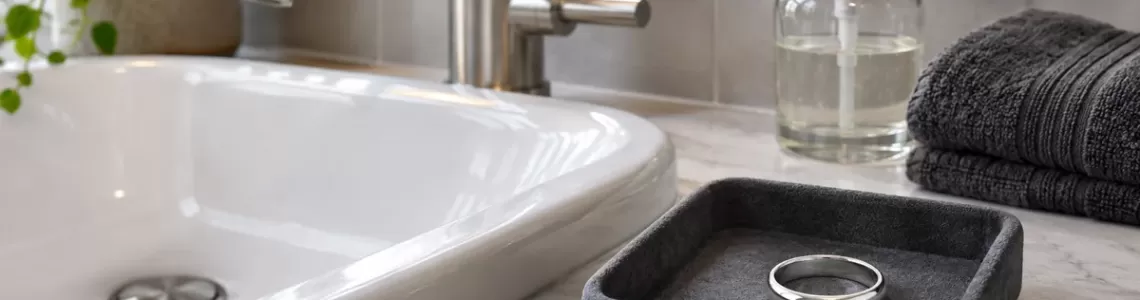
Brief contact with clean water and mild soap does not automatically ruin a plain sterling-silver band, but removing the ring before washing is the more conservative routine. Hand hygiene comes first. The jewelry questions are whether soap and moisture remain beneath the band, whether the ring contains stones, coatings or adhesives with different care limits, and whether taking it off creates a sink-loss risk.
If you keep the ring on, wash your hands properly, rinse around and beneath the band, and dry both the finger and ring completely. Remove it first when the fit is tight, the skin is irritated, the setting is damaged, the construction is unknown, or the maker says to avoid water or cleansers. A 925 stamp alone cannot answer those questions.
The short answer: ordinary water is only one variable
A smooth, undamaged sterling-silver band may tolerate an ordinary handwash without an obvious change. That does not make every silver-colored ring waterproof or every soap compatible. A ring can combine sterling silver with rhodium plating, intentional oxidation, enamel, porous stone, pearl, wood, resin, adhesive, a hollow section or a repaired joint. Those components can set the care limit even when the band is correctly marked sterling.
The practical choice is not between “waterproof” and “ruined.” It is between a known, simple construction and a ring whose complete construction or condition is uncertain. When uncertainty is high, remove the ring over a safe surface, wash and dry your hands, then put it back on. When removal itself risks dropping the ring into an open drain, secure it in a closed tray or pouch before turning on the tap.
This question is narrower than showering or swimming. Handwashing is brief, necessary and usually uses clean running water and soap. A shower adds longer exposure and more personal-care products; a pool adds chlorine chemistry; dishwashing adds household cleaners, impact and prolonged soaking. Use the guide to showering with a sterling-silver ring for that separate exposure.
What a 925 mark proves—and what it leaves unknown
The U.S. Federal Trade Commission explains that “sterling silver” describes material containing 92.5% silver. That is a fineness statement. It does not identify every other alloy metal, establish that the whole ring is solid rather than plated or hollow, or describe the finish, solder, repair, stone, treatment, adhesive or setting.
Those omitted facts matter at the sink. Plain sterling silver and an assembled ring are not the same evidence problem. Water that is unremarkable for a bare band may reach a cavity, collect beneath an inlay, leave residue around a textured finish or affect a component that should not be immersed. The article on 925 stamps and hallmarks explains why a mark is not a complete construction report.
Do not use repeated handwashing as an authenticity test. A real sterling ring can tarnish, hold residue or carry a coating. A plated item can look unchanged for a while. A skin reaction can involve moisture, soap, friction or an alloy component and cannot establish silver content. If identity matters, use documented seller information and qualified testing rather than exposure experiments.
Hand hygiene should not be weakened to protect jewelry
The U.S. Centers for Disease Control and Prevention advises wetting hands with clean running water, applying soap, lathering the backs of the hands, between fingers and under nails, scrubbing for at least 20 seconds, rinsing and drying. A jewelry-care decision should not shorten those steps or leave parts of the hand unwashed.
A ring can make access beneath a broad band less convenient. Sliding a loose ring slightly may expose skin, but rotating jewelry is not a substitute for thorough handwashing. In settings with professional infection-control requirements, follow the workplace's jewelry and hand-hygiene policy rather than a general jewelry article. This guide does not certify a ring-wearing method for healthcare, food service or another regulated workplace.
If you remove the ring, do it before your hands become wet and slippery. Put it directly into a dedicated closed container—not on the sink rim, in a pocket with keys or beside an open drain. Then complete the full wash. The point is to protect both hygiene and the ring without improvising a shorter wash.
Soap residue and moisture can stay beneath the band
The American Academy of Dermatology notes that soap and water trapped beneath a ring may irritate the skin. That does not mean soap always causes a rash or that the ring metal is innocent in every case. Irritation, friction and allergic contact can overlap.
Broad, tight and textured bands can be harder to rinse and dry underneath. Lotion, cleanser and skin debris may collect in recesses. If the ring stays on, rinse carefully and dry the finger, inner band and edges. Do not leave a damp band pressed against already irritated skin.
A red, itchy or sore mark is not a purity test. Remove the ring if symptoms develop and allow the skin to dry. Seek medical advice when symptoms are severe, persistent or recurrent. The guide to ring rash, moisture and metal clues separates likely possibilities without diagnosing the cause.
Not every soap or cleaner is equivalent
GIA jewelry-care guidance often uses warm water and mild dish soap for compatible jewelry, but that is not permission to expose every assembled ring to every product. Household cleaners may contain ammonia, bleach, abrasives, solvents, fragrances or other ingredients that interact differently with precious-metal alloys, delicate gems and treatments. GIA specifically recommends removing fine jewelry before using household cleaners.
Ordinary hand soap is usually less aggressive than a cleaning chemical, yet formulations vary. Exfoliating particles can act differently from a plain liquid soap. Dyes and fragrance can leave residue. Antibacterial claims do not tell you whether a product suits a coating, inlay or treated stone. Read the ring maker's instructions and the cleanser label instead of inferring compatibility from the word “soap.”
Hand sanitizer is a separate exposure because alcohol concentration and other ingredients differ from hand soap. See the dedicated guide to hand sanitizer and sterling-silver rings. Do not replace required handwashing with sanitizer merely to avoid getting a ring wet.
Stones, inlays, coatings and adhesives set their own limits
GIA explains that gemstone durability includes hardness, toughness and stability. Scratch resistance alone does not predict how a material handles chemicals, temperature changes, humidity or prolonged water contact. Some gems are porous; some have fillings, coatings, oils or other treatments; some organic materials and assembled inlays need especially cautious care.
A stone may remain intact while its setting or adhesive changes. Water can carry soap into a recess that is difficult to rinse. A lifted inlay edge can trap moisture. Plating may wear according to thickness, friction and exposure. Intentional oxidation can change unevenly if repeatedly cleaned. None of those outcomes can be predicted from the silver fineness mark.
Use the guides to gemstone durability and prong, bezel and channel settings to identify the questions to ask. If you cannot identify the stone, treatment, inlay or adhesive, removal before washing is the conservative choice.
The sink may be a bigger immediate risk than tap water
Wet fingers are slippery. A loose ring can slide off; a ring removed carelessly can bounce from a counter into a drain. GIA recommends rinsing jewelry in a glass of water rather than directly over a sink when cleaning because loose stones—or an entire piece—can be lost. Handwashing is not a jewelry-cleaning session, but the loss principle still applies.
Close the drain or move away from the basin before handling the ring. Better, place a small lidded tray or soft pouch on a dry shelf. Do not balance the ring on the faucet, soap bottle or sink edge. Avoid putting it into a tissue that can be thrown away or into a pocket with coins, keys and grit.
If the ring feels newly loose, do not rely on soap residue or swollen knuckles to retain it. Recheck the fit and use the ring-size chart to understand measurements. A chart cannot diagnose a changing fit, so ask a qualified jeweler when the ring regularly spins, slips or becomes tight.
Water does not explain every dark or dull area
Silver tarnish is mainly associated with sulfur-containing compounds. Canadian Conservation Institute guidance also emphasizes construction, surface condition, humidity and contaminants. A brief handwash may leave water spots or soap film, but appearance alone cannot prove tarnish, corrosion, plating loss or fake silver.
Dry the ring and inspect it in neutral light before treating it. A dull patch may be residue. A dark recess may be intentional oxidation. A pale area may reflect a brushed finish. A green residue near a crevice can involve trapped cleaning product and copper-containing material. Do not scrape or polish first and identify later.
Repeated polishing removes material and can flatten texture or alter coatings and intentional patina. The guides to polishing cloths and sterling-silver rings and oxidized silver versus tarnish explain why one brightening method does not suit every finish.
A practical handwashing routine
If you remove the ring
- Choose a safe place first. Close the drain or step away from the sink and use a dry, padded, closed tray.
- Remove it while hands are dry. Do not force a tight ring or use soap as a removal aid when the finger is painful or injured.
- Wash fully. Follow the complete handwashing steps and required workplace guidance.
- Dry the hand. Include the area where the ring sits and between the fingers.
- Check the ring before replacing it. Look for residue, a loose stone, lifted edge, sharp area or distorted shank.
- Put it back on only when comfortable. Leave it off if the skin or fit has changed.
If you keep the ring on
- Do not shorten the wash. Lather, scrub, rinse and dry as required.
- Rinse around the band. Remove visible soap from the inner and outer edges without pulling on a setting.
- Dry beneath it. Pat the skin and ring dry; do not leave moisture trapped under a broad band.
- Inspect after drying. Look for fresh residue, stone movement, a lifted inlay or finish change.
- Stop when something is wrong. Remove the ring and obtain appropriate jewelry or medical advice rather than repeating the exposure.
After any suspected setting change, use the ring inspection checklist. Do not press a loose stone, pull a prong, scrape a recess with a pin or bend a distorted shank back by hand.
When removal is the better default
Remove the ring before handwashing when it contains an unidentified or delicate stone, a glued inlay, wood, resin, enamel, pearl, a coating with unknown care limits or an open cavity. Also remove it when the setting moves, the band is damaged, the finish is actively flaking, the ring is very loose, the finger is sore or the maker specifically says to keep it dry.
Removal is also sensible before using household cleaners, bleach, ammonia, solvents, abrasive soaps or strong degreasers. That is no longer an ordinary handwash. If you are washing after gardening, mechanical work or chemical handling, follow the relevant safety guidance and treat the ring as a separate contaminated object rather than assuming a quick rinse is enough.
A plain, known, well-fitting band may present fewer care variables. Even then, thorough rinsing and drying are useful. The conclusion is not that water is harmless; it is that complete construction, condition, cleanser, skin contact and handling determine the practical risk.
Frequently asked questions
Will hand soap ruin sterling silver?
Not automatically. Brief contact with a mild soap may leave no visible change on a compatible plain band, but soaps vary and a ring may include coatings, stones, adhesives or finishes with different limits. Rinse and dry completely, and follow the maker's instructions for the whole ring.
Can I wash my hands while wearing a plain 925 band?
You may be able to, but 925 confirms silver fineness rather than the complete construction or fit. Wash thoroughly, rinse beneath the band and dry it. Remove the ring if it is tight, damaged, irritating the skin or difficult to clean and dry underneath.
Should I remove my ring every time I wash my hands?
Removal is the conservative routine, especially for unknown or composite construction. It is not helpful if the ring is then balanced over an open drain. Use a secure tray or pouch, and never shorten proper handwashing to protect jewelry.
Does water make sterling silver tarnish?
Water alone does not explain every color change. Sulfur-containing compounds are central to silver tarnish, while humidity, residues and surface condition also matter. Dry the ring and identify residue, intentional oxidation, plating and tarnish before polishing.
Why is the skin under my ring red after washing?
Soap, retained moisture, friction and allergic contact are among the possibilities. A mark cannot identify one cause or prove metal purity. Remove the ring, dry the area and seek medical advice if symptoms are severe, persistent or recurrent.
Can I dry the ring with a paper towel?
A clean soft lint-free cloth is generally less likely to leave fibers or scratch a delicate finish than a rough paper product. Pat rather than scrub. Follow special instructions for stones, coatings, intentional oxidation and inlays.
What if the ring slips off when wet?
Stop handling it over the sink. Close the drain, dry your hands and place the ring in a secure container. A consistently loose ring needs a fit assessment; do not rely on soap, tape or an unknown insert to keep it on.
Can I clean the ring while washing my hands?
Handwashing and jewelry cleaning are different tasks. A cleanser suitable for skin is not automatically the correct cleaner for every ring. Clean jewelry separately with a method matched to the complete construction, away from an open drain.
References
- U.S. Federal Trade Commission, Buying Platinum, Gold, and Silver Jewelry — sterling-silver fineness terminology.
- U.S. Centers for Disease Control and Prevention, About Handwashing — wet, lather, scrub, rinse and dry guidance.
- Gemological Institute of America, Tips on Caring for Jewelry — chemicals, compatible gentle cleaning, secure rinsing and storage.
- Gemological Institute of America, More than the Mohs Scale — gem hardness, toughness and stability.
- American Academy of Dermatology, Itchy rash could be contact dermatitis — soap, water, jewelry and skin-irritation boundaries.
- Canadian Conservation Institute, Silver: Care and Tarnish Removal — construction-aware aqueous cleaning, rinsing, drying and abrasion limits.
- Canadian Conservation Institute, Understanding how silver objects tarnish — sulfur compounds, humidity and tarnish mechanisms.
Evidence boundary: this article provides general handwashing and jewelry-care information. It does not certify a product as waterproof, diagnose dermatitis, identify an alloy component or stone treatment, establish workplace infection-control compliance, or override product-specific instructions. Unknown construction and health conditions remain unknown.
Leave a Comment