
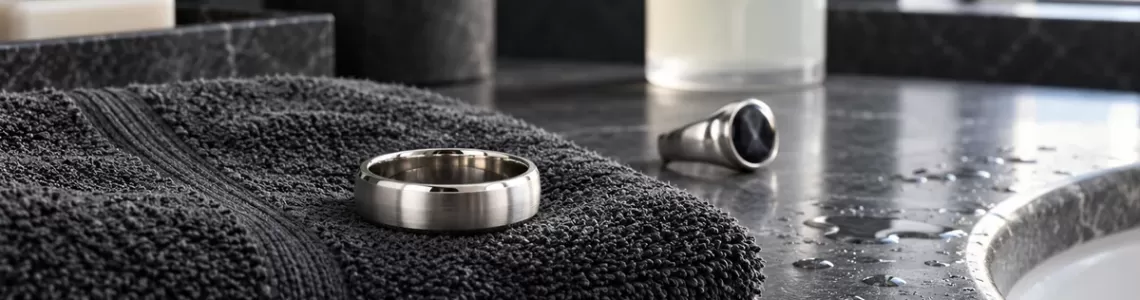
Removing a sterling-silver ring before showering is the safest default. A brief splash of clean water does not automatically ruin a plain solid-sterling band, but a shower is more than water: it adds soap, shampoo, conditioner, warm humidity, residue and repeated handling. If the ring is plated, intentionally oxidized, stone-set, glued, coated or previously repaired, the care limit may be set by those features rather than by the silver alloy.
If you accidentally shower with the ring, do not panic or start polishing immediately. Rinse only if the maker's instructions allow it, dry the piece completely with a soft lint-free cloth, inspect the finish and settings, and stop wearing it if a stone moves, a coating changes, residue remains in a recess or the ring feels unusually tight. Unknown construction is a reason to ask the seller or a qualified jeweler, not a reason to try a stronger cleaner.
Why “sterling silver” is not the whole care answer
The U.S. Federal Trade Commission explains that “sterling” and “sterling silver” describe material containing 92.5% silver. A 925 mark expresses that fineness claim. It does not tell you whether the finished ring is rhodium plated, gold plated, lacquered, selectively oxidized, soldered, resized, filled, stone-set or assembled with adhesive.
That distinction matters in a shower. Exposed sterling alloy, a thin outer coating, an intentionally dark recess and a porous stone do not respond in the same way. The separate guide to 925 stamps and hallmarks explains why a mark is useful evidence but not a complete identity or care certificate.
Read the product page and care card for the complete ring. Confirm the metal, any plating, the finish, every stone or inlay, known treatments, adhesives and repair history. When those facts are absent, treat the piece as a composite object with unknown limits.
Plain water, shower water and storage humidity are different exposures
Silver does not behave as though a timer starts the moment it touches water. Tarnish is mainly associated with reactions involving sulfur-containing substances, while the copper in sterling alloy can also influence surface change. The Canadian Conservation Institute notes that relative humidity affects tarnish rate and that salts, oils and contaminants can make corrosion more likely.
A shower combines variables that a quick hand rinse may not. Warm water can remain in seams and under a ring head. Soap and shampoo can leave surfactants, oils, fragrance or conditioner film. Hard-water minerals can dry as a pale deposit. Repeated wetting and incomplete drying can keep recesses damp. None of these observations proves that the ring is fake; they describe an exposure environment.
Do not turn this into the opposite absolute claim. One accidental shower does not establish permanent damage, and visible darkening may be ordinary tarnish, intentional oxidation, trapped residue or plating wear. Compare the ring under neutral light with its original photographs before deciding what changed.
A shower is not a silver-cleaning method
Running water and body wash do not provide controlled tarnish removal. Shower products are formulated for skin or hair, not for a known jewelry alloy and finish. They may leave emollients, fragrance, surfactants or mineral deposits behind, while water pressure cannot reliably reach or rinse every seam beneath a setting. A ring that looks brighter while wet may simply be reflecting a water film; inspect it only after complete drying.
Cleaning and routine wear are different decisions. A maker-approved cleaning method uses a known solution, limited contact time, a protected work area and complete rinsing and drying. Wearing the ring through a shower exposes it to an uncontrolled mixture and adds the chance of impact against tile, metal fixtures or the sink. Even if the exposed sterling tolerates the water, a loose prong, thin coating or glued inlay can remain the limiting feature.
Do not use repeated showers as a test of authenticity or quality. A ring that does not visibly change may still collect residue, and a ring that darkens is not automatically counterfeit. Metal identity requires documentation and appropriate testing; care compatibility requires construction-specific guidance.
Soap and shampoo can leave a dull film
A ring that looks cloudy after showering may be coated with residue rather than deeply tarnished. Bar soap, body wash, shampoo, conditioner and skin-care products can collect under a broad band, inside engraving and around settings. Jewelers of America advises removing jewelry in the shower because these products can form a film that makes jewelry look dull.
Do not scrape dried film with a pin or knife. Do not add toothpaste, baking soda, scouring powder, bleach, ammonia or a random silver dip. Abrasive or reactive products can change a polished surface, brighten intentional darkening, lodge in details or harm a stone. The recent guide to silver polishing cloths also explains why “soft” does not mean lossless on every finish.
If the maker permits mild soap-and-water cleaning, use the specified method outside the shower, where you can control the solution, protect the drain, inspect the settings and dry the ring fully. General cleaning guidance is not permission to immerse every ring.
Plating and coatings change the answer
Rhodium plating, gold plating, vermeil, lacquer and other surface treatments create an outer layer with its own wear pattern. Water may not be the only concern: repeated contact with cleansers, friction from towels and residue at high-wear edges can make a coating look uneven sooner. The lower shank, corners and raised details usually receive the most mechanical wear.
Do not assume that a 925 mark means every visible surface is bare sterling. A plated sterling ring can still carry a sterling fineness mark because the substrate is sterling. Ask the seller to identify the coating and approved care method. The guide to rhodium-plated silver separates the white outer layer from the underlying alloy.
After accidental shower exposure, look for a new color boundary, patchy brightness, flaking, a different tone on an edge or residue trapped where the coating is already worn. Do not polish the boundary in an attempt to make both areas match.
Intentional oxidation and textured finishes need restraint
Many men's rings use darkened recesses to emphasize engraving, rope borders, skull motifs or signet details. That contrast may be intentional oxidation, not dirt. Shower products can leave pale residue in those recesses, while aggressive cleaning can remove the dark finish that gives the design its depth.
A satin or brushed surface also has controlled directional texture. Random rubbing with a treated cloth can create a bright patch or cross-grain marks. The guide to polished versus satin sterling-silver rings explains why finish identity matters before cleaning.
Photograph the ring before any corrective care. Compare the face, shoulders, lower shank, inside marks and recesses. If the product photographs show the same dark pattern, preserve it. The guide to oxidized silver versus tarnish provides a separate decision framework.
Stone-set rings may be limited by the stone or setting
Gem durability is not captured by hardness alone. GIA distinguishes hardness, toughness and stability. A hard gem may still have cleavage, fractures, filling, coating or heat sensitivity. Porous materials can absorb liquids; treated materials may react to chemicals; organic materials and adhesives create additional limits.
Warm water and mild soap are appropriate for many gems in a controlled cleaning process, but not all. GIA specifically advises care with delicate, porous, coated, filled and treated materials. A shower adds unknown product formulas and prolonged exposure without the inspection controls of deliberate cleaning.
Check the guide to gemstone durability for rings and ask what the stone is, whether it is treated, how it is set and whether adhesive is present. Do not infer compatibility from color, price or a trade name.
After getting the ring wet, inspect each prong, bezel edge and inlay boundary. If a stone rotates, clicks, rattles or catches fabric, stop wearing the ring and seek professional inspection. Do not test a loose setting by pushing repeatedly with a fingernail or tool.
Warmth and moisture can change how the ring feels
Fingers can swell with heat, activity, salt intake and time of day. Warm shower conditions can make a previously comfortable ring feel tighter. Soap can also make a ring slippery while you are handling it, increasing the risk of dropping it or losing it down a drain.
If the ring feels tight, do not keep twisting it over irritated skin. Cool and elevate the hand, then reassess without forcing the ring. Seek appropriate medical help for severe pain, color change, numbness or swelling that does not settle. This article is a jewelry-care guide, not medical advice.
Moisture and residue trapped under a band can also irritate skin. A skin mark is not a reliable metal test. The guide to ring rash, moisture and metal clues explains why allergy, friction and trapped products require different responses.
What to do after an accidental shower
- Remove the ring safely. Work away from an open drain and do not force a tight band.
- Check the care instructions. Confirm whether rinsing is allowed for the complete ring, including plating, stones and adhesives.
- Remove compatible surface residue. If approved, use clean lukewarm water rather than adding more shower products.
- Dry completely. Blot with a clean soft lint-free cloth. Do not pull fabric across raised prongs.
- Let hidden moisture escape. Place the ring in a protected, ventilated location until seams and recesses are dry; do not use a hair dryer or high heat.
- Inspect under neutral light. Compare color, finish, settings and seams with the original photographs.
- Stop for a change. A loose stone, lifted bezel, flaking coating, altered oxidation, packed residue or new gap needs professional assessment.
- Store separately when dry. Keep it away from bathroom humidity and from harder jewelry that can scratch it.
The post-delivery ring inspection guide gives a useful baseline for documenting the ring before routine wear and care.
A safer daily routine
Create a dry landing place outside the bathroom: a padded tray, ring box or soft pouch positioned where the piece cannot fall into a sink or drain. Remove the ring before showering, applying lotion, using hair products or cleaning. Put it back on only when your hands are clean and dry.
Wipe fingerprints and ordinary skin oils with a clean untreated soft cloth after wear. Store sterling silver separately in a dry environment using the maker's recommendations. GIA notes that anti-tarnish storage is appropriate for sterling silver. Prevention reduces the need for repeated polishing, which can gradually change a surface.
Accept that normal wear can create fine marks on a polished band. Water avoidance will not prevent every scratch, and polishing after every shower can remove more material than the original exposure affected. The guide to sterling-silver scratches separates ordinary wear from damage that needs refinishing.
Questions to ask before wearing the ring in water
- Is the visible surface bare sterling, or is it plated, coated or lacquered?
- Is any dark area intentional oxidation?
- Is the finish mirror polished, satin, brushed, hammered or mixed?
- What are all stones, inlays and decorative materials?
- Are any stones filled, dyed, coated, impregnated or otherwise treated?
- Are adhesives used anywhere in the ring?
- Has the ring been resized, soldered, repaired or replated?
- Does the maker approve immersion or only wiping?
- Which soap, temperature and drying method are approved?
- What visible change should trigger professional inspection?
Save the seller's answers and the original listing photographs. If the construction cannot be confirmed, removing the ring before showering is the low-risk choice.
Frequently asked questions
Will one shower ruin a sterling-silver ring?
Not necessarily. One brief exposure does not prove permanent damage, especially on a plain solid-sterling band. Dry it fully and inspect it. Plating, stones, adhesives, intentional oxidation and residue can change the risk.
Does water tarnish sterling silver?
Water alone is not the complete explanation. Tarnish involves reactions with sulfur-containing substances, and humidity, salts and contaminants can accelerate surface change. Shower products and incomplete drying add variables.
Can soap make a silver ring look dull?
Yes. Soap, shampoo, conditioner and skin-care products can leave a film in recesses and around settings. Dullness after showering is not automatically deep tarnish or proof of fake silver.
Can I shower with a rhodium-plated sterling-silver ring?
Removal is the safer default. The outer rhodium layer has its own wear pattern, and product-specific instructions should govern cleaning and water exposure.
What if the ring has a gemstone?
Identify the gem, treatments, setting and any adhesive first. A method tolerated by sterling may not be appropriate for a porous, organic, coated, filled, dyed or heat-sensitive material.
Should I polish the ring after every shower?
No. Polishing removes material and can alter plating, oxidation and texture. Dry and inspect first; use only the maker-approved method when actual tarnish or residue needs attention.
Can I use a hair dryer to dry the ring?
Avoid high heat. Heat and sudden temperature change can affect some gems and treatments. Blot with a soft cloth and allow the ring to finish drying in a protected ventilated place.
When should I take the ring to a jeweler?
Seek inspection for a loose or rattling stone, lifted bezel, flaking coating, altered dark finish, packed residue, cracked inlay, split seam, unexpected color boundary or any construction you cannot identify safely.
References
- U.S. Federal Trade Commission — Buying Platinum, Gold, and Silver Jewelry
- Canadian Conservation Institute — Silver: Care and Tarnish Removal
- Canadian Conservation Institute — Understanding how silver objects tarnish
- Canadian Conservation Institute — Caring for metal objects
- Gemological Institute of America — Tips on Caring for Jewelry
- Gemological Institute of America — Gemstone Durability: Design to Display
- Jewelers of America — Care & Cleaning Tips
- U.S. National Park Service — Caring for Silver and Copper Alloy Objects
Leave a Comment