
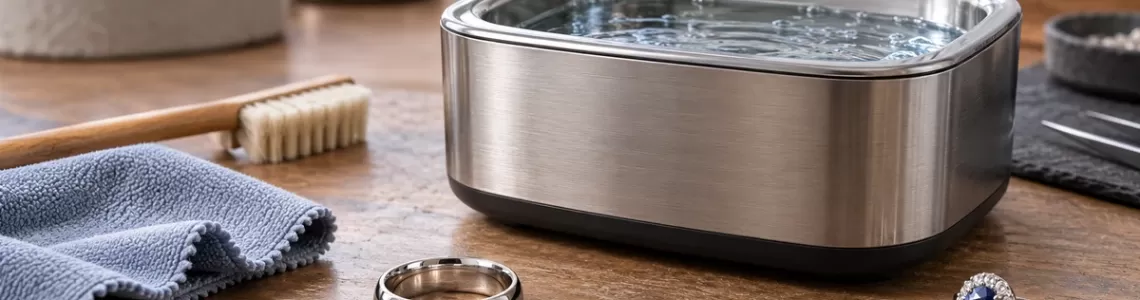
Do not put a sterling-silver ring in an ultrasonic cleaner until you know every material, treatment, finish and setting in the piece. A plain solid band may be simpler than a stone-set or plated ring, but the word “sterling” alone is not a machine-cleaning approval. Ultrasonic vibration, warmed solution and cleaning chemicals can reach seams and under-stone spaces that a cloth cannot, and those same forces can expose a loose setting or damage a treatment-sensitive material.
The conservative rule is simple: when the construction or treatment is unknown, skip the machine. Use the maker’s approved care method or ask a qualified jeweler to inspect the ring. An ultrasonic cleaner is a tool, not a purity test, gemstone test or substitute for identifying the whole piece.
What an ultrasonic cleaner actually does
GIA explains that an ultrasonic machine sends high-frequency sound waves through water or a cleaning solution. The process creates pressure and heat that can dislodge dirt from small recesses and from behind stones. That can be useful for compatible jewelry in sound condition, but it also means the machine acts on places you cannot easily see.
Vibration is not automatically gentle. GIA warns that it can shake a loose gem or chip stones whose girdles touch. Its durability research also notes risks from heated solution, ammonia, fractures, cleavage, porosity, dyes, oils and fillings. A short cycle cannot make an incompatible material compatible.
Do not judge safety from the machine’s retail label. “Jewelry cleaner” describes an intended category, not approval for every alloy, finish, adhesive, gem or treatment. The ring and the solution both need to be identified.
“925” answers only one part of the question
A 925 mark indicates a silver fineness claim of 925 parts per thousand, but it does not tell you whether the ring is plated, oxidized, lacquered, soldered, glued, hollow, stone-set or repaired. It also does not identify the remaining alloying metals or confirm that the mark is genuine. Use the separate guide to 925 stamps and hallmarks when a product page relies heavily on a mark.
Before cleaning, ask whether the ring is solid sterling throughout, rhodium plated, selectively oxidized, antiqued, enameled or coated. Check whether decorative parts are mechanically set, soldered, glued or combined. A plain-looking band can still have a seam, repair, sizing joint or surface treatment.
The Federal Trade Commission’s Jewelry Guides emphasize truthful claims about metallic content, treatment, durability and serviceability. For a buyer, that means care instructions should match the actual construction rather than relying on the broad word “silver.”
Plain sterling bands still need inspection
A truly plain solid-sterling band without stones, plating, intentional oxidation, enamel, adhesive or fragile attachments presents fewer variables. That does not mean every such band should go straight into a home ultrasonic cleaner. Inspect for cracks, deep dents, a split seam, a recent sizing joint, loose inlay, unknown repair material or a finish the maker says to protect.
Look under neutral light before cleaning. Photograph the ring and note existing scratches, dark recesses and solder color. If the band has a satin or brushed surface, aggressive chemistry or later polishing may change the controlled texture. The guide to polished versus satin finishes explains why one bright patch can become a visible mismatch.
If the ring has deliberate darkening, do not assume the dark area is dirt. Machine cleaning or follow-up polishing can reduce contrast. Read the guide to oxidized silver versus tarnish before trying to “restore” an intentionally antiqued surface.
Plating and coatings change the surface
Rhodium-plated sterling has a surface layer over the silver alloy. A lacquer, wax or other coating creates another compatibility question. Even if the underlying silver tolerates a process, the outer layer may have different care limits, and existing wear can be made more obvious after cleaning.
Ask the seller to name the coating and provide approved cleaning instructions. Do not use an ultrasonic cycle to determine whether plating is present. The guide to rhodium-plated silver separates the coating from the sterling substrate.
If a finish clouds, flakes, changes color or exposes a boundary after any cleaning, stop. Repeating the cycle removes evidence and may make a reversible service problem harder to evaluate.
Gemstones and treatments are the main decision gate
GIA advises against ultrasonic cleaning for many organic, porous, filled, coated, impregnated, heat-sensitive and treatment-sensitive materials. Its examples include pearls, coral, amber, turquoise, opal, lapis lazuli, malachite, tanzanite, feldspar, fluorite, iolite, kunzite, topaz and zircon, among others. The exclusion is not based on hardness alone.
A hard stone can still contain a surface-reaching fracture, filling or coating. A porous stone can absorb solution. Oil, resin, wax, dye or glass-like filler may react differently from the gem itself. GIA’s durability research also warns that vibration can enlarge existing fractures or affect materials with cleavage.
The FTC says sellers should disclose gemstone treatments when they are non-permanent, create special care requirements or significantly affect value. If treatment is unknown, the honest status is unknown. Do not convert “natural,” “genuine,” a species name or a certificate-free product description into permission for machine cleaning. The gemstone-treatment guide explains the buyer questions in more detail.
Settings can fail even when the stone is compatible
A ring is a system: stone, setting, solder, shank and finish. A compatible stone in a loose setting is still a no-go. Inspect prongs for unequal height, a visible gap, a snagging tip or movement. Check bezel edges for lifting. Look along channel walls for a shifted stone or damaged rim. Do not push hard, twist a stone or use a metal pick as a test.
GIA specifically warns that ultrasonic vibration can shake gems loose and can damage stones set with girdles touching. If the ring makes a new rattle, a stone moves under very light observation, or the setting has recently been repaired, stop and obtain a jeweler’s inspection. The guide to prong, bezel and channel settings provides a non-destructive visual checklist.
The cleaning solution is a separate risk
Machine compatibility and solution compatibility are two different questions. GIA’s durability paper notes that ammonia-and-water solutions can damage sensitive stones as the liquid warms. Porous materials may absorb solution, while oil, dye or filler can be affected.
Do not improvise with bleach, toothpaste, abrasive powder, silver dip, concentrated ammonia, solvent or a mixture of household cleaners. Never combine chemicals. Follow the machine maker’s instructions and the ring maker’s material-specific care instructions; when they conflict, do not proceed until a professional resolves the conflict.
Warm water and mild soap with a soft brush are described by GIA and CIBJO as conservative care for many compatible materials, but even that is not universal. Pearls, porous gems, glued components and special finishes may need different handling. “Mild” does not mean suitable for every ring.
A go/no-go checklist before machine cleaning
- Identify the metal. Confirm solid sterling, plating, coating, intentional oxidation and any repair or sizing joint.
- Identify every stone. Include small accent stones and inlays, not only the center stone.
- Ask about treatments. Check for filling, oil, resin, wax, dye, coating, impregnation, heat treatment and assembled material.
- Inspect the setting. Stop for movement, lifting, gaps, damaged prongs, rattling or recent repair.
- Confirm the solution. Use only a formula approved for the exact materials and machine.
- Protect the finish. Do not treat intentional darkening or satin texture as contamination.
- Keep pieces separate. Do not let rings strike one another in the basket.
- Use the maker’s cycle. Do not extend time or raise temperature to chase a stain.
- Inspect immediately afterward. Compare with the before photographs and stop at the first warning sign.
If any item is unknown, the answer is no for home ultrasonic cleaning. That is not proof the ring can never be cleaned professionally; it means the missing fact should be resolved first.
What to document before and after cleaning
Before any cleaning, photograph the ring face, shank, inside marks, setting profile and each side under neutral light. Record existing scratches, dark recesses, plating wear and stone position. Save the product listing and care instructions.
After compatible cleaning, inspect under the same light. Look for stone movement, a changed gap, new cloudiness, color transfer, coating lift, loss of intentional oxidation, a bright patch on satin texture or residue under the setting. A fingerprint or changed reflection angle is not damage evidence; a repeated structural or surface change is more useful.
The post-delivery ring inspection guide gives a broader baseline checklist. The guide to sterling-silver scratches explains why ordinary wear marks are not a metal-purity test.
Why a jeweler's ultrasonic service is not the same as a blind home cycle
A professional service can begin with information that a home machine does not have. A jeweler can inspect prongs, bezels, channels, soldered areas and prior repairs under magnification; identify an obvious coating or intentional finish; and decline ultrasonic cleaning when a stone, treatment or construction is unsuitable. The value is not simply access to a stronger machine. It is the decision made before the machine is used.
That distinction matters when a ring has mixed materials. The silver shank, a gemstone, a filler, an adhesive and a plated surface may each respond differently to vibration, warmth and solution. A label such as "sterling silver ring" names the main metal but may omit the exact information that controls cleaning safety. The same caution applies to a ring bought second-hand, inherited without documentation or repaired by an unknown workshop.
Professional cleaning is not a guarantee against every hidden defect, so give the jeweler the evidence you have. Mention known treatments, a laboratory report, plating, deliberate oxidation, recent resizing, stone replacement, impact damage and any earlier rattling. Ask what method will be used and whether the ring will be inspected again after cleaning. These questions turn a generic service request into a material-specific decision.
If a seller advertises an ultrasonic cleaner as universally safe, compare that claim with the care instructions for the actual ring. GIA's guidance separates compatible and incompatible gems and warns about treatment and setting condition. The FTC's consumer and Jewelry Guide materials reinforce the importance of accurate treatment and care information. A broad marketing phrase should not override those piece-specific facts.
There is no need to prove that a home machine can clean every ring. A soft cloth, a maker-approved manual method or a professional inspection may be the better choice when uncertainty remains. The goal is a clean ring that retains its stones, finish and documented condition, not completion of a particular cleaning process.
Questions to ask the seller or jeweler
- Is the ring solid sterling, plated, coated, oxidized or lacquered?
- What are all stones, inlays and decorative materials?
- Are any stones filled, dyed, oiled, waxed, coated, impregnated or heat treated?
- Are stones mechanically set, glued or both?
- Has the ring been sized, soldered or repaired?
- Is ultrasonic cleaning approved for this exact ring, not only for the metal?
- Which solution, temperature and cycle limits apply?
- What warning signs should stop cleaning and trigger service?
Save the answer with the listing. The online jewelry buying checklist explains how to preserve product-page evidence without creating a test order.
Frequently asked questions
Can every plain sterling-silver ring go in an ultrasonic cleaner?
No universal approval follows from the word “sterling.” Confirm that the band is solid, unplated, uncoated, free of fragile attachments and in sound condition, then follow the maker’s instructions.
Are diamonds always safe in an ultrasonic cleaner?
No. Treatment, fractures and setting condition matter. GIA warns against ultrasonic cleaning for fracture-filled stones, and vibration can loosen a stone even when the gem material itself is compatible.
Does hardness determine ultrasonic safety?
No. Hardness measures resistance to scratching. Toughness, cleavage, fractures, porosity, treatment, heat sensitivity and setting condition are separate factors.
Can I use ammonia in the machine?
Do not improvise. GIA notes that heated ammonia-and-water solution may damage sensitive stones. Use only a solution approved for the exact ring and machine.
What if the stone treatment is unknown?
Skip home ultrasonic cleaning. Ask the seller, review any laboratory report, or have a qualified jeweler identify a safe method.
Will an ultrasonic cleaner remove tarnish?
It may remove dirt from recesses, but tarnish and intentional oxidation are surface-chemistry and finish questions. Do not repeat cycles or add aggressive chemicals to chase dark color.
Can rhodium-plated sterling be cleaned ultrasonically?
The plating, underlying ring, stones, settings and solution all need to be compatible. Obtain care instructions for the exact piece rather than relying on the sterling substrate alone.
When should I stop and see a jeweler?
Stop for a loose or rattling stone, lifted bezel, damaged prong, coating change, unexpected color transfer, new crack, recent repair, unknown treatment or any conflict between care instructions.
References
- Gemological Institute of America — Tips on Caring for Jewelry
- GIA 4Cs — Ultrasonic Cleaners for Gems: What You Need to Know
- Gemological Institute of America — Gemstone Durability: Design to Display
- U.S. Federal Trade Commission — Buying Gemstones, Diamonds, and Pearls
- U.S. Federal Trade Commission — Jewelry Guides
- CIBJO — The Blue Books
- CIBJO Coloured Stone Commission — The Gemstone Book
Leave a Comment