
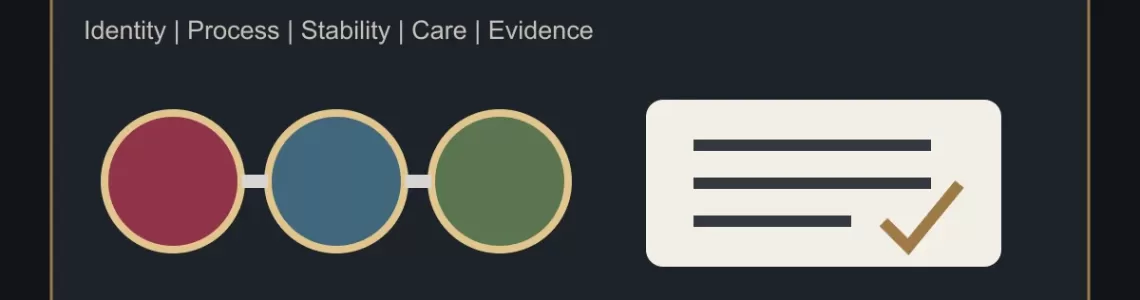
Answer first: gemstone treatments in bracelets are not automatically bad, fake, unsafe or low quality. A treatment is a process used to change a stone's color, clarity, durability or surface appearance. The buying question is not simply "treated or untreated?" It is: what material is present, what treatment was used, is its effect stable, does it change care, and was the claim disclosed clearly enough to support the price? Photographs can sometimes reveal clues such as dye concentrated in pores or a worn coating, but most treatments cannot be identified reliably from ordinary listing photos. Ask for treatment information in writing and choose care methods for the least tolerant component in the bracelet.
Research question and scope
This guide asks how a buyer should evaluate treatment claims for gemstone and stone-bead bracelets. It covers heat treatment, dyeing, impregnation or filling, coating, irradiation, bleaching and stabilization. It also explains what a seller disclosure can establish, what a laboratory report can add, and what photos cannot prove.
The scope is buying risk and care, not an authenticity verdict for a specific item. "Gemstone," "stone," "crystal" and trade names are not interchangeable in every market. The same treatment can behave differently on different materials, and two beads in one bracelet may not share the same history. No visual checklist can replace qualified testing when identity, treatment or value materially affects a purchase.
Definitions buyers should separate
- Natural material
- A material formed in nature. Natural origin does not mean untreated, flawless, rare or suitable for every cleaning method.
- Treatment or enhancement
- A human-applied process intended to change appearance, durability or another property. Cutting and polishing are normally discussed separately from treatments in gemological disclosure systems.
- Synthetic material
- A laboratory-grown material with substantially the same chemical composition and crystal structure as its natural counterpart. Synthetic is not the same as imitation.
- Imitation or simulant
- A material used to resemble another material without having the same essential composition or structure. Glass made to resemble a gemstone is one example.
- Composite or assembled material
- A product made from two or more joined parts. The parts may be natural, synthetic or manufactured and should not be assumed to be one solid stone.
- Stability
- How well a treatment and its visible effect persist under expected wear, light, heat, chemicals, cleaning and time. Stability is not identical to scratch hardness.
- Disclosure
- Information given to the buyer about identity or treatment. A disclosure should be specific enough to guide price comparison and care; a vague word such as "enhanced" may not answer the practical question.
The five-question treatment decision
Use the same sequence for a $20 bead bracelet and a high-value gemstone piece. The amount of documentation should be proportional to the price and the importance of the claim.
- Identity: what does the seller claim the bead or stone is? Record the exact wording rather than substituting a broader or more valuable name.
- Process: does the listing say heated, dyed, coated, filled, stabilized, irradiated, bleached, diffused, reconstructed, synthetic or imitation?
- Permanence and care: can heat, light, chemicals, solvents, ultrasonic cleaning or normal abrasion change the treatment?
- Value relevance: would the same-looking untreated, differently treated, synthetic or imitation material normally be valued differently?
- Evidence: is the claim supported only by a photograph, by the seller's written representation, or by an independent report that actually tests the relevant question?
The U.S. Federal Trade Commission's current Jewelry Guides section on gemstone treatments identifies three important disclosure triggers: a treatment that is not permanent, one that creates special care requirements, or one that has a significant effect on value. That rule is more precise than the common but overbroad statement that every treatment is handled identically. It is a U.S. guide, not a worldwide legal rule, and it does not identify an individual bracelet.
Common treatments and the buyer question each creates
The following comparison is a decision aid, not a home-identification test. Treatment names describe processes; they do not by themselves establish whether a product is fairly priced.
| Treatment | What it may change | What a photo may show | Best buyer question |
|---|---|---|---|
| Heat | Color, clarity or optical effects in some gem materials | Usually nothing conclusive in ordinary photos | Was it heated, and does that treatment create any special care requirement for this material? |
| Dye | Color in porous material, fractures or surface-reaching features | Sometimes color concentration in pores, drill holes or cracks | Is color added, and can water, solvents, light or abrasion affect it? |
| Filling or impregnation | Apparent clarity, continuity, durability or surface appearance | Sometimes filled cavities, flashes or residue, but often inconclusive | What substance was introduced, and what heat, solvent or cleaning limits apply? |
| Coating | Surface color, luster or optical appearance | Possible edge wear, uneven color or surface scratches | Is the color surface-applied, and how resistant is it to abrasion and chemicals? |
| Irradiation | Color through changes in color centers | Normally not identifiable from a retail photo | Was the material irradiated, and is it compliant with applicable controls and correctly disclosed? |
| Bleaching | Removal or reduction of unwanted color | Usually not conclusive | Was bleaching combined with filling, dyeing or stabilization? |
| Stabilization | Durability, porosity or color retention in some materials | Often not conclusive | What stabilizing substance was used and what care follows? |
The Gemological Institute of America's treatment overview explains that treatments can be permanent, long-lasting or short-lived under normal jewelry use, and that some treated gems require special care. It also describes frequently encountered processes and their detection limits. This supports a process-by-process approach; it does not justify assuming that every colored bead is dyed or that every natural-looking inclusion proves no treatment.
Heat treatment: common does not mean visible
Heat can alter color or clarity in several gem materials. Depending on the material and process, the effect may be stable during ordinary wear, but that generalization cannot be transferred to every stone or every later repair. High temperatures from jewelry repair can still affect a stone, a filling, an adhesive, a coating or another component in the same bracelet.
A buyer usually cannot confirm heating from a standard product photograph. Laboratory identification may rely on microscopic features, spectroscopy and other evidence interpreted for a particular material. The practical buying step is to ask the seller for the treatment representation and to preserve it with the receipt. Do not market a personal visual guess as a laboratory conclusion.
Dyeing: visible clues are screening clues, not proof
Dye may enter pores, fractures or surface-reaching features. Under magnification, suspicious concentration around drill holes, cracks or porous zones can justify a question. It does not by itself prove what colorant was used, whether the entire bracelet was treated, or whether a similarly colored bead is an imitation.
The Gemmological Association of Great Britain's guide on recognizing dyed gemstones describes how color can concentrate in pore spaces and fractures. That is a useful observational clue. It is not permission to use acetone, bleach, hot water or another solvent on a finished bracelet. A home swab test can damage dye, finish, cord, adhesive, metal or neighboring beads and may still produce an ambiguous result.
For material-specific context, compare the live claim with the red agate color and dye buyer checks. That article addresses one material family; it should not be generalized to every stone bead.
Filling, impregnation and stabilization: ask what was added
Filling and impregnation introduce a substance into cavities, fractures or porous material. Stabilization can improve handling or durability in some materials. The relevant care risk depends on the stone, the substance, the depth of treatment and the bracelet's construction. Heat, steam, ultrasonic energy or solvents may affect some filled or impregnated materials even when the underlying mineral would tolerate a different method.
The key disclosure is not merely "treated." Ask what process was used, whether the effect is permanent under normal use, and what cleaning or repair limitations follow. If the answer affects a high-value purchase, request documentation proportionate to that claim. A generic card that lists many possible treatments without identifying the item is weaker evidence than an item-specific representation.
Coatings and diffusion: separate surface from bulk appearance
A coating sits on or near the surface and may change color, luster or optical effects. Surface wear can appear first at bead holes, edges and high-contact points. Diffusion processes can affect color at or below a surface to different depths depending on the material and method. Ordinary photos rarely establish treatment depth.
Ask whether the visible color is surface-applied, whether re-polishing would change it, and whether abrasion, cosmetics or cleaning agents are restricted. A bracelet is a high-contact object: beads rub against skin, sleeves, desks and each other. That contact pattern can matter more than a treatment's abstract description.
Irradiation: distinguish the treatment from unsupported fear
Irradiation is used to alter color in some gemstones. It should not be confused with a claim that the finished jewelry continuously delivers a health effect. The U.S. Nuclear Regulatory Commission's backgrounder on irradiated gemstones says the agency has no reason to believe that wearing irradiated gemstones can be harmful and reports no cases of harm from wearing them. It also describes U.S. controls for certain irradiated gemstones entering distribution.
That statement supports a bounded safety conclusion about compliant products in the NRC context. It does not prove the origin, treatment history or compliance of a particular bracelet, and it does not create a therapeutic benefit. Ask for the seller's written disclosure and, for a consequential purchase, appropriate documentation.
What disclosure systems add
CIBJO, the World Jewellery Confederation, publishes Blue Books covering gemstone nomenclature and disclosure. Its Gemstone Book provides a structured vocabulary for treated, synthetic, artificial and composite materials and distinguishes levels of treatment disclosure. This is useful because consistent names reduce the chance that a broad marketing term hides the buying decision.
The American Gem Trade Association's Gemstone Information Manual uses enhancement codes and care guidance for colored gemstones. Codes are shorthand, not a complete consumer explanation. A buyer should still ask what the code means for the item, permanence, cleaning and value. Standards and trade manuals guide communication; they do not certify a bracelet unless the item has actually been examined under the relevant process.
Can listing photos prove a treatment?
Usually not. Photos can support observations about visible color distribution, surface wear, drill holes, fractures, assembly and consistency. They cannot normally prove treatment absence, geological origin, exact mineral identity or the depth of a coating. Camera processing, lighting, compression and display settings add uncertainty.
Use a three-level evidence label:
- Visible observation: "Color appears concentrated near several drill holes in the supplied image."
- Reasonable question: "Please confirm whether dye or a surface color treatment was used."
- Unsupported leap: "The bracelet is definitely dyed and fake."
The difference protects both buyer and seller. For more detail on photo limits, see what jade bracelet photos can and cannot prove and why jewelry colors look different online.
Durability is not one number
Scratch hardness, toughness, cleavage, porosity, treatment stability and bracelet construction are different variables. A hard stone can still chip; a tough material can still have a vulnerable coating; a stable stone can still be mounted on a cord that dislikes chemicals. The gemstone bracelet hardness and toughness guide explains why the Mohs scale alone cannot predict bracelet survival.
For treated material, add four questions:
- Does the treatment change only appearance, or does it also affect structural behavior?
- Can ordinary light, heat, water, sweat or cosmetics change the effect?
- Can repair heat or ultrasonic vibration affect an introduced substance?
- Will abrasion expose a different-looking layer or wear a surface coating?
Do not infer an answer for a specific product from a general treatment name. Ask for item-specific care instructions.
Choose care for the least tolerant component
A bracelet may combine treated beads, untreated beads, metal spacers, wood, cord, elastic, adhesive and a closure. The safest routine is conservative: wipe with a clean soft cloth, keep dry unless the seller confirms water tolerance, avoid household chemicals and cosmetics, and store away from heat, prolonged strong light and abrasion. Do not use steam or an ultrasonic cleaner unless every component and treatment is confirmed compatible.
Review the ultrasonic cleaning compatibility checklist before using powered equipment, and use the mixed-material bracelet cleaning guide when more than one material is present. Those guides favor the least tolerant component because damage to cord, filler or coating can occur before a durable metal shows any problem.
How to audit a live bracelet listing
Start with the exact product page, not assumptions based on color or category. The sunMYLOVE beaded bracelets category contains different constructions and material claims; no single treatment statement should be applied to every item. For an item such as the coral stone double-wrap beaded bracelet listing or the black hair crystal bracelet listing, read the live description and ask questions about that exact product rather than importing claims from a general article.
Save these fields before purchase:
- the exact material name and whether "natural" modifies the stone, color, pattern or another feature;
- any treatment, enhancement, synthetic, imitation or composite disclosure;
- bead size, bracelet size and construction;
- care restrictions and whether an ultrasonic or steam cleaner is excluded;
- the seller's answer to a treatment question, preserved in writing;
- the return policy and the deadline that applies to a material mismatch.
For a high-value claim, a laboratory report may be appropriate. The appraisal versus laboratory report guide explains that an appraisal estimates value for a stated purpose, while a gemological report addresses testable identity or treatment observations within its scope. Neither document should be treated as saying more than it actually says.
A buyer's treatment checklist
- The material name is specific and does not blur natural, synthetic and imitation.
- The seller has answered whether color, clarity, durability or surface appearance was treated.
- The treatment's permanence and special care requirements are stated where relevant.
- The price comparison uses similarly disclosed material, not merely similar color.
- Photos are treated as visual evidence, not laboratory proof.
- A report, if supplied, matches the item and actually addresses the disputed claim.
- Care is based on the least tolerant bead, treatment, cord, adhesive or metal component.
- The listing and written answers are saved before the return window closes.
Common mistakes
- Assuming treated means fake. A natural gem can be treated; a synthetic or imitation material is a different classification.
- Assuming natural means untreated. Natural origin and treatment history answer different questions.
- Calling every color variation dye. Natural variation, lighting, coating, dye and camera processing can look similar online.
- Using a destructive home test. Solvents, scraping, heat and chemicals can damage the item and still fail to identify the process.
- Using hardness as a care guarantee. Coatings, fillers, cleavage, cord and adhesives introduce separate vulnerabilities.
- Reading a code without its definition. Enhancement codes need the issuing system and current legend.
- Assuming a report covers every bead. Check which item or sample was tested and what conclusions are within scope.
- Making health claims from irradiation or minerals. Treatment physics does not establish that wearing jewelry treats pain, circulation, anxiety, immunity, sleep or any disease.
Frequently asked questions
Are treated gemstone bracelets lower quality?
Not automatically. Quality depends on identity, workmanship, durability, treatment stability, disclosure and price. A stable, clearly disclosed treatment can be acceptable; an undisclosed treatment that changes care or value is a different risk.
Can I tell whether a bead is dyed from a photo?
Sometimes a photo shows suspicious color concentration in pores, cracks or drill holes, but that is a screening clue, not proof. Ask the seller and seek qualified testing when the answer affects value.
Does "natural stone" mean untreated?
No. Natural origin and treatment history are separate facts. Ask both what the material is and whether it has been treated.
Is heat treatment permanent?
Some heat-induced changes are stable in ordinary wear, but stability depends on the material and process. Repair heat can also affect other components or treatments. Use item-specific care guidance.
Are irradiated gemstones safe to wear?
The U.S. NRC says it has no reason to believe wearing irradiated gemstones can be harmful and reports no known cases of harm from wearing them. That does not verify a particular item's compliance or create any health benefit.
Can I use an ultrasonic cleaner on treated beads?
Only when every stone, treatment, filling, adhesive, cord and metal component is confirmed compatible. When the treatment is unknown, choose a conservative manual method.
Does an appraisal prove that a bracelet is untreated?
Not necessarily. Read the document's scope. An appraisal and a laboratory report serve different purposes, and a report may test only one stone or one stated question.
What should I ask before buying?
Ask for the exact material identity, all known treatments, whether the effects are permanent, any special care, and the evidence supporting a high-value claim. Save the answer with the listing and receipt.
Method, evidence limits and editorial note
We compared current U.S. federal guidance, CIBJO nomenclature, AGTA disclosure codes, GIA treatment education, NRC irradiation guidance and Gem-A observational guidance with the live sunMYLOVE catalog and existing material-specific guides. Search results show informational and buying-risk intent around treatment disclosure, dyed beads, heat treatment and care. Reliable current search volume was unavailable and is recorded UNKNOWN.
Reviewed: September 22, 2026. sunMYLOVE editorial note: treatment terminology, seller disclosures and product listings can change. Check the live listing and ask for item-specific information before purchase or cleaning. This guide does not identify, grade, value or certify any product, and it makes no medical claim.
References and evidence scope
- Legal Information Institute, 16 CFR 23.24 - current U.S. treatment disclosure text covering permanence, care and value.
- Federal Trade Commission, In the Loupe - plain-language U.S. advertising and point-of-sale disclosure guidance.
- Gemological Institute of America, An Introduction to Gem Treatments - treatment processes, detection limits and care implications.
- CIBJO, The Gemstone Book - international trade nomenclature and treatment disclosure framework.
- American Gem Trade Association, Gemstone Information Manual, 17th edition - enhancement codes and care guidance.
- U.S. Nuclear Regulatory Commission, Backgrounder on Irradiated Gemstones - bounded safety and regulatory context.
- Gemmological Association of Great Britain, How to Recognise Dyed Gemstones - observational clues and their limits.
Leave a Comment